

A high-converting cosmetic surgery website design layers seven trust signals in sequence: board certification above the fold, HIPAA-compliant before-and-after galleries organized by procedure, one dedicated page per service, patient testimonials placed at decision points, mobile performance under 2.5 seconds LCP, 24/7 lead capture with a short form and after-hours automation, and SEO architecture built for both Google and AI answer engines. As of 2026, 76% of plastic surgery site traffic arrives on mobile, 54% of patient inquiries happen after hours, and the physician-and-surgeon category converts search at 12.43%. Each step in this guide targets a specific failure point that most plastic surgery websites never fix.
-
50 msTime patients take to judge your site's credibility on first impression
-
76%Share of plastic surgery site traffic arriving on mobile devices
-
54%Patient inquiries that happen outside normal business hours
-
12.43%Search conversion rate for plastic surgeons — 1.5x the all-industry average
-
$40.04Average organic cost per lead for plastic surgery vs. $150-$400+ for paid search
-
6–14 weeksFull custom plastic surgery website build timeline from kickoff to launch
A prospective plastic surgery patient is making one of the highest-stakes personal decisions of their life — and they are making most of that decision alone, on a phone screen, after hours. Cosmetic surgery website design is not a branding project. It is a patient psychology problem. Every layout choice, color scheme, and page structure either reduces the anxiety that keeps a hesitant visitor from booking, or adds to it. There is no neutral. This guide walks plastic surgery practice owners and agency buyers through 7 sequential steps to build a plastic surgery website that generates qualified consultation requests around the clock — covering instant authority signals, HIPAA-compliant gallery architecture, procedure-specific site structure, social proof placement, mobile performance optimization, 24/7 lead capture, and SEO built for both search engines and AI answer engines. Timeline: 6–14 weeks for a full custom build, or 2–4 weeks for a structured audit and phased rebuild of an existing site.
Before you start
- Google Search Console and Google Analytics 4 already installed and collecting data on the current site
- Signed HIPAA Business Associate Agreements with every vendor that will store or transmit patient data, including hosting, form tools, and photo storage platforms
- A library of real patient before-and-after images with separate, signed HIPAA photo authorization forms — not bundled into clinical consent paperwork
- Board certification documentation, society membership logos (ABPS, ASPS), and surgeon bio assets ready to place above the fold
- A defined list of every procedure the practice offers, each ready to become its own page with candidacy criteria, technique options, recovery timeline, risk disclosures, and a pricing range
- A Webflow or WordPress development environment with a developer who can target a Largest Contentful Paint under 2.5 seconds on mobile

Build Instant Authority Above the Fold on Your Plastic Surgery Website
Users judge a plastic surgery website's credibility in approximately 50 milliseconds, and design drives most of that judgment — so your above-the-fold layout is a conversion lever, not a branding exercise. A board-certified plastic surgeon's name, a real photo of that surgeon (not a stock image of a stethoscope), and visible ABPS or ASPS certification logos need to appear before the user scrolls. Nothing else in your site structure affects first impression as directly as this placement. As of 2026, 49% of patients delay booking until they see surgeon credentials online, and 61% abandon practices with unclear credentials altogether. Those are booked consultations walking out the door before your intake form ever loads.
Color scheme matters as much as credential placement. Neutral palettes — whites, soft grays, muted blues or greens — build trust without competing with surgical result photography. A well-designed website for a plastic surgery practice should feel calm and precise, reflecting the same qualities patients want from their surgeon. Every spacing decision and typographic choice either reduces patient anxiety or adds to it. Warm, clinical layouts that reflect the surgeon's actual brand identity perform better than loud hero sections with generic imagery.
Board-certified plastic surgeon credentials, society membership badges, and years of experience belong in the hero section — not buried on an About page three clicks deep. Potential clients decide within seconds whether the site signals expertise or looks like a template build. Sixty-nine percent of users prefer real patient content over stock imagery, so apply that stat to your hero first, then to your gallery. A real surgeon photo in a real clinical or professional environment outperforms every stock image of a stethoscope, operating room, or white-coat model.
Webflow
From $23/mo (CMS plan)
Gives designers pixel-level control over above-the-fold layouts without sacrificing page speed — critical for hitting Core Web Vitals targets on image-heavy plastic surgery sites.
WordPress with GeneratePress or Kadence theme
Free to $79/yr for theme license
Widely supported, SEO-friendly, and compatible with the plugin ecosystem plastic surgery practices need — from HIPAA-compliant forms to gallery management.
Don't skip this
Stock photography of surgical tools, generic medical imagery, or a logo-only hero section all signal template build to a prospective surgical patient. Sixty-nine percent of users prefer real patient content over stock imagery — apply that to your hero section before you apply it anywhere else on the site.
Build HIPAA-Compliant Before-and-After Galleries Organized by Procedure
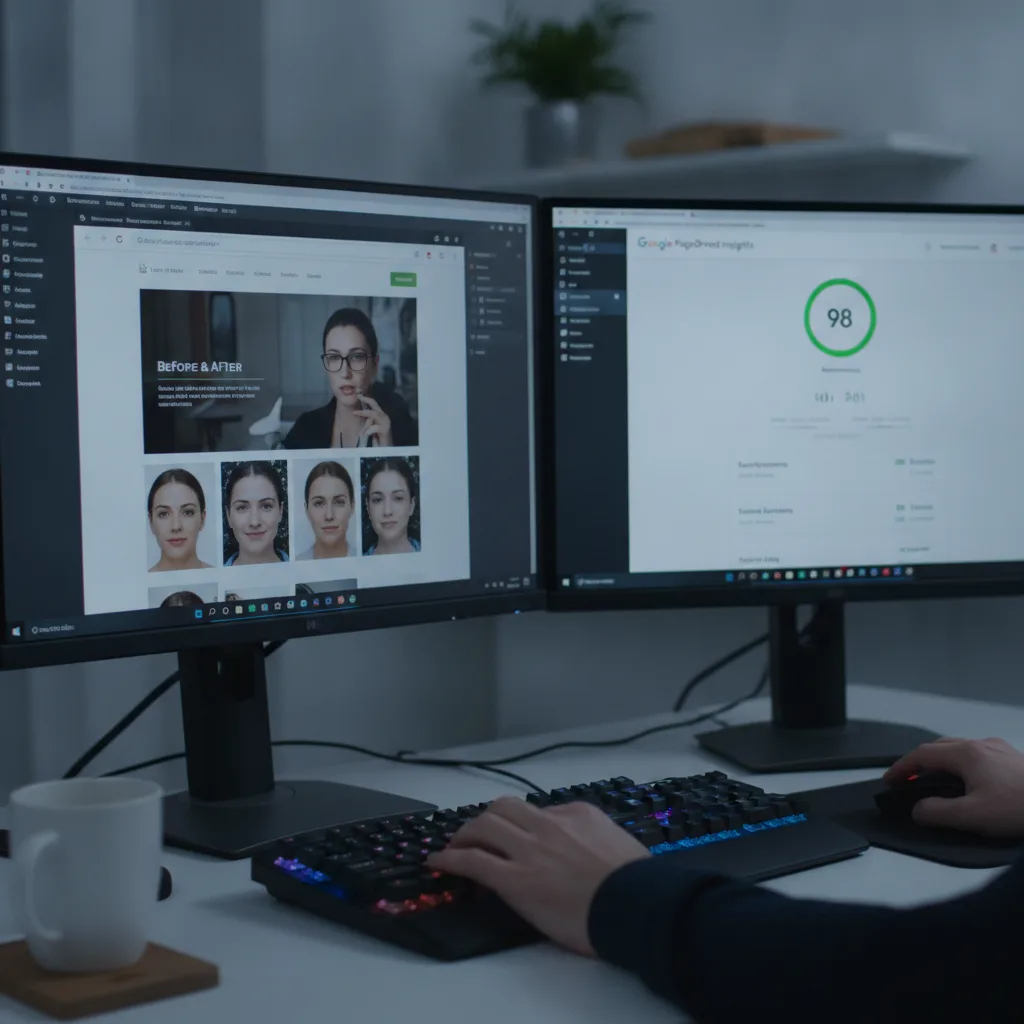
Before-and-after galleries are the single most important trust signal on a cosmetic surgery website — patients spend more time there than anywhere else on the site. A prospective surgical patient is buying an outcome they cannot yet see. Galleries fill that gap, and the surgeon's work speaks more clearly in photos than any amount of polished copy. Rhinoplasty results need to live in a rhinoplasty gallery, breast augmentation results in their own section, and body procedures like body contouring in a separate category. Mixing all procedures into one undifferentiated feed forces patients to search instead of feel confident.
HIPAA compliance is non-negotiable for every image in these galleries. Each photo requires a signed, standalone HIPAA photo authorization form — separate from the clinical consent paperwork the patient signs pre-procedure. HHS penalties run $100–$50,000 per violation as of 2026, and the enforcement environment has intensified. Store images on a HIPAA-compliant photo management platform like RxPhoto or PatientNow, and confirm your signed Business Associate Agreement covers that vendor before a single image goes live. Standard cloud storage and most basic CMS media libraries do not qualify.
On the SEO side, galleries organized by procedure create naturally deep site structure. A rhinoplasty gallery page targets 'rhinoplasty before and after Houston' on its own URL, without cannibalizing your main rhinoplasty procedure page. That architecture compounds over time, building search engine authority while simultaneously giving patients the procedure-specific visual evidence they need to book. For analytics, use Piwik PRO instead of standard Google Analytics — unlike GA4, it does not send patient behavioral data to third-party servers, keeping your plastic surgery practice on the right side of HHS guidance.
RxPhoto
From $199/mo
HIPAA-compliant photo storage built for plastic surgery practices, with BAA included, consent tracking, and direct integration with most practice management systems.
PatientNow
Custom pricing (request demo)
Combines HIPAA-compliant photo management with CRM and intake workflows, reducing manual steps between gallery capture and patient record.
Piwik PRO
Free tier available; paid from $500/mo
HIPAA-compliant analytics that does not transmit patient behavioral data to third-party servers — the correct replacement for Google Analytics on any cosmetic surgery website.
Compliance reminder
Bundling the HIPAA photo authorization into the standard clinical consent form is one of the most common compliance mistakes in plastic surgery website design. They must be separate documents. Your attorney and your BAA vendor should both review the authorization language before galleries go live.
Rebuild Site Structure With One Dedicated Page Per Procedure
A single 'Procedures' page listing twenty services is the most common structural failure in plastic surgery website design. Each procedure — rhinoplasty, breast augmentation, body contouring, facelifts, blepharoplasty, and every other service your plastic surgery group offers — needs its own dedicated URL. That page must cover candidacy criteria, technique options, recovery timeline, risk disclosures, a pricing range, and a procedure-specific FAQ. That depth signals expertise to both patients and search engines. A proper site structure for a plastic surgery practice includes a homepage, surgeon bio page, individual procedure pages for every service, city or neighborhood landing pages for each market served, a gallery section organized by procedure, and a blog for patient education content.
The patient psychology behind one-page-per-procedure is straightforward: someone researching breast augmentation is not also researching rhinoplasty on the same visit. They arrived with a specific question. A dedicated page answers that question completely, keeps website visitors on the site longer, and moves them toward booking. The 2026 benchmark shows plastic surgery website visitors average 2 minutes and 15 seconds on-site and view 2.8 pages per session — procedure pages are typically the second or third page visited after the homepage. If those pages are shallow, the session ends without a consult request.
Procedure pages carry the heaviest SEO weight for organic lead generation. Organic search drives 42% of global traffic to plastic surgery sites, and 28.5% of searchers click the first Google result. A well-structured procedure page targeting 'breast augmentation Austin TX' captures that click. Pair each procedure page with a clear CTA — a short consultation request form, a click-to-call button, or both — and you have a lead generation asset, not just a patient education page. Price ranges on procedure pages consistently increase time-on-page and reduce the volume of price-only phone inquiries that waste your front desk's time.
Pro tip
Stating 'breast augmentation at our practice typically ranges from $6,500–$9,500 depending on implant type and technique' pre-qualifies the visitor before they ever call. Patients who contact you after seeing a pricing range are already self-selected for budget fit — those consultations convert at higher rates than cold inquiries.
Place Patient Testimonials and Social Proof Where They Change Decisions
Patient testimonials increase conversions on cosmetic surgery websites by 39% — but only when they appear where the decision is actually being made, not just on a standalone Reviews page. Place testimonials on procedure pages, next to the consultation form, and in or just below the hero section. A five-star quote from a rhinoplasty patient placed on the rhinoplasty procedure page carries far more weight than the same quote on a generic testimonials page patients rarely reach. As of 2026, 58% of patients trust online reviews as much as personal recommendations — embedded Google review widgets and video testimonials are conversion assets, not reputation management afterthoughts.
Video carries additional weight. A 60-second patient video discussing their experience with your plastic surgeon builds credibility that polished copy cannot replicate. Patients are buying a relationship with a surgeon, not just a set of body procedures. The surgeon's actual communication style, warmth, and approach to personalized care come through in video in a way that a bio page never achieves. Embed video testimonials on the most-visited procedure pages first — breast augmentation, rhinoplasty, and body contouring typically drive the highest organic search volume.
Social proof compounds over time. The 32% returning visitor rate for plastic surgery websites means patients come back across multiple sessions before booking — they are building a case file on your practice. Each session where they find another testimonial, another gallery result, another signal that your surgeon delivers natural-looking results, closes the psychological gap between interest and commitment. Build your social proof architecture with that multi-session research pattern in mind. Potential clients who return three times before booking are not hesitant — they are thorough. Make sure the site rewards that thoroughness with more evidence, not more friction.
Podium
From $399/mo
Automates review requests post-consultation and post-procedure, and embeds verified reviews directly on your plastic surgery website with real-time updates.
Birdeye
From $299/mo
Aggregates reviews from Google, Healthgrades, and RealSelf into a single dashboard and generates embeddable widgets for procedure pages.
Optimize Performance So Your Surgery Website Loads Fast on Every Screen Size
Performance optimization for plastic surgery websites starts with one number: 76% of all site traffic arrives on mobile devices as of 2026. Responsive design is the baseline, not a feature. Every layout, gallery, and consultation form must work on a 390px screen before it works on a desktop. A site that looks premium at 1440px but breaks the gallery layout at 390px is losing three out of four visitors before they see a single surgical result. Responsive design failures on mobile are not UX preferences — they are conversion failures measured in lost consultations.
Every one-second delay in page load time reduces conversions by 7%, and a page that takes four seconds to load loses a third of its visitors before it renders. Plastic surgery sites are image-heavy by necessity — galleries, surgeon headshots, procedure photography. The fix is technical: compress every gallery image to WebP format, lazy-load anything below the fold, and target a Largest Contentful Paint under 2.5 seconds. Google's Core Web Vitals directly influence search engine rankings, so performance optimization is both a user experience and an SEO issue at the same time. A real-world 2026 audit of plastic surgery sites found one practice with a 25-second LCP and a Lighthouse mobile score of 51 — that site was invisible on mobile search.
The business case for performance investment is concrete. A Texas med spa with a properly optimized site generated $28,000 in first-visit revenue from $2,500 in ad spend in 30 days — performance optimization was a direct factor because paid traffic converts fastest when the landing page loads in under two seconds. Set a hard rule: no image uploaded to the gallery exceeds 150KB in WebP format. Your developer should enforce this at the upload level, not as a post-launch checklist item.
Google PageSpeed Insights
Free
Surfaces Core Web Vitals data and flags specific image compression, render-blocking, and layout shift issues on your live plastic surgery website.
Cloudflare Pro
$20/mo
CDN and automatic WebP conversion that cuts load times for image-heavy plastic surgery sites without requiring manual image re-export on every upload.
Lighthouse 12 (Chrome DevTools)
Free
Runs the same mobile performance audit that search engines use — essential for validating your LCP, CLS, and FID before launch.
Critical check
Most plastic surgery sites fail mobile performance not because of bad code, but because full-resolution before-and-after images are served directly from the CMS without compression or lazy loading. Enforce a 150KB WebP maximum at the upload level — not as a post-launch checklist item.
Build 24/7 Lead Capture So Your Surgery Website Works After Business Hours
54% of patient inquiries happen outside normal business hours, which means a plastic surgery website that only works as a digital brochure is missing more than half its potential leads. A well-designed website for a plastic surgery practice functions as a 24/7 consultation engine. That requires three components working together: a short, mobile-friendly consultation request form on every procedure page (not just the contact page), a click-to-call button pinned to the mobile screen, and an after-hours chatbot or automated SMS follow-up that captures intent when your front desk is closed. Clinics using chatbots or automated follow-up increase lead capture by 31%.
The math behind that 31% lift is meaningful for any plastic surgery group. If your practice books 20 consultations per month and adds 31% more, that is six additional consults. At a median consult-to-surgery conversion rate of 35–50% and an average surgical fee well above $5,000, each incremental consultation adds thousands in downstream revenue. Tools like GoHighLevel handle this with HIPAA-compliant chat widgets, automated text follow-up, and a pipeline view of every lead from first contact to booked appointment. CallRail layers in call tracking with keyword attribution so you know which procedure pages and paid search campaigns are driving phone leads, not just form fills.
Form length is a conversion variable that most plastic surgery sites get wrong. The consultation request form should ask for name, phone, email, procedure of interest, and one optional open-text field. Nothing more. Every additional field you add reduces form completion. The goal is to get a name and phone number into your CRM — your front desk qualifies the rest in the follow-up call. Seamless integration between the form, the CRM, and the automated follow-up sequence is what separates a 24/7 lead machine from a form that generates a weekly email digest no one reads.
GoHighLevel
From $97/mo
All-in-one CRM, HIPAA-compliant chat widget, SMS automation, and pipeline management — purpose-built for lead-capture-heavy practices like plastic surgery groups.
CallRail
From $45/mo
Call tracking with keyword attribution so you know which procedure pages and paid search campaigns are driving phone leads, not just form fills.
Layer SEO Into Your Plastic Surgery Website Architecture From Day One
The physician and surgeon category converts search traffic at 12.43% — roughly 1.5 times the all-industry average of 8.18%. That makes a well-optimized plastic surgery website one of the highest-ROI digital investments a plastic surgery practice can make, and it starts with site structure, not content volume. Organic search drives 42% of global traffic to plastic surgery sites, and 61% of patients access online resources before their first consultation. The average organic cost per lead for plastic surgery is $40.04, compared to $150–$400 or more for paid search leads in competitive Texas metros. That gap is why SEO is a long-term brand presence strategy, not an optional add-on to a paid ad budget.
As of 2026, AI assistants now account for 45% of local recommendation sources alongside traditional search engines. That means your procedure pages need to be written so that both a Google crawler and a ChatGPT or Perplexity AI can extract a clear, citable answer to questions like 'what is the recovery time for rhinoplasty?' or 'how much does breast augmentation cost in Austin?' Lead every procedure section with the direct answer, then support it with specifics. That structure gets your plastic surgery website cited in AI Overviews and answer engines, not just ranked in classic search results. Practices in major metros like Houston and the San Francisco Bay Area are already competing for those AI citations alongside traditional rankings.
A deeper breakdown of your SEO site structure should include: a homepage, a surgeon bio page for each board-certified plastic surgeon on staff, individual procedure pages for every body procedure and facial procedure the practice offers, city or neighborhood landing pages for each local market, a HIPAA-compliant gallery section organized by procedure, and a blog for patient education content that targets long-tail search queries. SEO for plastic surgery websites takes 4–6 months to show meaningful ranking movement. Pair it with Google Ads to maintain lead volume while organic brand presence builds — and set that expectation with the practice before the campaign starts, not after the first monthly report.
Timeline reality
SEO for plastic surgery websites takes 4–6 months to show meaningful ranking movement. Practices that expect first-page results in 30 days will churn before the compounding benefit kicks in. Set that expectation before a campaign starts, and pair SEO with Google Ads to cover the lead gap during the ranking build period.
What Most Plastic Surgery Websites Get Wrong About Patient Psychology
Most plastic surgery sites are built as digital brochures — visually polished on the surface, silent on everything a hesitant patient actually needs before they pick up the phone. No pricing signals, no procedure-specific depth, no after-hours lead capture, and galleries that load in six seconds on mobile. A prospective surgical patient is making one of the highest-stakes decisions of their life online. Every moment of friction, confusion, or slow load time reads as a reason to keep searching. The practices winning the most consultations as of 2026 treat their website as a trust architecture — built with the same precision they'd apply in the operating room. A well-designed website for a plastic surgery group is not the end goal. It is the engine.
A plastic surgery website that converts does not happen by accident. It is built in sequence: authority above the fold, HIPAA-compliant galleries organized by procedure, one dedicated page per service, social proof placed at decision points, sub-2-second mobile performance, 24/7 lead capture with automated follow-up, and SEO architecture that works for both search engines and AI answer engines. When all seven layers are in place, the site stops functioning as a brochure and starts functioning as a consultation engine — one that generates qualified leads while the practice sleeps. Geek Powered Studios builds custom websites for plastic surgery practices and cosmetic surgery groups ready to turn their web presence into a qualified-lead machine. Our creative team handles the full stack: Webflow or WordPress development targeting sub-2-second mobile load times, HIPAA-compliant gallery architecture, procedure-specific site structure, and GoHighLevel automation for 24/7 lead capture. We've driven a 196% increase in PPC leads and a 156% increase in organic leads for a medical specialty practice within six months. Every retainer includes a custom website — an $8,000–$15,000 value — with no long-term contract. If your plastic surgery website is not generating qualified consultation requests on its own, get your free strategy session and we'll show you exactly where your current site is losing patients before they ever reach your front desk.
Frequently Asked Questions
Ready to get started? Contact Geek Powered Studios today.