
To build a fencing lead generation system on your website, complete these 7 steps: audit your real cost per booked job, build dedicated service pages for every fence material you install, embed an instant quote tool like MapMyFence or mySalesman, fix mobile page speed to under 3 seconds, optimize your Google Business Profile for the local map pack, add review widgets and a filterable project gallery, and set up a CRM-automated lead response that fires within 60 seconds of form submission. A mature version of this system produces fencing leads at $0–$15 each with 30–50% close rates — compared to $20–$70 shared Angi leads closing at 5–10%. Total implementation time: 4–8 weeks.
-
$30–$150Cost per booked job via mature organic SEO vs. $667+ on shared leads
-
2.1xBetter conversion on pages with embedded quote calculators vs. static forms
-
70–75%Of fence-related search clicks go to the Google Maps 3-pack
-
53%Of mobile visitors leave if your site takes more than 3 seconds to load
-
391%Lead conversion lift when you respond within 60 seconds of form submission
-
47 reviewsAverage Google review count for top-ranking fence contractor GBPs
-
$3,901Average fence installation cost in Texas as of 2026
Most fence contractors are chasing leads they never own. A shared Angi lead costs $20–$70 on paper, but that same lead goes to 3–5 fence contractors simultaneously — and at a 5–10% close rate, your real cost per booked fence installation job lands between $250 and $1,700. Meanwhile, fence companies with an owned lead generation system on their website generate exclusive fencing leads at $0–$15 each and close them at 30–50%. This guide walks through the exact 7-step system to build that engine on your own website: from auditing your true lead cost to setting up automated follow-up that beats the 60-second response window. The US fencing market sits at $12.4 billion as of 2026, with Texas ranking in the top three states for demand. There is no shortage of potential customers. The shortage is fence contractors whose websites are built to capture that demand before their competitors do.
Before you start
- An existing fence company website (or willingness to build one) on WordPress or Webflow — these platforms support the tools and integrations this system requires.
- A Google Business Profile claimed and verified for your fence company — you cannot optimize what you haven't claimed.
- Access to your website's CMS or a developer who can embed third-party tools like MapMyFence or mySalesman.
- CallRail or a similar call-tracking tool installed so you can attribute phone calls to specific pages and channels, not just overall traffic.
- At least 10 completed fence projects you can photograph and add to a gallery — the review widgets and project gallery in Steps 5 and 6 depend on having real visual proof.
- A working knowledge of your service area by city or zip code so you can build location-specific pages that capture local intent.

Audit Your Current Lead Flow and Calculate Your Real Cost Per Booked Job
Most fence contractors don't know their true cost per booked job because they measure cost per lead instead — and the math looks very different once you factor in close rates. A shared Angi lead costs $20–$70 on paper, but it's sold to multiple contractors simultaneously. At a 5–10% close rate, your effective cost per booked job lands between $250 and $1,700. Compare that to a mature SEO-driven organic lead at $0–$15 per lead with a 30–50% close rate, producing a cost per booked job of $30–$150. Those two numbers do not belong in the same category.
Before building anything, pull 90 days of lead data. Count every inquiry by source — Angi, HomeAdvisor, Google Ads, organic search, referral leads, direct calls — then divide total spend by booked jobs, not leads. If you're running Google Local Services Ads, the math is more favorable: fencing contractors average $25–$65 per LSA lead with a 40–50% close rate after the site visit, putting your cost per signed contract at $55–$140 for an average $3,500–$7,500 project. That's a strong channel. Shared lead platforms are almost never as efficient as they appear on a cost-per-lead basis, and most contractors who run the real numbers are surprised by how far they've been overpaying.
Write down one number before moving to Step 2: your current cost per booked fence installation job. That's your baseline. Every step in this guide is designed to cut it. The fence company that knows its numbers controls its marketing budget; the one that doesn't is hoping the phone keeps ringing.
CallRail
From $45/mo
Tracks which channels and pages generate phone calls so you can attribute booked jobs accurately — not just form fills.
Google Analytics 4
Free
Maps form submission events back to traffic sources so you can separate organic leads from paid and referral traffic.
Pro tip
If you can't pull 90 days of booked-job data by source, start with 30 days and estimate. An imperfect baseline beats no baseline. You'll refine it in month two once CallRail is tracking calls by page and campaign.
Build Dedicated Service Pages for Every Fence Type You Install to Capture High-Intent Keywords
A single 'Fencing Services' page cannot rank for wood fence installation, vinyl fence installation, chain-link, fence repair, and commercial fencing simultaneously — Google ranks individual pages for specific topics, and search engines reward focused, material-specific content. Wood and vinyl alone represent 65% and 25% of residential fencing demand respectively, making dedicated pages for each material the two highest-priority SEO assets on your entire site. If you have one generic services page today, you are invisible for every material-specific search your potential customers are typing.
Each dedicated service page needs four components to generate fencing leads: a keyword-focused headline (example: 'Wood Privacy Fence Installation in Austin, TX'), a paragraph explaining the material's benefits and typical costs for your market, a photo gallery of completed projects in that material, and a quote form or calculator above the fold. In Texas, where fence installation averages $3,901 per project (range $2,370–$5,573 as of 2026), including a cost range for each fence material on the page sets realistic expectations and filters price shoppers before they call. Cedar runs $25–$45 per linear foot installed in the Austin market; vinyl runs $30–$60/ft; ornamental iron runs $35–$70/ft. Put those numbers on the page — property owners who see real prices convert at higher rates than those who see nothing.
Add city or neighborhood location modifiers to each service page where you serve multiple areas. A page titled 'Vinyl Fence Installation in San Antonio' and another for 'Vinyl Fence Installation in Round Rock' each capture local intent that a generic page never will. Location pages also feed the Google Business Profile authority that gets you into the map pack. Use relevant keywords naturally — 'privacy fence contractor,' 'chain-link fence,' 'wood fence installation' — and build internal links from your homepage to each material page. Without at least three internal links pointing to your wood fence and vinyl fence pages, Google doesn't know you consider those pages important.
Common mistake
Fence contractors often build material pages but forget to add internal links from the homepage and blog posts back to those pages. Without internal links, search engines don't know which pages you consider most important. Link to your wood fence page and vinyl fence page from at least three other places on your site.
Embed an Instant Quote Tool or Material Calculator on Every High-Intent Page
Pages with embedded calculators convert 2.1x better than static contact forms, according to LOCALiQ research — and for fence companies, the logic is obvious. Homeowners pricing a fence project want a number before they call. Giving them a self-service estimator on your site means you capture the lead at the moment of highest intent, before they open three more browser tabs comparing fence contractors. This is the core mechanic of a working fence company lead generation system. Most contractors offer a generic 'Get a Free Estimate' form; an embedded calculator is a fundamentally different product that positions your fencing business above competitors who rely on static forms.
MapMyFence is a satellite-based estimator that embeds on any contractor website. The homeowner draws their property line on a satellite map, selects materials, and gets a budget range — all before your sales team picks up the phone. By the time the lead hits your CRM, you already know the property address, the linear footage, the preferred fence material, and the budget. That's a pre-qualified buyer, not a cold inquiry. mySalesman works similarly, functioning as a 24/7 digital salesperson that lets homeowners configure their fence project independently and receive an initial estimate while your crew is on a job site. Both tools replace the generic quote form that every other fence contractor in your market uses.
Multi-step quote forms — where the homeowner answers 3–5 questions one at a time rather than filling out a single long form — deliver 86% higher conversion rates than single-page alternatives, with some implementations reaching 300% improvement. If you're not ready to implement MapMyFence or mySalesman immediately, at minimum switch your quote form to a multi-step format. Reducing form fields from 11 to 4 increased conversions 120% in HubSpot testing. Ask for fence type, approximate footage, project timeline, and contact info. That's it. More fields mean more friction, and friction is what drives potential local customers to your competitor's site instead.
MapMyFence
Contact for pricing
Satellite-based fence estimator that collects property drawing, material choice, and budget range before the first phone call — turns visitors into pre-qualified buyers.
mySalesman
Contact for pricing
24/7 fence estimating tool that lets homeowners configure projects and receive budget estimates independently, delivering structured lead data to your sales team before any site visit.
ROI check
If a Texas fence installation averages $3,901 and your site converts at 2% with a quote tool embedded, 500 monthly visitors produces 10 leads. Close 30% of those and you've added 3 booked jobs per month — roughly $11,700 in revenue — from traffic you already have.

Fix Your Mobile Page Speed to Sub-3-Second Load Time
The average home service website loads in 8.7 seconds on mobile — nearly 3x the 3-second threshold where 53% of mobile visitors abandon the page. Every additional second of load time costs fence contractors roughly 7% of conversions. A site that loads in 5 seconds loses 35% of leads compared to a 1-second site. For a fencing business where a single booked job averages $3,901 in Texas, slow mobile load time is not a technical annoyance — it's a direct revenue leak that compounds every day you leave it unfixed.
A 0.1-second speed improvement produced a 21.6% increase in users reaching the form submission page on lead-generation sites in a Google and Deloitte study. Fractions of a second matter at scale. The fixes that move the needle fastest: compress images to WebP format, eliminate render-blocking JavaScript, enable browser caching, and use a CDN. If your site is on WordPress, WP Rocket handles most of this with minimal configuration. On Webflow, image optimization and CDN delivery are built in. Run your site through Google PageSpeed Insights today and get your mobile score. Anything below 70 is actively costing you fencing leads.
Mobile click-to-call placement is part of speed-to-conversion, not just technical page speed. Service businesses with a prominent click-to-call button in the mobile header see up to 200% more conversions on mobile compared to sites that bury the phone number in the footer. Pin your number at the top of every page. 78% of homeowners hire the first contractor who responds to their inquiry — so if a potential customer calls from your mobile site and hits voicemail while your competitor's site loads with a tap-to-call button, you've already lost the job.
Google PageSpeed Insights
Free
Diagnoses specific mobile speed issues with actionable fix recommendations — run it on your homepage and your most-trafficked service page first.
WP Rocket
$59/yr
WordPress caching plugin that handles image lazy loading, render-blocking JS deferral, and CDN integration with minimal technical setup.
Optimize Your Google Business Profile for Local SEO and More Fencing Leads from the Map Pack
The Google Maps 3-pack captures 70–75% of all clicks for fence-related local searches, and fence companies outside those three positions are functionally invisible for map-based queries. Local SEO for fence contractors starts with the Google Business Profile — not the website. Your GBP is the primary asset that determines whether you appear when someone searches 'fence contractor near me' or 'wood fence installation Austin' on their phone. Local businesses that treat GBP as an afterthought forfeit the majority of available search results clicks to the three contractors who don't.
The four GBP elements that drive local pack ranking for fence companies: primary category set to 'Fence Contractor,' service areas configured by city (not just zip code), a complete services list with each fence type listed individually, and a minimum of 47 reviews — which is the average for top-ranking GBPs in this category. Google Reviews contribute roughly 15% to local pack ranking algorithms, and each 10-review increment increases conversion rates by 2.8%. If you have 20 reviews right now, getting to 50 is a measurable revenue move, not a vanity metric. Generation for fence contractors through the map pack depends almost entirely on getting these fundamentals right first.
Post to your GBP at least once per week with project photos tagged to specific neighborhoods and local communities in your service area. Add before-and-after images with captions that include the fence type, fence material, and city. These posts signal to Google that your fencing business is active. Enable Google Messages and respond to every inquiry within 60 minutes. Responding within 60 seconds lifts lead conversion by 391% — GBP messages are no different from website form fills in that regard. Active engagement on your GBP also builds the kind of online visibility that compounds over time.
Quick win
If your Google Business Profile primary category is anything other than 'Fence Contractor,' change it today. Mismatched primary categories are one of the most common reasons fence companies don't appear in the local 3-pack even when they have strong reviews and a solid website.
Add Online Reviews, Widgets, and a Project Gallery to Convert Visitors Into Fence Installation Leads
Displaying online reviews can increase website conversions by 270%, according to Spiegel Research Center data — making a live review widget one of the highest-ROI additions a fence company can make to their site. Not a static list of testimonials you hand-picked. A live widget that pulls your Google reviews in real time, shows the star rating, and displays reviewer names and dates. Static testimonials don't build trust the same way a live feed of 47 verified Google reviews does. Embed it on your homepage, your most-trafficked service page, and your quote request confirmation page. Trust signals in those locations improve conversion at every stage of the funnel.
A filterable project photo gallery is the other conversion lever that most fence company websites skip. Homeowners shopping for a wood privacy fence want to see your wood privacy fence work — not a grid of every project you've ever completed. A gallery filterable by fence type (wood, vinyl, chain-link, ornamental iron) lets potential clients self-select into the material they want, spend more time on your site, and arrive at the quote form with higher confidence. A fence company website with a material gallery, per-material pages, and a detailed quote form lands around a $4,700 median build cost in 2026 with a professional agency — and a filterable gallery is specifically the main conversion lever at that build level.
Set up a structured review-request system using Podium or a similar tool. After every completed fence installation, trigger an automated text to the homeowner with a direct link to your Google review page. Don't ask for 'five stars' — ask them to 'share what the project was like.' Specific, story-based reviews give future potential customers the social proof they need to choose your fencing business over a competitor. These reviews also showcase your fencing solutions across different materials and neighborhoods, naturally increasing your online visibility in local communities you serve.
Podium
From $289/mo
Sends automated review request texts after job completion and consolidates all review responses in one dashboard — purpose-built for local service businesses.
Platform note
Google reviews are your top priority for fence contractor lead generation — they feed both your GBP ranking and your website trust signals. Facebook reviews matter for social proof in Facebook and Instagram Ads campaigns and social media marketing efforts, but they don't affect local search rankings. Focus on Google first.
Set Up a Lead Response System That Beats the 60-Second Window and Closes the Loop on Your Lead System
Responding to a website inquiry within 60 seconds lifts lead conversion by 391%. Waiting just 5 minutes cuts your odds of qualifying that lead by 80%. For fence contractors, this gap between form submission and first contact is where most of the revenue gets lost — not in the marketing, not in the quote tool, but in the follow-up. A homeowner who submits a quote request at 7:30 PM on a Tuesday and doesn't hear back until Wednesday morning is already talking to two other fence contractors before your team calls. The proven system for closing this gap is automation, not hustle.
Connect your quote forms and calculator tools to a CRM like GoHighLevel or Jobber. The moment a lead submits, trigger an immediate SMS: 'Thanks — we received your fence project request and will have a custom quote ready within 2 hours. If you'd like to speak with someone now, call [number].' That text goes out in under 60 seconds without anyone on your team touching a keyboard. Set a follow-up call task for the next available team member. AI chatbots on your website handle after-hours capture — contractor websites deploying AI chatbots see 23% increases in conversion rates, with chatbot leads converting at 3x the rate of unassisted visitors. Even a basic chatbot that collects name, fence type, and phone number at 10 PM is better than a contact form sitting idle overnight.
Track every lead source in your CRM from day one. When a lead comes in through your MapMyFence tool versus your contact form versus a Google Ads landing page, those are different data points that tell you where to invest next. Facebook and Instagram Ads, Google Local Services Ads, organic search, and direct referrals all produce different lead quality profiles — and your CRM is the only place where you can see which channels are producing your cheapest lead and your highest close rate simultaneously. After 90 days of clean data, you'll know exactly which pages are generating fencing leads, which fence types are driving the most inquiries, and where to allocate your monthly marketing budget for maximum ROI. That's the complete system — not just the website features, but the closed loop between traffic, conversion, follow-up, and measurement.
GoHighLevel
From $97/mo
All-in-one CRM and automation platform that handles instant SMS responses, pipeline tracking, and follow-up sequences — used by home service contractors to close the speed-to-lead gap.
Jobber
From $49/mo
Field service management CRM built for contractors — handles quoting, scheduling, and follow-up in one place, with integrations for Google Local Services Ads lead syncing.
Warning
Don't build a lead generation system and then have no sales process to close the leads it generates. If your team isn't trained to follow up within 60 minutes and run a structured estimate appointment, the best website in your market won't save your conversion rate. The system only works when the field and the office are aligned.
The Shared Lead Trap Is Costing You More Than You Think
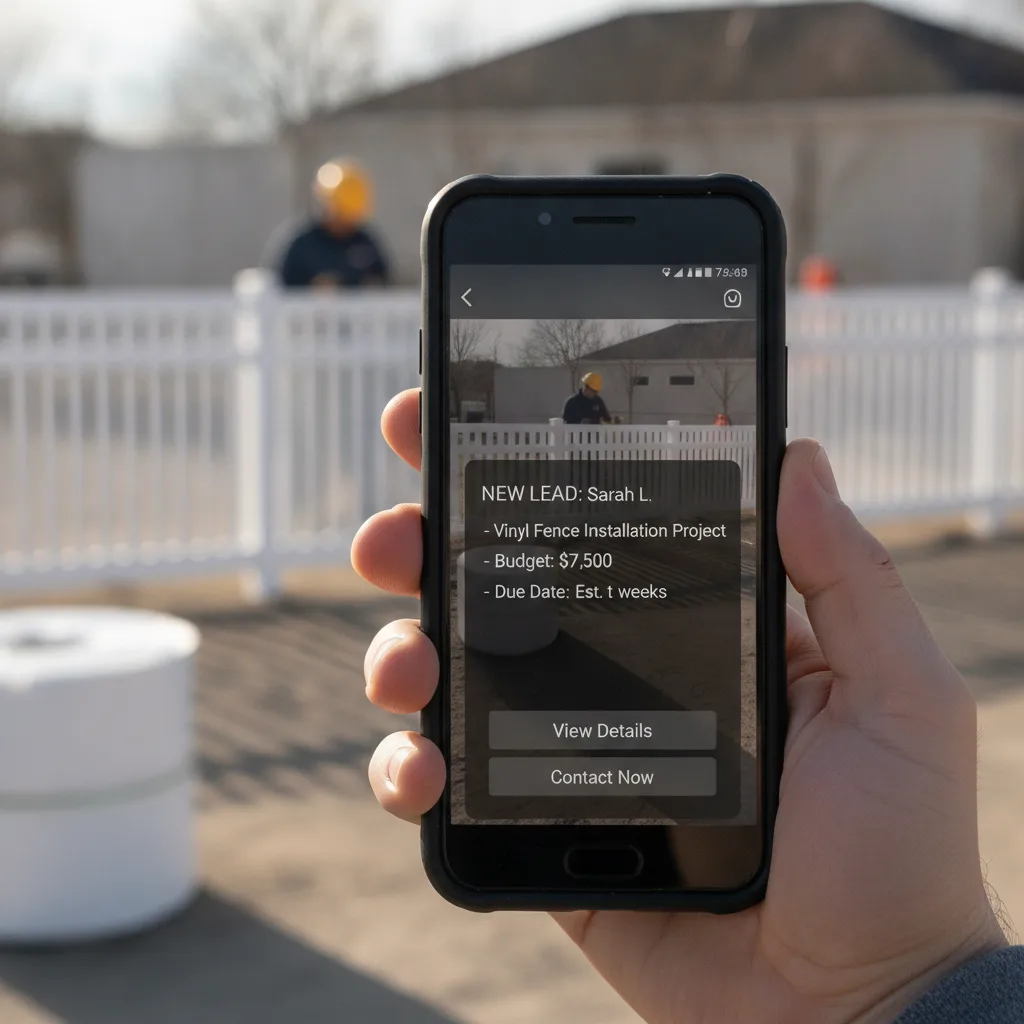
A $40 Angi lead closing at 6% costs $667 per booked fence installation job. A $15 organic lead closing at 35% costs $43 per booked job. Most fence contractors running on shared leads are spending 15x more per booked job than fence companies with an owned lead system — and they're competing against 3–5 other fence contractors for every single opportunity. The fencing industry sits at $12.4 billion as of 2026, with Texas ranking in the top three states for demand alongside Florida and California. There is no shortage of homeowners who need fences. The shortage is fence contractors whose websites are set up to capture that demand before their competitors do. Every week you spend chasing leads on Angi is a week your competitor is building consistent leads from a website that does the work automatically.
Geek Powered Studios built this exact lead generation system for Serview Home Pros — a fence contractor that started with nearly no online presence. The result: 325+ ranked keywords, $25 per qualified lead, and a 6% conversion rate on a site that now generates steady inbound leads without a single dollar going to shared lead platforms. That's what an owned lead generation system looks like when all 7 steps are working together. We build fence company websites that include instant quote tools, material-specific service pages, Google Business Profile optimization, and automated lead follow-up — as part of a full-service retainer that includes a custom website at no extra cost (an $8K–$15K value). No long-term contracts. Exclusive to one fence company per market. If you want to see what this system would look like for your fencing business, book a free strategy session and we'll show you the numbers from your own market.
Frequently Asked Questions
Ready to get started? Contact Geek Powered Studios today.