
A restoration SEO agency outperforms a general SEO company on three specific fronts: keyword targeting (emergency-intent terms like "emergency water damage restoration near me" instead of broad home improvement terms), page architecture (separate service pages for water damage, fire damage, mold remediation, and storm damage instead of a single bundled services page), and trust signals (IICRC certification placement, 24/7 response claims, and systematic review acquisition). As of 2026, the median Google Ads cost per lead for water damage restoration hit $676 nationally and exceeds $1,447 in Houston and Dallas. Restoration companies with 12-plus months of specialist SEO execution see 42-61% of all inbound leads come from organic search, with organic cost per lead dropping below $25 by year three. The math makes the case: specialization is not a luxury, it is the only compounding cost-reduction strategy in the restoration industry.
-
$676Median Google Ads cost per lead for water damage restoration nationally in 2026
-
Under $25Organic cost per lead at year three of a specialist restoration SEO campaign
-
42-61%Share of inbound leads from organic search after 12+ months of restoration SEO
-
9.9 secondsAverage restoration website LCP — 7.4 seconds over Google's passing threshold
-
81%Restoration searches that include a local intent term like "near me" or a city name
-
5.3xHigher long-term ROI from organic SEO vs. paid channels for restoration businesses
A general SEO company does not just rank slower for restoration searches — it targets the wrong keywords entirely, builds the wrong page structure, and skips every trust signal that makes a panicked homeowner pick up the phone. As of 2026, the median Google Ads cost per lead for water damage restoration hit $676 nationally and exceeds $1,447 in Houston and Dallas. By year three of a properly executed restoration SEO campaign, organic cost per lead drops below $25. That $1,422 gap per lead is not a rounding error — it is the entire financial case for working with a restoration SEO agency instead of a generalist contractor SEO company. This 6-step audit walks restoration company owners through the exact diagnosis: pull your keyword rankings, check your page architecture, fix your technical SEO, optimize your Google Business Profile, build the right trust signals, and execute a link building strategy that creates a ranking moat your paid-ad budget cannot buy. Complete the self-audit in 20-30 minutes; expect measurable ranking results in 3-6 months after fixing what you find.
Before you start
- A live restoration company website with at least one service page published and indexed by search engines
- Access to Google Search Console or Google Analytics to check current organic traffic, keyword rankings, and click data
- A baseline cost-per-lead number from your current paid ads, LSA campaigns, or both — you need this to compare against organic SEO performance later
- A clear list of which restoration services you offer (water damage, fire damage, mold remediation, storm damage, biohazard cleanup) and which cities or service areas you cover
- A Google Business Profile already claimed and verified for your primary location

Audit What Keywords Your Current SEO Agency Is Actually Targeting
The fastest way to diagnose a generalist SEO problem is to pull your current keyword rankings in Google Search Console and check whether any of them contain emergency-intent phrases like 'emergency water damage restoration near me,' 'flood cleanup [city],' or 'burst pipe repair [city] tonight.' If your keyword list reads more like 'home improvement tips' or 'water damage prevention,' your SEO company is optimizing for the wrong audience entirely — homeowners who are browsing, not panicking. Restoration customers are not comparison shopping. They have a flooded basement at 11 p.m. and they are calling the first credible result they see.
A restoration SEO agency targets relevant keywords with verified purchase intent and real search volume. 'Water damage restoration near me' pulls 111,000 US searches per month. 'Mold remediation near me' pulls 62,000. 'Fire damage restoration near me' pulls 36,000. Keyword research done by a general SEO company in the home services space often misses these in favor of broader, lower-converting terms because they have never mapped the emergency psychology of a restoration customer. The search intent for 'water damage restoration' and 'home improvement contractor' are completely different, and the SEO strategies to capture them are just as different.
Run this check now: open Google Search Console, filter by your top 20 keywords by impressions, and count how many include a city name, a damage type (water, fire, mold, storm), or the word 'emergency.' If fewer than half do, your current restoration SEO campaign is not targeting the searches that generate phone calls. That is not a minor gap — it is the whole game. A dedicated account manager at a restoration SEO agency will track keyword rankings broken out by service line and city every month, because ranking timelines and competition levels differ significantly across each damage type.
Google Search Console
Free
Shows every keyword your restoration company's website currently ranks for, with impressions, clicks, and average position — the fastest way to confirm whether your agency is targeting emergency-intent terms or generic home improvement queries.
Ahrefs
$129/mo
Lets you run a keyword gap analysis against local restoration competitors to identify high-intent local keywords they rank for in search results that your site does not.
Quick shortcut
If your SEO company sends monthly reports but never breaks out keyword rankings by service type (water vs. fire vs. mold) and by city, that is a structural warning sign. A restoration SEO specialist tracks each service line separately because search volume, competition, and conversion rates differ across damage types — and because Google Analytics alone will not show you which specific service queries are driving calls.
Check Whether Your Restoration Website Has Separate Service Pages for Each Damage Type
Restoration companies with separate, fully built-out service pages for water damage, fire damage, mold remediation, and storm damage consistently rank faster and higher in search engine results than those with a single bundled 'Our Services' page. Search engines treat each page as a distinct topical authority signal. A single page trying to rank for four different restoration services splits that authority four ways — and ranks for none of them competitively. 81% of all restoration searches include a local intent term like 'near me' or a city name, which means each of those four service types also needs city-level variants to capture local search traffic at full strength.
Mold remediation services and fire damage restoration service pages often reach first-page search rankings faster than water damage pages because fewer restoration companies have properly built them out. A general SEO company rarely knows this because they have never done keyword research specific to the restoration industry. They will build one services page, call it done, and move on to their dental or roofing client. A restoration SEO agency builds each service page as a standalone conversion asset with separate metadata, city-specific copy, IICRC certification callouts, response time claims, and schema markup that boosts organic click-through rates by 20-40%.
The page architecture that search engines reward follows a clear hierarchy: homepage targeting your primary city, individual service pages (water damage restoration, fire damage restoration, mold remediation services, storm damage cleanup), then city or neighborhood landing pages under each service. That structure gives search engines a clear map of exactly what your restoration company does and exactly where you do it. Most restoration company websites we audit are missing at least three of these layers entirely — and that structural gap is why organic traffic stays flat no matter how much content your generalist SEO company publishes.
Why this matters for local SEO
The top 3 local search results capture nearly 68% of all clicks on restoration-related queries. If you have one combined services page targeting four damage types across multiple cities, you are competing for none of those local search results at full strength. Separate service pages with city variants are the structural foundation of effective restoration SEO — and they are the single most common element most restoration companies are missing.
Fix the Technical SEO Failures That Are Silently Killing Your Search Engine Rankings
The average restoration website takes 9.9 seconds to render its main content — 7.4 seconds over Google's 2.5-second Largest Contentful Paint threshold. That single technical failure is enough to push your restoration company's website off the first page of search results regardless of how strong your content is. Restoration websites with LCP under 1.8 seconds convert 2.3x more calls than those above 3.5 seconds, and technical SEO returns 117% ROI with the fastest break-even of any SEO service type at just 6 months. Website speed is not a cosmetic issue — it is a search engine ranking factor with a direct line to phone calls and booked jobs.
A general SEO company may flag site speed as a line item in their monthly reports, but they rarely fix it with the specificity restoration sites need. Restoration company websites tend to carry oversized before-and-after photo galleries, uncompressed hero images, and bloated page builders — all of which compound the LCP problem. Technical optimization for a restoration site means compressing images to under 150KB, enabling lazy loading for below-the-fold photos, reducing server response time (TTFB under 600ms), and resolving Core Web Vitals failures that generalist agencies typically gloss over in favor of content tasks.
Run a free audit at PageSpeed Insights on your homepage and each service page. If your LCP score is above 2.5 seconds on mobile, you are losing organic traffic to competitors whose sites load faster. Schema markup implementation — which most restoration sites skip, with adoption at only 22% industry-wide — adds a 20-40% lift in organic CTR when deployed correctly on service pages. Technical optimization is not a one-time fix. It is a monthly maintenance discipline, and a restoration SEO specialist will track it across every service page and city landing page, not just the homepage.
Google PageSpeed Insights
Free
Shows your LCP, FID, and CLS scores by page — the exact Core Web Vitals Google uses to score your restoration website's technical health and decide how it ranks in search engine results.
Screaming Frog SEO Spider
$259/yr
Crawls your entire restoration site to surface broken links, missing metadata, duplicate content, and redirect chains that suppress your search engine rankings across service pages and city landing pages.
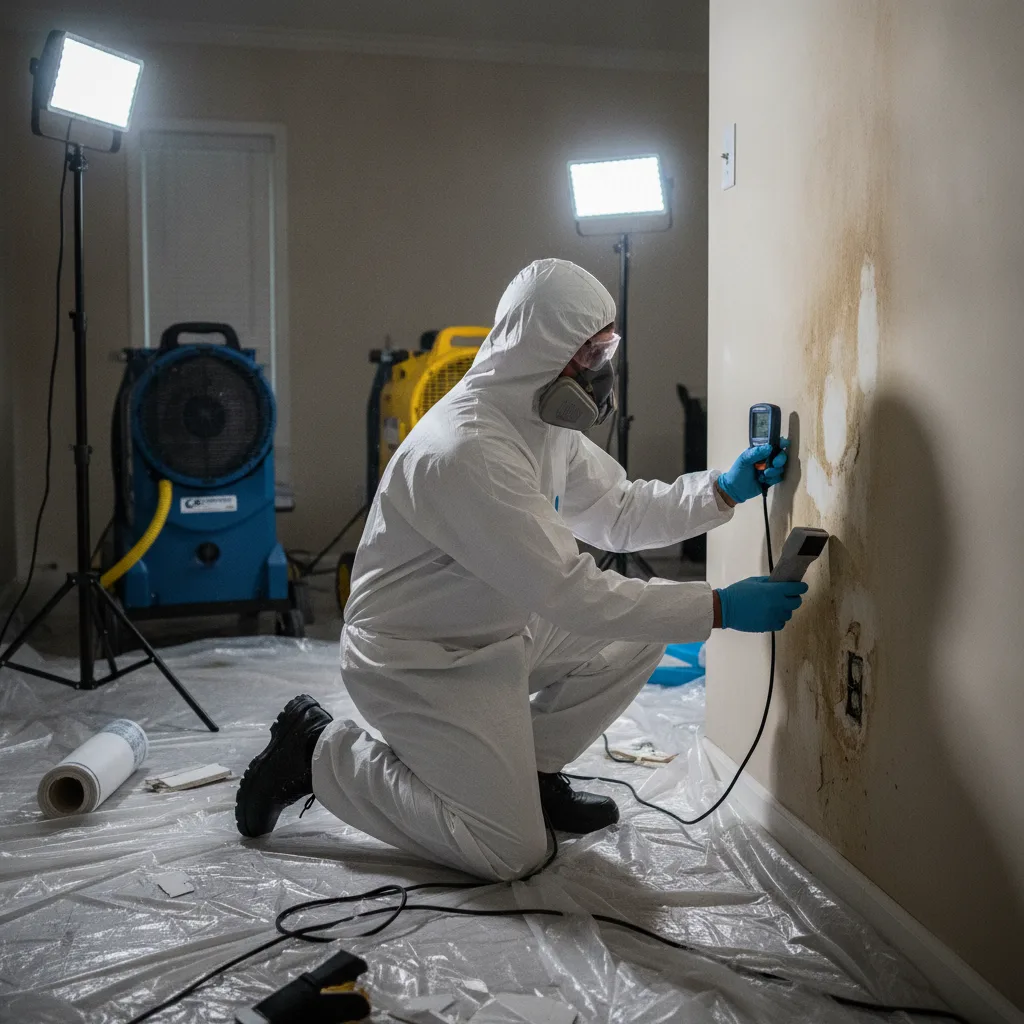
Optimize Your Google Business Profile and Local SEO Signals for High-Intent Keywords
57% of restoration companies say their Google Business Profile is their single top lead source, and emergency-intent queries generate local pack click-through rates 2-3x higher than informational queries. An optimized GBP is not a set-it-and-forget-it task — it is an active local SEO campaign that requires weekly photo uploads, Google Posts timed around seasonal storm events, and service descriptions that mirror the exact language homeowners type when their basement is flooding at 11 p.m. GBP is also the primary driver of Google Maps visibility, which means neglecting it costs you position in the map pack where most emergency searches convert.
A general SEO company fills out the basics: name, address, phone. A restoration SEO agency knows that GBP optimization for a restoration business means adding every service category (water damage restoration, fire damage restoration, mold remediation, biohazard cleanup), uploading real job-site photos with geo-tagged filenames, writing service descriptions that call out IICRC certification and 24/7 emergency response, and actively managing reviews that mention response time — because response-time reviews carry particular weight in local search rankings. Search engine visibility in the local pack is overwhelmingly driven by GBP signals, and most restoration companies leave the majority of those signals empty.
Local SEO for restoration also requires consistent NAP citations across 50-80 directories, with exact-match formatting across Yelp, Angi, HomeAdvisor, and industry-specific directories like the IICRC contractor locator. A free business listing on IICRC's own directory doubles as a trust signal and a local backlink. Inconsistent NAP data — different phone numbers, suite numbers formatted differently, business name abbreviations — is one of the most common issues in restoration company SEO audits. It suppresses local search rankings and is one of the fastest wins to fix once identified.
BrightLocal
$39/mo
Manages NAP citation consistency across 80-plus directories and tracks local search rankings by city and zip code — essential for restoration companies serving multiple service areas.
Google Business Profile Manager
Free
Direct interface for managing your GBP posts, photos, Q&A, and review responses — the control panel for your most important local SEO and Google Maps visibility asset.
High-intent keywords tip
Optimized GBP profiles receive 5x more direction requests than unoptimized ones. For a restoration company, direction requests are a direct proxy for booked jobs — local customers searching for the nearest available crew. Every week you leave your GBP partially filled out is a week other restoration companies are capturing those direction requests and the jobs that come with them.
Build the Trust Signals a Restoration SEO Agency Knows to Surface On-Page
67% of consumers recognize the IICRC logo as a mark of professionalism, and insurance companies increasingly require IICRC-certified technicians before approving a claim. A general SEO company writing content for a restoration company's website will produce keyword-dense copy about water damage cleanup, but they will not know to place the IICRC certification badge above the fold on every service page, embed insurance coordination language into the body copy, or include 24/7 response time claims in the metadata where search engines read them for featured snippets. These are restoration-specific SEO strategies that require industry knowledge a generalist does not have. Digital marketing strategies that work for a dental office do not transfer to emergency restoration — the trust signals are completely different.
Review signals account for approximately 17% of local pack ranking factors, and 91% of consumers say positive reviews make them more likely to call a business. A restoration SEO agency builds a systematic review acquisition process into the campaign — automating post-job review requests via SMS through tools like Podium or NiceJob, responding to every review within 24 hours, and surfacing the best reviews as on-page testimonials next to the click-to-call button. Review generation is a weekly operational discipline at a specialist agency. At a generalist company, it shows up once in a quarterly report.
On-page trust for restoration services also means publishing real before-and-after project photos with descriptive alt text, listing technician names and certifications on service pages, and displaying response time guarantees prominently near the top of each web page. Schema markup that structures this information helps search engines parse and surface it in rich results — boosting organic CTR and search engine visibility simultaneously. These signals do not just build consumer trust. They give search engines more content signals to associate your restoration company's website with the relevant service area, damage type, and emergency intent.
Podium
$399/mo
Automates post-job review request texts to customers, increasing review volume and local search rankings for your restoration business without adding manual follow-up work.
NiceJob
$75/mo
Triggers review and referral requests automatically after job completion — a lower-cost alternative to Podium built specifically for home services businesses that want to implement strategies without heavy manual oversight.
Execute a Link Building Strategy Built Around Restoration Industry Authority Sources
The number-one ranking result for any restoration keyword carries 3.8x more backlinks than positions 2-10. Building 30-40 high-quality local backlinks creates a map pack ranking moat that protects your positions in search results for 6-12 months. A general SEO company runs a generic link building campaign — guest posts on home improvement publications, directory submissions, the occasional local news mention. A restoration SEO agency targets the specific sources that carry the most authority in the restoration industry: IICRC contractor directories, local insurance agency websites, municipality emergency preparedness pages, and regional real estate investor blogs. These web pages already rank for property damage and insurance terms, so a backlink from them compounds your organic authority directly.
Link building for restoration companies also includes building referral relationships that produce both backlinks and direct job referrals. Local insurance adjusters, public adjusters, and property managers are referral sources that a restoration SEO specialist will pitch for co-branded content or resource page placements. These relationships produce backlinks from pages that already appear in search engine results for insurance and property damage terms — and they generate offline referral volume simultaneously. That dual return is something no paid ads campaign can replicate.
The financial case for building this organic authority is straightforward. Google Ads CPL for water damage restoration nationally hit $676 in 2026, and in competitive Texas markets like Houston and Dallas, CPL regularly exceeds $1,447. 'Water Damage Restoration Dallas' costs $250.79 per click on Google Ads — the most expensive keyword niche in all of home services. Organic SEO produces 5.3x higher long-term ROI than paid channels for restoration businesses, and the advantage compounds every month you stay consistent. By year three of a consistent SEO campaign, restoration companies with a properly built link profile report organic cost per lead below $25. The math is simple: 30 quality backlinks today costs far less than writing a $676 check every time the phone rings on a paid ad.
Ahrefs
$129/mo
Identifies which sites link to your top restoration competitors, giving you a prioritized target list for your own link building outreach and revealing gaps in your current backlink profile.
Pitchbox
$195/mo
Manages outreach campaigns for link building at scale — tracks email sequences, follow-ups, and response rates so no target restoration industry contact goes cold.
Cost reality check
47% of restoration companies do not track cost per lead by channel — which means they are spending marketing dollars without knowing whether paid ads, LSA, organic SEO, or referrals are actually generating calls. National SEO and local SEO require different link building approaches: national SEO targets domain authority broadly, while local SEO for restoration prioritizes city-specific citations, local media mentions, and neighborhood-level service area pages. Track both separately or you will not know which investment is working.
The Generalist Agency Trap: What It Is Actually Costing You
A generalist SEO company does not just rank slower for restoration queries — they target the wrong search terms, build the wrong page structure, and skip the trust signals that make homeowners call your restoration business instead of a competitor. The result shows up in your cost-per-lead data: $676 per lead on Google Ads nationally, $1,447-plus in Houston and Dallas. Restoration SEO agency pricing runs 20-40% higher than generalist rates for a reason. Specialists know IICRC certification signals, emergency search intent, and the service-area page architecture that generalists consistently get wrong. SEO for restoration companies done correctly produces 5.3x higher ROI than paid channels at maturity, with organic cost per lead below $25 by year three. That gap between $1,447 and $25 is not a rounding error. It is the entire business case for specialization.
Geek Powered Studios has spent 15 years building organic lead engines for home services businesses across Texas. We helped Serview Home Pros go from a nearly nonexistent online presence to 325 ranked keywords and $25 qualified leads. We helped Stan's Heating, Air, Plumbing and Electrical reach 150-plus first-page keywords and a 300% increase in organic leads. We understand the restoration industry's emergency search psychology, its seasonal demand cycles around storms and freezes, and the page architecture that makes search engines rank restoration service pages above generic competitors. Every retainer includes a free custom website (an $8,000-$15,000 value), no long-term contracts, and market exclusivity — one restoration company per city. If your current SEO agency cannot show you keyword rankings broken out by damage type and city, or cannot tell you your organic cost per lead by service line, you are not getting restoration SEO services. You are getting generic content with a monthly invoice. Book a free strategy session and we will show you exactly where your current campaign is leaving jobs on the table.
Frequently Asked Questions
Ready to get started? Contact Geek Powered Studios today.