
Surgeon SEO works when each surgeon has a dedicated bio page — not a shared team paragraph — with a clean URL containing their name and specialty, 1,500–2,500 words of credential-rich content, Physician schema with their NPI number and board certification, and city-level keyword targeting in headings. AI engines (ChatGPT, Perplexity, Google AI Overviews) describe known medical practices accurately 96% of the time but name them in only 11% of category answers. A properly built surgeon bio page closes that 85-point AI citation gap by giving search engines and AI models a named entity to cite. Combined with a surgeon-specific Google Business Profile strategy, a review solicitation protocol, and off-site directory mentions, this approach produces rank-one placement for surgeon-name queries and 40–60% named AI citation rates within 6 months.
-
85 pointsAI citation gap: accuracy rate (96%) minus named-mention rate (11%) for medical practices
-
3.4xMore inbound conversion actions from rank-one surgeon-name pages vs. rank-two pages
-
1,500–2,500 wordsMinimum viable surgeon bio page length to compete with Healthgrades in most markets
-
82% higher CTRClick-through lift from schema-driven rich results versus plain search listings
-
45 minutesTime to implement and validate Physician schema for one surgeon (NPI data in hand)
-
$200 vs. $1,824Organic SEO patient acquisition cost vs. paid search cost-per-booked-consultation
Surgeon SEO fails at a specific, predictable point: when a practice invests in polished procedure pages but leaves each surgeon as an anonymous contributor to a shared team page. The result is a site that ranks for broad informational queries but loses every referral validation search — the moment a referred patient types a surgeon's name into Google and lands on Healthgrades instead of the practice's own domain. As of 2026, AI assistants account for 45% of local recommendations alongside Google's dominant organic search share, and AI systems describe known medical practices accurately 96% of the time but name them in only 11% of category answers. That 85-point visibility gap closes exactly one way: a dedicated, credential-rich surgeon bio page that gives search engines and AI models a named entity to find, verify, and cite. This guide walks through the seven steps to build that page — from auditing the current named-entity gap through measuring AI citation rates — with specific tools, word counts, schema fields, and conversion benchmarks at every stage. Total time: 8–12 hours across content creation, schema implementation, and off-site entity building.
Before you start
- Access to your practice website's CMS with the ability to create new pages and edit URL slugs
- The surgeon's NPI number, board certification details, fellowship institution name, and procedure volume data
- A Google Search Console property verified for the practice domain
- At least one active Google Business Profile (GBP) listing tied to the practice location
- A Semrush or Ahrefs account for keyword research and on-page search optimization tracking
- Google's Rich Results Test or Schema.dev for Physician schema validation
Audit Your Current Surgeon Pages Against the Named-Entity Gap
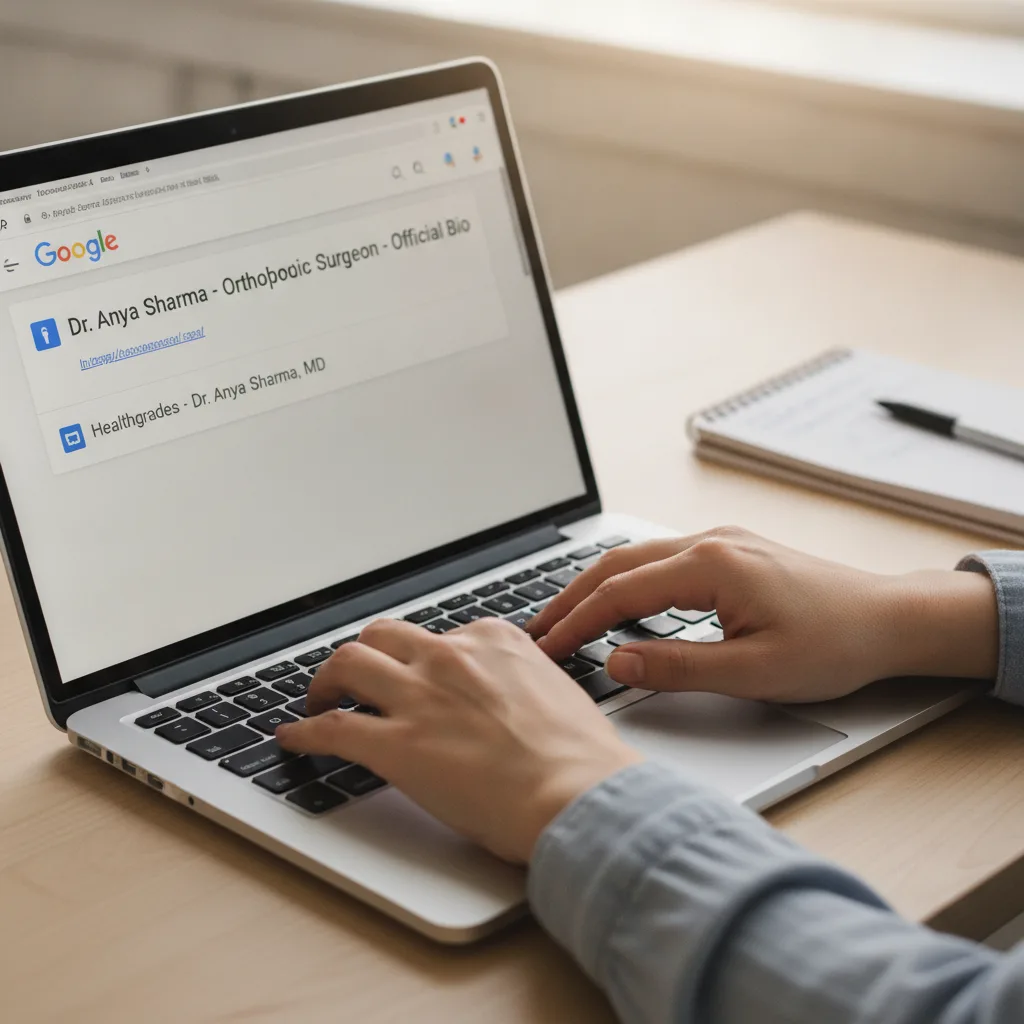
A dedicated surgeon bio page — not a 'Meet Our Team' paragraph — is the foundational unit of surgeon SEO, and most plastic surgery practices don't have one that meets Google's minimum bar. Run a Google search for '[Surgeon First Last] [City]' right now. If Healthgrades, Vitals, or a hospital directory listing occupies position one instead of your own domain, you have a named-entity gap: Google cannot confirm the surgeon exists as a verified clinical entity on your site. Patients who receive referrals still search that surgeon's name before calling, and a thin profile fails this referral validation step, redirecting those patients to a competitor with a full bio page and 40+ reviews.
Provider pages under 1,000 words rarely rank for surgeon-name searches when competing against Healthgrades and hospital directory listings. The minimum viable surgeon page for a competitive market runs 1,500–2,500 words, with specialty focus, training background, procedure volume, a FAQ section of 5–8 direct-answer questions, and attributed outcome content. Audit every surgeon's current page against that benchmark — not just word count, but whether the page carries fellowship institution, named board certifications, procedure-specific long-tail keywords, and city-level location signals that drive local search rankings.
Log each surgeon's gap score in a simple spreadsheet: current word count, current Google rank for '[Name] + [City]', presence or absence of Physician schema, number of Google reviews attributed to that surgeon, and whether internal links connect the bio to each relevant procedure page. This audit becomes your prioritization list and the foundation of your surgeon SEO strategy going forward.
Semrush
$139/mo
Run position tracking for surgeon-name queries and surface which third-party directories are outranking your own pages in search results
Google Search Console
Free
Pull click and impression data for branded surgeon queries to quantify how much organic traffic the named-entity gap is costing you right now
Screaming Frog SEO Spider
Free up to 500 URLs / $259/yr
Crawl the practice site to confirm dedicated surgeon page URLs, word counts, title tags, and internal link structure in one export
Common Failure Mode
Practices that list multiple surgeons on a single '/our-team' page cannot rank that page for any individual surgeon's name query — search engines need one URL per surgeon with that surgeon's name in the slug, title tag, and H1. A shared team page splits topical relevance across every surgeon simultaneously and wins for none of them.
Build a Dedicated URL and On-Page Structure for Each Surgeon
Each surgeon needs a self-contained page at a clean, permanent URL: '/surgeons/dr-jane-smith-rhinoplasty-dallas' or '/doctors/dr-james-chen-orthopedic-surgeon-houston'. The URL should include the surgeon's name and their primary specialty keyword — this gives search engine crawlers an immediate topical signal before they read a single word of the page body. Never use '/team/member-4' or parameter-based URLs; these cannot rank for surgeon-name searches and will not be cited by AI systems. On-page optimization begins at the URL level.
The page title tag format that consistently outperforms generic alternatives is: '[Dr. Name] — [Primary Procedure] Surgeon in [City], [State] | [Practice Name]'. The H1 should mirror the title tag closely but can expand: 'Dr. Jane Smith: Board-Certified Rhinoplasty Surgeon in Dallas, TX'. The meta description — 155 characters maximum — should open with a self-contained credential statement an AI could cite verbatim: 'Dr. Jane Smith is a Dallas rhinoplasty surgeon fellowship-trained at Johns Hopkins with 800+ procedures performed and a 4.9-star rating across 120 reviews.' Meta descriptions written this way serve double duty: they drive click-through from search engine results pages and give AI models a confidence-calibrated summary to extract.
Structure the page body in this order: credentials summary above the fold (board certification, fellowship, years in practice, procedure volume), specialty focus section with procedure-specific content targeting long-tail keywords like 'rhinoplasty revision specialist Dallas' or 'hip replacement surgeon with anterior approach Houston', training and education section with fellowship institution named explicitly, a patient outcomes section with attributed quotes or case studies, and a FAQ section of 5–8 questions written as direct-answer sentences for AI extraction. Close with a consultation CTA and internal links to every procedure page relevant to that surgeon — those links increase consultation scheduling likelihood by 70%, per 2026 data from Plastic SEO.
Surfer SEO
$89/mo
Real-time on-page optimization scoring against the top-ranking surgeon and provider pages for your target keyword set — tells you exactly how many times to use 'rhinoplasty Dallas' vs. 'nose job Dallas' before you publish
Semrush Keyword Magic Tool
Included with Semrush
Surface procedure-specific long-tail keywords and question-based keywords (voice search and AI query formats) that belong in the FAQ section
SEO Tip
Keyword research for surgeon bio pages should include voice search variants — 'who is the best rhinoplasty surgeon near me' and 'which Dallas plastic surgeon does revision rhinoplasty' — because these are the exact phrasing patterns AI models use when constructing recommendation responses. Include at least three voice-search-format questions in the FAQ section and answer each in 2–4 complete sentences.
Implement Physician Schema with NPI and Board Certification Data
Physician schema — a subtype of the Person schema — links a surgeon's NPI number and board certifications directly to their bio page, giving Google machine-readable proof of clinical expertise. This is not optional for YMYL medical content: Google's E-E-A-T framework classifies all surgical pages under its highest quality bar, and named clinicians with verifiable credentials are ranking prerequisites, not extras. Pages with schema errors are actively worse than pages with no schema for AI citation purposes — a malformed block signals to search engine algorithms that the entity data cannot be trusted.
The minimum viable Physician schema block includes: '@type': 'Physician', 'name': full legal name as it appears on board certification, 'medicalSpecialty': the SNOMED-aligned specialty term (e.g., 'Plastic Surgery', 'Orthopedic Surgery'), 'hasCredential' referencing the board certification body and year, 'identifier' carrying the NPI number, 'worksFor' linking to the MedicalBusiness schema entity for the practice, and 'areaServed' with city and state. Add 'alumniOf' for the fellowship institution — this is the field AI models pull when constructing 'fellowship-trained surgeon in [city]' recommendation responses in ChatGPT and Perplexity.
After publishing the schema, validate it with Google's Rich Results Test within 24 hours. A clean validation unlocks physician profile card eligibility in Google search results — and pages with schema-driven rich results achieve 82% higher click-through rates than plain listings, according to a Nestle R&D study cited by Healthcare Success. For the practice entity, pair the Physician schema with a MedicalBusiness schema block on the homepage and a FAQPage schema block on each procedure page the surgeon's bio links to. Technical SEO at the schema level is what separates practices that appear in Google AI Overviews from those that don't.
Google Rich Results Test
Free
Validates Physician schema implementation and flags errors before they suppress rich result eligibility and AI citation confidence
Schema.dev
Free / $29/mo Pro
Generates clean JSON-LD Physician schema blocks with guided field entry — faster than hand-coding and less error-prone than plugin-generated markup
45 minutes
Time to complete this step for a single surgeon, assuming NPI and credential data are on hand. The schema block itself takes 15 minutes to generate and validate; the remaining 30 minutes go to embedding it correctly in the page's head section and testing across desktop and mobile in Search Console's URL Inspection tool.

Write 1,500–2,500 Words of Credential-Rich, AI-Citable Content
The single highest-leverage surgeon SEO move is publishing a bio page long enough and specific enough that AI models can extract and cite discrete facts from it. As of 2026, over 230 million health-related queries are submitted to ChatGPT worldwide each week, and AI systems describe known medical practices accurately 96% of the time but name them in only 11% of category answers — an 85-point visibility gap. The way to close that gap through generative engine optimization is to give AI models high-confidence named-entity associations: specific surgeon name, specific procedure, specific credential, specific city. Content marketing that serves AI citation has the same structure as content that serves classic Google rankings: it leads with facts, not narrative.
Every paragraph on the page should open with a self-contained answer sentence. Not 'Dr. Smith has years of experience in rhinoplasty' but 'Dr. Jane Smith has performed 800+ rhinoplasty procedures at Dallas Presbyterian, with 94% of patients reporting satisfaction at 6-month follow-up.' That sentence structure is what Google AI Overviews, Perplexity, and ChatGPT extract and cite. Generic qualitative claims — 'passionate about patient care,' 'dedicated to excellence' — consume word count without contributing to AI citation or search rankings for plastic surgeons. Patient testimonials and outcome data, by contrast, add both trust signals and citable specificity.
The FAQ section carries outsized weight for both voice search and AI extraction. Write 5–8 questions in the exact phrasing prospective patients use: 'How many rhinoplasty surgeries has Dr. Smith performed?', 'Where did Dr. Smith complete her fellowship training?', 'Does Dr. Smith perform revision rhinoplasty in Dallas?', 'What is Dr. Smith's average recovery time for rhinoplasty patients?' Each answer should be 2–4 sentences — long enough to answer completely, short enough to be extracted verbatim by AI search. Add FAQPage schema to this section so Google can surface answers directly in search engine results pages.
Content Marketing Warning
AI models cite named entities — specific surgeons with verifiable, specific credentials — far more reliably than anonymous practice pages. If the bio page's procedure volume section reads 'extensive experience,' an AI model has nothing concrete to cite. Replace every qualitative phrase with a number: years in practice, case volume, fellowship institution, residency hospital, board certification year. Concrete data is the difference between a page AI engines ignore and one they recommend to prospective patients.
Execute Local SEO and Google Business Profile Optimization for the Surgeon
46% of Google searches carry local intent, and a properly optimized surgeon bio page that incorporates city-level keywords, board certifications, and hospital affiliations captures nearby patients at the moment of highest intent. Local SEO for an individual surgeon requires three synchronized elements: the bio page itself with city and neighborhood keyword targeting, the practice's Google Business Profile with the surgeon listed as a primary provider, and consistent NAP (name, address, phone) data across all directories where the surgeon appears by name. When these three elements align, Google Maps rankings for procedure-plus-city queries improve within 60–90 days. Orthopedic surgeon SEO and plastic surgeon SEO both follow this same local search pattern.
For Google Business Profile optimization, the surgeon's name should appear in the practice's GBP description with their specialty and city: 'Home of Dr. Jane Smith, Dallas rhinoplasty surgeon fellowship-trained at Johns Hopkins.' Add the surgeon as an attribute under 'Meet the Team' if your GBP category supports it, and post Google Business Profile updates that name the surgeon and their specific procedures at least twice per month. Each post is a local search signal that keeps the entity fresh in Google Maps rankings. Google Business Profile optimization done at the surgeon level — not just the practice level — is the local SEO step most plastic surgery clinics skip entirely.
For local search rankings specifically, add city-modified long-tail keywords to the bio page's H2 and H3 headings — not just the body copy. 'Rhinoplasty in Dallas, TX: Dr. Smith's Approach' as an H2 outperforms the same phrase buried in a paragraph because search engine crawlers weight heading tags more heavily in local search results. The heading-level local signal improves overall SEO performance for city-specific queries, building a strong online presence that compounds as the surgeon accumulates reviews and directory citations over time.
BrightLocal
$39/mo
Tracks local search rankings by surgeon name and city keyword, and audits NAP consistency across Healthgrades, Vitals, Zocdoc, and 50+ other directories
Google Business Profile Manager
Free
Directly controls the practice's Google Maps presence and enables surgeon-attributed GBP posts that build local search authority
Local SEO Shortcut
If the practice has multiple locations, each location needs its own GBP listing — and the surgeon who primarily operates at each location should be named explicitly in that location's GBP description. A single GBP for a multi-location practice splits local search authority and prevents any individual location from ranking competitively in its own city or suburb.
Build Off-Site Surgeon Entity Mentions for AI Citation and Link Authority
Off-site mentions predicted AI citation approximately three times more strongly than backlinks in a 175-brand medical study — a 0.664 vs. 0.218 correlation coefficient. That finding reframes the entire link building strategy for surgeon SEO: the goal is not just backlinks but named-entity mentions of the specific surgeon in directories, review platforms, and third-party profiles. Healthgrades, Vitals, Zocdoc, RealSelf (for plastic surgery and cosmetic surgery), and Castle Connolly are the five non-negotiable profiles every surgeon needs fully built out and verified. These profiles are both local SEO signals and AI citation anchors — Perplexity and ChatGPT pull from them when constructing 'best plastic surgeon in [city]' answers.
Each directory profile should mirror the bio page's credential data exactly: same NPI, same board certification language, same fellowship institution name, same procedure list. Inconsistency between directory profiles and the practice bio page creates a named-entity conflict that suppresses AI citation confidence. Reputation management at the directory level means auditing these profiles quarterly for accuracy, not just building them once. After claiming and completing each profile, the surgeon's Google Knowledge Panel — the entity card that appears for named searches — typically populates within 60–90 days if schema and directory data are aligned. That Knowledge Panel is visible confirmation that the surgeon exists as a verified entity in Google's knowledge graph.
For link building that specifically lifts search rankings, target topical-relevance bylines in medical and health publications with domain rating 50–65: bylined articles in Aesthetic Surgery Journal, American Academy of Orthopaedic Surgeons news, or city-level health publications. A bylined article titled 'What Dallas Rhinoplasty Patients Should Know About the Recovery Timeline — by Dr. Jane Smith' earns a named-entity mention, a contextual backlink to the bio page, and topical authority signals in a single placement. Guest posts on generalist outlet sites (DR 70+ but off-topic) underperform this approach for personal-brand search optimization since the 2024 helpful-content updates. For seo for plastic surgeons specifically, RealSelf bylines and Aesthetic Society articles carry the strongest topical authority signal.
BrightLocal Citation Builder
Included with BrightLocal
Automates NAP submission to 50+ healthcare directories simultaneously, ensuring consistency across every named-entity mention and supporting local SEO goals
Ahrefs
$129/mo
Identifies competitor surgeons' backlink and mention profiles so you can target the same DR 50–65 publications already citing peer surgeons in your specialty
Reputation Management Note
As of 2026, 97% of patients read reviews before a consultation decision, and 68% require a minimum 4-star average before considering a surgeon. Build a surgeon-specific review solicitation protocol: send a review request via email or text at the 2-week post-op check-in (sentiment is high, outcome is visible) and again at the 6-month follow-up milestone. Attribute the review request to the named surgeon — 'How was your experience with Dr. Smith?' — so reviews accumulate on the surgeon's named profile rather than the generic practice profile.
Measure Surgeon SEO Performance and Close the AI Visibility Gap
Surgeon SEO performance requires tracking three separate surfaces: classic Google SERPs, Google Maps and local search results, and AI search citation. Most practices track only the first surface and miss the AI citation gap entirely. As of 2026, AI assistants account for 45% of local recommendations alongside Google's dominant organic search share — a practice with strong search visibility in Google SERPs but invisible to ChatGPT, Perplexity, and Google AI Overviews is losing nearly half its AI-driven patient inquiries to competitors whose surgeon pages give AI models named entities to cite. Overall SEO performance measurement must include all three surfaces to reflect actual patient acquisition outcomes.
Set up a monthly AI citation audit: run the queries 'best rhinoplasty surgeon in [city]', 'top orthopedic surgeon [city] for [procedure]', and '[Dr. Name] [specialty] [city]' in ChatGPT, Perplexity, and Google AI Overviews. Log whether the surgeon is named, whether the practice is named, and which page or profile the AI links to. The 11% named-citation rate from the 175-brand study is your baseline — any surgeon page built to the spec in this guide should reach 40–60% named citation within 6 months. Tracking AI search citation monthly lets you identify which content gaps, schema errors, or directory inconsistencies are still suppressing named-entity recognition.
Track conversion outcomes separately from traffic to understand true SEO campaign performance: Google Search Console shows impressions and clicks for surgeon-name queries, but CallRail shows whether those clicks convert to calls, and Podium tracks whether those callers book consultations. Pages ranking first for a named professional's query pull 3.4x more inbound conversion actions than pages ranking second — so the KPI that matters is not rank alone but rank-one status for the surgeon's full name query paired with the consultation scheduling rate from that page's traffic. Use this data to refine the SEO strategy quarterly and prioritize which surgeons need additional content depth, review volume, or off-site citation building. An SEO agency managing these seo campaigns should report on all three surfaces: Google, Maps, and AI search.
CallRail
$45/mo
Attributes inbound calls to the specific surgeon bio page that drove them, separating conversion performance by surgeon rather than lumping all calls into a single practice-level report
Podium
$399/mo
Manages surgeon-specific review requests via SMS at post-op milestones and consolidates Google, Healthgrades, and RealSelf review responses in one dashboard
Google Search Console
Free
Pull monthly impression and CTR data filtered by surgeon-name queries to confirm rank-one status and identify new branded query variants to target
Tracking Note
Position one for a surgeon-name query in a mid-size market averages a 31.7% CTR for plastic surgery queries, and the top three organic results capture 75.1% of all clicks. If your surgeon bio page is at position four or lower after 6 months of a complete build, the gap is almost always one of three things: insufficient review volume (under 40 attributed reviews), directory inconsistency suppressing AI citation, or a competitor with a longer and more specific bio page. Address these in that order before considering paid search as a supplement.

The Paid Channel Ceiling Makes Organic Non-Negotiable
Meta's January 2025 policy change banned lower-funnel plastic surgery ads — before/after photos, procedure-specific targeting, and conversion-optimized campaigns — across Facebook and Instagram. Google LSA (Local Services Ads) remains ineligible for most surgical categories. Paid search for plastic surgery procedures now runs a $379 cost per lead that compounds to $1,824 by the time a patient books a consultation. Organic SEO, by contrast, runs a patient acquisition cost of roughly $200 with an 18.9% conversion rate vs. 10.7% for PPC. For plastic surgery practices and cosmetic surgery clinics in these verticals, organic search through named surgeon pages is not a supplement to paid channels — it is the only compounding, scalable acquisition channel left. The plastic surgery SEO cost for a strong agency-led engagement pays back within the first two to three booked consultations. Build the bio pages now, before a competitor in your market does.
The structural argument for surgeon personal-brand pages is now airtight: Google requires named entities for YMYL content, AI systems cite named surgeons 3x more reliably than anonymous practice pages, and the paid channel ceiling in surgical marketing makes organic search the only channel that compounds month over month. A practice with four surgeons that builds four fully optimized bio pages — each 1,500–2,500 words, Physician schema with NPI, city-level keyword targeting in headings, and 80+ attributed reviews — multiplies its total search footprint in ways no single procedure page can replicate. The position-one conversion lift is 3.4x. The AI citation gap closes from 11% to 40–60%. And unlike ad spend, the asset stays ranked. The bio page is not a nice-to-have. It is the SEO asset that makes every other page on the site rank better — and the one most surgical practices still haven't built correctly. Start with the audit in Step 1 today, prioritize your highest-volume surgeon first, and work through each step in sequence. The practices that build this foundation in 2026 will own their local search results for years.
Frequently Asked Questions
Ready to get started? Contact Geek Powered Studios today.