Brand Mentions SEO for Home Services Businesses in 2026: The Complete Guide
November 18, 2026
💡 Quick Answer
Brand mentions SEO is the practice of building a consistent, cross-platform pattern of references to your business name — linked and unlinked — so AI search engines can confidently identify and cite your brand. For home services contractors, this means keeping your NAP identical across every directory, earning editorial mentions in local news and trade publications, and monitoring whether ChatGPT and Google AI Overviews actually name your business when customers ask. An Ahrefs study of 75,000 brands found branded web mentions correlate with Google AI Overview visibility at 0.664, while backlink count correlates at only 0.218 — roughly three times weaker. Ranking #1 organically is no longer enough; entity recognition, built off-site, is the separate gate AI search uses to decide which brands to name.
📊 Key Takeaways
Six data-backed facts every home services contractor needs to understand before spending another dollar on SEO or ads in 2026.
0.664 vs. 0.218
Web mentions beat backlinks for AI visibility by 3x
76.95% of AI citations
Come from outside the organic top-10 results
17% local pack gain
Average improvement after fixing NAP inconsistencies in 90 days
169 vs. 14 AI mentions
Top-quartile web mention brands vastly outpace the next tier
Entity recognition is topic-level
AI cites brands for specific services, not globally
Rank #1 and still get skipped
Organic rank and AI citation are two separate visibility states
Google Alerts misses social
A full monitoring stack requires dedicated social listening tools
Branded search volume is the leading signal
It rises before local pack or AI citation improvements show up
If you're running a $2M–$5M home services business and you already have a website, a Google Business Profile, and some SEO in place, you've probably noticed something frustrating: ChatGPT doesn't name you. Google AI Overviews skip you. Perplexity cites a competitor who doesn't even rank above you organically. That gap has a specific cause — and it's fixable. This guide explains what brand mentions SEO actually is, why AI search engines treat mention patterns as the primary gate for citation, and what a plumber, HVAC company, roofer, or electrical contractor needs to do right now to build the off-site signals that make a brand citable.
What this guide covers
Brand mentions SEO is the practice of building a consistent, cross-platform pattern of references to your business name — linked and unlinked — so that AI search engines and Google can confidently identify and cite your brand. This guide covers what counts as a brand mention, why AI systems like Google AI Overviews, ChatGPT, and Perplexity use mention patterns to decide which businesses to name, and the specific steps a home services contractor can take — from cleaning up NAP inconsistencies to earning editorial placements in local news — to become a brand these engines trust. It does not cover on-page SEO tactics, paid ads, or social media growth strategies unrelated to citation-building.
Chapter 1 · Foundation
What Brand Mentions Actually Are (and Why AI Treats Them Differently Than Google Did)
A brand mention is any reference to your business name across the web — in a news article, a review, a Reddit thread, a social media post, or a directory listing — whether or not it carries a hyperlink back to your site. For the last decade, most contractors ignored unlinked mentions entirely because traditional PageRank only counted links. That logic no longer applies. AI search engines treat your brand as an entity, not a URL, and they build their picture of who you are from every reference they can find across independent sources — linked or not. Understanding this shift is the starting point for any brand mention strategy worth building.
Linked versus unlinked mentions differ in their SEO mechanism but not in their AI value. A linked mention passes traditional link equity; an unlinked mention does not affect PageRank. What it does affect is entity recognition — the process by which AI systems resolve 'Austin HVAC company' into a specific, named brand they can confidently cite. An Ahrefs study of 75,000 brands found branded web mentions have a 0.664 Spearman correlation with Google AI Overview brand visibility, while backlink count correlates at only 0.218 — roughly three times weaker. That gap is why unlinked mentions deserve a spot in every contractor's brand mention strategy.
AI systems evaluate mentions as corroboration signals, not ranking signals. When ChatGPT, Perplexity, or Google AI Overviews decide which HVAC company to name in a response about summer AC tune-ups, they scan for a pattern: multiple independent sources — a local news site, an Angi profile, a Nextdoor thread, a trade publication — all pointing to the same business with consistent language. When three unrelated, credible sources converge on the same fact about a brand, the model's confidence in that entity rises fast. A single high-authority backlink does not replicate that effect.
The practical gap this creates for home services contractors is real. A plumber ranking #1 organically for 'emergency plumber Austin' can still get skipped by Google AI Overviews if the brand has thin third-party corroboration. A May 2026 study of 153,425 AI citations found 76.95% of cited URLs came from outside the organic top-10. Ranking and being cited are two separate visibility states, each requiring different work — and most contractors are only optimizing for one of them.
Sentiment and context matter alongside volume. AI systems analyze not just how often a brand appears, but the language surrounding each mention. A mention that pairs your business name with category terms — 'licensed plumber,' 'AC repair,' 'emergency roofing' — carries more entity-building weight than a bare name drop. A brand mention strategy built purely on mention volume misses this. The context, frequency, and sentiment of brand mentions shape how and when a brand surfaces in AI-generated answers, which is why quality and placement matter as much as count.
It's also worth naming the boundary of what brand mentions SEO can't do. Google's John Mueller has confirmed that unlinked mentions are not used for PageRank or the link graph in the classic sense. An 80.9% majority of SEO practitioners (Editorial.link, 2025) believe unlinked mentions materially affect rankings, but that effect runs through entity recognition and topical authority — not through traditional link equity. The honest framing for a home services contractor: unlinked brand mentions are essential for AI search visibility and plausibly helpful for local organic rankings, but they do not replace the value of earning genuine backlinks from authoritative websites and local news outlets.
Key takeaway
Branded web mentions correlate with Google AI Overview visibility at 0.664 versus 0.218 for backlinks — making off-site mention patterns roughly three times more predictive of AI citation than traditional link building alone.
Chapter 2 · Foundation
NAP Consistency: The Brand Mention Strategy Every Contractor Already Has (But Probably Got Wrong)
NAP consistency — keeping your business Name, Address, and Phone number identical across every directory, platform, and profile — is the most basic form of brand mention strategy, and it is the one most home services companies have quietly broken. Even small variations like 'ABC Plumbing Inc' on Yelp versus 'ABC Plumbing' on Angi register as conflicting entity signals in Google's algorithm. Those conflicts do not just hurt local pack rankings — they create the exact kind of fuzzy, unresolved entity that AI search engines skip when composing answers. Citation cleanup is the starting point because you cannot build a credible mention strategy on top of a broken foundation.
Citation signals carry roughly 7% of local pack ranking weight directly, but their indirect effect is larger. They confirm the NAP data that feeds Google Business Profile signals, which account for 32% of local ranking weight according to 2026 BrightLocal data. A roofer whose GBP says '(512) 555-0100' but whose BBB listing says '512-555-0100 ext. 1' is not committing a catastrophic error. But that discrepancy creates enough ambiguity that Google's entity resolution pass may treat them as two separate businesses, diluting authority across both records instead of concentrating it on one.
For HVAC contractors specifically, the citation footprint that matters spans well beyond the obvious directories. Google Business Profile, Yelp, Angi, BBB, HomeAdvisor, Houzz, Manta, and Nextdoor are table stakes. The directories most HVAC companies miss are manufacturer dealer locator pages — Daikin Comfort Pro, Carrier Expert, Lennox Premier Dealer, and Trane Comfort Specialist pages carry domain authority and industry-specific entity signals that general directories cannot replicate. A competitor whose Carrier Expert profile matches their GBP exactly has a structural entity advantage that shows up in AI visibility over time.
Correcting NAP inconsistencies produces faster results than most contractors expect. Research across multiple local SEO sources found businesses that fixed major NAP conflicts saw an average 17% improvement in local pack rankings within 90 days. The audit process is straightforward: search your business name in quotes across each major platform, note every variation in formatting or phone number, and standardize to the exact string on your GBP. Tools like Whitespark or BrightLocal's citation tracker make this systematic rather than manual, which matters when a company operates across multiple service areas.
Trade association directories add an entity dimension that general citations cannot match. The Air Conditioning Contractors of America (ACCA) directory for HVAC companies, the Plumbing-Heating-Cooling Contractors Association (PHCC) directory for plumbers, and the National Roofing Contractors Association (NRCA) directory for roofers are sources AI systems recognize as authoritative within their trade categories. A mention in an ACCA member directory is not just another citation — it associates your brand with a recognized professional category, which strengthens the AI's confidence in what your business actually does and where it belongs in the professional services landscape.
Key takeaway
Businesses that correct major NAP inconsistencies see an average 17% local pack ranking improvement within 90 days — making citation cleanup one of the highest-return activities in a home services SEO strategy.
Chapter 3 · Strategy
Building a Brand Mention Strategy: Digital PR, Content Marketing, and AI Visibility
The fastest path to AI visibility for a home services contractor is earning editorial mentions on sources AI engines already trust — local news sites, regional business journals, trade publications, and community platforms. Digital PR is not about press releases or vanity coverage. It is about giving journalists and editors a reason to name your business in stories they are already writing, so that your brand appears in the kind of independent, authoritative context that AI systems use to validate entity claims. For a plumber or HVAC company, the hooks are consistent and seasonal — and most contractors never use them.
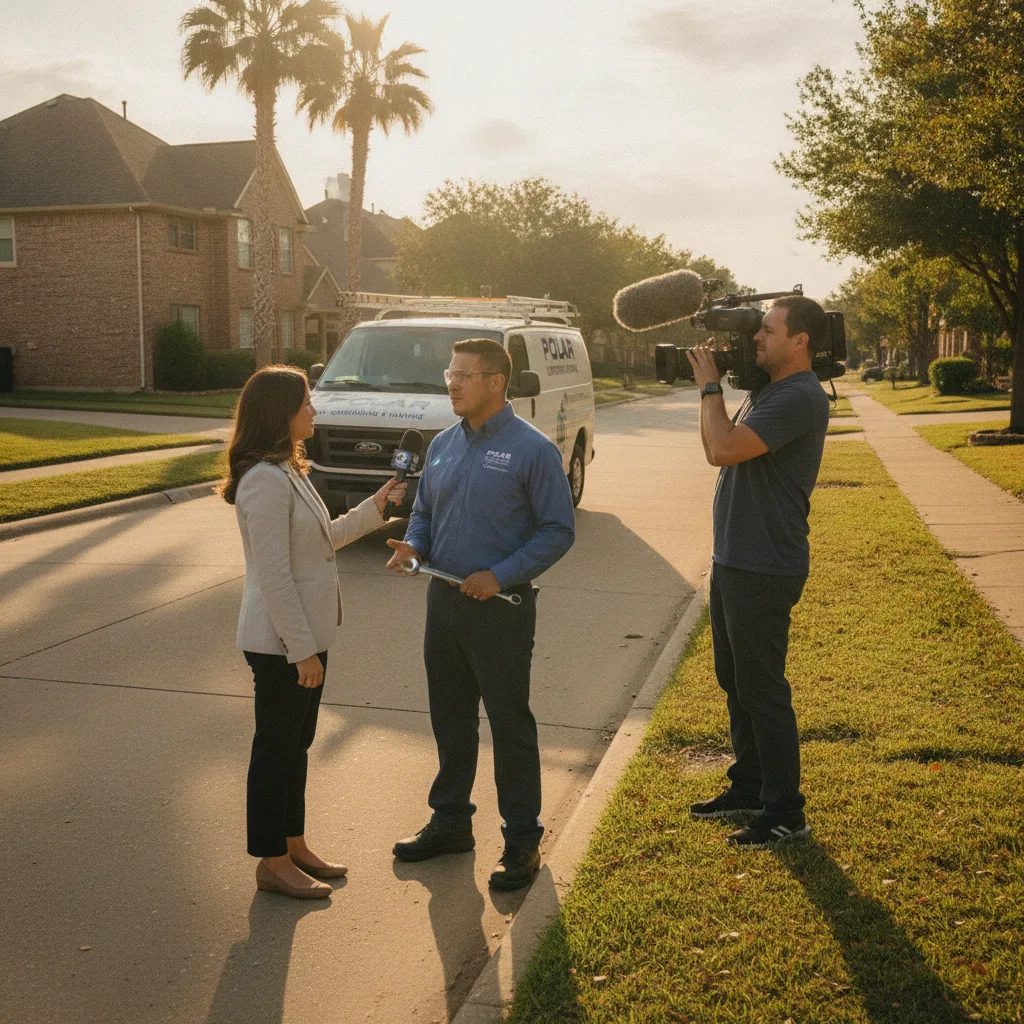
The journalist hook for home services is not complicated. A reporter covering a heat emergency in Austin needs an HVAC contractor to explain what homeowners should do when their AC fails at 105°F. A consumer protection story on unlicensed contractors needs a licensed plumber to explain what customers should check before hiring. A winter freeze preparedness piece needs a roofing or plumbing expert to explain pipe protection. These stories get written every year in every Texas metro. The contractor who makes themselves reachable as a named expert earns the kind of editorial mention that carries both brand authority and entity corroboration in AI search results — and those mentions appear on news sites that AI engines already cite frequently.
Content marketing on your own site amplifies the entity signals earned through external mentions. When your brand appears in a local news article about storm preparedness, that mention carries more weight if your own site has a matching topic cluster — blog posts, service pages, or FAQ content that uses the same category language. AI engines cross-reference a brand's owned content against third-party mentions to validate topical authority. A plumbing company whose site covers water heater emergencies in depth, and which also gets quoted in a news article about water heater recalls, is building a consistent entity story across multiple digital channels. Neither the site content nor the external mention is as strong alone as it is paired.
Review platforms are a channel most contractors already use but undervalue for entity building. Google reviews, Yelp, and Nextdoor recommendations are forms of user-generated content — each one is an independent brand mention that includes your business name in a local service context. The aggregate of hundreds of reviews mentioning 'best HVAC company in San Antonio' or 'fast plumber near me' creates the kind of distributed, sentiment-positive mention pattern AI systems weight heavily when deciding which local brands to surface. Reputation management — actively requesting reviews after every completed job and responding to both positive and negative mentions professionally — is a direct input to AI visibility, not just a customer service exercise.
Strategic brand mentions in industry publications and podcasts serve a different function than local news coverage. A mention in an HVAC trade publication positions your brand within a professional peer context that AI systems recognize when answering questions about contractor qualifications, industry standards, or regional expertise. Five to ten placements that include your business name and domain URL — across a mix of local news outlets, trade publications, and community platforms — materially improve citation eligibility according to 2026 research on Google AI Overviews source selection. The goal is not volume; it is a diverse set of non-affiliated sources all corroborating the same entity. That diversity is what builds brand credibility in the broader web of signals AI engines read.
Key takeaway
Brands in the top 25% for web mentions averaged 169 AI Overview mentions versus 14 for the next quartile — a gap that compounds non-linearly once a threshold of entity corroboration is crossed across multiple independent sources.
Chapter 4 · Mechanics
Entity Recognition and Competitive Positioning: Why Your Competitor at Position 15 Gets Cited Over You
AI search engines run an entity resolution pass before retrieving any content — they decide which businesses deserve to be named before they decide which pages to cite. That resolution depends on how clearly and consistently a brand is described across the broader web, not on where it ranks in classic search results. A home services company at organic position 15 can earn a Google AI Overview citation over a company at position 2 if its entity record is cleaner, more corroborated, and more consistently described across independent sources. This is the competitive positioning problem most contractors don't know they have.
Entity recognition is topic-level, not global. AI engines do not flag a brand once and apply that recognition everywhere — they recognize a brand for a specific subject area based on the pattern of mentions in that context. An HVAC company mentioned repeatedly in local news in relation to summer heat emergencies builds entity recognition for 'emergency AC repair Austin' specifically, not for HVAC services in general. This means competitive positioning in AI search requires deliberate mention strategy around specific service categories, not just generic brand awareness across social media platforms. The brand conversations that matter are the ones that tie your name to a service and a city.
Google's Knowledge Graph contains over 800 billion facts about 8 billion entities as of 2025, and AI search engines query that graph directly when deciding which brands to cite. Brands with structured data on their own sites and complete, accurate entries in publicly editable knowledge sources show higher entity recognition and increased inclusion in AI-generated answers. For most home services contractors, this means ensuring that the structured data on their website correctly names the business, its service categories, and its geographic coverage — the same information that should appear consistently across every citation and directory listing.
The AI citation gap between brands is not linear — it compounds. The same Ahrefs data that shows a 10x difference in AI Overview mentions between the top quartile and the next quartile also reveals that the gap widens as AI engines gain more corroborating evidence for well-mentioned brands. A brand that earns consistent mentions across multiple platforms — local news, review platforms, trade directories, social media — builds an entity chain that makes each new mention more valuable than the last. A brand that lets its name drift, describing itself differently on every platform and earning no trusted external mentions, stays a fuzzy cluster of keywords AI systems cannot confidently name regardless of its organic rankings.
Competitive benchmarking on AI visibility requires tracking a different set of metrics than classic SEO. A contractor in Austin should ask: does ChatGPT name my business when asked for the best HVAC company in Austin? Does Google AI Overviews include my brand in answers about AC tune-ups or emergency plumbing? Does Perplexity cite my site when answering home services questions in my metro? A June 2026 study found 61.7% of AI citations used a page as a source without the brand ever appearing in the answer text — meaning you can be cited without being named, and named without having the best ranking page. Both states require monitoring, and they require different responses. Cited but unnamed means your content is working but your entity clarity is not; unnamed and uncited means entity building is the priority.
Key takeaway
A May 2026 study of 153,425 AI citations found 76.95% of cited URLs came from outside the organic top-10 — confirming that entity recognition, not search rank, is the primary gate for AI search visibility.
Chapter 5 · Tools
Brand Monitoring: Google Alerts, Social Media Monitoring, and the Tools That Actually Cover AI Visibility
Knowing whether your brand mention strategy is working requires tracking mentions across the web, social media platforms, and AI search engines — three coverage areas that no single tool handles well on its own. Google Alerts is the starting point for most contractors, but it covers only the web index, misses social media entirely, and runs with a 24–48 hour lag. Building a monitoring stack that tells you what people are saying, where they're saying it, and whether AI engines are naming you requires a layered approach. Here is what that stack looks like for a home services company without an enterprise budget or dedicated communications teams.
Google Alerts is free and functional as a backup layer for news mentions, but it has real limitations as a primary brand monitoring tool. It does not track social media mentions — Facebook, Instagram, LinkedIn, Reddit, Nextdoor — which is where home services customers are most likely to discuss their contractor experiences outside of formal reviews. Set up Google Alerts for your exact business name, common misspellings, and your owner's name as a minimum. Use automated alerts to catch web index mentions while a dedicated social listening platform handles everything else.
Google Alerts
Web monitoring (free)
Covers the web index with a 24–48 hour lag. Useful as a backup layer for news article mentions; does not track social platforms at all.
Brand24
Social and web monitoring (from $149/month annual)
Adds social media monitoring across major platforms, sentiment analysis, mention volume tracking, and influence scores. The mid-market standard for contractors who want to centralize monitoring across web and social.
Awario
Social and web monitoring (from $29/month annual)
Lower-cost alternative to Brand24 with similar social coverage, real-time alerts, and competitor tracking. Good fit for contractors who want brand versus competitors reporting without enterprise pricing.
Whitespark
Citation audit and tracking
Finds citation inconsistencies across directories and tracks local search rankings. Pairs with a monitoring stack to close the gap between citation cleanup and ongoing brand mention tracking.
BrightLocal
Local SEO and citation management
Tracks local pack rankings, citation consistency, and review platform performance on a weekly cadence. Used by home services teams to monitor search engine rankings across multiple service cities.
Brand24 and Awario are the mid-market tools that fill the social monitoring gap Google Alerts leaves open. Both add social media monitoring across major platforms, sentiment analysis on mentions, and mention volume tracking over time — the key metrics a contractor needs to understand brand health and respond to negative mentions before they compound. Neither platform tracks AI search citations natively, which creates a third coverage gap that requires separate tools or manual prompting to close. That gap is real: as of late 2026, the dedicated AI monitoring tools available are built for enterprise organizations and are priced accordingly, which puts them out of reach for most home services contractors.
Monitoring AI visibility directly means querying ChatGPT, Perplexity, Gemini, and Google AI Overviews regularly with the prompts your customers actually use: 'best HVAC company in Austin,' 'emergency plumber near me,' 'licensed roofer San Antonio.' Track whether your brand appears, whether it is named in the answer text or only used as a background source, and how that changes month over month as your mention strategy builds. This manual process is time-consuming, but it is currently the most reliable way to assess AI search visibility for a local contractor. Set a calendar reminder and run these queries the same week each month using separate tools and fresh sessions.
Sentiment analysis from social media monitoring tools surfaces the distinction between positive and negative mentions that raw mention volume obscures. An HVAC company getting mentioned frequently on Nextdoor because of a service dispute is building brand awareness in entirely the wrong direction. AI systems analyze sentiment as part of their entity evaluation — a brand with high mention volume but net-negative sentiment does not earn the same citation eligibility as a brand with moderate volume and consistent positive context. Online reputation management and ongoing monitoring are the same workflow: catch negative mentions early, respond professionally, and work to convert complaints into resolved cases that become positive references. That is not just good customer service — it directly shapes brand perception in the signals AI engines read.
Key takeaway
Google Alerts covers web index mentions with a 24–48 hour lag but misses social media entirely — a complete brand monitoring stack requires at least one dedicated social listening platform and a separate manual process for tracking AI search citations.
Chapter 6 · Measurement
Measuring What's Working: Key Metrics, Consumer Intelligence, and Building for Multiple Markets
Brand mention strategy produces results that show up in several places at once: AI search citation rates, local pack rankings, branded search volume, and direct referral traffic from editorial placements. Tracking all of them is essential because the relationship between mention activity and downstream ranking improvement is not always direct or immediate. A roofer who earns ten editorial mentions in local news articles over six months may not see Google AI Overview inclusion for another three months — the entity recognition process has a lag, and measuring too early produces false negatives. Here is how to read the signals correctly, in the order they tend to arrive.
The key metrics for a home services brand mention strategy fall into three tiers. The first tier is mention volume and sentiment: total web mentions per month, social media mentions per month, the ratio of positive to negative mentions, and mention velocity (are counts growing or flat?). These are the leading indicators that show whether your digital PR and content marketing activity is producing external references at all. Brand24 or Awario reports can generate these automatically on a weekly cadence — most contractors find a monthly review sufficient unless they are in an active PR campaign.
The second tier is search impact: local pack ranking position for your top five service-plus-city keyword combinations, branded search volume in Google Search Console (are more people searching your business name directly?), and organic lead volume from your website. These are the lagging indicators that confirm whether mention activity is translating into search visibility and qualified leads. A plumber running three trucks who adds consistent NAP corrections, earns four local news mentions, and builds out trade directory listings should see local pack movement within 90 days and AI citation improvement within six months. That is the realistic timeline — not three weeks.
The third tier is competitive positioning: how does your AI search visibility compare with the two or three competitors you actually lose jobs to? Manual AI prompting across ChatGPT, Perplexity, and Google AI Overviews for your highest-value service categories — 'HVAC repair Austin,' 'emergency plumber Houston,' 'licensed roofer San Antonio' — tells you whether you are being named, cited without being named, or absent entirely. Absent means entity building is the priority. Cited but not named means content and structured data alignment is the gap. Named sometimes means mention volume and consistency need to increase. Competitive benchmarking against specific rivals in your metro is the market intelligence that tells you which tier to invest in next.
For contractors operating across multiple markets — an HVAC company serving both Austin and San Antonio, or a plumbing company expanding from Houston into Dallas — entity building must be done at the city level, not just the brand level. AI engines recognize brands for specific service-plus-geography combinations. A mention of your business in an Austin Business Journal story about summer heat preparedness builds entity recognition for Austin specifically. It does not transfer automatically to your San Antonio service area. Building AI visibility across multiple markets means earning independent mention chains in each city: local news outlets, local directories, local review platforms, and local trade associations, all with consistent NAP and consistent category language tied to that specific geography. Each city is a separate entity-building project, and treating them as one is a common and costly mistake.
Key takeaway
Branded search volume growth in Google Search Console is the clearest early signal that a brand mention strategy is working — it rises before local pack improvement and AI citation inclusion become measurable, often within weeks of an active digital PR push.
Mini-glossary — terms you'll see throughout this guide
Brand Mention
Any reference to a business name across the web — in a news article, review, forum post, social media update, or directory listing — whether or not the reference includes a hyperlink back to the business's website.
Entity Recognition
The process by which AI search engines resolve a cluster of web references into a single, named business or organization they can confidently cite in generated answers. Entity recognition is topic-level and geography-level, not global.
NAP Consistency
The practice of keeping a business's Name, Address, and Phone number formatted identically across every directory, platform, and citation. Even minor variations — punctuation differences, suite number formats — create conflicting entity signals that reduce local pack visibility and AI citation eligibility.
Unlinked Brand Mention
A reference to a business name that does not include a hyperlink. Unlinked mentions do not pass traditional PageRank link equity, but they correlate strongly with AI search visibility by contributing to the cross-platform entity corroboration pattern AI engines rely on.
Local Citation
A structured listing of a business's NAP data on a directory, map platform, or industry database. Citations carry roughly 7% of direct local pack ranking weight and indirectly support Google Business Profile signals, which account for 32% of local ranking weight.
Digital PR
The practice of earning editorial coverage — interviews, expert quotes, and business features — on news sites, trade publications, and regional journals. For home services contractors, digital PR is the highest-leverage tactic for building the kind of independent, authoritative brand mentions AI engines trust.
Google AI Overviews
AI-generated answer summaries that appear above organic search results on Google. AI Overviews cite an average of 15 sources per result and select brands based on entity recognition and cross-platform mention patterns, not exclusively on organic search ranking.
Sentiment Analysis
The automated classification of brand mentions as positive, neutral, or negative based on surrounding language. AI search systems incorporate sentiment signals when evaluating entity trust — high mention volume paired with net-negative sentiment reduces citation eligibility.
Social Media Monitoring
The ongoing tracking of brand mentions across social platforms — Facebook, Instagram, Reddit, Nextdoor, LinkedIn, and others. Social media monitoring requires dedicated tools like Brand24 or Awario because Google Alerts does not index social platform content.
Topical Authority
The degree to which a brand is recognized by AI and search engines as a credible source on a specific subject area. For home services contractors, topical authority is built by earning consistent mentions in the context of specific service categories paired with specific geographic markets.
Knowledge Graph
Google's structured database of entities — businesses, people, places, and concepts — containing over 800 billion facts about 8 billion entities as of 2025. AI search engines query the Knowledge Graph directly when deciding which brands to cite, making accurate entity records a prerequisite for AI visibility.
Branded Search Volume
The number of searches per month that include a specific business name as a keyword. Rising branded search volume in Google Search Console is an early indicator that a brand mention strategy is building awareness and entity recognition before local pack or AI citation improvements become measurable.
The Trap: Ranking #1 While Getting Skipped by AI
Organic search rank and AI search citation are no longer the same thing. A plumber or HVAC company can hold the top organic position for every target keyword in their market and still be absent from every Google AI Overview, ChatGPT answer, and Perplexity response about their service category. That is not a hypothetical — 76.95% of AI citations in a May 2026 study came from outside the organic top-10. If your brand mention strategy consists entirely of on-page SEO and paid ads with no external citation-building, no digital PR, and no NAP cleanup, you are optimizing for a visibility channel that now coexists with a second, separate channel you have not touched. The fix is not complicated, but it does require off-site work: consistent citations, editorial mentions, review platform presence, and a monitoring stack that tells you whether AI engines are actually naming your business when customers ask.
The home services companies that show up in AI Overviews in 2027 are building their entity footprint right now. That means consistent NAP across every directory and manufacturer dealer locator page, editorial mentions in local news, active reputation management on review platforms, and a monitoring stack that tells you month over month whether AI engines are naming your brand or skipping it. Brand mentions SEO is not a vanity project — it is infrastructure. The contractors who treat it that way, and do the off-site work consistently, are the ones who will show up when a homeowner asks ChatGPT for the best HVAC company in their city. If you want to know exactly where your brand stands in AI search right now and what it would take to close the gap, start with a free strategy session with Geek Powered Studios.
A brand mention is any reference to your business name across the web — in a news article, a review, a Reddit thread, a directory listing, a Nextdoor recommendation, or a social media post — whether or not it includes a hyperlink back to your site. Linked mentions pass traditional link equity through PageRank. Unlinked mentions do not affect PageRank directly, but they contribute to entity recognition, which is what AI search engines use to decide which brands to name in generated answers. For home services contractors, the most valuable brand mentions are those that pair your business name with service-specific language — "licensed HVAC company," "emergency plumber," "certified roofer" — in a local geographic context, because that combination tells AI systems exactly what your brand does and where it operates.
Who benefits most from a brand mention strategy?
Home services contractors doing $2M–$5M in annual revenue who already have basic on-page SEO in place but are absent from AI search results benefit most. If you rank on page one for your top keywords but ChatGPT, Perplexity, and Google AI Overviews never name your business, the gap is almost always off-site entity building — not on-page content. Brand mention strategy is also the right priority for contractors expanding into a new city or service area, because AI engines recognize brands at the city-service level and the new market requires its own independent mention chain. Contractors with badly inconsistent NAP data across directories — common after rebrands, phone number changes, or office moves — also see fast returns from citation cleanup before any new mention-building begins.
Where should a home services contractor start with brand mentions SEO?
Start with a NAP audit. Search your exact business name in quotes across Google, Yelp, Angi, BBB, HomeAdvisor, Houzz, and Nextdoor, and note every variation in how your name, address, or phone number is formatted. Standardize everything to match your Google Business Profile exactly. Then claim and complete your trade association directory listing — ACCA for HVAC, PHCC for plumbing, NRCA for roofing — because these are the sources AI systems recognize as authoritative within specific trade categories. After the citation layer is clean, the next step is digital PR: identify two or three story hooks relevant to your service category and pitch yourself as a local expert to a reporter at your city's newspaper or business journal. That sequence — NAP cleanup, trade directories, then editorial mentions — produces the fastest measurable return on entity building.
What are the most common mistakes contractors make with brand mentions?
The biggest mistake is treating brand mentions as a vanity metric and doing nothing systematic about them. The second-most-common mistake is chasing mention volume without attention to context or sentiment — a flood of Nextdoor complaints about your company builds brand awareness in entirely the wrong direction, and AI systems factor sentiment into entity trust. A third mistake is building citations on low-authority directories while ignoring manufacturer dealer locator pages (Daikin, Carrier, Lennox, Trane for HVAC) and trade association directories, which carry category-specific entity signals that generic directories cannot replicate. Finally, most contractors monitor for brand mentions using only Google Alerts, which covers just the web index, misses all social media platforms, and runs with a 24–48 hour lag — meaning negative mentions on Facebook or Nextdoor can compound for days before you see them.
What should contractors skip or deprioritize in a brand mention strategy?
Skip bulk citation submission services that spray your NAP across hundreds of low-authority directories at once. As of 2026, Whitespark research confirms that low-authority citations have been further discounted while NAP consistency across the top 25 authoritative sources matters more than raw citation count. Also skip the temptation to chase national press coverage before your local entity foundation is solid — a mention in a national trade publication is valuable, but not if your Google Business Profile, BBB listing, and Angi profile still disagree on your phone number. Social media follower growth strategies are out of scope for brand mention SEO specifically; the goal is cross-platform corroboration from independent sources, not audience size on a single platform.
How do I measure whether my brand mention strategy is actually working?
Track three tiers of metrics. The leading indicators are mention volume and sentiment: total web mentions per month via Brand24 or Awario, social media mentions across major platforms, and the ratio of positive to negative mentions. The lagging indicators are search impact: local pack ranking for your top service-plus-city keywords, branded search volume in Google Search Console (a rising count means more people are searching your business name directly, which precedes AI citation improvement by weeks to months), and organic lead volume. The third tier is competitive positioning: manually query ChatGPT, Perplexity, Gemini, and Google AI Overviews for your highest-value service categories each month and note whether your brand appears, is named in the answer text, or is absent entirely. Each state requires a different response.
Do unlinked brand mentions directly improve Google rankings?
Google's John Mueller has stated that unlinked mentions are not used for PageRank or the link graph. However, they correlate strongly with AI search visibility — an Ahrefs study of 75,000 brands found unlinked web mentions correlate with Google AI Overview visibility at 0.664 versus 0.218 for traditional backlinks. The practical implication for contractors: unlinked mentions won't move classic organic rankings the way a backlink from a high-authority site would, but they are the strongest measurable predictor of whether AI engines cite your brand. As of 2026, an Editorial.link survey found 80.9% of SEO practitioners believe unlinked brand mentions materially affect rankings, driven largely by their observed impact on AI visibility rather than traditional PageRank.
How long does it take to see results from brand mention strategy?
NAP cleanup and citation corrections typically produce local pack ranking improvements within 90 days, based on research across multiple local SEO sources showing an average 17% improvement in that window. Branded search volume in Google Search Console is usually the first measurable signal — it starts rising within weeks of an active digital PR push as more people search your business name after seeing it mentioned. AI citation inclusion takes longer: a contractor who earns consistent editorial mentions and completes trade directory listings should expect AI Overview visibility improvements within three to six months. The entity recognition process has a lag because AI engines need to find a cross-platform pattern of independent corroboration before confidence in a brand rises enough to cite it in generated answers.
Brand Mentions SEO for Home Services Businesses in 2026: The Complete Guide
Senior Digital Marketing Strategist at Geek Powered Studios
Google Ads Certified, Google Analytics Certified, 15+ years in digital marketing, Home Services SEO Specialist
Chris Johnson leads digital marketing strategy at Geek Powered Studios, where he has helped hundreds of home services contractors across Texas grow their businesses through SEO, paid media, and AI-powered lead automation. He specializes in translating complex search-engine changes into practical playbooks that actually move the needle for plumbers, roofers, HVAC, and electrical contractors.