
SMS is faster — 90% of texts are read within 3 minutes, with an average response time of 90 seconds (versus 90 minutes for email). That makes it the right channel for appointment reminders, on-the-way notifications, quote follow-ups, and post-job review requests. Email wins on ROI depth: Litmus 2025 data puts email marketing returns at $36–$42 per $1 spent in home services, making it the right channel for seasonal promotions, annual electrical inspection reminders, EV charger installation campaigns, and electrical safety tips to segmented past customer lists. The mistake most electrical contractors make is using whichever channel they set up first for everything. This playbook fixes that by assigning each channel to the jobs it actually wins.
-
SMS for speed, email for depthThe core channel rule that shapes every automation decision
-
3-touch reminder sequenceBooking confirmation, 48-hour reminder, same-day text
-
42% review response rateWhen review request SMS fires within 2 hours of job completion
-
Day 1 SMS, Day 3 SMS, Day 4 emailThe quote follow-up sequence for panel upgrades and EV charger installs
-
Segment by service history, not list sizeActual job history converts better than a full-list blast
-
$500–$1,500 per messageTCPA fine per unsolicited marketing text — document every opt-in
SMS and email aren't competing channels for electrical contractors — they play different positions. SMS is the fastest marketing channel available: 90% of texts are read within 3 minutes, with an average response time of 90 seconds (SMS Marketing Statistics 2026, alive5.com). Email's average response time is 90 minutes, but it returns $36–$42 for every $1 spent in home services (Litmus, 2025 State of Email) — the highest ROI of any digital marketing channel. The mistake most electrical contractors make is using whichever channel they set up first for everything. This playbook walks through six steps to build a coordinated system that cuts no-shows, recovers more quotes, generates Google reviews automatically, and re-engages past customers — without hiring a marketing team. Setup takes 3–5 hours; ongoing management runs 30–60 minutes per month.
Before you start
- Active CRM or field service platform — Jobber, Housecall Pro, or GoHighLevel — with your customer list imported and job history intact
- Google Business Profile claimed and verified so automated review requests have a working destination link
- A documented list of your core electrical services and typical job types (panel upgrades, EV charger installations, inspections) for list segmentation
- A business phone number registered for 10DLC SMS compliance — required by carriers as of 2026 or your messages may be filtered as spam
- Written opt-in consent language ready for your website booking form, technician workflow, and any in-person sign-off process — required before any promotional SMS goes out
- A rough sense of your current no-show rate and average job value so you can calculate whether the platform cost pays for itself on avoided no-shows alone
Understand Which Channel Wins on Speed vs. ROI — and Why It Changes Everything
SMS owns anything time-sensitive; email owns everything that benefits from depth. The 98% open rate on text messages versus 20–30% for email isn't a reason to drop email — it's a reason to stop using the two marketing channels interchangeably. Send a 'your tech is 20 minutes out' notice via email and you'll lose the job before the message gets opened. Send a panel upgrade promotion via SMS to 800 past customers and you'll burn through opt-outs before you book a single job.
The practical split for electrical contractors: SMS handles appointment reminders, on-the-way notifications, quote follow-ups, emergency service alerts, and post-job review requests. Email handles seasonal promotions, annual electrical inspection reminders, electrical safety tips for older homes, EV charger installation campaigns to segmented lists, and anything that benefits from before-and-after photos or a longer sales cycle. Those two lists cover almost every customer communication an electrical business sends.
Most electrical contractors default to whichever channel they set up first. The ones consistently filling their schedule with high-value panel upgrades and EV charger installations run a coordinated sequence: SMS fires first because speed wins the response, email follows because depth wins the relationship. That's the system this playbook builds.
Quick Reference
Use SMS when speed is the job: reminders, quote follow-ups, review requests, dispatch updates. Use email when depth is the job: seasonal promotions, inspection reminders, EV charger campaigns, electrical safety tips to segmented customer lists.
Set Up SMS and Email Appointment Reminders to Cut No-Shows
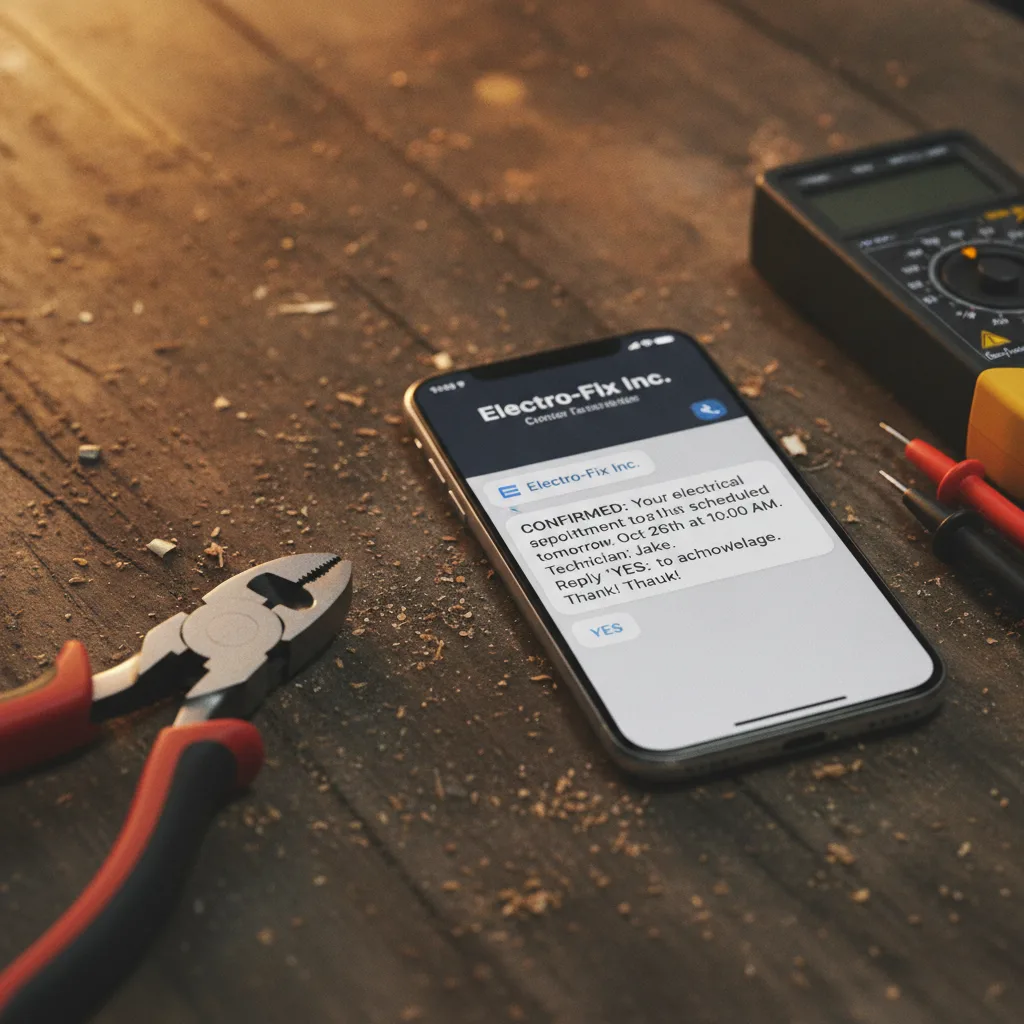
Automated SMS appointment reminders reduce no-shows by 29–50% for home service businesses. Without them, electrical contractors typically see no-show rates of 8–14%. A three-touch reminder sequence — booking confirmation immediately after scheduling, a 48-hour reminder, and a same-day text — brings that rate below 5% for electrical businesses that deploy it correctly. On a panel upgrade or EV charger installation booked at $3,000–$8,000, one avoided no-show covers the cost of an SMS platform for months.
The sequence: Text 1 goes at booking confirmation ('Hi [Name], your panel inspection with [Company] is confirmed for Thursday at 2 PM — reply STOP to opt out'). Text 2 goes 48 hours before ('Reminder: your appointment is Thursday at 2 PM. Reply YES to confirm or call us to reschedule'). Text 3 goes the morning of ('Your tech is on schedule for today at 2 PM — we will text when they are 30 minutes out'). Each message must identify your business by name, include opt-out instructions, and stay within TCPA quiet hours: 8 AM–9 PM in the recipient's time zone.
Transactional texts like appointment confirmations and job status updates operate under less strict TCPA requirements than promotional SMS — but they still require that the customer provided their number for the purpose of receiving communications from you. Build the consent capture into your booking flow, not as an afterthought. In Housecall Pro and Jobber, the reminder sequence is configured natively. In GoHighLevel, it's a workflow with triggers tied to job status changes in your connected field service platform.
Housecall Pro
$65–$169/mo
Built-in SMS appointment reminders with two-way texting; no separate platform needed for electrical contractors running 1–5 trucks.
Jobber
$49–$249/mo
Field service management with automated client reminders via SMS and email; native GoHighLevel integration added September 2025.
GoHighLevel
$97–$297/mo
Full CRM plus SMS, email, and reputation management in one platform; standard stack for agency-managed electrical businesses.
Watch Out
Register your business phone number for 10DLC (10-digit long code) SMS through your platform before sending any reminders. Unregistered numbers are increasingly filtered by carriers as of 2026 — messages land in spam or get blocked entirely, with no error notification to your team.
Automate Post-Job Review Requests to Build Google Reviews at Scale
An automated review request SMS sent within 2 hours of job completion achieves a 42% response rate for home service businesses. That number drops sharply the longer you wait — most electrical contractors who send manual review requests do so days later, if at all, which is why 67% of home service business owners report consistent review collection as their biggest challenge. The fix is a trigger, not a habit: set the workflow once and let job completion fire it automatically.
In GoHighLevel or Podium, configure a workflow that fires the moment a job is marked complete in Jobber or Housecall Pro. The text goes: 'Thanks for letting [Company] take care of your panel upgrade today, [Name]. If we did a good job, a quick Google review means a lot to us: [direct Google review link]. Reply STOP to opt out.' That direct Google review link — not a link to your website, not a Yelp page — is what drives action. As of 2026, 97% of consumers read online reviews before choosing a local home service business (BrightLocal, February 2026, n=1,002 US adults), and 47% won't hire a business with fewer than 20 reviews. Automated review requests that link straight to your Google Business Profile are a lead generation strategy, not just reputation management.
Post-service follow-up email sequences also outperform general marketing email by a wide margin — 45–65% open rates when sent within 24–48 hours of job completion, compared to 20–30% for standard email campaigns. Use this window for a short thank-you email that includes before-and-after photos of the completed job, a referral ask, and a soft prompt to book their annual electrical inspection. The SMS gets the Google review. The email builds the customer relationship and sets up repeat business.
Podium
$299–$599/mo
Review request automation with direct Google Business Profile links; strong two-way texting and reputation management for electrical contractors.
GoHighLevel
$97–$297/mo
Trigger-based workflows that fire review request SMS the moment a job status changes in connected field service software.
Pro Tip
Put the Google review link in the first SMS, not behind a landing page. Every extra click cuts response rate. Use a shortened URL that goes directly to your Google Business Profile review form — not to your website's testimonials page.
Build Quote Follow-Up Sequences for Panel Upgrades and EV Charger Installations
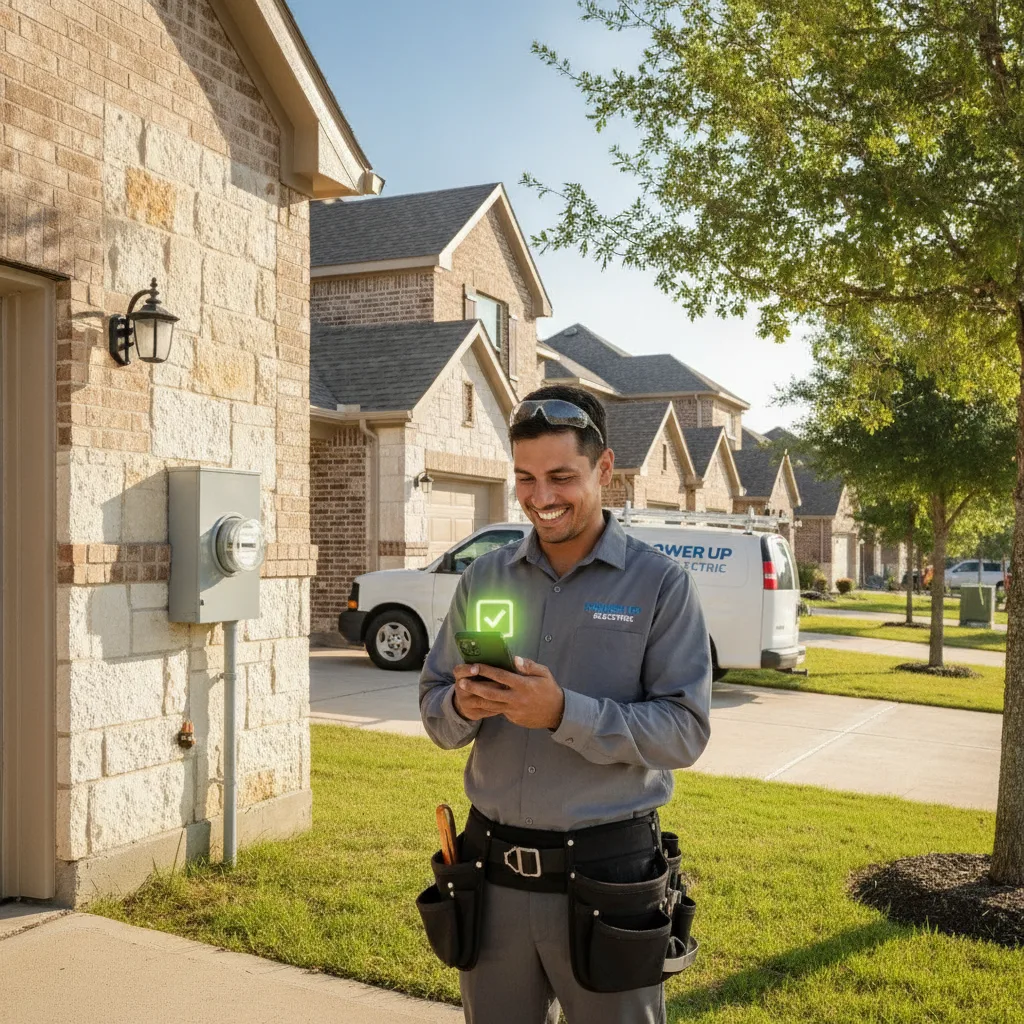
Most electrical contractors send one follow-up after a quote and give up. The electricians filling their schedule with high-value panel upgrade and EV charger installation jobs run a multi-touch sequence: Day 1 SMS immediately after quote delivery, Day 3 SMS if no response, Day 4 follow-up email. The SMS response rate for quote follow-ups is 45% versus 6% for email — which makes the first touch via text non-negotiable on jobs where the quote sits at $3,000–$8,000 and customers are comparing multiple electrical companies.
A Day 1 text: 'Hi [Name], this is [Tech] from [Company]. I sent over your quote for the panel upgrade — just wanted to make sure you got it. Any questions? Reply or call [number].' Short, personal, no pressure. Day 3: 'Hey [Name] — checking back on your panel upgrade quote. We have an opening next week if you would like to get it on the schedule.' Day 4 email: subject line 'Your panel upgrade quote — a few things worth knowing,' body covers what is included, why the upgrade matters for older homes, a link to your Google reviews, and a clear call to action to book. That email can include before-and-after photos from completed jobs and a financing option if you offer one. This multi-touch approach captures jobs that go to whoever follows up most persistently — and most electrical contractors do not follow up at all.
EV charger installation quotes follow the same structure but with a tighter window — customers comparing quotes often decide within 48 hours as EV adoption accelerates. Run the Day 1 SMS / Day 3 SMS / Day 4 email sequence, and segment those contacts in your CRM by quote type. Past customers who had a panel inspection are your warmest audience for a future EV charger installation campaign — their actual job history tells you they have the panel capacity and the interest.
Watch Out
Quote follow-up texts are transactional — responding to an expressed inquiry — which means they do not require a separate marketing opt-in under TCPA while the conversation is active. After 30 days with no response, treat the contact as a cold marketing list and get written consent before texting again.
Run Segmented Email Campaigns for Seasonal Promotions and Customer Retention
Email wins when you have something worth reading, not a quick action item. Seasonal promotions, annual electrical inspection reminders, electrical safety tips for residential customers in older homes, and EV charger installation campaigns all belong in email, not SMS. The 80/20 rule applies here: about 80% of your email marketing revenue will come from your past customer list, not new leads. A segmented campaign to past customers — split by service history — will out-convert a blast to your full list every time, because relevant messages match what the customer already knows they need.
Segment by what your customers have actually had done. Contacts who had a panel inspection are prime targets for a panel upgrade campaign. Contacts in older homes flagged during the service call are candidates for electrical safety tip sequences and rewiring outreach. Contacts who requested an EV charger quote but did not book go into a drip campaign that covers installation timelines, rebate eligibility, and before-and-after photos from completed residential electrical jobs. This actual job history-based segmentation converts better than blasting the entire customer list because the email campaigns match what the customer already knows they need. Contact management by service history — not just by list size — is what separates electrical companies generating repeat business from those chasing new customers every month.
For seasonal promotions, the best windows for electrical contractors are pre-summer (outdoor outlet and lighting campaigns in April–May), late fall (whole-home safety checks before the holidays in October–November), and January (panel inspections and generator service when budgets reset). Send 2–4 email campaigns per month maximum. Every promotional email must include a clear call to action, your business name in the sender field, and an unsubscribe option — both for legal compliance and to keep your list clean and engaged.
GoHighLevel
$97–$297/mo
Email campaigns, drip sequences, and CRM segmentation by job history in one platform — ideal for agency-managed electrical businesses.
Mailchimp
Free–$135/mo
Straightforward email campaigns with list segmentation; works well for smaller electrical operations that want email-only without full CRM complexity.
Housecall Pro
$65–$169/mo
Built-in email marketing tied directly to job history — no data export required to segment past customers by electrical service type.
Heads Up
Sending the same seasonal promotion to your entire customer list without segmentation is the fastest way to drive up unsubscribe rates. Even a basic split — contacts who have had electrical work done in the last 12 months versus contacts inactive for more than a year — will improve open rates and reduce opt-outs on every campaign you send.
Stay Compliant with TCPA Rules and Register Your Tool Stack
The Telephone Consumer Protection Act (TCPA) requires prior express written consent before sending automated marketing texts. A customer who gave their phone number during a service call did not automatically consent to promotional SMS — that's a separate documented opt-in. TCPA violations carry fines of $500–$1,500 per message with no cap on class size for class-action suits. Most electrical contractors skip this step entirely because it feels bureaucratic, which is exactly why it's worth taking seriously before you launch any promotional campaigns.
The FCC's One-to-One Consent Rule, in effect as of 2026, means lead aggregators like Angi or HomeAdvisor can no longer bundle SMS consent for multiple contractors. You must collect your own opt-in directly — at the point of booking via a checkbox on your website form, on-site via a tablet sign-off during the estimate, or via a text-based opt-in keyword. Every marketing text must identify your business by name, include opt-out instructions ('Reply STOP to unsubscribe'), and honor opt-outs within 10 business days. TCPA quiet hours under federal rules are 8 AM–9 PM in the recipient's time zone. Transactional texts — appointment confirmations, job status updates, on-the-way notifications — have different, less strict legal requirements, but still require that the customer provided their number for receiving communications from you.
For tool stack decisions: electrical contractors running 1–3 trucks without agency support should start with Housecall Pro or Jobber, which include basic built-in SMS and email at lower cost and complexity. Small electrical businesses running 4 or more trucks, or operations working with a marketing agency, typically graduate to GoHighLevel ($97–$297 per month), which handles email, SMS, reputation management, and CRM in one platform. Register your 10DLC number through your chosen platform before sending any messages — this is a carrier requirement as of 2026 that directly affects whether your texts reach customers on their mobile devices or get filtered before delivery.
Legal Reminder
Keep records of every opt-in: the date, method (web form, text keyword, in-person sign-off), and the exact consent language shown to the customer. If a TCPA complaint is filed, that documentation is your defense. Store it in your CRM so it's tied to the contact record, not in a separate spreadsheet that gets lost.

Don't Let Your Customer List Sit Unused
Your past customer list is your highest-ROI marketing asset — and most electrical contractors never touch it between jobs. Every contact who had a panel inspection, an EV charger quote, or a whole-home safety check is a warm lead for your next campaign. If your customer data is sitting in Jobber or Housecall Pro with zero automations attached to it, you are leaving repeat business and referrals on the table month after month. The system described in this guide does not require a marketing team. It requires one afternoon of setup and the right platform firing the right message at the right moment.
The electrical contractors who consistently fill their schedules with high-value jobs — panel upgrades, EV charger installations, generator service — are not spending more on Google Ads. They are communicating more systematically with the customers they already have. When SMS and email marketing are part of a larger digital marketing system — one that connects your Google Ads, local SEO, Google Local Services Ads, and Google Business Profile into a predictable lead flow — the whole thing compounds. SMS and email working alone recover lost quotes and collect reviews. SMS and email working inside a full system turn completed jobs into the next booked appointment, build local search visibility through review volume, and reduce your reliance on paid advertising over time. If your customer communication is still happening manually or not at all, that is the first thing to fix. Everything else in your digital marketing strategy builds on top of it.
Frequently Asked Questions
Ready to get started? Contact Geek Powered Studios today.