
Generic healthcare agencies get cosmetic surgery PPC wrong because they benchmark plastic surgery against lower-cost specialties, build one campaign for all procedures, skip procedure-specific landing pages, ignore Google's category-specific compliance rules, and use 30-day attribution windows on a patient journey that runs 6–18 months. The result: wasted ad spend, disapproved ads that look active, and CPL reports that obscure a true patient acquisition cost closer to $769 per surgical patient. Fixing these errors requires procedure-level campaign architecture, aggressive negative keyword management, dedicated landing pages, LegitScript certification review, corrected attribution settings, and a multi-channel paid search approach that includes Microsoft Advertising and Local Service Ads.
-
$769 per surgical patientTrue patient acquisition cost after funnel math — not CPL
-
One campaign for all proceduresThe structure error that kills consultation volume fastest
-
19.4% vs. 6.2%Procedure landing page vs. general page conversion rate gap
-
Build the negative keyword list firstRecovers 15–30% of wasted ad spend before anything else
-
Compliance check before first dollar spentSilent disapprovals drain budget with no email alert
-
90-day attribution window minimumDefault 30-day windows miss most of the patient journey
-
Microsoft Advertising cuts CPCs 30–50%The secondary channel most generalist agencies never test
Cosmetic surgery PPC is one of the fastest growing and most expensive paid search categories in healthcare — and it punishes generic campaign management more severely than almost any other medical specialty. At an average of $102.51 per lead (LocaliQ, tracking 3,542 US campaigns from October 2024 through September 2025), plastic surgery ranks third-highest of 16 healthcare subcategories for cost per lead. But that number doesn't tell plastic surgery practice owners what they actually need to know. Work the funnel forward and the real patient acquisition cost climbs to roughly $769 per surgical patient — a figure that most generic healthcare agencies never show their clients. This seven-step audit walks through each structural and strategic failure mode that separates profitable cosmetic surgery PPC from campaigns that look active on paper while silently draining your monthly ad budget. The remediation window is 2–4 weeks for most misconfigured accounts.
Before you start
- An active Google Ads account running paid search for a plastic surgery practice
- Access to your Google Ads search term reports and campaign structure
- Google Analytics 4 property linked to your ads account with conversion tracking active
- A working knowledge of your practice's lead-to-consult and consult-to-booked-surgery rates
- Clarity on which cosmetic procedures generate the most revenue per patient
- A list of the ad policies your current agency told you apply to your campaigns
Run the Real Patient Acquisition Cost Math Before You Judge Any Campaign
Plastic surgery PPC averages $102.51 per lead at a $5.75 CPC and 8.52% conversion rate — the third-highest cost per lead across 16 healthcare subcategories tracked by LocaliQ. That figure sounds like the whole story. It isn't. It's the starting line for the real patient acquisition cost calculation that most generic healthcare agencies skip entirely.
Work the funnel forward and the actual number emerges. At a 40% lead-to-consult booking rate, a practice pays roughly $256 per booked consultation. At a 1-in-3 consult-to-surgery conversion, patient acquisition cost climbs to approximately $769 per surgical patient. A generic healthcare PPC agency that reports '$102 CPL — well within healthcare norms!' without walking you through that chain is reporting a vanity metric, not a business metric. The CPL benchmark is useful for setting expectations on a single procedure campaign; the full funnel math is what determines whether your cosmetic surgery PPC spend generates positive ROI.
The comparison to dermatology illustrates exactly why plastic surgery PPC demands vertical expertise. Dermatology averages $18.54 per lead. The CPC gap between the two specialties is only $0.85. The CPL gap is $84 — and that gap is almost entirely driven by what happens after the click, not before it. Dermatology converts roughly 1-in-4 clicks to a lead; plastic surgery converts fewer than 1-in-11. Generic healthcare agencies that benchmark plastic surgery patient acquisition cost against other specialties will consistently set false budget expectations from day one. Before evaluating any campaign metric your agency shows you, plug your own consult booking rate and surgery conversion rate into this chain.
Google Ads
Free (ad spend separate)
Primary paid search platform for high-intent cosmetic surgery queries; campaign structure and bidding settings live here
Google Analytics 4
Free
Tracks the full funnel from click to form submission and phone call; attribution window settings determine whether your PPC campaigns look profitable or not
CPL Benchmarks Change — Attribution Windows Don't
The LocaliQ 2026 benchmark shows plastic surgery CPL fell 29% year-over-year. That's a market-wide shift worth noting, but your practice's real number depends on your consult booking rate and surgery conversion rate — not the industry average. Plug your own rates into the chain before deciding whether your current paid search spend is working.
Audit Your Campaign Architecture: Separate Procedure Campaigns or One 'Surgery' Bucket
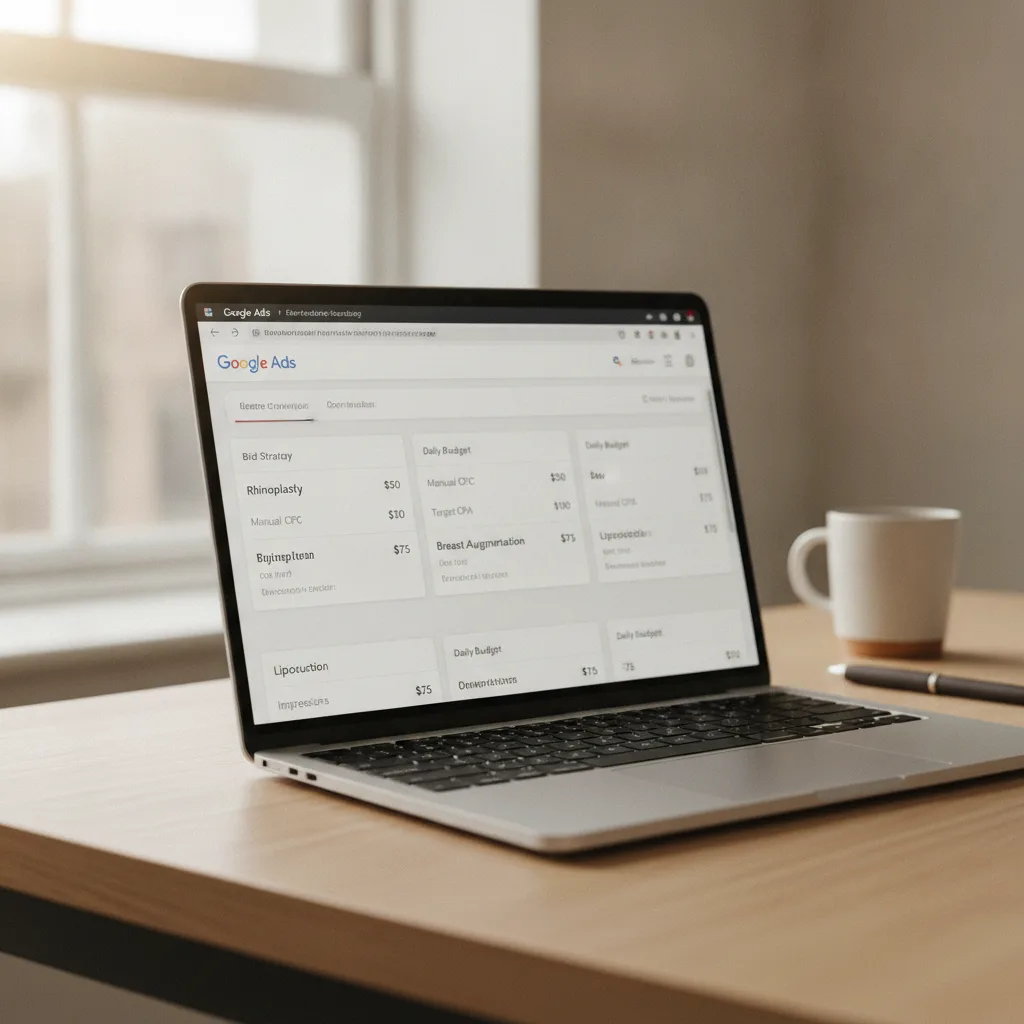
The most common and costly structure mistake in plastic surgery PPC is running one campaign with all procedures lumped into a single ad group. A rhinoplasty ad group and a breast augmentation ad group behave entirely differently: different search intent, different CPCs, different conversion rates, different patient demographics, and different seasonal demand curves. Generic agencies that build one 'surgery' campaign with 40 keywords and three generic ads produce high spend and low consultation volume — because the account cannot optimize what it cannot distinguish. Separate campaigns are not optional at these CPCs. They're the structural minimum for a solid PPC strategy.
In standard US markets, plastic surgery keywords run $8–$25 per click. In major metros like Miami and Dallas, CPCs reach $55–$85. At that price, sending a breast augmentation searcher to a landing page built for rhinoplasty isn't a minor inefficiency — it's a $55 error repeated hundreds of times a month. Procedure-specific campaigns with separate ad groups, dedicated ad copy, and matched landing pages are the structural baseline for profitable cosmetic surgery PPC campaigns. Most plastic surgery practices need at least five to eight separate campaigns to cover their core procedure mix correctly.
To audit your own account: pull your campaign list and count how many distinct procedures have their own campaign or ad group. If rhinoplasty, breast augmentation, liposuction, facelift, blepharoplasty, body contouring, and mommy makeovers are all sharing the same campaign budget and bidding strategy, that's the structure error to fix first. Each procedure needs its own ad group at minimum, its own ad copy that speaks to that procedure's specific patient intent, and its own landing page. Competitive research on what search terms are converting in your market should inform the keyword list for each individual procedure campaign.
Bidding Strategy Matters by Procedure
Manual CPC bidding gives you control during the first 60–90 days when the account has limited conversion history. Once a procedure campaign reaches 30+ conversions per month, switching to Target CPA bidding lets the Google algorithm optimize toward your cost-per-consultation goal. Generic agencies that apply one bidding strategy across all procedures lose efficiency in both directions: overpaying on competitive procedures and underbidding on high-converting ones.
Build Procedure-Specific Landing Pages That Convert Paid Search Traffic
Procedure-specific landing pages convert cosmetic surgery paid search traffic at 12–20%, versus a blended 3.8% for homepage traffic. A documented A/B test with a Dallas plastic surgery practice showed a consultation-focused dedicated procedure landing page converting at 19.4% versus 6.2% for a general information page on identical paid search traffic — a 3x gap that directly determines whether a campaign generates qualified consultation requests or burns through budget with nothing to show. Landing page optimization is not a finishing touch on a plastic surgery PPC campaign. It is the primary lever on patient acquisition cost.
What separates a landing page that converts from one that doesn't? For cosmetic surgery patients in the comparison stage of their research journey, trust signals matter as much as the offer. Patient testimonials, board-certified plastic surgeon credentials, and before-and-after photo galleries on landing pages are the primary elements that move a prospective patient from considering to ready to book a consultation. Generic agencies without cosmetic surgery experience frequently build landing pages that lead with the practice's service menu or a generic contact form — not the specific procedure the patient searched for, not the surgeon's credentials, not social proof from past patients who had that exact procedure performed.
Landing page quality also directly affects your Google Ads Quality Score, which determines how much you pay per click. A relevant, fast-loading procedure landing page with strong engagement signals — time on page, form completions, phone calls tracked through CallRail — lowers your effective CPC. Homepage traffic routing wastes ad spend twice: once on the lower conversion rate, and again on the higher CPCs that result from Google penalizing low-relevance ad-to-page pairings. Build dedicated procedure landing pages for every ad group, strip the navigation to remove distractions, and keep a single call-to-action — booking a consultation — above the fold.
Webflow
From $23/mo
Builds fast-loading, SEO-forward procedure landing pages with no-code design control; ideal for practices that need to iterate quickly on page layout and copy without developer bottlenecks
CallRail
From $45/mo
Tracks phone call conversions from paid search at the keyword level, so you know exactly which procedure campaigns are generating calls and which are generating form fills
One Page, One Goal
The biggest landing page error in plastic surgery PPC is giving potential patients too many options. Navigation menus, links to other procedures, and general 'about us' content all pull visitors away from the one action you're paying for: booking a consultation. Strip the navigation from your paid search landing pages. Keep one offer, one form, one phone number.
Build and Maintain an Aggressive Negative Keyword List from Your Search Term Reports
Aggressive negative keyword management reclaims 15–30% of wasted ad spend in documented plastic surgery PPC accounts. Without a negative keyword list tailored to cosmetic surgery, campaigns serve on queries from job seekers (searches like 'plastic surgery nurse salary'), medical students ('plastic surgery residency programs'), people researching complications ('botched rhinoplasty lawsuit,' 'breast augmentation gone wrong'), celebrity-search intent ('celebrity plastic surgery before and after'), and patients looking for financing with no intention of booking at your practice. Some audits report 20–40% of monthly ad budgets consumed by these categories before any negative keyword hygiene is applied — a significant portion of spend generating zero qualified leads.
Broad match keywords make this problem worse. Many generic healthcare agencies default to broad match for plastic surgery campaigns because it generates high impression volume, which looks good in a monthly report. What it actually does is match your rhinoplasty search ad to queries about 'nose jobs on TV shows' and 'free rhinoplasty clinical trials.' Reviewing your search term reports weekly and moving irrelevant queries to your negative keyword list is not a one-time setup task. It is an ongoing campaign management discipline that requires someone who knows this vertical well enough to recognize which terms signal genuine patient intent and which signal research, education, or career interest. Exact match keywords alone are not the answer — that approach limits reach for high-intent queries you haven't thought of yet.
Start your negative keyword list with these categories at minimum: job and career terms (salary, training, school, residency, apprenticeship), complication and legal research terms (botched, lawsuit, malpractice, risks, side effects), insurance and coverage terms (covered by insurance, Medicaid, Medicare), and celebrity or pop-culture terms. Add procedure-specific exclusions as you review search term reports each week. A well-managed negative keyword list for a plastic surgery practice running four to five procedure campaigns typically reaches 200–400 terms within the first 90 days of active management. Keyword research should inform both what you bid on and what you explicitly exclude.
Exact Match Isn't a Shortcut
Switching entirely to exact match keywords to avoid irrelevant search terms sounds clean, but it drastically limits reach for high-intent queries you haven't anticipated. The right answer is a mix of phrase match and exact match keywords, combined with an aggressive negative keyword list built from weekly search term report reviews. Exact match alone leaves qualified patients on the table.
Clear Google's Compliance Requirements Before You Spend a Dollar on Plastic Surgery Ads
Google's personalized advertising policy prohibits audience targeting based on health-sensitive topics, including invasive cosmetic surgery. This is a category-specific restriction that most generic healthcare agencies miss on the first build of a plastic surgery practice campaign. A cosmetic surgery PPC campaign can be silently restricted or disapproved and continue depleting ad spend on reduced impressions — without the advertiser receiving any notification. Policy violations in the healthcare advertising category often do not trigger email alerts. Your campaign looks live, your budget is depleting, and your impressions are a fraction of what they should be.
Before-and-after images are banned in Google Search Ads for plastic surgery. Ad copy must also avoid unsubstantiated outcome claims. These two rules catch generic healthcare agencies repeatedly, because the same image-and-claim creative strategy that works for dental or dermatology advertising is policy-compliant in those categories but will get a plastic surgery ad disapproved. The LegitScript certification process is a prerequisite for running certain healthcare ad categories on Google; plastic surgeons should confirm with their agency whether their account has completed this certification and what it covers before assuming their campaigns are fully approved. This certification process runs approximately $995 per year and adds 2–4 weeks to the launch timeline if not already in place.
Google's September 2025 policy update removed mature cosmetic procedures — breast augmentation, buttock implants, and vaginal rejuvenation — from its Sexual Content restrictions, opening up geo-targeting that was previously blocked for those procedures. This change is not widely known among generalist agencies. Cosmetic surgery practices and plastic surgery advertisers that haven't updated their campaign geo-targeting settings since the update are leaving search visibility on the table in markets they're legally permitted to target. Run an audit of your campaign geo-settings and your audience exclusions to confirm you're not still operating under the pre-September 2025 restrictions.
LegitScript
From $995/year (healthcare merchant certification)
Required certification for certain healthcare ad categories on Google and Microsoft Ads; without it, campaigns in restricted categories may be disapproved or throttled without notification
Silent Disapprovals Are the Real Compliance Risk
Google does not always send an email when a plastic surgery ad is disapproved or a campaign is restricted due to policy violations. Check your Google Ads account's Policy Manager tab weekly, not just when you notice a drop in impressions. By the time most plastic surgery clinics notice the traffic drop, they've already spent weeks of budget on a restricted campaign.
Fix Your Attribution Window to Match the 6-18 Month Patient Research Journey
The patient research-to-booking window for major cosmetic procedures runs 6–18 months. For rhinoplasty and breast augmentation, the gap between first curiosity search and booked consultation commonly spans 8–12 months. Generic agencies using default 30-day attribution windows in Google Analytics will systematically undercount the ROI of their plastic surgery PPC campaigns — leading them to cut or defund paid search campaigns that are actually working. GA4's default attribution model doesn't capture most of this journey, which means a campaign that generated the first touchpoint for a patient who books surgery seven months later shows zero credit for that conversion. The result is that your most effective campaigns look like underperformers.
The fix requires two changes. First, extend your Google Ads conversion window to 90 days at minimum — the maximum Google allows — for consultation bookings and form submissions from plastic surgery campaigns. Second, use data-driven attribution rather than last-click in your Google Ads account, so campaigns that influenced the patient early in their research journey receive partial credit for the eventual conversion. For practices using CallRail or a CRM like GoHighLevel to track lead-to-consult progression, manually connecting paid search campaign data to downstream consultation and surgery bookings gives a more accurate picture of true patient acquisition cost and actual ROI.
Meta's January 2025 policy update restricted healthcare advertisers from running lower-funnel ads targeting users based on health-related behaviors and interests, reducing paid social reach for plastic surgery practices. TikTok bans cosmetic surgery ads outright in the US. This leaves Google Search as the primary high-intent paid advertising channel for surgical procedures — which makes attribution accuracy on Google Search more critical than ever. If your attribution model is wrong, your most important channel looks like it's underperforming, and you'll make budget decisions based on incomplete data.
GoHighLevel
From $97/mo
CRM and pipeline tracking for following plastic surgery leads from initial PPC inquiry through consultation booking and surgery close, giving a true patient acquisition cost by campaign
Google Analytics Default Attribution Misses Most of the Patient Journey
GA4's default attribution lookback window is 30 days for non-direct sessions and 7 days for direct. For a cosmetic surgery patient who first clicks a rhinoplasty ad in January and books a consultation in August, that original paid search click gets zero attribution credit under default settings. Set your GA4 attribution lookback window to the maximum available and use data-driven attribution across all paid search campaigns.
Add Microsoft Advertising and Local Service Ads to Close the Channels Generic Plastic Surgery PPC Agencies Ignore
Microsoft Advertising is a consistently underutilized secondary channel for cosmetic surgery PPC. Plastic surgery keywords on Microsoft Ads run 30–50% lower CPCs than equivalent Google Ads keywords, and the Bing audience skews slightly older — which aligns well with facelift, blepharoplasty, and body contouring patients who tend to fall in higher age and income brackets. Microsoft also has no LegitScript-equivalent certification requirement for standard cosmetic surgery advertisers. Most plastic surgery PPC agencies that specialize in general healthcare default to Google-only campaigns and never test Microsoft. Allocating 15–25% of your total paid search budget to Microsoft Advertising is a straightforward way to reach high-intent plastic surgery patients at a meaningfully lower cost per click. Use the Microsoft Ads import tool to pull your existing Google Ads campaign structure directly — then review for platform-specific adjustments before activating spend.
Local Service Ads are worth testing as an additional paid search layer for plastic surgery practices in markets where the format is available. LSAs appear above standard Google Ads in search results and bill per lead rather than per click — which shifts the risk model for the practice and can lower effective patient acquisition cost when managed correctly. Most plastic surgery PPC campaigns are Google Search Ads only, missing both Microsoft and LSAs as complementary paid search channels. A practice running all three in parallel captures more of the available paid search real estate and reduces its dependence on any single platform. Ad extensions on each channel — call extensions, location extensions tied to Google Maps — add additional real estate in search results and can improve click-through rates without increasing CPCs.
The broader context: the US cosmetic surgery market was valued at $21.63 billion in 2025 and is projected to reach $44.17 billion by 2035, growing at a 7.4% CAGR (Precedence Research, 2026). Cosmetic surgery is one of the fastest growing medical industries in America. More practices competing for the same paid search inventory means campaign architecture and channel coverage — not just budget — are what separate profitable plastic surgery marketing campaigns from expensive ones. Generic healthcare agencies that treat a plastic surgery PPC setup as a standard Google Ads build miss both the compliance complexity and the multi-channel opportunity that plastic surgery PPC experts know to pursue from day one.
Microsoft Advertising
Free (ad spend separate)
30–50% lower CPCs than Google for plastic surgery keywords; no LegitScript-equivalent certification requirement; older demographic skew aligns with facelift, blepharoplasty, and body contouring patients
Google Local Service Ads
Pay-per-lead (varies by market)
Appears above standard Google Search Ads in search results; bills per lead rather than per click; adds a second paid search layer for practices already running Google Ads campaigns
Import Your Google Ads Campaigns Into Microsoft Advertising First
Microsoft Advertising's import tool lets you pull your existing Google Ads campaign structure directly into a new Microsoft account. It's not a perfect 1:1 transfer — match types and some ad extensions differ — but it's a faster starting point than building from scratch. Review the imported campaigns for Microsoft-specific adjustments before activating spend.

The Silent Budget Drain: What You Don't Know Is Costing You Consultations
The most dangerous plastic surgery PPC problems don't announce themselves. A silently disapproved ad still shows as 'active' in your dashboard. A campaign running on reduced impressions from a personalized advertising policy violation still depletes your monthly ad budget. A 30-day attribution window still generates a tidy-looking CPL report while missing 80% of the patient journey. Generic healthcare agencies often don't know what they don't know about this vertical — and practices pay for that knowledge gap in wasted ad spend, underreported ROI, and booked consultations that never happened. If you haven't audited your campaign structure, negative keyword list, compliance settings, attribution windows, and channel mix in the last 90 days, that audit is overdue.
A plastic surgery practice that gets these seven steps right ends up with something most generic healthcare agency setups never produce: a paid search program where every dollar spent traces back to a consultation booked or a surgical patient acquired. Procedure-specific campaign architecture, dedicated landing pages, aggressive negative keyword hygiene, compliance-first account setup, accurate attribution, and a multi-channel approach across Google Search, Microsoft Advertising, and Local Service Ads — that's not a custom playbook built for one practice. That's what cosmetic surgery PPC is supposed to look like. Lakeway Cosmetic Dentistry came to Geek Powered Studios with a paid search setup that looked functional on paper. Within the first year, the practice saw 105% more ads leads year-over-year and a 133% increase in conversion rate — not by spending more, but by fixing the structural and attribution errors that were silently burning budget. The same principles apply directly to plastic surgery practices. If you want to know exactly where your current campaigns are leaving consultations on the table, start with our free strategy session. No long-term contracts, market exclusivity by city and vertical, and a custom website included at no extra cost.
Frequently Asked Questions
Ready to get started? Contact Geek Powered Studios today.