
Restoration PPC budgets in 2026 run $3,000–$5,000/month for mid-tier Texas markets, $5,000–$10,000/month for Houston and San Antonio, and $10,000–$20,000+/month for Dallas, where a single keyword cleared $250.79 per click. During an active named storm, any of those baselines can triple in a single week. The median cost per lead across the category hit $676 in 2026, up 34% from $504 in 2024, based on analysis of $1.9M+ in ad spend. The gap between a $347 cost per lead (top 10% of accounts) and a $1,447 cost per lead (90th percentile) is not budget size. It is campaign structure, Quality Score discipline, and negative keyword management.
-
$3,000–$20,000+/monthFull budget range by market and storm activity
-
$676 median cost per lead in 2026Up 34% from $504 in 2024 across 107 advertisers
-
Segment by service line, not channelMold leads cost $165; fire damage leads cost $705
-
30% of annual budget held as storm reserveIndustry benchmark for rapid surge-week scale-up
-
Pre-build and pause your storm campaign72-hour demand window closes before you finish writing ad copy
-
Quality Score is your CPC control leverStrong accounts pay $125–$175 where weak ones pay $250+
-
CallRail tied to campaigns, not just the websiteThe only way to separate booked jobs from wasted clicks
Water damage restoration PPC runs $3,000–$20,000+ per month in 2026, and that range tells you almost nothing on its own — because the number that matters is your market's cost per click, not an industry average. 'Water Damage Restoration Dallas' cleared $250.79 per click as of 2026, and the Google Ads median cost per lead for the category hit $676, up 34% from $504 in 2024, based on analysis of $1.9M+ in ad spend across 107 advertisers. Those figures shape the floor. What drives restoration PPC above that floor, sometimes tripling spend inside a single week, is storm activity: CPCs jump 30–60% within 48 hours of a major flood or hurricane event as national franchise restoration companies flood the same auction. The restoration companies that pay $38 per call rather than $82 — the documented gap between top-performing and average accounts — built their campaign structure before the storm hit, not during it.
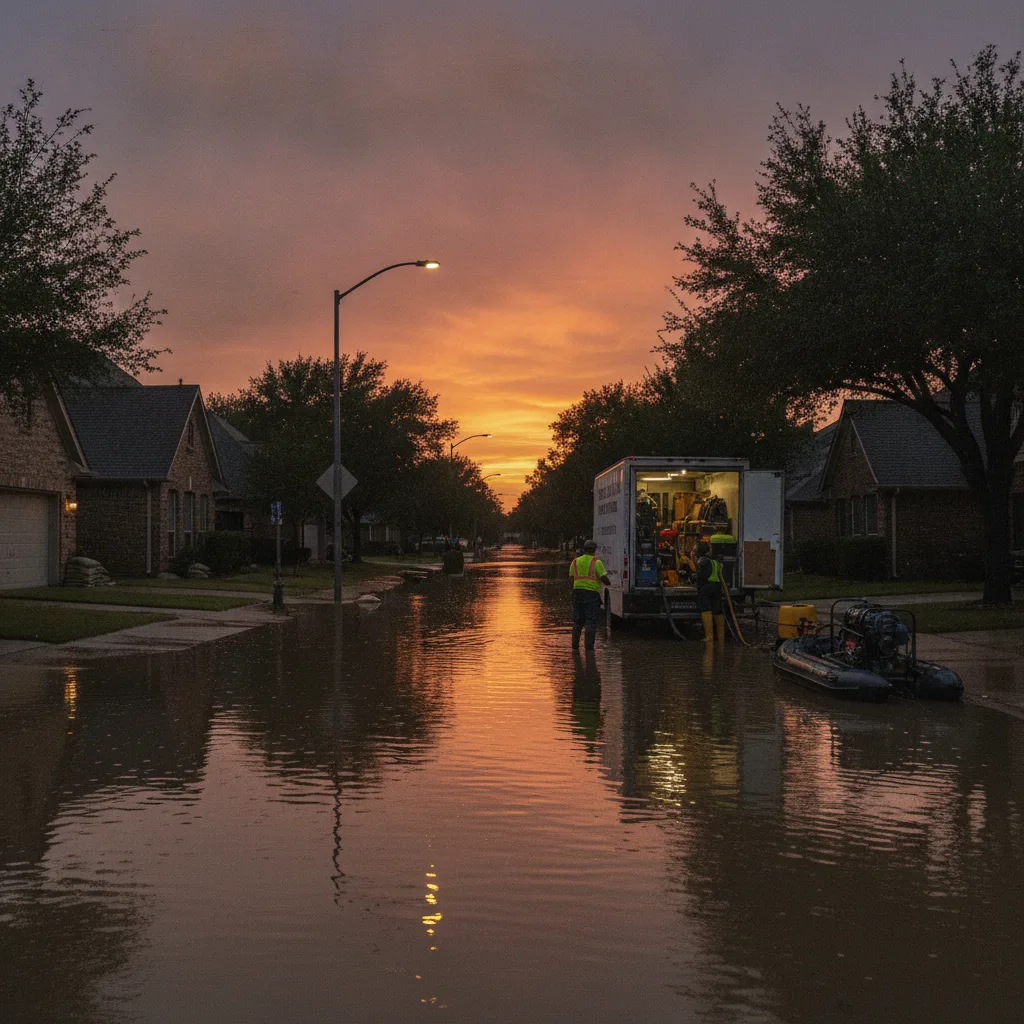
Restoration PPC Costs in 2026: What You'll Pay by Market and Season
| Tier | Price range | What's included | Best for |
|---|---|---|---|
| Baseline (Calm-Weather Floor) | $3,000 – $5,000/month | Single Google Search Ads campaign, basic negative keyword list, standard geo-targeting, CallRail call tracking | Restoration companies in mid-tier Texas metros outside Dallas/Houston, or operators moving off referral-only lead generation |
| Competitive (Multi-Channel, Mature Account) | $5,000 – $10,000/month | Segmented campaigns by service type, Google Local Services Ads (LSA), active Quality Score management, dedicated landing pages per service line, CallRail + Podium integration | Restoration companies in Houston or San Antonio competing against regional franchise operators |
| Storm Surge (Active Event Protocol) | $9,000 – $15,000/week during active storm events | Pre-built paused storm campaigns activated within hours of landfall, manual CPC increases of 30–40%, budget caps set 5–8x daily baseline, storm-specific keywords, zip-code-level geo-fencing | Any restoration company in a Gulf Coast, Atlantic seaboard, or flood-prone market that wants to capture the 72-hour demand spike when phone volume runs 5–10x normal |
| High-Competition Major Metro (Dallas/Houston) | $10,000 – $20,000+/month | Full service-line campaign segmentation, LSA + Google Search Ads + remarketing, Quality Score optimization, dedicated storm reserve budget, Google Business Profile management, weekly bid strategy reviews | Established restoration companies in Dallas or Houston competing directly against national franchise operators with automated bidding strategies |
What You Get at Each Budget Level
Baseline (Calm-Weather Floor)
A baseline restoration PPC budget covers steady-state lead volume in markets where CPCs run $40–$80 per click. At this spend level you can generate enough water damage restoration leads to keep one or two crews working without storm activity driving the auction. The critical discipline at this tier is campaign structure from day one: mold remediation, sewage cleanup, and general water damage restoration should each have their own ad group, because mold remediation leads cost $165 each while sewage cleanup leads cost $525. Blending them into one campaign hides where your money is going and produces a blended CPL that tells you nothing about which restoration services to target.
This tier also requires a clean negative keyword list before the first Google Ads dollar is spent. Without one, roughly 26% of clicks go to job seekers and DIY researchers, not homeowners with flooded basements. Running Google Ads for water damage restoration without negative keywords for terms like 'restoration jobs' and 'how to fix water damage yourself' is a structural waste problem that compounds every day the account runs uncleaned.
Competitive (Multi-Channel, Mature Account)
At this tier, restoration PPC management shifts from setup to ongoing optimization. Google Local Services Ads run alongside Google Search Ads — LSAs averaged $156 per lead nationally as of July 2026, which often undercuts Search Ads CPL in the same market. The separation matters because LSA costs and Search Ads costs move differently during storm events, giving restoration companies two independent cost-per-lead levers to pull when the auction heats up.
Quality Score becomes the primary cost control mechanism here. A restoration company with strong Quality Scores might pay $125–$175 per click for the same keyword where a competitor with a weak own account pays $250+. Over a $6,000 monthly budget, that gap translates to 15–20 more clicks per month, clicks that at a 13% conversion rate represent meaningful incremental qualified leads. Dedicated landing pages for each service line, not just the homepage, are non-negotiable at this spend level. The landing page tied to 'emergency water removal' should not be the same page as the one tied to mold remediation — search terms signal different urgency levels and require different ad copy and landing page messaging to convert.
Storm Surge (Active Event Protocol)
Storm surge is not a separate PPC campaign you build after the storm hits. It is a pre-built, paused campaign that activates within hours of a named storm warning. The demand window closes fast: phone volume peaks in the first 72 hours and decays back to baseline over roughly two weeks, so a restoration company still assembling ad copy on day two has already missed the highest-intent window. Storm-day searchers use queries that evergreen campaigns do not cover — 'flooded basement emergency,' 'tarp roof now,' 'tree on house who to call' — and those queries need dedicated ad copy and landing pages built in advance.
Despite the higher spend, storm PPC often generates water damage restoration leads at 40–60% lower cost per acquisition than normal periods, because every searcher clicking those ads is a homeowner with an active emergency right now. A restoration company spending $3,000 per month during calm weather should plan for $9,000–$12,000 during an active storm week. The 2024 hurricane season — Helene at $78.7B and Milton at $34.3B in damage across the Gulf region, per NOAA — created exactly this environment repeatedly, exposing restoration businesses that had no surge protocol in place.
High-Competition Major Metro (Dallas/Houston)
In Dallas, 'Water Damage Restoration Dallas' cleared $250.79 per click as of 2026 — the highest documented CPC in the entire home services paid search category. Houston runs lower at $114.43 for 'Water Damage Repair Houston,' but both markets require serious budget discipline and mature account structure to stay profitable. The 90th percentile cost per lead in high-competition markets hit $1,447 in 2026, up 64% from $882 in 2024, driven by national brands running aggressive automated bidding strategies in the same auctions where local restoration companies are trying to stay visible.
Top-performing restoration PPC accounts in these major metro markets hold cost per call to $38 and produce 7.2x ROAS. Average accounts in the same city pay $82 per call and generate 3–4x ROAS. That gap is not budget size — it is campaign structure, Quality Score discipline, and negative keyword management. At this spend level, a dedicated storm reserve fund of roughly 30% of annual ad budget should be held back for rapid scale-up during named storm events. Google Business Profile management also matters here: a strong profile reinforces the Google Guaranteed badge from LSAs and builds trust with potential clients who are calling during a stressful situation.

Pros and Cons of Running Google Ads for Water Damage Restoration
- Highest-intent buyers in home services: a homeowner searching 'emergency water removal' at 2 AM has already decided to hire someone. Restoration PPC captures that moment in a way no other channel can match, generating more calls from people actively in crisis.
- Storm surges generate water damage restoration leads at 40–60% lower cost per acquisition than normal periods, because elevated search volume pairs with the highest-intent buyers in the category. Every click during an active event is a real emergency, not someone window-shopping for future reference.
- Top accounts produce $38 cost per call and 7.2x ROAS, proving that well-structured restoration PPC campaigns outperform average accounts by more than 2x on cost efficiency — without spending more money. The difference is account discipline, not budget.
- LSA and Google Search Ads cost differently during storm events, so running both channels gives restoration companies two independent cost-per-lead levers and reduces over-reliance on any single auction when competitors are spiking bids simultaneously.
- Pre-built storm campaigns activate within hours, capturing the 72-hour demand spike when phone volume runs 5–10x normal. Restoration companies with this infrastructure in place generate more jobs per storm dollar than those assembling campaigns under live conditions.
- Quality Score is a direct cost control lever: restoration companies with excellent Quality Scores pay $125–$175 per click where competitors with poor optimization pay $250+ on the exact same keywords in the same city.
- Water damage restoration is the most expensive paid search vertical in home services: the 2026 median cost per lead hit $676, and competitive markets like Dallas push single-keyword CPCs past $250. This channel punishes undercapitalized accounts that enter without a funded strategy.
- Storm surges are unpredictable in timing, which means restoration companies must maintain a funded storm reserve budget year-round for events that may not materialize in a given season — money that sits idle until the moment it's urgently needed.
- 47% of restoration companies do not track cost per lead by channel, so PPC campaigns can consume budget for months before anyone notices. Without CallRail or equivalent call tracking tied to individual campaigns, there is no way to know which ad groups drive booked jobs.
- Missing negative keywords waste roughly 26% of clicks on job seekers, DIY researchers, and restoration training course searches. This is structural waste that compounds every day an account runs without a clean keyword exclusion list.
- National franchise restoration companies enter storm auctions with automated bidding, pushing CPCs 30–60% higher within 48 hours and pricing underprepared local contractors out of the auction at the exact moment search volume and demand are highest.
- PPC spend returns to zero the moment you stop paying: unlike SEO, there is no residual traffic floor, which is why restoration PPC should function as the surge-capture channel layered on top of an organic foundation — not the only lead generation strategy the business runs.
How to Size and Structure Your Restoration PPC Budget
- Size your baseline budget by market CPC, not by gut feel Set calm-weather monthly spend based on your metro's real CPC range: mid-tier Texas markets run $40–$80 per click, Houston runs $114+, and Dallas tops $250, meaning a $3,000 budget that generates meaningful water damage restoration leads in San Marcos will buy you far fewer clicks in Dallas, where you need $10,000+ just to stay visible in search results.
- Build your storm reserve fund before storm season opens Hold back roughly 30% of your annual PPC budget as a storm reserve, structured so your campaign budget caps can scale 5–8x above daily baseline spend within hours of a named storm entering your service area — a $3,000/month baseline may need $9,000–$12,000 in a single active storm week.
- Segment campaigns by service line from day one Run mold remediation, sewage cleanup, water damage restoration, and fire damage restoration as separate campaigns with separate budgets and dedicated landing pages, because blending them produces a meaningless average CPL — mold remediation leads cost $165 each while fire and smoke damage leads cost $705, and you cannot optimize what you cannot see.
- Pre-build your storm campaign and keep it paused Before the first named storm of the season, build a dedicated storm PPC campaign with storm-specific search terms and storm-specific ad copy and landing pages, then leave it paused and ready — activation within hours of a storm warning is the difference between capturing the 72-hour demand spike and watching national franchise restoration companies take every lead in your service area.
- Install call tracking before the first Google Ads dollar is spent Connect CallRail to every individual campaign and ad group so you can measure cost per booked job rather than just cost per click — without that link, the distinction between a $38 cost per call in a top-performing account and $82 in an average account is invisible, and you will never know which campaigns to scale and which to cut.
- Raise CPCs manually when a named storm enters your service area When a storm warning is issued for your market, manually increase max CPCs by 30–40% to compete against national franchise restoration companies spiking their automated bids simultaneously — waiting for Google's automated bidding to catch up means paying the same elevated CPCs while losing impression share to competitors who moved first.

The Paused Campaign Is the Most Expensive Mistake in Restoration PPC
Most restoration companies scramble to build storm campaigns after landfall, writing ad copy while their service area is flooding. That approach guarantees they miss the first 24–48 hours of the demand spike, when phone volume runs 5–10x normal and every click is a homeowner with an active emergency. A restoration company in Houston that lacked pre-built storm campaigns during Hurricanes Helene and Milton in 2024, combined $113B+ in damage across the Gulf region per NOAA, did not just lose leads during those events. They paid the highest CPCs at the highest volume moment, while competitors with mature accounts and established Quality Scores held their cost per lead near the $156 LSA average.
The restoration companies paying $38 per call instead of $82 are not spending more money. They built their account structure before the storm hit: segmented campaigns by restoration service line, a funded storm reserve, a pre-built paused surge campaign with storm-specific ad copy and landing pages, and call tracking tied to actual booked jobs rather than clicks. Restoration PPC is the most expensive paid search vertical in home services, but the gap between a $1,447 cost per lead and a $347 cost per lead is not budget size. It is campaign discipline. If you want a free strategy session to audit where your restoration PPC spend is going and what it would take to build a storm-ready account structure, reach out and let's talk through your specific market and service area.
Frequently Asked Questions
Ready to get started? Contact Geek Powered Studios today.