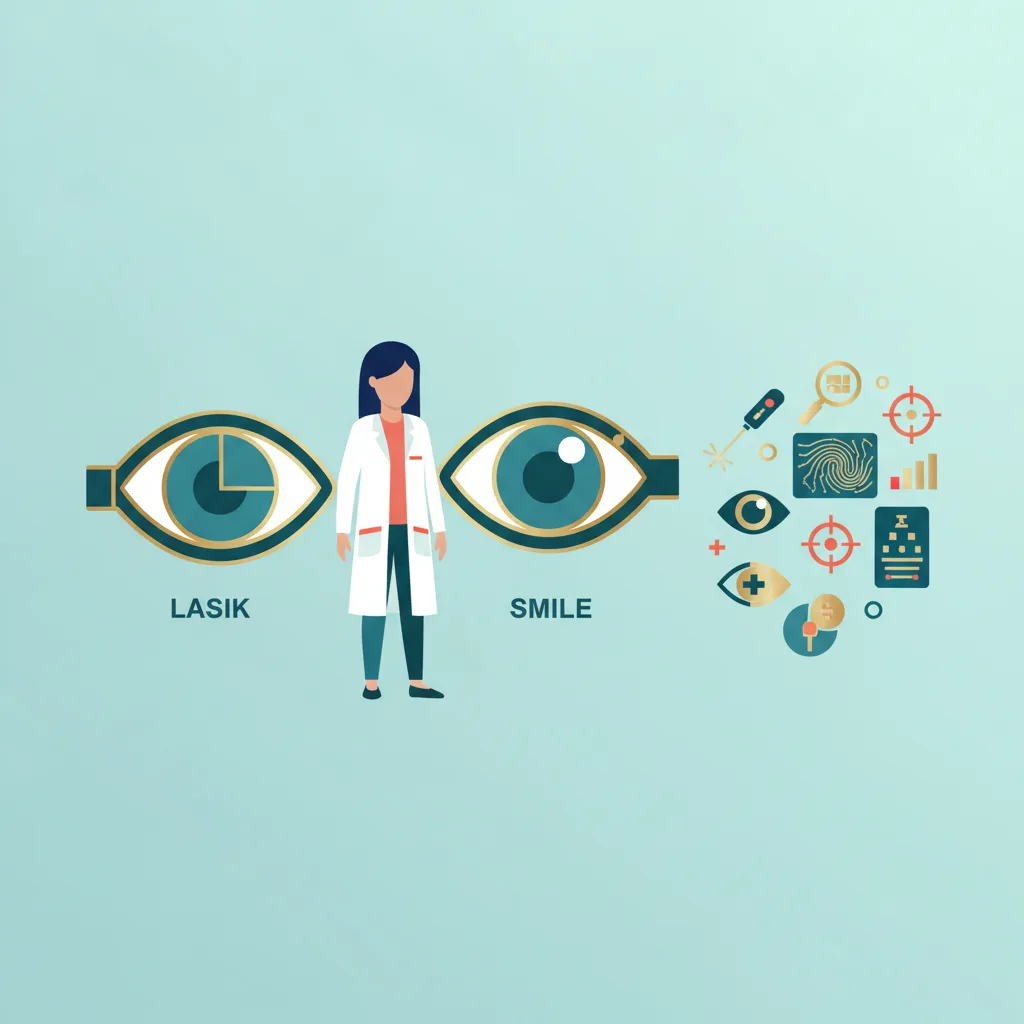
LASIK and SMILE are both effective laser eye surgery options, but they serve different patient profiles. LASIK corrects myopia, hyperopia, and astigmatism with rapid visual recovery — most patients drive the next day. SMILE (Small Incision Lenticule Extraction) uses a single femtosecond laser, creates no corneal flap, and produces significantly less postoperative dry eye, making it the clinical choice for athletes, dry-eye-prone patients, and those with thin corneas. As of 2026, LASIK costs $2,000–$3,500 per eye; SMILE runs $2,000–$4,000. At high-volume academic centers like UCLA Health, both are priced identically at $3,500 per eye. For refractive practices, marketing only one procedure means losing 20–30% of qualified leads.
-
1998 vs. 2016LASIK vs. SMILE U.S. FDA approval years
-
24 hours vs. 2–3 daysLASIK vs. SMILE initial visual recovery time
-
Over 90% vs. 88%LASIK vs. SMILE patients achieving 20/20 or better
-
23% more LASIK patientsRequired eye drops for dry eye at 6 months post-op vs. SMILE
-
MD = -4.82SMILE's OSDI dry eye score advantage over FS-LASIK at 1 month
-
$2,000–$4,000 per eyeSMILE cost range in the U.S. as of 2026
-
475 micronsMinimum corneal thickness for SMILE vs. stricter LASIK threshold
-
20–30% more candidatesPatient pool expansion when practices market both LASIK and SMILE
SMILE vs. LASIK is the question refractive practices aren't answering well enough — and patients are noticing. As of 2026, SMILE eye surgery (Small Incision Lenticule Extraction) is FDA-approved, backed by over a decade of international clinical data, and priced identically to LASIK at high-volume centers like UCLA Health ($3,500 per eye for both). The clinical differences are real: LASIK delivers rapid visual recovery within 24 hours and corrects a broader range of refractive errors including hyperopia; SMILE eliminates corneal flap creation entirely, preserves more corneal tissue, and produces significantly less postoperative dry eye. Neither procedure beats the other universally. What matters for refractive practices is marketing each one to the patient avatar it actually serves — and capturing the 20–30% of patients who were previously told they weren't LASIK candidates.
Option A
LASIK
The gold standard with a 25-year track record, fast visual recovery, and the broadest treatment range in laser eye surgery.
- FDA-approved since 1998: over 25 years of U.S. clinical data and 600,000–700,000 procedures per year as of 2026.
- Fastest visual recovery: most LASIK patients see clearly within 24 hours and return to work the next day.
- Broadest candidacy range: corrects myopia, hyperopia, and astigmatism — the only laser vision correction option approved for farsightedness.
- Over 90% achieve 20/20: advanced ray-tracing LASIK placed 100% of treated eyes within a quarter-diopter of target at 3 months per AAO 2025 data.
Option B
SMILE
The flap-free alternative that expands your candidate pool — especially for dry-eye-prone patients, athletes, and thin corneas.
- No corneal flap — ever: the femtosecond laser creates a lenticule removed through a 2–3 mm small incision, eliminating all flap-related complications.
- Significantly less dry eye: meta-analyses of 4,892 eyes show OSDI scores MD = -4.82 lower than FS-LASIK at one month post-op.
- Preserves more corneal tissue: SMILE can be performed at 475 microns of corneal thickness, capturing borderline-thin cornea patients who fail LASIK screening.
- SMILE Pro FDA-approved January 2024: the VISUMAX 800 platform extends SMILE's clinical lineage with faster lenticule creation per eye.
How LASIK Eye Surgery Works: Flap Creation, Excimer Laser, and Rapid Visual Recovery
LASIK is a two-step, two-laser process: the surgeon creates a corneal flap using a femtosecond laser, lifts it, and then the excimer laser reshapes the tissue underneath to correct refractive errors. The excimer laser reshapes the stroma with UV pulses calibrated to the patient's prescription — correcting myopia, hyperopia, and astigmatism in a single ablation pass. The flap is then repositioned without sutures and adheres within minutes. Total laser time per eye runs roughly 30–60 seconds.
LASIK's rapid visual recovery is its most marketable clinical attribute. Most patients achieve functional clarity within hours and drive to their follow-up appointment the next morning. The flap heals quickly because the epithelium is preserved — unlike photorefractive keratectomy (PRK), which removes the surface layer entirely and extends recovery time to 3–5 days of significant discomfort. For patients who need fast visual recovery — executives, surgeons, pilots — LASIK's timeline is a genuine differentiator.
The procedure's 25-year track record makes it the dominant option for laser eye surgery globally. Over 70% of refractive surgeries worldwide are still LASIK as of 2026, and the U.S. alone sees 600,000–700,000 LASIK procedures per year. That volume means a large base of experienced surgeons, well-established clinical protocols, and long-term outcomes data that SMILE simply can't match yet. Advanced LASIK platforms now use ray-tracing wavefront maps and corneal topography to personalize ablation profiles — a level of customization that continues to improve precision year over year.
How SMILE Eye Surgery Works: One Femtosecond Laser, a Tiny Incision, No Flap Created
SMILE stands for Small Incision Lenticule Extraction. The surgeon uses a single femtosecond laser — the Zeiss VisuMax laser, the only platform currently FDA-approved for the procedure — to create a lens-shaped piece of corneal tissue called a lenticule entirely within the stroma. No flap is created at any step. The lenticule is then removed through a 2–3 mm tiny incision, reshaping the cornea to correct nearsightedness and myopic astigmatism. Total laser time per eye is approximately 10 seconds for lenticule creation.
The flap-free design is SMILE's defining clinical advantage. Flap complications — including traumatic flap dislocation from a blow to the eye — are impossible when no corneal flap exists. This makes SMILE the procedure of choice for athletes, first responders, and military personnel. The U.S. Army Aeromedical Research Laboratory published 2025 clinical trial data confirming both procedures achieved better than 20/20 mean uncorrected visual acuity by post-op week two, but only SMILE eliminates the ongoing flap dislocation risk entirely.
SMILE's corneal nerve preservation is a mechanistic reason for its dry eye advantage. LASIK severs corneal nerves along the full circumference of the flap, with reinnervation measured at just 27% at 6 months post-op. SMILE, with its small incision, cuts fewer nerves and shows 55% corneal nerve reinnervation at just 1 month post-op. Those preserved corneal nerves drive tear production — which is exactly why meta-analyses covering 4,892 eyes consistently show SMILE patients report fewer dry eye symptoms and need fewer eye drops. At 6 months post-op, 23% more LASIK patients required eye drops than SMILE patients in published comparisons.
Visual recovery with SMILE is slower than LASIK in the first 48–72 hours. Patients notice hazy or blurry vision for the first 1–3 days, reaching functional clarity by day 2–3, with full stabilization taking up to 3 months. By one week post-op, vision outcomes between the procedures are typically equivalent. Patient satisfaction with SMILE exceeds 95% in published reports — on par with LASIK — but the first-day experience is different. Proper healing requires patients to plan for a few days away from driving and screen-heavy work.
SMILE's FDA-approved prescription range covers myopia from -1 D to -10 D and astigmatism up to -3 D. It does not correct hyperopia. Patients with farsightedness, irregular astigmatism, or high refractive errors beyond SMILE's current approval must pursue LASIK or PRK. This candidacy boundary is not a failure of the procedure — it's a clinical fact that refractive practices need to build into their intake screening and their content strategy alike.
SMILE vs. LASIK: The 8-Dimension Comparison for Refractive Practices
| Dimension | LASIK | SMILE |
|---|---|---|
| FDA Approval & Track Record | Approved since 1998; 25+ years of U.S. clinical data; ~600K–700K procedures/year as of 2026 | Approved September 2016 (myopia); SMILE Pro FDA-approved January 2024; 10+ years of international data |
| Procedure Mechanics | Two-step, two-laser: femtosecond laser creates a corneal flap, then excimer laser reshapes tissue underneath | Single femtosecond laser (Zeiss VisuMax) creates a lenticule removed through a 2–3 mm small incision — no flap at any step |
| Visual Recovery Speed | Clear vision within 24 hours; drive and return to work the next day for most patients | Hazy or blurry for first 1–3 days; functional clarity by day 2–3; full stabilization up to 3 months |
| Dry Eye Risk | Statistically significant reduction in tear production post-op; 23% more patients required eye drops at 6 months vs. SMILE | Only nonsignificant reduction in tear production in meta-analyses; OSDI scores significantly lower at 1 month (MD = -4.82) |
| Candidacy Range | Corrects myopia, hyperopia, and astigmatism; broader prescription range including farsightedness | FDA-approved for myopia (-1 D to -10 D) and astigmatism (up to -3 D); no hyperopia correction currently approved |
| Flap-Related Complications | Corneal flap creation carries risk of flap dislocation from trauma — a real concern for athletes and first responders | Zero flap-related complications — flap creation is eliminated entirely; safer for contact sports, military, high-impact occupations |
| Visual Outcomes (20/20) | Over 90% of myopia + astigmatism patients achieve 20/20 or better; ray-tracing LASIK hit 100% within quarter-diopter of target at 3 months (AAO 2025) | 88% of patients achieve 20/20 or better in recent studies; ~75% of SMILE Pro eyes within quarter-diopter of target at 3 months (AAO 2025) |
| Cost Per Eye (US, 2026) | $2,000–$3,500 per eye; UCLA Health benchmarks LASIK at $3,500/eye | $2,000–$4,000 per eye; many high-volume centers price identically to LASIK at $3,500/eye |
The Biggest SMILE vs. LASIK Marketing Mistake Refractive Practices Make
Most practices either ignore SMILE entirely — losing every patient who isn't a LASIK candidate — or pitch SMILE as a LASIK replacement, which the clinical data doesn't support. The right move is to market each procedure to the patient avatar it actually serves. SMILE doesn't replace LASIK; it expands your candidate pool. That reframe turns a competitor-vs.-competitor dynamic into a larger total addressable market. Practices that build both procedure content properly don't split their leads. They add new ones.
LASIK Is the Right Call for These Patients
LASIK remains the clinical and marketing choice for four specific patient groups that SMILE simply cannot serve.
- Patients with farsightedness (hyperopia): SMILE is not FDA-approved for hyperopia, making LASIK the only laser eye surgery option for this refractive error — full stop.
- Anyone requiring the fastest possible visual recovery: LASIK patients typically drive and return to work within 24 hours, while SMILE patients should plan for 2–3 days of reduced clarity.
- High-prescription myopes who want maximum precision data: advanced ray-tracing LASIK placed 100% of eyes within a quarter-diopter of target at 3 months per the AAO 2025 annual meeting, compared to roughly 75% for SMILE Pro.
- Patients with high astigmatism beyond -3 D: LASIK handles astigmatism well past the -3 D cap that SMILE's current FDA approval carries.
- Patients seeking a stable prescription with a long, well-documented long-term outcomes dataset: 25 years of U.S. clinical trial data provides a level of evidence SMILE is still building.
For practices, this is straightforward: build LASIK content around rapid visual recovery, farsightedness correction, and broad prescription range. Those are the three clinical attributes SMILE cannot match. Lead with them honestly, and patients who fit that profile will self-select.
SMILE Is the Right Call for These Patients
SMILE eye surgery wins on three specific patient profiles that LASIK-only marketing completely misses.
- Contact lens wearers with pre-existing dry eye symptoms: SMILE's nonsignificant tear-production reduction versus LASIK's statistically significant one means fewer post-op drops, less discomfort, and a smoother recovery for patients already managing postoperative dry eye symptoms with contacts.
- Athletes, first responders, and military personnel: no corneal flap means zero risk of traumatic flap dislocation during contact sports, training, or duty — the single most compelling clinical differentiator for this patient segment.
- Patients with borderline corneal thickness: SMILE can be performed at 475 microns of corneal thickness and preserves more corneal tissue than the standard LASIK ablation threshold requires, capturing patients who failed LASIK screening elsewhere.
- Anyone previously turned away as 'not a LASIK candidate' due to thin corneas or dry eye history: SMILE expands the total addressable patient pool by 20–30%.
- Patients correcting myopic astigmatism who prefer a less invasive approach: the 2–3 mm small incision versus a full corneal flap is a meaningful structural difference for patients who researched their options.
The marketing message for SMILE is not 'SMILE is better than LASIK.' It's 'we have the right laser vision correction procedure for your specific eyes.' That positioning captures the patient who was told no elsewhere — and turns a lost lead into a booked consult.
When Running Both LASIK and SMILE Procedures Grows Your Practice
Practices that offer both LASIK and SMILE and market them as a unified 'customized laser vision correction' program don't split their leads — they add new ones. The 20–30% of patients who were previously told they weren't LASIK candidates don't disappear; they go to a competitor who offers SMILE. When both lasik and smile are on your menu and in your content, that patient calls you instead.
The content strategy follows the same logic. Build LASIK pages targeting rapid visual recovery, hyperopia correction, and broad prescription range. Build SMILE pages targeting dry eye history, athletes, thin corneas, and flap-free recovery. Run both. When a patient searches 'can I get laser eye surgery with dry eyes' or 'laser eye surgery for athletes,' your SMILE content captures them. When they search 'fastest recovery laser eye surgery' or 'LASIK for farsightedness,' your LASIK content wins. The two pages serve genuinely different clinical profiles, so neither cannibalizes the other.
The intake process reinforces this positioning. Patients who arrive for a free consultation expecting LASIK and learn they're better suited for SMILE don't feel downgraded — they feel heard. Corneal topography screening and a stable prescription evaluation at the consult stage make the procedure recommendation feel clinical, not commercial. That's the trust-building moment that converts a shopper into a surgery patient.
Which Procedure Should Your Practice Lead With? A Budget and Patient-Profile Guide
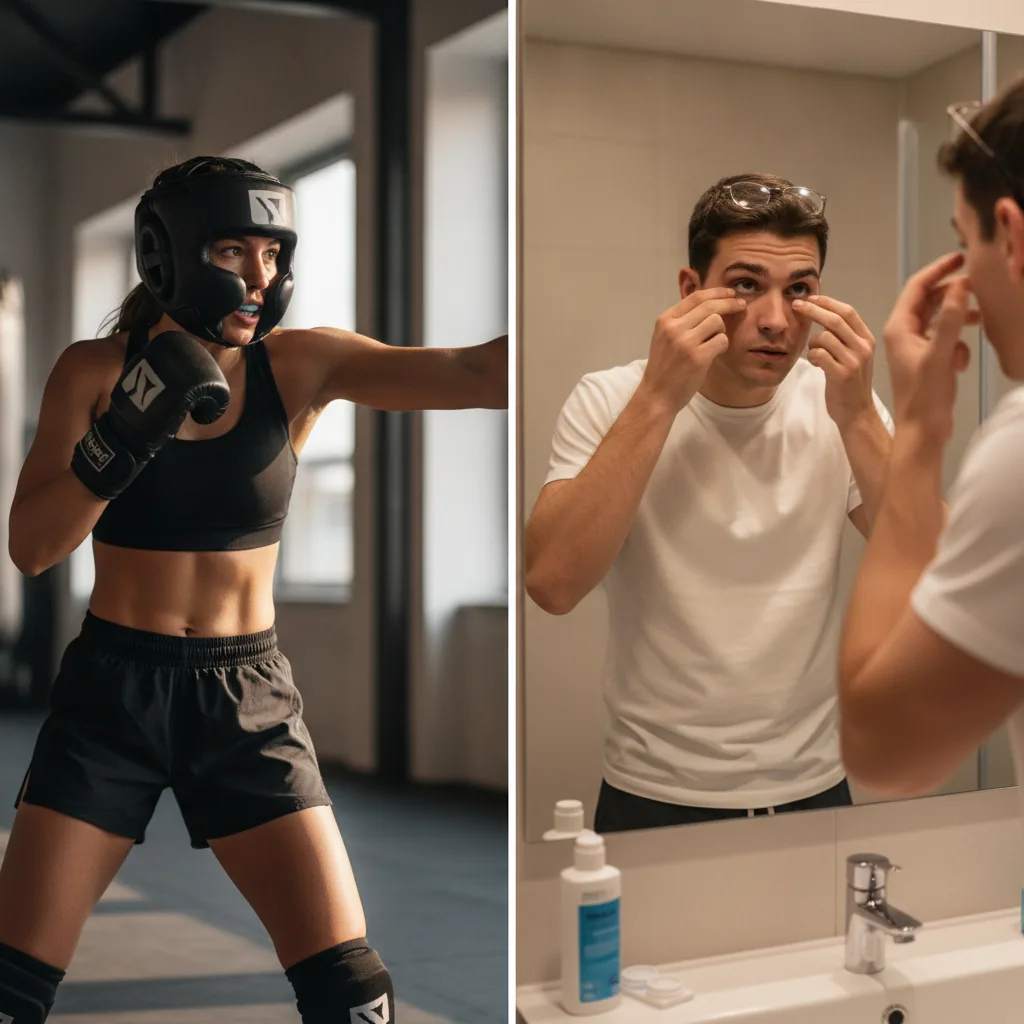
Go SMILE
Your Patient Has Dry Eye History, Plays Contact Sports, or Was Turned Away for LASIK Elsewhere
SMILE is the clinical answer for three specific patient profiles that LASIK-only marketing completely ignores. The first is the dry-eye-prone contact lens wearer. Meta-analyses covering 4,892 eyes show SMILE produces significantly lower OSDI dry eye scores at one month post-op (MD = -4.82). At six months, 23% more LASIK patients required eye drops than SMILE patients. For someone already managing dry eye symptoms with contact lenses, that difference is the reason they book the procedure.
The second profile is the athlete or first responder. No corneal flap means no flap complications — ever. A firefighter, MMA fighter, or active-duty service member who takes a blow to the face post-LASIK risks flap dislocation. Post-SMILE, that risk doesn't exist. The third profile is the patient with borderline corneal thickness who was told 'no' somewhere else. SMILE can be performed at 475 microns of corneal thickness, preserving more corneal tissue than LASIK requires. That patient was not a no — they were just at the wrong practice.
SMILE marketing content for these profiles should lead with the clinical differentiator, not the procedure name. 'Laser eye surgery for athletes,' 'vision correction for dry eye patients,' and 'laser eye surgery when LASIK said no' are the page titles that capture this audience before they ever read the word SMILE.
Offer Both
Market Customized Laser Vision Correction and Let the Clinical Consult Drive the Decision
Practices that market both LASIK and SMILE as a unified 'customized vision correction surgery' program capture the patients who were previously turned away as not eligible. The marketing message isn't 'SMILE is better than LASIK.' It's 'we have the right laser eye surgery for your specific eyes, not just the one we happened to buy equipment for.' That positioning ends the either/or conversation before it starts.
Build separate landing pages for each procedure. LASIK pages target rapid visual recovery, hyperopia correction, and the 25-year track record. SMILE pages target dry eye history, athletes, thin corneas, and the flap-free approach. Run Google Search Ads on both. Track calls with CallRail and attribute consults back to procedure keyword groups so you know which patient avatar is converting at the lowest cost per booked surgery.
At the consult stage, corneal topography mapping and a stable prescription review determine the right procedure — not the ad the patient clicked. The content just gets them in the door. Practices that frame this correctly don't lose patients to the competitor across town who offers SMILE. They become that competitor's reason to call.
Go LASIK
Your Patient Has Hyperopia, Needs Next-Day Vision, or Exceeds SMILE's Prescription Range
LASIK remains the only FDA-approved laser vision correction procedure for hyperopia (farsightedness). If a patient walks in with a positive prescription, the clinical decision is made before the marketing conversation starts. LASIK is also the right call when a patient's lifestyle absolutely requires rapid visual recovery — a surgeon, pilot, or executive who can't afford 2–3 days of reduced clarity.
For high-myopia patients who want maximum precision, the data from the AAO 2025 annual meeting gives LASIK a real edge: advanced ray-tracing LASIK placed every treated eye within a quarter-diopter of target at 3 months, compared to roughly three-quarters of SMILE Pro eyes. That's a nuance worth putting on your procedure comparison page, not hiding from it. Honest marketing about improved vision precision builds more trust than overclaiming.
LASIK also handles high astigmatism beyond the -3 D cap in SMILE's current FDA approval. Patients with irregular astigmatism or high refractive errors who don't qualify for SMILE are strong LASIK candidates — and they're specifically looking for a practice that can serve them. Clear content about LASIK's candidacy range captures that search traffic before a competitor does.
SMILE vs. LASIK is a clinical question your surgeons answer in the consult room. But it's a marketing question your content needs to answer before patients ever call. Practices that treat both laser assisted procedures as separate patient avatars — not competing products — grow their consult volume without cannibalizing either procedure's lead flow.
At Geek Powered Studios, we've built SEO and paid search programs for refractive practices that generated 196% more PPC leads and record-breaking sales months within six months — by targeting the right patient avatars with the right procedure messaging at every step of the funnel. Your custom website is included at no extra cost, there are no long-term contracts, and we work with one refractive practice per market.
If your practice offers both LASIK and SMILE and your content still only talks about one of them, you're leaving qualified leads on the table. Book your free consultation and let's fix that.
Frequently Asked Questions
Ready to get started? Contact Geek Powered Studios today.