
The best electrician websites in 2026 convert at 6–10% by combining four non-negotiable elements: a mobile-friendly layout that loads in under 2.5 seconds, license and insurance credentials above the fold (not buried in the footer), dedicated landing pages for each electrical service category, and keyword-matched CTAs tied to real Google reviews embedded on-page. Sites like NuBlue, SALT Service Co, and Thor Electric demonstrate every one of these patterns. The average contractor site scores 54/100 on mobile PageSpeed and converts at 2–4%, meaning the gap between the best and average electrician websites is a 3–5x difference in qualified leads from the same ad spend.
-
3.2xConversion rate multiplier: sites loading under 2.5s vs. over 4.5s
-
9.08%Electrical industry Google Ads conversion rate — highest of any home service trade
-
+23%More form submissions when license badges appear above the fold vs. the footer
-
5–15%Conversion rate on dedicated service landing pages vs. 1–3% on homepages
-
+87%Conversion lift from keyword-matched CTAs vs. generic "Contact Us" buttons
-
9xLead increase for one Texas electrician after a website redesign (Feb–Apr 2026)
-
54/100Average electrician website's mobile PageSpeed score — well below the 70 threshold
-
$5K–$15KTypical agency cost for a custom, conversion-optimized electrician website build
The best electrician websites in 2026 convert at 6–10%. The average electrician website converts at 2–4%. That gap is not a design preference — it is a direct dollar figure attached to every ad you run, every organic visitor who lands on your homepage, and every referral who Googles your company name before calling. This guide breaks down the specific design patterns, trust signals, and technical benchmarks that separate the top performers from the rest, using real named examples: NuBlue, SALT Service Co, Thor Electric, Penna Electric, Nordeast Electric, and Beel Electrical. Read it in 20–30 minutes, and use the five-point audit in the final step to benchmark your own site today.
Before you start
- Access to your current electrician website on both desktop and mobile view
- Google PageSpeed Insights (free) — have your URL ready to run a live score
- A written list of your current service offerings: residential, commercial, and emergency electrical services
- Basic familiarity with your website platform (WordPress, Webflow, or a hosted builder like Wix or Squarespace)
- Your Google Business Profile login to verify your current review count and star rating
- Your current monthly lead volume — the baseline you will benchmark improvement against
Understand the Conversion Gap Before You Touch Your Site
The best electrician websites convert at 6–10%, while the average contractor website sits at 2–4% — and that gap is a direct dollar figure attached to every ad you run. According to OnwardCraft's 2026 study of 200 contractor websites, a site loading under 2.5 seconds averages a 6.8% conversion rate. The same site loading over 4.5 seconds drops to 2.1%. That is a 3.2x difference with identical web traffic.
Put that in real numbers: on a $1,200 Google Ads spend, a poorly optimized electrician website produces 2–3 leads. A custom, technically optimized site produces 5–12 leads from that same spend. The electrical industry actually has the highest Google Ads conversion rate of any home service trade — 9.08% as of 2026, ahead of HVAC (8.2%), plumbing (7.9%), and roofing (6.5%). That means your site's performance is the bottleneck, not the ad channel.
Before rebuilding anything, run your site through Google PageSpeed Insights. The average electrician website scores 54/100 on mobile with a main content load time of 8.84 seconds. Only 1.9% of electrician websites score above 80. If your score is under 70, speed fixes alone could double your conversion rate before you change a single word of copy or a single element of your website design.
Google PageSpeed Insights
Free
Gives your mobile and desktop performance score instantly — the baseline number every step in this guide builds on.
Google Analytics 4
Free
Shows your current conversion rate, bounce rate by device, and which pages are sending visitors away without contacting you.
Quick Benchmark
Pull your PageSpeed score now. Under 70 on mobile means speed fixes alone could double your conversion rate before you change a single word of copy or a single image on your site.
Put Trust Signals Above the Fold on Every Electrical Website Page
Electrician websites that display license and insurance badges above the fold see 23% more form submissions than sites that bury those signals in the footer — yet fewer than 15% of visitors ever scroll far enough to see footer-level credentials. Most contractor sites get this backwards: they open with a generic tagline and push the proof to the bottom of the page.
The specific wording matters too. Displaying a 'Licensed Master Electrician' badge on service pages drives a 14% conversion uplift over the generic 'Licensed and Insured' label, per OnwardCraft's 2026 analysis of 200 sites. Sites like NuBlue and Penna Electric put their credentials in the first viewport: license number, years in service, and certification badges all visible before the user scrolls. Beel Electrical goes further — NECA credentials visible directly in the hero section alongside a real team photo, making a clear value proposition out of their certifications rather than hiding them.
If your electrical business operates in a state with public license lookup — Texas, Florida, and Arizona all do — display the actual license number, not just the word 'licensed.' Potential customers can verify it in one tap on mobile, and that verifiability builds trust that a badge image alone does not. A professional electrician who shows the number signals confidence; one who only claims to be licensed signals uncertainty. Neca credentials and other third-party certifications belong in the same viewport as your phone number, not four screens down the page.
Common Mistake
Putting trust signals only in the footer is the single most common error on electrician websites. Fewer than 15% of visitors reach the footer — which means your credentials are invisible to 85% of your traffic.
Build a Mobile-Friendly Layout That Converts on the Device Your Customers Actually Use
70% of 'electrician near me' searches happen on mobile devices, and 58.4% of all electrician website traffic is mobile as of 2026. A mobile responsive layout is not a nice-to-have — it is the primary design surface for any electrical company competing for local customers. The best electrician websites treat the mobile experience as the default and desktop as the secondary view.
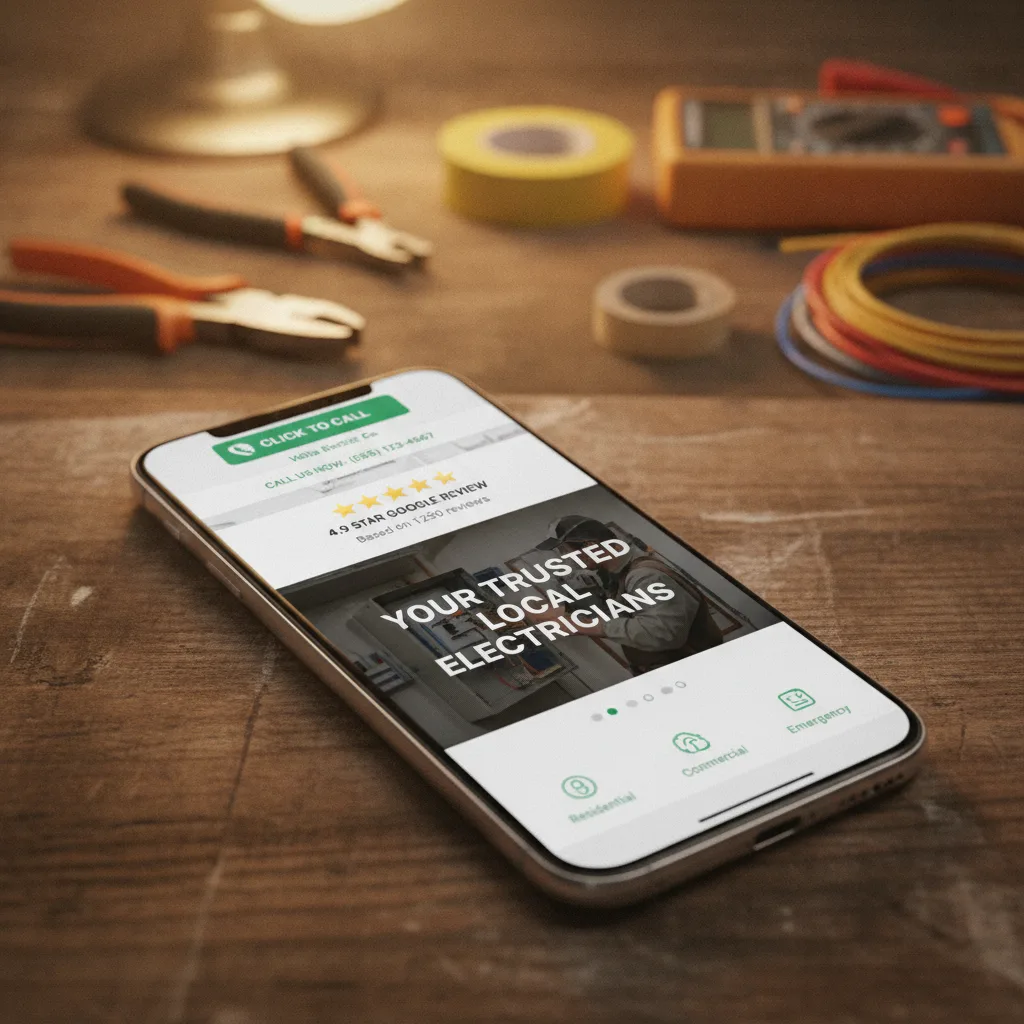
The non-negotiables for mobile: a sticky click-to-call button in the header or a persistent bottom bar, tap targets at least 44x44 pixels (Apple's minimum for thumb accuracy), and a form that does not require zooming or horizontal scrolling to complete. Only about 55% of electrician sites currently have a click-to-call button on mobile, which means adding one alone can produce a 25–40% mobile conversion lift. NuBlue's electrician website puts the click-to-call number and an 'Emergency Services' button in a sticky header visible on every scroll position — a pattern that shows up consistently across the best-performing electrician websites. User-friendly navigation with a clean, logical four icon grid for service categories is another pattern the top sites share.
Platform choice has a measurable effect on mobile performance. Webflow scores 85–95 on mobile PageSpeed out of the box; the average WordPress electrician site scores 54/100. If you are rebuilding, that is a meaningful head start. The Core Web Vitals pass rate is 68.9% for Webflow-built electrician sites versus 49.3% for WordPress, per WebTonic's 2026 platform data. Modern design expectations from potential clients — fast load, user-friendly interface, clean navigation — are easier to meet on a platform built for performance from the ground up.
Webflow
From $23/mo (CMS plan)
Produces mobile PageSpeed scores of 85–95 out of the box for electrician sites — vs. the 54/100 average on WordPress — without additional plugin overhead.
BrowserStack
From $29/mo
Test your electrician website on real mobile devices across iOS and Android to catch layout breaks before potential customers see them.
Speed Target
Your mobile main content (LCP) should load in under 2.5 seconds. At that threshold, the data shows an average 6.8% conversion rate. Every second over that mark costs you quality leads.
Segment Services Into Dedicated Electrical Services Landing Pages
Dedicated landing pages for electricians convert at 5–15%, while homepages receiving the same paid traffic convert at just 1–3%. That is not a small difference — it is the difference between profitable ads and ads that hemorrhage cash. The best electrician websites do not send Google Ads traffic to their homepage. They send it to a page built around exactly what the searcher typed, with a clear value proposition matched to that specific intent.
The right architecture segments services into at minimum three tracks: residential electrical services, commercial services, and emergency electrical. Each track gets its own URL, its own headline, its own CTA, and its own trust signals relevant to that audience. A commercial electrician page should show panel upgrades and tenant build-outs — commercial projects that communicate scale to business clients. A residential page should show panel inspections and EV charger installs. An emergency page should show response time and a phone number in 48pt font. Separate service pages improve both local search engine rankings and conversion clarity — Google rewards topical relevance, and visitors reward specificity.
SALT Service Co in Austin demonstrates this pattern: their hero section presents 4.8 stars from 5,314 reviews alongside a real team photo, and the navigation separates residential from commercial projects immediately. Thor Electric places multiple 'Get an Estimate' CTAs above the fold with authentic project photography specific to the service being displayed. These are not design accidents — they are the patterns that show up repeatedly across the best electrician websites in 2026, and they directly optimize user experience for each distinct customer segment.
Local SEO Bonus
Each dedicated service page is also an opportunity to target a city-specific keyword — 'emergency electrician Austin' vs. 'emergency electrician Houston.' One page per service per city is the fastest path to local SEO visibility and search engine rankings for multi-location electrical companies.
Replace Stock Photos With Real Team Photos and Project Shots
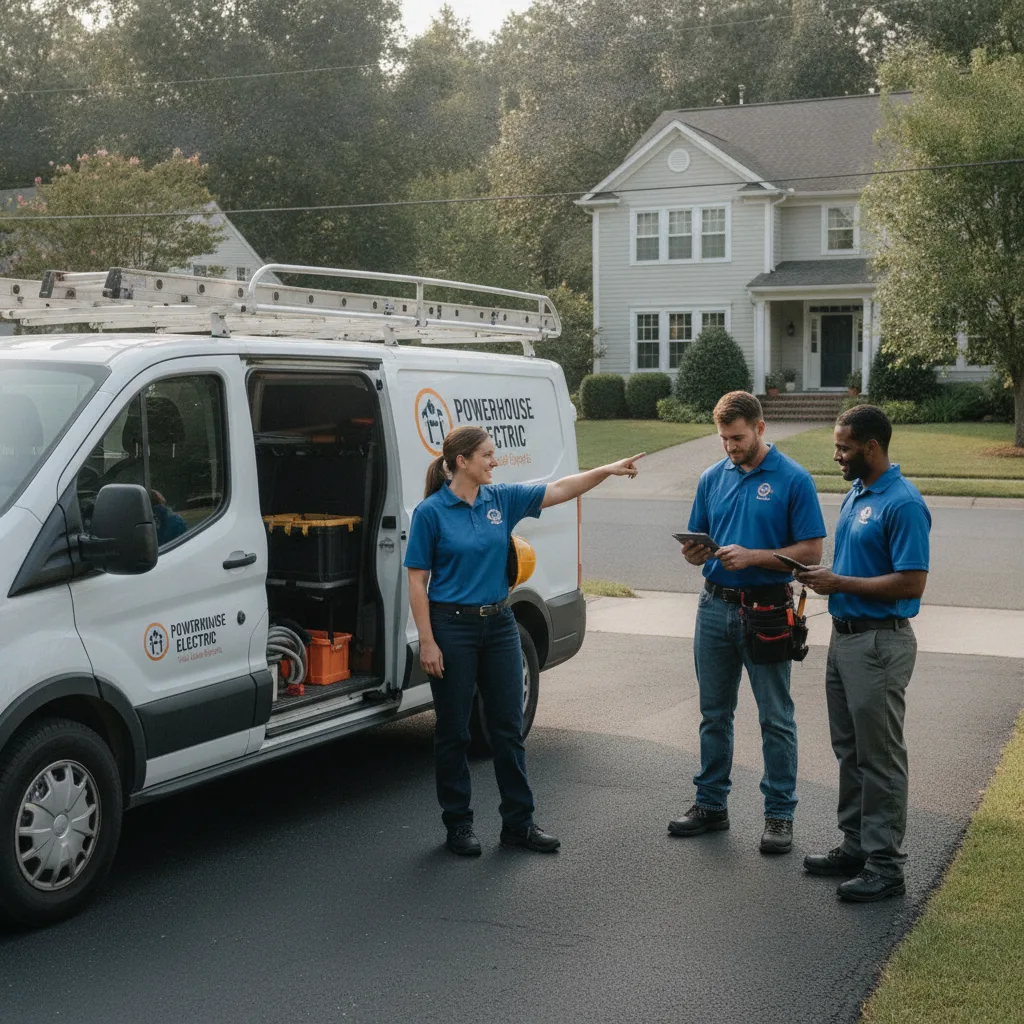
Real team photos, real truck photos, and before/after project shots outperform stock electrician imagery for trust and conversion. Stock photos of anonymous people in hard hats are invisible because every competitor in the electrical trade uses the same ones. When a homeowner sees the same blue-collar stock image on three different electrical company websites, none of those companies feel real — and local reliability is impossible to communicate with generic imagery.
Nordeast Electric leads with 45 years in service, their review count, and their license number visible on the actual truck in photos — turning a vehicle shot into a trust signal. SALT Service Co's hero section uses a real team photo that communicates local reliability in a way no stock image can. The underlying principle: electrical work happens in someone's home. Customers are making a trust decision as much as a price decision. Professional photos of your actual crew, your actual trucks, and your actual completed projects answer the question the homeowner is really asking: 'Are these real people, and are they any good?' Strong visuals tied to real service area geography build brand recognition that stock imagery never will.
A strong project portfolio does not require a professional photographer every time. Before/after photos shot on a modern smartphone — well-lit, horizontal orientation, showing a clean finished panel or a completed EV charger install — build credibility with potential clients that stock imagery never will. Aim for 10–15 real project photos before launch and add 2–3 per month. For industrial work or large commercial projects, include a brief caption noting the scope: square footage, panel size, or number of units wired. That detail communicates professional design thinking and signals scale to commercial buyers evaluating your electrical company.
Write Keyword-Matched CTAs and Embed Google Reviews Across the Electrical Website
Keyword-matched CTAs boost conversions by up to 87% compared to generic 'Contact Us' buttons, per Cube Creative's home services research. The logic is direct: if someone searched 'emergency electrician near me,' a button that says 'Call Now for Emergency Service' speaks directly to their intent. 'Contact Us' does not. The best electrician websites match the CTA to the specific service page and the specific traffic source. That single change — swapping generic button text for intent-matched copy — can produce more conversion lift than a full visual redesign.
Embedded Google reviews are the second most neglected conversion element on electrician websites. Electrical contractor sites with 50 or more detailed Google reviews embedded on-page see a +4.6% conversion rate boost over sites with fewer or no embedded reviews — yet only about 20% of electrician sites currently embed them. 91% of consumers read reviews before hiring a contractor. That means your 4.9-star rating sitting only on your Google Business Profile is doing less work than it should. Pull it onto your homepage, your service pages, and especially your landing pages with a live review feed via a tool like Podium or Birdeye to build trust at every point in the conversion funnel.
One more CTA pattern worth copying from the best electrician websites: the dual-path header. NuBlue gives visitors two options in the header — a phone number for people ready to call and a form for people who want a free quote but are not ready to talk. That design respects how different potential customers prefer to contact service businesses, and it removes friction from both paths. Add a 'Schedule Online' option alongside 'Call Now' and you will capture leads that would otherwise leave without converting — especially the growing share of users who prefer not to make a phone call as their first contact.
Podium
From $399/mo
Automates Google review requests after each job and provides an embeddable live review feed that updates your site in real time — directly addressing the 20% adoption gap among electrician websites.
CallRail
From $45/mo
Tracks which pages and campaigns are generating phone calls, so you know exactly which CTAs and landing pages are producing qualified leads and which are not.
Audit Your Electrical Contractor Website Against the 2026 Benchmarks Before Spending Another Dollar on Ads
A Texas electrician's website redesign launched in February 2026 grew weekly qualified leads from 2.5 to 22 by April 2026 — a nearly 9x improvement with no change in traffic source or ad budget. The website was the only variable. That case study is not an outlier; it is what happens when you close the gap between what a high-converting electrician website looks like and what your old website is currently doing. The essential web design principles that drive that result are consistent across every high-performing site in this analysis.
Run this five-point audit on your site right now. First, pull your mobile PageSpeed score — anything under 70 is an emergency fix before you increase ad spend. Second, check whether your license credentials appear in the first viewport on mobile or only in the footer. Third, count your dedicated service-specific landing pages: if you have one homepage and no separate pages for residential, commercial, and emergency electrical services, you are sending all paid traffic to the lowest-converting page you own. Fourth, check whether your click-to-call button is sticky on mobile. Fifth, count how many Google reviews are embedded on-page (not just linked to your Google Business Profile) — if the answer is zero, you are leaving an 18–30% conversion lift untouched.
Custom, technically optimized electrician websites from a design company or agency typically cost $5,000–$15,000 to build. A freelancer build runs $1,500–$5,000. A DIY builder like Wix or Webflow starts under $500. The essential web design principles do not change across price tiers — but execution quality does. At Geek Powered Studios, a custom conversion-optimized website is included with every retainer at no extra build cost, so the same $1,200 ad spend that produces 2–3 leads today starts producing 8–12 quality leads from the day the site launches.
Decision Framework
If your site scores under 70 on PageSpeed, has no dedicated landing pages per service, and shows zero embedded reviews, a rebuild will produce more ROI than any increase in ad spend. Fix the site first — then scale the traffic.

The Conversion Gap Is Costing You Real Money Every Month
At a 2% conversion rate, a $3,000/month Google Ads budget produces roughly 6–9 leads. At 8% — the rate the best electrician websites achieve with well-targeted traffic — that same $3,000 produces 24–36 leads. The electrical industry already has the highest Google Ads conversion rate of any home service trade (9.08% when the site is set up correctly). The bottleneck is not the channel. It is the website. If your electrician website was built more than 3 years ago, has not been audited for mobile speed, and sends paid traffic to your homepage, you are not running ads — you are running a very expensive awareness campaign with no way to measure it or improve it.
Stan's Heating, Air, Plumbing and Electrical came to Geek Powered Studios with a standard contractor website and left with 150+ first-page keywords, a 300% increase in organic leads, and a 23% jump in conversion rate — enough to become a household name in their market. We build custom, conversion-optimized websites as part of every retainer (an $8,000–$15,000 value included at no extra cost), then pair that site with a full traffic strategy built around your specific service areas and service mix. No long-term contracts. Market exclusivity in your city. And a site that starts working the day it launches. Book your free strategy session and we will audit your current electrician website against the 2026 benchmarks — no charge, no obligation, just the data on what it is currently costing you.
Frequently Asked Questions
Ready to get started? Contact Geek Powered Studios today.