
Cosmetic surgery SEO is a seven-step process covering procedure page architecture, local SEO and Google Maps optimization, review velocity, patient education content, technical site performance, and conversion tracking — all built on E-E-A-T signals that Google requires for YMYL medical content. Organic search drives 38% of US plastic surgery website traffic and acquires consultation requests at roughly $200 per patient versus $610 through Google Ads. Plan for 4–6 months before rankings move meaningfully, with the fastest returns coming from Google Business Profile optimization, which typically shows ranking movement within 30 to 60 days.
-
YMYL rules everythingGoogle scrutinizes plastic surgery content harder than almost any other vertical
-
One page per procedureA single optimized procedure page outranks a catch-all services page every time
-
$200 vs. $610 CPLOrganic search acquires consultation requests at roughly one-third the cost of Google Ads
-
GBP first for fastest ROIGoogle Business Profile improvements show local ranking movement in 30 to 60 days
-
Review velocity beats review count74% of patients only trust reviews from the past three months — recency wins
-
4–6 months to meaningful organic movementSet this timeline before you start — abandoning at month three is the most common mistake
Cosmetic surgery SEO is not standard healthcare search engine optimization with a different logo on the letterhead. The patient journey is longer, the trust threshold is higher, and Google treats every page on a plastic surgery website as YMYL — Your Money or Your Life — which means E-E-A-T signals carry more ranking weight here than in almost any other vertical. This guide walks practice owners and administrators through every layer of a cosmetic surgery SEO strategy that captures prospective patients from their first curiosity search through surgeon comparison, then converts that visibility into booked consultations at a lower cost per patient than paid ads. Plan for 2 to 4 hours to implement the foundational audit and content plan, and 4 to 6 months before organic traffic moves at scale.
Before you start
- A claimed and verified Google Business Profile for your practice, with the primary category set to Plastic Surgeon
- Access to Google Search Console and Google Analytics 4 on your plastic surgery website
- A list of your top 5 to 10 procedures by consultation volume — rhinoplasty, liposuction, breast augmentation, facelift, body procedures, and others
- Named board-certified surgeon(s) with verifiable credentials available to review or author procedure content
- A review collection process or tool — Podium, Birdeye, or a direct Google review link — already in use or ready to deploy
- A baseline of your current monthly consultation requests, broken out by channel if possible, so you can measure organic search impact over time

Understand Why Cosmetic Surgery SEO Demands a Different Strategy
Cosmetic surgery SEO demands a different approach because the patient research cycle is fundamentally longer and more skeptical than any other elective healthcare category. Over 70% of cosmetic surgery patients research extensively before making any contact, and that research runs for more than a month on average. Peer-reviewed data puts internet use before consultation at 95% of patients, with 68% starting their search online first. Elective patients are significantly more likely to research their surgeon online than reconstructive or cancer patients — meaning your SEO strategy has to serve a longer, more skeptical buyer than almost any other medical specialty. If your plastic surgery website only optimizes for bottom-of-funnel booking intent, you are invisible during the weeks when the actual decision is forming.
The economic case for search engine optimization in this vertical is specific. Organic search drives 38% of US plastic surgery website traffic — the single largest channel, ahead of paid search at 29%. Organic converts plastic surgery traffic at 18.9% versus 10.7% for PPC, and generates consultation requests at approximately $200 per patient acquired compared to $610 or more through Google Ads. For a practice doing 50 consultations a month, that difference compounds fast. A generic SEO agency that optimizes title tags and builds a few backlinks will not move the needle here — the YMYL classification means Google's quality raters actively evaluate whether the surgeon is credentialed, whether risks are disclosed honestly, and whether the content was written or reviewed by a named expert. Content produced without healthcare SEO experience behind it will stall or drop after any core update, regardless of technical work underneath it.
The dual-channel reality of 2026 adds another layer. AI assistants now account for 45% of local recommendations alongside Google's dominant search market share. That means generative engine optimization — structuring content so ChatGPT, Perplexity, and Google AI Overviews can cite it directly — is no longer optional for plastic surgery practices that want to remain visible across all the surfaces where patients search. Build the E-E-A-T foundation first. Everything else layers on top.
Why generic SEO agencies consistently fail plastic surgery practices
YMYL classification means Google's quality raters actively evaluate whether the surgeon is credentialed, whether risks are disclosed honestly, and whether the content was written or reviewed by a named expert. A content mill producing 500-word procedure summaries without named authorship, board certification details, or honest risk sections will see search rankings stall or drop after any core update — no matter how many backlinks are pointed at the page.
Build Your Procedure Page Architecture for Plastic Surgery SEO
The core unit of plastic surgery SEO is one dedicated, fully optimized procedure page per procedure — not a services overview page that lists rhinoplasty, liposuction, and breast augmentation in three bullet points. Each procedure page needs to function as the definitive answer to every question a prospective patient might have: who is a good candidate, what technique options exist, what recovery looks like week by week, what the realistic cost range is, what the risks are, and what before-and-after results typically look like. That depth is what earns rankings in competitive markets and what keeps website visitors on the page long enough to book. Procedure page optimization is where most of the gap between high-ranking and invisible practices actually lives.
Every procedure page must be written or reviewed by a named board-certified surgeon with their credentials visible on the page. This is not reputation polish — it is a direct ranking factor under YMYL. The page should include the surgeon's board certification, fellowship training if applicable, and a byline or reviewer credit linking to a full bio. Before-and-after galleries on the page, with properly consented patient photos and descriptive alt text, serve double duty: they satisfy the visual trust requirement that cosmetic surgery patients bring to their research, and they give search engines indexable content that competitors often skip. Internal linking between procedure pages and from blog content to procedure pages builds topical authority and passes ranking signals across the site.
Title tags and meta descriptions are the first thing a prospective patient sees in search engine results before they reach your page. For a rhinoplasty page in Austin, the title tag should include the procedure name, the surgeon's location, and a trust signal — something like 'Rhinoplasty in Austin, TX | Board-Certified Plastic Surgeon | Practice Name.' Meta descriptions should answer the implicit question behind the search: not just what the procedure is, but why this practice is the right choice. These brief descriptions directly affect click-through rates from search results, and in a vertical where the top three organic search results capture 75.1% of all clicks, every percentage point of CTR matters.
Surfer SEO
$89/mo
Analyzes top-ranking procedure pages and produces a content brief showing which terms, headings, and word counts correlate with first-page rankings for a specific query like 'rhinoplasty Austin' — eliminates guesswork on page optimization.
Ahrefs
$129/mo
Keyword research and content gap analysis — shows which procedure queries your competitors rank for that your site doesn't, and how much search volume each carries, so you prioritize procedure pages by actual demand.
Google Search Console
Free
Shows exactly which queries are sending impressions to your existing procedure pages so you can identify underperforming pages worth expanding before building new ones.
Procedure page optimization quick checklist
Each page needs: (1) a unique title tag with procedure name, city, and practice name, (2) a unique meta description that answers the implicit patient question, (3) named surgeon authorship with board certification visible on-page, (4) candidacy criteria, technique options, cost range, recovery timeline, risk disclosure, and FAQ sections, (5) before-and-after photos with descriptive alt text, (6) internal links to related procedure pages and relevant blog posts.
Dominate Local SEO and Google Maps for Plastic Surgery Practices
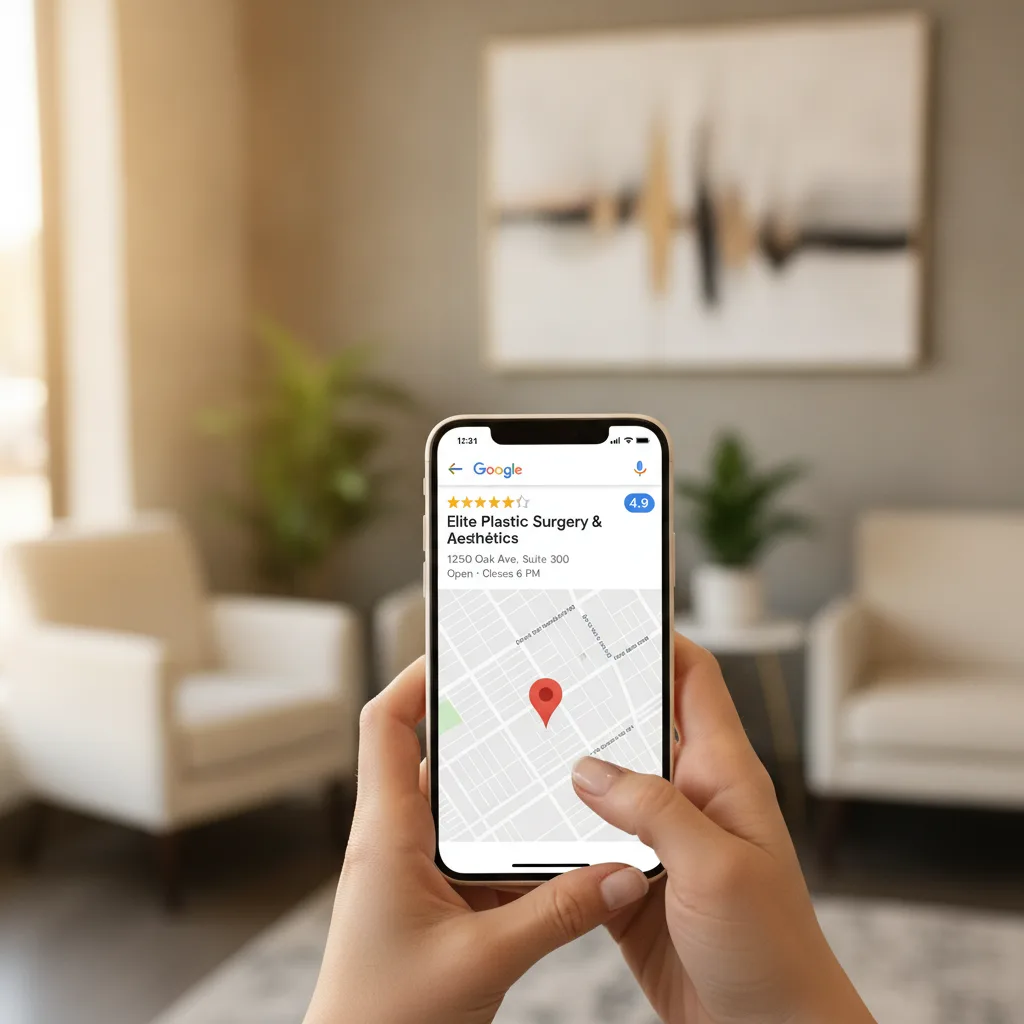
Local SEO is not optional for plastic surgery practices — 60% of plastic surgery searches include a 'near me' modifier, and local search drives over half of clinic discovery. The Google Maps local pack sits above organic results and captures 44% of all clicks for local-intent searches. Because plastic surgery is not eligible for Google Local Services Ads in most US markets as of 2026, winning the 3-Pack through organic Google Business Profile optimization is the only way to claim that top-of-page real estate beyond standard organic rankings. This makes Google Business Profile optimization the highest single-ROI activity in a plastic surgery SEO program — and the fastest, with local search ranking movement typically appearing within 30 to 60 days of meaningful GBP work.
Google ranks local listings on three signals: relevance, distance, and prominence. Relevance means your GBP categories and website content match the procedure keywords a patient is searching. Distance is not something you can change, but you can influence it by ensuring your practice address is consistent everywhere it appears online. Prominence is built through reviews, citations, and backlinks — and it is the signal where most practices have the most room to improve. Start by auditing your GBP: confirm your primary category is set to Plastic Surgeon, add every relevant secondary category your practice serves, write a keyword-rich business description that names your top procedures and your city, and upload high-quality photos of your office, staff, and consented work monthly.
NAP consistency — your Name, Address, and Phone number — must be identical across your website, GBP, Healthgrades, Vitals, RealSelf, Zocdoc, and every other directory where your practice is listed. A single digit difference in a phone number or an outdated suite number is enough to suppress your local search rankings. Tools like BrightLocal or Whitespark can audit your citations across hundreds of directories and flag inconsistencies. Beyond directories, local backlinks from hospitals, medical associations, and regional media outlets in Texas or your home market signal prominence to Google and push your Maps ranking higher than citation cleanup alone can reach.
BrightLocal
$39/mo
Audits NAP consistency across 300-plus directories, tracks local search rankings by zip code, and monitors review velocity across Google, Healthgrades, and RealSelf — the most complete local SEO dashboard for medical practices.
Whitespark
$33/mo
Local citation finder and cleanup tool — identifies where your practice is listed incorrectly and builds new citations in directories your competitors are using to strengthen local search results.
GBP posts are an underused local ranking signal
Publishing a GBP post weekly — a before-and-after case highlight, a recovery tip, a seasonal procedure reminder — signals active listing management to Google and keeps your profile fresh. Practices that post consistently tend to hold their 3-Pack positions more reliably than those that set up GBP once and leave it. This takes under 15 minutes per week and costs nothing.
Build a Review Velocity System That Strengthens Search Rankings
Reputation management is a core ranking system for plastic surgery practices, not a reputation nicety. BrightLocal data shows 97% of consumers read online reviews, 68% require at least a 4-star minimum before booking, 47% avoid practices with fewer than 20 reviews, and 74% only trust reviews from the last three months. That last figure matters most: a practice with 200 reviews but none from the past 90 days will lose patient confidence to a competitor with 40 fresh ones. Review velocity — the ongoing rate at which new reviews arrive — is as important as total review count for both patient trust and local search rankings.
The clinical evidence is specific. A single positive review on RealSelf was associated with a 30% increase in aesthetic surgery volume in peer-reviewed research, and review quantity affects patient perceptions more strongly than average star rating. This means your review strategy should prioritize consistency of asks over chasing five-star outcomes. A system that asks every satisfied patient for a Google review within 48 hours of their follow-up appointment — via a direct link in an SMS or email from Podium or Birdeye — will out-collect a practice that relies on a printed card at checkout. Train front desk staff to mention the review request verbally, then back it up with the automated message. Patients who had a positive experience are almost always willing to leave a review; they just need a frictionless path.
RealSelf deserves its own attention as part of your digital marketing and reputation management plan. RealSelf operates as a search engine in its own right for cosmetic surgery patients — prospective patients compare plastic surgeons there the same way they compare hotels on TripAdvisor. A complete, current RealSelf profile with procedure-specific reviews, before-and-after photos, and answered Q&As drives referral traffic to your website and builds the backlink authority that feeds both your local search rankings and your domain-level credibility with Google. For practices in competitive markets like Houston or Miami, an active RealSelf presence is a meaningful signal of search engine authority.
Podium
From $399/mo
Sends automated SMS review requests triggered by appointment completion, routes responses, and centralizes reputation management across Google, Healthgrades, and RealSelf in one dashboard.
Birdeye
From $299/mo
Automated review collection with strong healthcare-specific integrations and reporting on review velocity over time — useful for practices tracking GBP ranking correlation with incoming reviews.
Responding to reviews is a ranking signal
Google's own documentation lists owner responses to reviews as a local prominence signal. Responding to every review — especially negative ones, calmly and without disclosing patient information — demonstrates active management and builds trust with prospective patients reading the exchange. Aim for a response within 24 to 48 hours of any new review.
Build a Patient Education Content System That Feeds the Full Research Cycle
Clinics with active blogs generate 67% more organic traffic than those without consistent content output. For plastic surgery practices, the blog is not a vanity channel — it is the mechanism for capturing potential patients during the curiosity and research phases that happen weeks or months before they ever look up a specific surgeon. A patient who first finds your practice through a blog post on rhinoplasty recovery is at a different point in their decision than someone searching 'best rhinoplasty surgeon Austin TX,' but they are on the same path. Your patient education content system should intercept both, with each blog post linking back to the relevant procedure page so search engines understand the topical relationship.
Plastic surgery search demand is seasonal and predictable. A peer-reviewed Google Trends analysis across 13 cosmetic procedures found that facial rejuvenation and anti-aging procedures — facelift, brow lift, eyelid surgery — peak in January through March, injectables like Botox peak in late winter and early spring, and rhinoplasty peaks strongly in summer months with a significant lull across autumn. A practice that publishes facelift cost guides and recovery timelines in November and December, right before the January search surge begins, compounds its content advantage. Align your content calendar to this demand curve: face and aging content in Q4 to rank by Q1, rhinoplasty content in spring to capture summer searchers, injectables content in January to meet the early-year spike.
Patient education content should be organized into topic clusters, with each procedure page serving as the hub and supporting blog posts linking back to it. A rhinoplasty hub page would connect to supporting posts covering candidacy criteria, non-surgical rhinoplasty alternatives, ethnic rhinoplasty considerations, revision procedures, and before-and-after results by technique. This internal linking structure tells search engines that your site has comprehensive authority on the subject. Each supporting post should follow the same E-E-A-T standard as procedure pages: named surgeon authorship or review, honest information, and answers that an AI search engine like Perplexity or Google AI Overviews could cite directly. For breast procedures, body procedures, and liposuction pages, the same hub-and-spoke model applies — one anchor page, multiple supporting posts that each address a specific patient question.
Format content for AI citation and generative engine optimization
Only 37.9% of URLs cited in AI Overviews actually rank in the top 10 organic results — meaning you can earn AI search visibility without holding a classic top-ten ranking if your content is structured to answer specific questions directly. Write FAQ sections on every procedure page and blog post with the question as the heading and the answer in the first sentence. Keep answers under 60 words where possible. That structure is exactly what ChatGPT, Perplexity, and Google AI Overviews pull when they cite a source. Generative engine optimization for cosmetic surgery content is a real, trackable channel — not a future concern.
Fix Technical SEO and Site Performance on Your Plastic Surgery Website
Technical SEO is the foundation that all other efforts build on. A plastic surgery website with compelling procedure pages and strong reviews will still underperform if its pages load slowly, its mobile experience is broken, or Google can't crawl and index its content correctly. As of 2026, 76% of plastic surgery website visits come from mobile devices — meaning a page that takes more than three seconds to load on a phone is losing a substantial share of prospective patients before they read a single word. Core Web Vitals scores — Largest Contentful Paint, Interaction to Next Paint, Cumulative Layout Shift — are part of Google's ranking signal set for medical websites, and page speed is a direct factor in both search engine results pages placement and consultation conversion rates.
Before-and-after galleries are one of the most common sources of technical drag on plastic surgery websites. High-resolution image files that aren't compressed and lazy-loaded will tank page speed scores. Compress every gallery image using a tool like ShortPixel, serve images in WebP format where possible, and implement lazy loading so images below the fold don't block the initial page render. Google Search Console will flag Core Web Vitals failures at the page level — start there to find which pages are dragging your overall site performance, and prioritize procedure pages and the homepage first. A site speed improvement that brings a procedure page from a four-second load to under two seconds typically produces a measurable lift in both search engine rankings and time-on-page for website visitors who would have otherwise bounced.
Site structure matters for how Google assigns authority across a plastic surgery website. Each procedure should have a clean URL structure that includes the procedure name: '/rhinoplasty-austin/' not '/procedure-7/'. Your sitemap should be submitted to Google Search Console and updated every time a new procedure page or blog post goes live. HTTPS is non-negotiable for a medical website — any HTTP pages signal to both Google and patients that your site doesn't take security seriously. If your site is on WordPress, Rank Math handles most of the on-page technical SEO configuration; Webflow bakes clean code and fast load times into the platform by default and is a strong choice for new plastic surgery website builds.
Google Search Console
Free
The authoritative source for your site's indexing status, Core Web Vitals failures, and which queries are driving impressions — always the first diagnostic tool to open when troubleshooting search rankings.
PageSpeed Insights
Free
Google's own tool for diagnosing page speed and Core Web Vitals at the URL level — run every procedure page through it and fix the highest-impact issues first.
ShortPixel
From $4.99/mo
Bulk image compression and WebP conversion for WordPress or Webflow sites — before-and-after gallery pages are almost always the biggest speed offenders on plastic surgery websites.
Rank Math
Free / $59/yr Pro
Handles title tags, meta descriptions, XML sitemaps, and on-page SEO configuration for WordPress medical websites without requiring developer involvement.
Track What Matters and Know When to Hire a Plastic Surgery SEO Agency
Plastic surgery SEO takes 4 to 6 months to produce measurable organic traffic movement, with months four through six showing 20 to 50% month-over-month organic traffic growth for practices that execute the foundational steps correctly. By month twelve, practices typically report 50 to 150% year-over-year increases in organic consultation requests depending on starting baseline and competitive market. Set that timeline expectation before you start, because practices that abandon their SEO strategy at month three — right before rankings begin to compound — are the ones that conclude the investment doesn't work. GBP and local citation improvements are the exception: those typically show search ranking movement within 30 to 60 days.
Track the metrics that connect to revenue, not vanity. The numbers that matter are consultation requests from organic search tracked in Google Analytics 4 by channel and landing page, cost per consultation from organic versus paid, keyword rankings for your top procedure-plus-city combinations tracked weekly in Ahrefs or BrightLocal, and GBP actions — calls, direction requests, website clicks — month over month. If you're running Google Ads alongside your SEO efforts during the first six months before organic rankings kick in, CallRail lets you attribute inbound calls to the specific search channel and even the specific keyword that drove the call. That attribution is what separates ROI-accountable reporting from a PDF of traffic graphs. Qualified patient leads that can't be traced to a channel are budget you can't optimize.
The honest answer on DIY versus agency: a practice owner can execute the Google Business Profile optimization, review collection system, and basic on-page procedure page improvements without outside help — those steps are documented in this guide and produce real results. Where the math shifts toward hiring a plastic surgery SEO agency is technical SEO at scale, link building, and content production across ten or more procedure pages with proper E-E-A-T documentation. Specialist plastic surgery SEO services typically run $1,500 to $5,000 per month for most markets; Tier 1 metros like Miami, LA, and NYC run $3,000 to $12,000. At $200 per organically acquired patient against an average procedure value of $5,000 to $15,000, a well-run SEO program pays for its retainer with two or three consultations a month. The question is not whether you can afford it — it's whether you can afford to let competitors take those consultations while you're still relying on referrals and paid ads alone.
CallRail
From $45/mo
Tracks and records inbound calls by source — organic search, paid, referral — so you can attribute consultation calls to your SEO efforts instead of guessing at channel contribution.
Google Analytics 4
Free
Tracks consultation form submissions, phone click events, and organic versus paid channel splits — the core reporting layer for measuring SEO-to-consultation attribution across your plastic surgery website.
Ahrefs
$129/mo
Weekly keyword ranking tracking for your procedure-plus-city target terms, plus backlink monitoring to see which competitors are earning new authority links and what it would take to match them.
When to hire a plastic surgery SEO agency versus doing it yourself
If your practice has fewer than five fully optimized procedure pages, no active review collection system, and a GBP that hasn't been touched in six months, those are DIY-fixable in 2 to 4 hours using this guide. If you're in a Tier 1 metro competing against 50-plus plastic surgeons with established domain authority, or if you need 15 or more procedure pages built from scratch with named surgeon authorship and E-E-A-T documentation, that is agency work. The technical complexity and content volume required will consistently exceed what a practice owner can maintain alongside a clinical operation.

The One Mistake That Kills Cosmetic Surgery SEO Before It Starts
Treating cosmetic surgery SEO like plumbing SEO will cost you six months and real money before you realize the problem. Plastic surgery content is YMYL — Google's most scrutinized category — and a procedure page without named board-certified authorship, honest risk disclosure, and verifiable credentials won't hold search engine rankings no matter how many technical optimizations sit underneath it. Build the E-E-A-T foundation first, then layer on keyword optimization and link building. Reversing that order is the most common and most expensive mistake plastic surgery practices make when they try to rank without healthcare SEO experience behind them.
Lakeway Cosmetic Dentistry came to us in a similar position to where most plastic surgery practices find themselves: solid clinical reputation, weak search visibility, and a referral pipeline that wasn't scaling. We rebuilt their digital foundation — procedure content, local SEO, reputation management, paid ads — and the results came in at plus 80% organic leads year over year, plus 105% ad leads year over year, and a plus 133% increase in consultation conversion rate. The same integrated system applies directly to plastic surgery practices. We work with one client per vertical per city, so if your metro slot is open, we'll put the full strategy to work exclusively for your practice. Get your free strategy session and we'll show you exactly what your current plastic surgery SEO is leaving on the table.
Frequently Asked Questions
Ready to get started? Contact Geek Powered Studios today.