
To rank a dental practice in the Google Map Pack, complete your Google Business Profile with the correct primary category ("Dentist"), add secondary categories for every dental service you offer, build 50–80 NAP-consistent citations across dental-relevant directories like Healthgrades and Zocdoc, and generate 10–15 new Google reviews per month. Align your dental website with your GBP using LocalBusiness structured data, dedicated service landing pages, and your NAP in the site footer. Use Google Posts at least twice per month to stay active. Initial Map Pack movement typically appears within 8–12 weeks; full competitive dominance takes 4–8 months. Track GBP profile actions, grid-based rank position, and new review count weekly.
-
32%Google Business Profile's share of Local Pack ranking weight — the single largest factor
-
50–80Dental-relevant directory citations needed for strong NAP consistency signals
-
10–15/monthTarget Google review velocity for solo and small-group dental practices
-
8–12 weeksTime to first Map Pack movement after completing all six optimization steps
-
$5,000–$8,000Average patient lifetime value — the ROI multiplier behind every Map Pack lead
-
34%Click-to-call rate lift from active Google Posts — used by only 40% of dental practices
The Google Map Pack captures approximately 48% of all local search clicks, delivers 93% more calls and 126% more website traffic than non-Map Pack listings, and costs $100–$200 per new patient acquired — against an average patient lifetime value of $5,000–$8,000 for a general dental practice. If your dental office is doing $2M–$5M in annual revenue and still not appearing in the top three local search results for 'dentist [your city],' you're not facing a marketing budget problem. You're facing an execution problem. This guide solves it. The following six steps cover everything that moves the needle in Google Maps SEO for dentist offices in 2026: Google Business Profile optimization, NAP citation consistency, review velocity, dental website on-page signals, Google Posts, and performance tracking — in the order that produces results fastest.
Before you start
- A claimed and verified Google Business Profile for your dental practice — unverified profiles cannot be optimized and will not appear in local search results
- Admin access to your dental practice's website (WordPress, Webflow, or a similar CMS) so you can edit title tags, meta descriptions, footer content, and page structure
- A complete list of every directory where your practice name, address, and phone number currently appear — run a quick search for your practice name plus city to find unlisted duplicates
- A Google account with access to Google Search Console linked to your dental website for indexing and search performance data
- A basic review solicitation workflow — even a manual text or email sent post-appointment — already in place or ready to build before you start Step 3
- A Local Falcon or BrightLocal account for grid-based Map Pack rank tracking — both offer free trials and you'll need one to measure the impact of every change you make
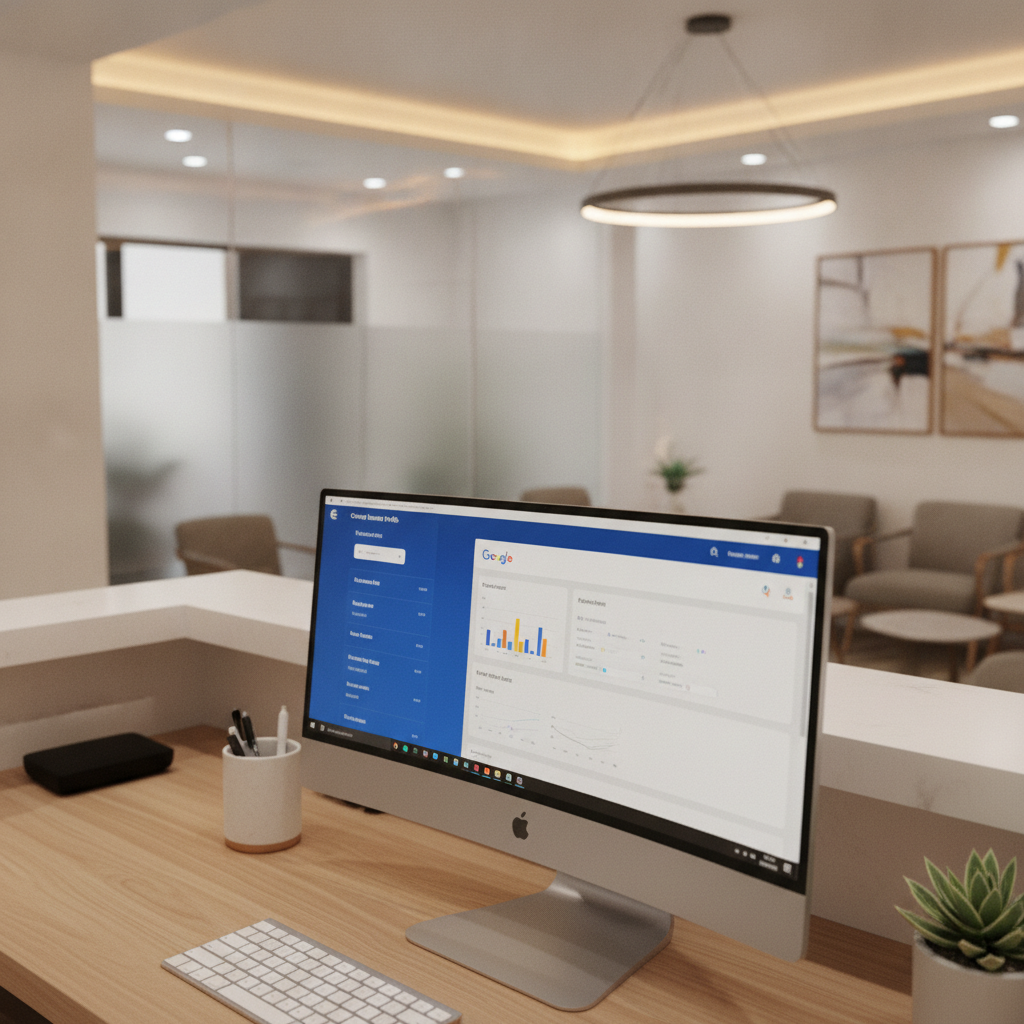
Fully Optimize Your Google Business Profile for Dental Services
GBP signals account for 32% of Local Pack ranking weight — no other single ranking factor comes close, according to BrightLocal's 2026 local ranking factors study. That makes your Google Business Profile the highest-ROI asset in your entire dental SEO strategy, and most dental offices leave it half-finished. A complete GBP gets 7x more clicks than an incomplete one and up to 18x more search visibility across local searches.
Start with the details most dental practices get wrong. Your primary category must be 'Dentist' — not 'Dental Clinic' or 'Health Consultant.' Add secondary categories for every dental service you actually offer: 'Cosmetic Dentist,' 'Pediatric Dentist,' 'Emergency Dentist,' 'Orthodontist,' as applicable. Each secondary category opens your profile to a new set of patient searches. Under the Services tab, list specific procedures: teeth whitening, Invisalign, dental implants, teeth cleaning, emergency dental care, and any specialty treatments your practice provides. Google reads these service entries to match your profile to potential patient searches — skipping them is leaving visibility on the table.
Your GBP description should run 700–750 characters and include your city name, your top two or three services, and a clear call to book an appointment. Upload at least 25 photos: 6 exterior shots, 6–8 interior and operatory images, 4–6 team headshots, and 4–5 clinical environment photos. Top-performing dental GBPs generate roughly 600 monthly profile actions (calls, direction requests, website clicks) versus 200 for the average dental practice. The difference is almost always completeness and photo count. Use the Google Business Profile Manager dashboard to audit every field — hours, phone number, website link, service areas — and confirm everything is accurate before moving to Step 2.
Google Business Profile Manager
Free
The native dashboard for editing categories, services, photos, hours, and description — the ground floor of dental Google Maps SEO.
Local Falcon
$29–$99/mo
Grid-based rank tracker that shows exactly where in your city your GBP appears for target searches like 'dentist near me' — essential for measuring the impact of every GBP change.
Common Mistake
Do not use a keyword-stuffed business name like 'Austin Family Dentist – Dr. Smith.' Google has suspended profiles for this. Your GBP name must match your real-world business name exactly as it appears on your signage and legal documents — no descriptors, no city modifiers appended to the name.
Lock Down NAP Consistency Across 50–80 Dental-Relevant Directories
Practices with consistent name, address, and phone (NAP) information across 25 or more directories rank 2.4 positions higher in the Local Pack than those with five or more citation discrepancies, according to 2026 benchmark data. Two and a half positions is the difference between Map Pack visibility and page-two obscurity. Citation signals are the trust verification layer that tells search engines your dental practice is a real, stable business at a fixed location — local citations are not optional for competitive dental SEO.
Dental practices need 50–80 high-quality, dental-relevant citations — not 500 random business directory listings. Prioritize in this order: Google Business Profile (done in Step 1), Healthgrades, Vitals, Zocdoc, WebMD Health, ADA Find-a-Dentist, your state dental association directory, Yelp, Facebook, Apple Maps, Bing Places, and Yahoo Local. These health directories carry far more local signal weight than generic business directories like Manta. Skip mass-submission services that push your practice onto 200 irrelevant sites — they dilute your citation profile and can introduce new discrepancies.
The number-one citation error is inconsistency, not absence. 'Suite 200' versus 'Ste. 200,' a disconnected phone number still live on an old directory, or a previous practice name on a Healthgrades profile — all of these confuse search engines and suppress rankings. Audit every existing listing using BrightLocal's Citation Tracker or Whitespark. Correct every discrepancy before building new accurate directory listings. Once your NAP information is accurate and consistent across online directories, those local citations stabilize your Local Pack rankings within 3–6 weeks. Removing duplicate listings that show up under an old address or phone number is equally important — duplicate listings split your citation authority and send mixed signals to search engines.
BrightLocal Citation Tracker
$29–$79/mo
Scans 50+ directories for NAP discrepancies and tracks citation accuracy over time — the fastest way to find and fix inconsistent listings before they suppress rankings.
Whitespark Local Citation Finder
$33–$83/mo
Identifies citation opportunities your competitors are using that you're missing — especially useful for finding dental-specific and local city directories in your region.
Pro Tip
After correcting citations, request a Google Business Profile re-verification if your profile was originally verified more than 12 months ago. A fresh verification signal can accelerate ranking movement by 2–4 weeks — and it confirms to Google that the same practice is still operating at the same location.
Build a Review Velocity System That Outranks Stale Competitors
Patient reviews account for roughly 24% of local pack ranking weight, making them the single largest prominence lever a dental practice directly controls — and velocity matters more than total count. A dental clinic receiving 5 new reviews every month consistently outranks a clinic that accumulated 100 reviews years ago and has gone quiet. Search engines read ongoing patient engagement as a recency trust signal, not just a popularity score. Velocity, consistency, and review content all factor in.
The review count benchmark depends on your market size. In small markets under 200,000 population, 50+ Google reviews at 4.2 stars or higher is enough to be competitive. Mid-size markets need 100–200 reviews at 4.4 stars or better. Major metros like Austin, Houston, or Dallas require 200–500+ reviews at 4.6 stars or higher to hold a top-three Map Pack position. The target velocity for a solo or small-group dental practice is 10–15 new Google reviews per month. Practices using automated review solicitation increase monthly review volume by 300–500% and reach a 4.8-star average within 6–12 months. Encourage patients to leave reviews immediately after their appointment, while the experience is fresh — every extra click in a review link drops potential reviewers by 20–30%.
Review content matters as much as count and velocity. Google's algorithm reads review text for keyword relevance — a patient who writes 'Dr. Smith completed my Invisalign treatment and the results were incredible' helps your practice rank for Invisalign searches more than a generic five-star tap with no comment. Train your front desk to coach patients verbally before they leave: 'When you leave us a review, mention the specific treatment you had — it helps other patients find the right dental care.' Respond to every patient review within 48 hours, including negative ones. Your response text is also indexed by search engines, so treat each reply as another local SEO signal. A strong review profile builds credibility and trust with both prospective patients and the algorithm simultaneously.
NiceJob
$75–$200/mo
Automated post-appointment review requests via text and email with direct links to your Google review page — the lowest-friction option for small dental practices.
Podium
~$399/mo
Full messaging platform with automated review solicitation, two-way text, and PMS integration — best for multi-location dental groups or practices doing 200+ appointments per month.
Birdeye
$299–$449/mo per location
Enterprise-grade reputation management with PMS integrations (Dentrix, Eaglesoft) and cross-platform review monitoring — ideal for DSOs and practices already using these systems.
Critical Warning
Never buy Google reviews, offer incentives for reviews, or use a review-gating system that only sends requests to patients you already know are happy. All three violate Google's review policies. A single enforcement action can suspend your entire GBP — which means zero Map Pack visibility until the issue is resolved, a process that typically takes weeks and can set your local SEO strategy back by months.
Optimize Your Dental Website to Reinforce Google Maps Signals
Your dental website and your Google Business Profile function as a two-way signal loop, and a strong GBP with a weak dental practice website produces lower local search results rankings than a practice that aligns both. Google cross-references the information on your dental practice's website against your GBP: the same NAP, the same service descriptions, the same service areas. Effective local SEO for dentists always treats the website and GBP as a single connected system, not two separate marketing assets. Dental practices with optimized websites consistently outperform those relying solely on GBP signals.
Three on-page elements produce the most local ranking impact. First, your homepage title tag should follow this format: 'Dentist in [City] | [Practice Name] | [Top Service]' — for example, 'Dentist in Austin | Riverside Dental | Invisalign and Family Dental Care.' Meta descriptions on service pages should include location-specific terms and a call to book. Second, embed a Google Maps iframe on your Contact page — this creates a direct geographic anchor that search engines read as location confirmation. Third, add LocalBusiness and Dentist structured data (schema markup) to your homepage and service pages. Include your NAP, hours, accepted insurance, and service list in the structured data — it helps search engines understand your practice as a local entity and feeds AI answer engines like ChatGPT and Perplexity that pull from the same data. Schema markup is one of the most underused tools in dental SEO, and adding it is a direct competitive advantage.
Build dedicated landing pages for each high-value dental service: dental implants, Invisalign, cosmetic dentist services, emergency dental care, teeth whitening, and pediatric dentist, at minimum. Each landing page should target a local keyword ('dental implants Austin TX'), include the service description, patient FAQs, and a call-to-action to book an appointment. Over 60% of dental website traffic now comes from mobile devices, so test every landing page on a smartphone. Pages that load in under 2.5 seconds on mobile hold patient attention; pages that take longer lose 20–30% of visitors before the page finishes loading. Use Google PageSpeed Insights to check your site speed score and target 85+ on mobile. Good mobile optimization is both a ranking factor and a direct conversion factor — search performance and patient experience improve together.
Google PageSpeed Insights
Free
Diagnoses mobile and desktop speed issues on your dental website with specific fix recommendations — directly correlates to both SEO search rankings and patient conversion rates.
Google Search Console
Free
Shows which search queries are driving impressions and clicks to your dental website, and flags indexing issues that suppress local search results performance.
Quick Win
Add your practice's full NAP in the footer of every page on your dental website. This single change aligns your website's location signals with your GBP and can produce measurable ranking improvement within 4–6 weeks — no developer required if you have CMS access. It also ensures Google cross-references your site and GBP consistently across every page it indexes.
Use Google Posts to Drive Click-to-Call Rate and Signal Activity
Dental practices that actively use Google Posts see a 34% higher click-to-call rate, yet 60% of dental offices have never used this feature. Google Posts appear directly in your GBP panel in local search results — they are free ad space that most of your competitors are ignoring. Activity signals — posting frequency, Q&A responses, photo uploads — tell Google's algorithm that your dental practice is engaged and current, which reinforces local ranking. The dental industry as a whole underuses this tool, which means the opportunity to stand out in the dental community is still wide open.
Post at least twice per month. Each post should follow this formula: one sentence hook, one specific offer or announcement, and one direct call-to-action with your phone number or a booking link. Effective post types for dental practices include: new patient specials, seasonal reminders (back-to-school cleanings in August, end-of-year insurance benefit reminders in October), new service announcements for treatments like same-day crowns or clear aligners, and team spotlights. Write posts in plain language — 150–200 words — and include a photo. Offer-type posts expire after 7 days; standard update posts remain visible, so check your GBP dashboard weekly.
Answer every question in the Q&A section of your GBP proactively. If your dental office repeatedly gets the same question — 'Do you accept Delta Dental?' or 'Do you see children?' — post the question yourself and answer it. This populates your GBP with keyword-rich content that search engines index and that prospective patients read before calling. Each answered Q&A is a free local SEO signal that most dental practices skip entirely. The Q&A section also gives you a place to address common patient concerns — insurance, appointment availability, emergency dental care — before a potential patient has to call to find out. That friction reduction directly improves conversion from search to booked appointment.
Frequency Rule
Two Google Posts per month is the floor, not the goal. Four to six posts per month — roughly one per week — produces the strongest engagement signal. Batch-write a month of posts in one 45-minute session and schedule them using the GBP dashboard's scheduling feature to ensure ongoing maintenance without adding weekly tasks to your calendar.
Track Map Pack Performance and Adjust Based on Real Data
Map Pack visibility improvements can appear within 8–12 weeks for practices with an optimized GBP and a structured review generation system. Full Map Pack dominance for competitive local keywords typically takes 4–8 months. You need a measurement system from day one — not because the results come fast, but because you need to know which specific actions are moving the needle and which are not. Tracking search performance weekly is what separates practices that compound results from those that plateau after early gains.
Track three numbers weekly: GBP profile actions (calls, direction requests, website clicks) inside the GBP Insights dashboard; grid-based rank position for your top five local keywords using Local Falcon or BrightLocal's Local Search Grid; and new Google review count versus the prior week. The average dental practice GBP generates 1,803 profile views per month and about 200 customer actions. If you've completed Steps 1–5 and are still at those averages after 12 weeks, your citation profile likely has unresolved discrepancies or your review velocity is below the 10–15 per month threshold. CallRail tracks which calls came directly from your GBP versus your dental website — so you can separate Map Pack ROI from organic search traffic ROI and report each channel accurately.
The ROI math on Map Pack ranking is straightforward. The average dental patient lifetime value runs $5,000–$8,000 for a general practice — up to $22,000 or more for cosmetic-heavy practices. Acquiring a new patient through local SEO for dentists costs $100–$200 per patient, compared to $150–$400 via Google Ads. A practice generating 20 new patients per month from Map Pack visibility at a $150 average cost per patient produces $3,000 in monthly marketing spend against $100,000–$160,000 in patient lifetime value. That return profile makes local dental SEO the highest-ROI channel in dental marketing — and it compounds every month you hold a top-three Map Pack position. Invest in the measurement infrastructure from month one so you can prove it to yourself and to any partner you bring in to help.
CallRail
$45–$145/mo
Tracks calls by source (GBP, website, ads) with call recording — the only way to know exactly how many new patient calls your Map Pack ranking is actually generating.
BrightLocal
$29–$79/mo
Combines citation tracking, local rank tracking, and GBP audit in one dashboard — the most cost-efficient all-in-one tool for solo and small-group dental practices managing their own local SEO.
Benchmark Check
By month 3: your GBP profile actions should be up at least 25% from your baseline. By month 6: you should hold a top-three Map Pack position for at least one primary keyword ('dentist [your city]') and be generating 10–20 new patient leads per month from organic local searches. If neither benchmark is true at month 6, pull a citation audit before changing anything else — citation discrepancies are the number-one reason properly optimized GBPs stall in the local pack.

AI Search Changes the Stakes — But Not the Playbook
As of 2026, AI Overviews from Google, along with ChatGPT and Perplexity, are compressing organic click-through rates for standard blue-link results. But these tools pull answers directly from Google Business Profiles and structured local data — which means the same Google Business Profile optimization that ranks your dental practice in the Map Pack also feeds AI-generated answers when a potential patient asks 'Who's the best dentist near me?' in an AI search engine. The GBP work isn't becoming less important. It's becoming the foundation for two channels at once. Dental practices that skip this work won't just miss the Map Pack — they'll be invisible in AI local search results too.
Ready to get started? Contact Geek Powered Studios today.