
A single-location LASIK practice working with a specialty-fluent LASIK marketing agency in 2026 should budget $8,000–$25,000+ per month all-in. That number stacks three separate line items: the agency management retainer ($4,500–$9,000/month), Google Ads spend passed through separately ($3,000–$15,000/month depending on metro density), and tool costs for CallRail at $45/month, Unbounce at $99/month, and Podium at $399/month for reputation management. Most proposals quote only the retainer. The full number is what pays for actual patients in the chair, and any LASIK marketing agency worth hiring will show you every line item before you sign anything.
-
$8,000–$25,000+/monthTrue all-in LASIK marketing cost, single location
-
$4,500–$9,000/monthAgency retainer only, single-location LASIK practice
-
$20–$80 per clickLASIK paid search CPC, nearly 15x the industry median
-
$1,500–$3,500 per surgeryFully loaded LASIK patient acquisition cost
-
30–60 daysTime for Google Ads to produce qualified consultation requests
-
9–18 monthsTime for SEO to produce compounding organic LASIK leads
-
4–8%Benchmark conversion rate for a well-built LASIK landing page
-
30–40% budget increaseRecommended spend lift during January and May–June demand peaks
A single-location LASIK practice working with a specialty-fluent LASIK marketing agency in 2026 will spend $8,000–$25,000+ per month when you add up every real line item. That number surprises most practice administrators and ophthalmology group buyers — because the retainer quote they received in the sales call was $4,000. The gap between what agencies quote and what practices actually spend is the core problem this guide solves. The LASIK industry runs on $4,000–$6,000 per-procedure cash-pay revenue. The patient acquisition math works at scale. But only if you know your true all-in number before you sign, and only if the agency running your patient pipeline understands that LASIK marketing services are not the same as general healthcare digital marketing. This breakdown covers every tier, every tool cost, and every fee that tends to vanish from proposals.
LASIK Marketing Services Pricing: What It Costs in 2026
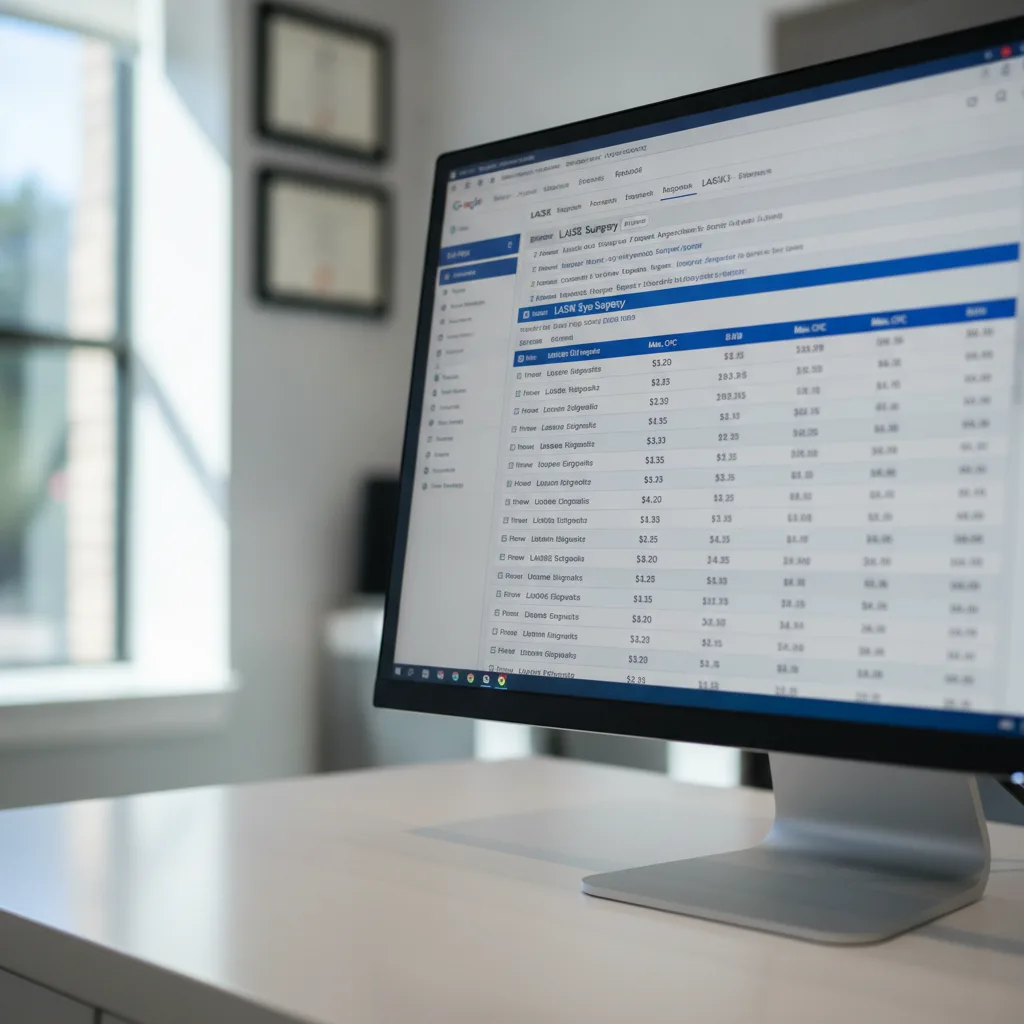
| Tier | Price range | What's included | Best for |
|---|---|---|---|
| Entry-Level / Flat-Fee Vendor | $2,000–$4,500/month (management fee only) | Basic Google Ads management, templated landing pages, monthly reporting | Practices testing digital marketing for the first time or running under $3,000/month in ad spend |
| Specialty-Fluent LASIK Marketing Agency (Single Location) | $4,500–$9,000/month (management fee) + $3,000–$15,000/month ad spend | Senior account management, full-funnel paid search, SEO, landing page optimization, CallRail tracking, reputation management oversight | Single-location LASIK practices doing $2M–$5M in revenue that need a true patient-generating machine |
| Multi-Location Group (2–5 Locations) | $9,000–$20,000/month (management fee) + ad spend per location | Multi-location campaign architecture, market-specific landing pages, cross-location reporting, brand consistency management, Podium reputation management | Regional LASIK groups running 2–5 clinics across one or more metros |
| Enterprise / PE-Backed MSO (6+ Locations) | $20,000–$60,000+/month (management fee) + consolidated ad spend | Enterprise campaign architecture, dedicated strategy team, custom reporting dashboards, national brand and local market execution, full content marketing and SEO program | Private equity-backed ophthalmology groups or MSOs scaling across multiple states |
What You Get at Each Tier: LASIK Marketing Agency Breakdown
Entry-Level / Flat-Fee Vendor
Flat-fee vendors in the $2,000–$4,500 range typically pass ad spend directly to Google and Meta at zero markup, which looks clean on paper. The real cost is staffing reality: at this fee floor, your account is handled by a junior account manager running automated playbooks, not a senior operator who knows which LASIK keywords drain budget fastest. You get coverage, not strategy.
Landing pages are templated, search engine optimization is shallow, and nobody on the team has built a LASIK patient pipeline from scratch. For a practice billing $4,000–$6,000 per bilateral procedure, the difference between a 3% and a 6% landing page conversion rate is material revenue. That gap rarely closes without senior attention and proven strategies tailored to the LASIK industry.
Specialty-Fluent LASIK Marketing Agency (Single Location)
This is the sweet spot for a single-location LASIK practice in 2026. The $4,500–$9,000 management retainer covers senior operators who understand LASIK keyword segmentation, landing page architecture, and the seasonal budget shifts that lower effective cost per booked consultation. Ad spend stacks on top as a separate pass-through. A mid-size metro practice typically runs $3,000–$8,000/month in Google Ads, while competitive markets like Austin, Dallas, and Phoenix push $8,000–$15,000/month.
Add CallRail at $45/month to attribute patient phone calls to specific campaigns, Unbounce at $99/month for landing page testing, and Podium at $399/month for reputation management, and your all-in monthly number lands between $8,000 and $25,000+ depending on metro density. At this tier, expect cost per qualified lead to run $80–$200 in mid-size markets and $150–$250 in dense metros, with a fully loaded patient acquisition cost of $1,500–$3,500 per surgery booked.
Multi-Location Group (2–5 Locations)
Running paid search and search engine optimization across multiple locations isn't twice the work of one location — it's four times the complexity. Each clinic needs its own campaign structure, landing pages calibrated to local competition, and reputation management that keeps the brand consistent across Google Business Profiles. Prospective LASIK patients read 10 or more reviews before ever contacting a practice, and 40% have reconsidered a LASIK provider based on negative online reputation signals — so reputation management at this tier is a direct revenue driver, not an optional add-on.
Podium at $399/month for SMS review solicitation outperforms email follow-up by 3–4x for post-op review collection. The management fee range of $9,000–$20,000 reflects the complexity of handling multi-location digital marketing strategies, and ad spend per location adds another $3,000–$10,000 per market on top. The brand consistency work across all clinic sites also requires a more robust web design and content marketing infrastructure than a single-location practice needs.
Enterprise / PE-Backed MSO (6+ Locations)
At the enterprise tier, LASIK marketing services shift from campaign management to integrated growth strategy. A dedicated team handles national brand consistency while individual market operators tune campaigns to local search engine auction dynamics and competitive density. Content marketing and SEO programs run in parallel to paid advertising, building organic lead pipelines that compound over 9–18 months while Google Ads delivers new refractive surgery patients in the near term.
The $20,000–$60,000+ management fee reflects both headcount and the infrastructure required to execute across six or more clinic locations without the reporting chaos that sinks multi-market programs. Social media marketing, email marketing campaigns, and web design updates across the full location portfolio all fall inside this tier's scope. Practices at this scale should also expect specialized services like custom dashboard builds and market-level attribution reporting that a standard retainer does not cover.

Pros and Cons of Hiring a LASIK Marketing Agency
- $4,000–$6,000 per-procedure revenue makes even a $1,500–$3,500 patient acquisition cost cash-flow positive from the first surgery — the math works at scale for LASIK practices in a way that most home services verticals cannot match, which is why LASIK and refractive surgery practices should invest 8–12% of target revenue on marketing.
- Google Ads delivers qualified consultation requests in 30–60 days, making paid search the fastest channel to put new refractive surgery patients in the chair while your SEO program builds long-term organic lead flow and search engine rankings compound over time.
- Ophthalmology paid search converts at 18.29%, one of the highest rates across all healthcare specialties — potential patients searching for LASIK procedures are high-intent, and the channel rewards practices that show up with the right message on the right landing pages.
- Seasonal demand spikes are predictable and actionable: practices that increase paid advertising spend 30–40% in January and May–June consistently lower their effective cost per booked consultation across the full year, creating a more efficient patient pipeline than those who run flat budgets.
- Search engine optimization compounds over time, giving a LASIK practice that starts SEO today meaningful traffic movement in 3–6 months and organic leads that arrive without incremental ad spend by month 9–18 — greatly increasing the return on the initial marketing investment.
- Market exclusivity protects your investment: working with a LASIK marketing agency that limits clients to one practice per metro means your budget, your marketing strategies, and your team's attention are never split with the competitor down the street, which makes a big difference in competitive urban markets.
- CPCs of $20–$80 per click make LASIK paid search nearly 15x the 2026 cross-industry median of $5.42 — a single poorly structured campaign can burn through $5,000 in ad spend before generating a single qualified consultation request, which is why senior operators managing these LASIK ads matter more than the retainer price.
- The stated retainer rarely reflects the true all-in cost: most LASIK marketing agency proposals omit the onboarding fee, the actual Google Ads budget, CallRail for call tracking, and Unbounce for landing page testing — which can add $500–$2,000/month before a single ad runs, and practices that discover this after signing face an unpleasant surprise.
- Percentage-of-spend agencies are structurally incentivized to push ad budgets higher: at $10,000/month in Google Ads, a 15–20% management fee markup adds $1,500–$2,000/month on top of any stated retainer, regardless of whether the extra spend is generating more new patients for your practice.
- CPQL above $300 for two consecutive months signals a structural problem, not a bid adjustment issue — practices that treat it as tactical instead of auditing their full patient pipeline (contact rate, show rate, consult-to-surgery conversion) will keep spending without fixing the actual break point, burning through their marketing budget.
- SEO takes 9–18 months to compound, and practices that expect first-page search results within 60 days will be disappointed — those who cancel at month four kill the investment before organic leads begin arriving, wasting the prior months of SEO techniques and site optimization work.
- 40% of potential customers have reconsidered a LASIK provider based on negative reviews, meaning an online reputation gap turns paid search traffic and organic website visitors into patients for other practices instead of yours — and no amount of Google Ads spend fixes a brand with a 3.8-star average on the first page of search results.
How to Set Your LASIK Marketing Budget: 6 Steps Before You Sign
- Calculate your all-in monthly number before comparing proposals Add the agency management fee ($4,500–$9,000 for a single location) to your Google Ads budget ($3,000–$15,000 depending on metro), plus tool costs for CallRail ($45/month), Unbounce ($99/month), and Podium for reputation management ($399/month) — your realistic all-in monthly investment runs $8,000–$25,000+, and any proposal quoting less than half of that deserves a full line-item audit before you proceed.
- Set your target cost per qualified lead before signing anything Benchmark your metro against 2026 standards: $80–$200 per qualified lead in mid-size markets, $150–$250 in dense urban metros, and write a clause into your agency agreement that triggers a strategy review if CPQL runs above $300 for two consecutive months — this single clause has more value than most agencies' standard service-level promises.
- Confirm your landing pages convert at 4–8% before scaling ad spend A LASIK landing page converting below 4% typically leads with surgeon credentials instead of addressing the fear and cost objections that prospective LASIK patients carry into every search session — fix the page first, because adding more Google Ads budget to a 2% converting page multiplies waste, not more qualified leads or actual patients.
- Build your seasonal budget plan around January and May–June demand peaks Practices that increase paid advertising spend 30–40% during the January FSA/HSA reset and the pre-summer demand spike in May–June, then pull back in shoulder months, lower their effective cost per booked consultation across the full year — build this calendar before Q4, not after the demand window has already opened.
- Treat reputation management as a required line item, not an optional service Prospective LASIK patients read 10 or more reviews before contacting a practice, and 40% have reconsidered providers based on negative reviews — Podium at $399/month for SMS text messages to post-op patients pays for itself the first month it captures a handful of satisfied patients who would otherwise have gone silent, protecting your online reputation and encouraging family members and friends to refer others.
- Verify the agency's fee structure is flat retainer, not percentage-of-spend A flat management fee aligns your agency's incentives with your patient pipeline results; a percentage-of-spend model at 15–20% of ad spend adds $1,500–$2,000/month on a $10,000 Google Ads budget and creates structural pressure to increase spend regardless of whether more spend is the right marketing strategy for your practice's current stage of growth.
The Hidden Fee Stack That Doubles Your Monthly Bill
A LASIK marketing agency quoting a $4,000/month retainer may be quoting only the management fee. The actual monthly bill often includes a $1,500–$3,000 onboarding fee in month one, the full Google Ads budget passed through separately, a 15–20% percentage-of-spend markup if the agency doesn't use a flat fee model, plus tool costs for CallRail, Unbounce, and Podium that nobody mentioned during the sales call. One practice we audited thought they were spending $6,000/month total — their actual all-in spend was $14,200. Know your full number before you sign.
San Antonio Eye Specialists came to Geek Powered Studios and saw +196% in PPC leads, +156% in organic leads, and record-breaking sales months within six months — because we treat LASIK practices the same way we treat our top home services clients: as a patient-generating machine that needs the right fuel, the right marketing strategies, and transparent reporting on every dollar. A custom website is included at no extra cost. No long-term contract. And you will know your full all-in monthly number before we touch a single campaign. If your current LASIK marketing services budget isn't producing $80–$200 cost-per-qualified-lead from paid search and a compounding organic pipeline, that is the conversation we should have. More LASIK patients start with a clear plan. Book your free strategy session and let's map out what the right budget actually looks like for your metro market.
Frequently Asked Questions
Ready to get started? Contact Geek Powered Studios today.