
Local SEO for dentists is a 6-step process: fully optimize your Google Business Profile, audit NAP consistency across 25+ directories, build 10–15 new Google reviews per month via automated SMS requests, create dedicated service pages targeting location-specific keywords, add Dentist schema markup and a Google Maps embed, then track Map Pack rankings and GBP actions monthly using BrightLocal and CallRail. As of 2026, GBP signals account for 32% of Local Pack ranking weight, review signals account for 24%, and on-page website signals account for 19%. A practice that completes all six steps can expect Map Pack appearances for lower-competition terms within 90 days and full competitiveness for 'dentist near me' in a mid-size Texas market by month 5–7. Once established, cost per new patient from organic local search runs $50–$150 — versus $150–$400 per lead from paid ads.
-
44%Map Pack click share on 'dentist near me' queries — highest of any SERP block
-
32%Google Business Profile signals' share of Local Pack ranking weight
-
10–15/moNew Google reviews per month needed to maintain Map Pack visibility
-
$50–$150Cost per new patient from organic local search once SEO is established
-
2.4 positionsLocal Pack ranking gain from fully consistent NAP across 25 directories
-
5–7 monthsTypical timeline to full Map Pack competitiveness in a mid-size Texas market
The Map Pack captures 44% of all local search clicks on 'dentist near me' queries — more than organic results (29%) and paid ads (19%) combined. Yet most independent dental practices hand that traffic to DSOs and insurance directories through five specific, fixable errors before a single ad dollar is spent. This guide is a 6-step operational playbook for local SEO for dentists: concrete benchmarks, named tools, realistic timelines, and a direct path to $50–$150 cost-per-new-patient once the system is built. Setup takes 6–10 hours across two weeks. Ongoing maintenance runs 2–3 hours per month. The dual reality of local search in 2026 is that the same Google Business Profile optimizations that win the Map Pack now also feed ChatGPT, Perplexity, and Gemini when someone asks 'best dentist in [your city].' Fix the fundamentals once, and they compound in two directions at once.
Before you start
- Verified Google Business Profile (GBP) ownership — claimed and verified, not just created
- Admin access to your dental practice website's CMS, or a developer on call for schema markup
- A spreadsheet listing your practice name, address, and phone number exactly as they appear on your GBP — this is your canonical NAP
- Access to at least one review automation tool: Birdeye ($299/mo), Podium ($399/mo), NiceJob ($75/mo), or Weave ($400+/mo)
- Google Search Console verified for your dental practice website domain
- A list of your top 5 procedures — dental implants, Invisalign, teeth whitening, emergency dental care, pediatric dentistry — to build service pages around
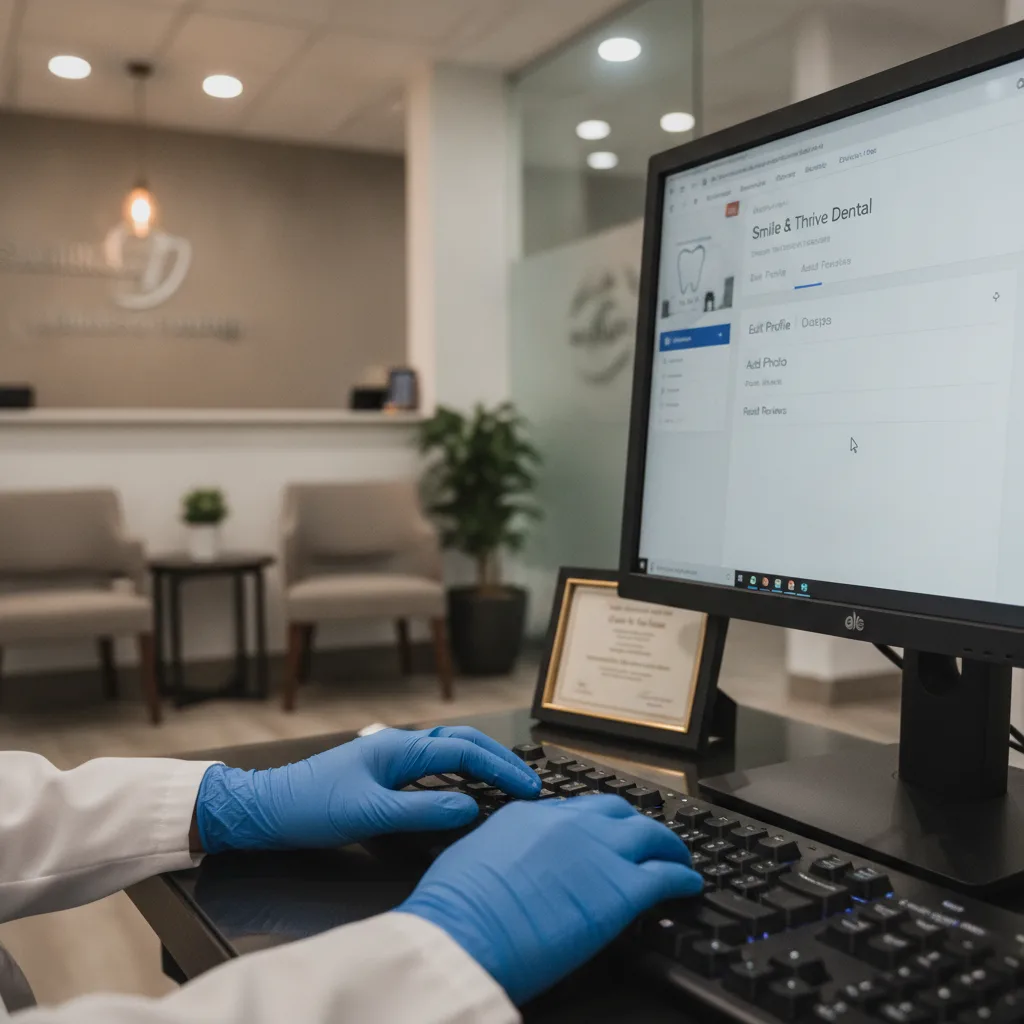
Fully Optimize Your Google Business Profile for Local Pack Ranking
Google Business Profile signals account for 32% of Local Pack ranking weight — the largest single factor in dental local SEO — making GBP optimization the highest-ROI hour you will spend on any dental marketing task. Audit your GBP for category accuracy, business description keyword density, service list completeness, and photo count before touching anything else. A profile with the primary category set to 'Dentist' plus secondary categories (Cosmetic Dentist, Emergency Dental Service) consistently outranks profiles using only the generic 'Dentist' designation in local search results.
Your GBP photo library needs at least 25 images to hit the competitive threshold: 6 exterior shots, 6–8 interior photos, 4–6 team headshots, and 4–5 clinical environment images. Dental practices meeting this benchmark outperform competitors in visual search and profile engagement, and photos should be refreshed every 60–90 days to signal an active profile to Google's prominence scoring. Confirm that business hours, holiday hours, phone number, website URL, and appointment link are all current and match your dental practice website exactly — any mismatch between your GBP and your site undermines both local search rankings and search engine confidence in your data.
AI assistants including ChatGPT, Perplexity, and Gemini now pull local business data directly from GBP when answering 'best dentist in [city]' prompts, so every Google Business Profile optimization feeds two channels at once: the Map Pack and the AI answer layer. GBP optimization produces measurable local ranking improvements within 30–60 days for most dental practices, with full Map Pack dominance for competitive local keywords arriving at 4–8 months. As of 2026, over 60% of dental website traffic comes from mobile devices — every friction point in your GBP (missing hours, wrong phone, no booking link) costs you nearby patients who found you on a phone and left before calling.
Google Business Profile Manager
Free
The native dashboard for editing categories, services, photos, posts, and Q&A — every local SEO effort starts here
BrightLocal
$39–$149/mo
GBP audit reports, local rank tracking by zip code grid, and citation monitoring in one platform
Pro tip
Post one GBP update per week — a completed case photo, a seasonal promotion, or an FAQ answer. Weekly posts correlate with higher profile action rates (calls, direction requests) and signal activity to Google's prominence scoring. The top 10% of dental practices generate 3x the GBP profile actions of the average practice, and post frequency is one of the clearest separators.
Audit and Fix NAP Consistency Across Local Citations and Dental Directories
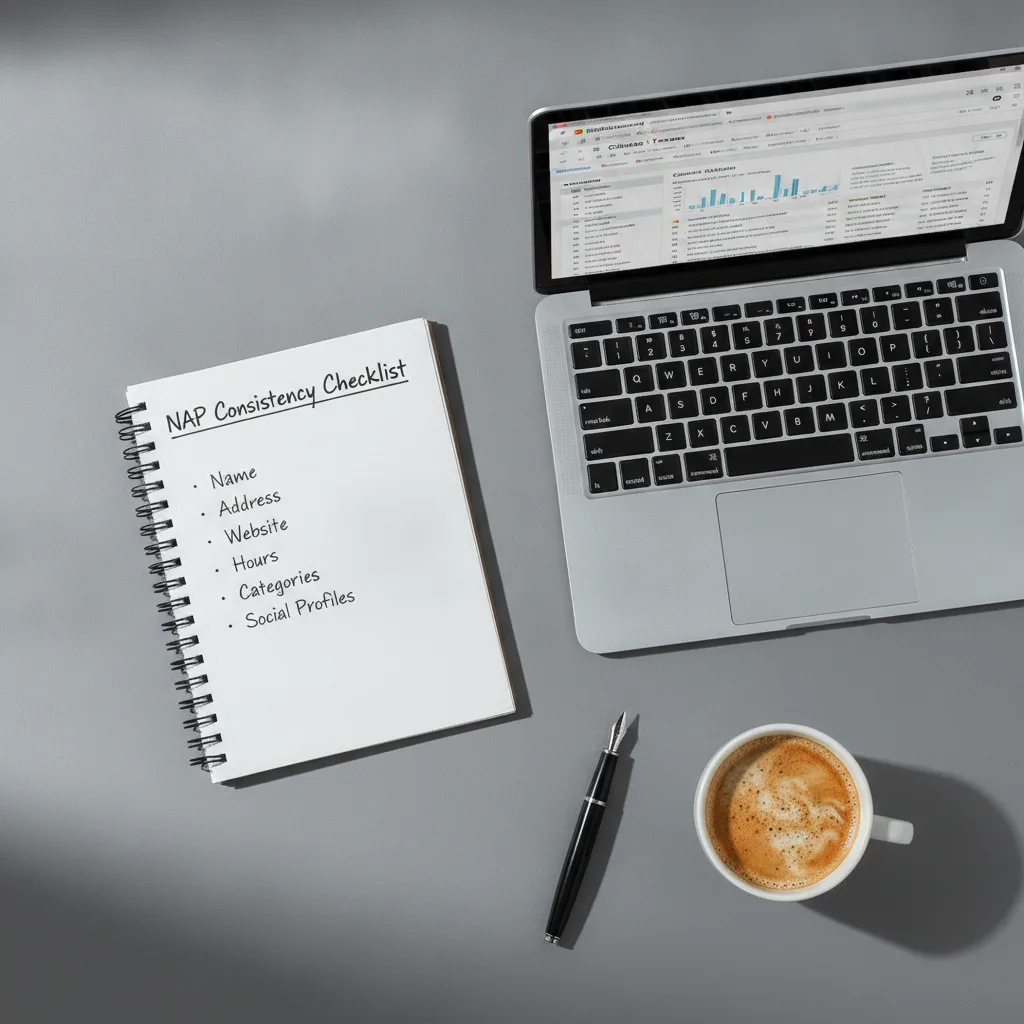
Dental practices with fully consistent NAP (Name, Address, Phone) data across their top 25 directories rank 2.4 positions higher in the Local Pack than practices with five or more discrepancies — and NAP consistency beats citation volume outright. A practice with 30 perfectly consistent local citations outranks a competitor with 150 citations that have minor address-format variations. Run a NAP audit before building any new local listings. Your canonical NAP format (Suite vs. Ste, periods in 'Dr.' or none) must be identical across every platform and must match your GBP exactly.
The priority citation stack for dental practices in 2026 is: Google Business Profile, Yelp, Healthgrades, Zocdoc, WebMD, 1-800-Dentist, the ADA's dentist finder, your state dental association directory, Bing Places, Apple Maps, Facebook, and your local chamber of commerce. Start with these 12, confirm every field matches your canonical NAP, then expand to the broader 25 dental directories. Use BrightLocal's Citation Tracker or Whitespark's Citation Finder to surface existing local listings you may not know exist — both tools show competitor citation profiles, so you can identify gaps in your own dental practice's online presence.
For practices with multiple locations, each location needs its own GBP profile and its own citation cluster built around that location's specific address and local phone number. Mixing location data — even a single shared phone number across two offices — creates NAP inconsistencies that suppress local search rankings for both locations. The local search engine optimization rule here is strict: one location, one NAP, one citation cluster. Moz Local automates duplicate suppression across major aggregators for $14–$33 per location per month, which is the most cost-efficient option for multi-location dental groups.
BrightLocal Citation Tracker
$39–$149/mo
Finds existing citations, flags NAP inconsistencies, and lets you push corrections to directories in bulk
Whitespark Citation Finder
$33–$83/mo
Surfaces dental-specific citation opportunities by market and tracks competitor citation profiles
Moz Local
$14–$33/mo per location
Automated NAP distribution and duplicate suppression across 15+ major aggregators — best for multi-location practices
Common failure mode
Practices that moved offices in the past three years almost always have a ghost listing at the old address still live on Yelp, Healthgrades, or Apple Maps. A single active wrong-address listing can suppress your Local Pack ranking even when everything else is correct. Search your practice name directly on Google Maps and Yelp to catch these before running any citation-building campaigns.
Build Review Velocity to Hit 10–15 New Google Reviews Per Month
Review velocity beats total review count in 2026: a practice with 80 reviews and 5 new ones this month consistently outranks one with 400 reviews and zero recent activity. Google's March 2026 review update weights recent reviews 2.3x more heavily than older ones, and stale profiles — no new Google review in 30+ days — see declining Local Pack visibility. Your benchmark is 10–15 new Google reviews per month. Setting up an automated SMS review request sent 2–4 hours after each appointment is the fastest path to hitting that number consistently.
Automated post-appointment review requests via SMS produce 3–5x review velocity within 30 days compared to passive or manual requests. Tools that integrate directly with dental practice management software (Dentrix, Eaglesoft, Open Dental) make this fully hands-off once configured. The request message should include a direct link to your Google review form — every extra tap cuts conversion rate. Set the send window to 2–4 hours post-visit, not the following morning, when the appointment experience is still fresh and patients are most likely to respond.
77% of new dental patients check online reviews before choosing a provider, and a practice with a 4.9-star rating and 200 positive reviews gets 3–4x the click-through rate of a 4.5-star practice with 30 reviews at the same Map Pack position. Responding to every review — positive and negative — within 24 hours adds an online reputation trust signal that prospective patients notice and that competitors rarely maintain consistently. This response discipline also signals to search engines that your business listing is actively managed, which reinforces local search rankings over time.
Birdeye
$299/mo
Automated SMS and email review requests, PMS integrations with Dentrix and Eaglesoft, and multi-location review dashboards
Podium
$399/mo
Two-way SMS platform with review automation, webchat, and payment collection — best for practices that want one inbox for all patient communication
NiceJob
$75/mo
Lowest-cost review automation option with Google and Facebook integration, best for solo practices with tight budgets
Warning
Never offer incentives — discounts, gift cards, account credits — in exchange for Google reviews. Google's review policy and the FTC's endorsement guidelines both prohibit this, and a single policy flag can result in your entire review profile being removed. The only compliant path is making the ask timely and easy. Encouraging existing patients to leave reviews is the right approach; paying for them is not.
Create Dedicated Service Pages That Target Location-Specific Keywords for Each Dental Procedure
On-page website signals account for 19% of Local Pack ranking weight, and 46% of all dental searches include a location modifier — a city name, 'near me,' or a neighborhood. Each major procedure needs its own dedicated page: dental implants, Invisalign, teeth whitening, emergency dental care, same-day dental implants, and emergency dentist visits each warrant a standalone URL. Target a geographic modifier in the title tag, H1, intro paragraph, and meta descriptions for every page. Service pages should reach 1,000–1,800 words with FAQ sections. Location pages for practices with multiple locations need at least 600 words of original, localized content per location.
Page structure for each service page follows a consistent pattern: a keyword-rich H1 (e.g., 'Dental Implants in [City, TX]'), a 150-word intro answering what the procedure is and why patients should choose your practice, a procedure overview section, a cost-and-insurance FAQ, a 'what to expect' walkthrough, and a conversion block with your phone number and a booking link. Internal linking from each service page to the homepage and from the homepage back to each service page builds the on-page authority loop that search engines reward. This internal linking structure also helps nearby patients navigate to their specific need without bouncing.
Dental search volume spikes 83% every January when patients activate new insurance benefits. Without ranking for 'dentist near me' and service-specific localized content before that window, independent practices lose that traffic surge to DSOs like Aspen Dental and insurance directories like Zocdoc. The January spike is a hard deadline: service pages not indexed and ranked by late December will miss the highest-intent search traffic month of the year. Use Google Search Console to confirm new service pages are crawled and appearing in search results within 7–14 days of publishing.
Surfer SEO
$89–$219/mo
Content scoring and NLP keyword analysis for each service page, with direct competitor benchmarking by target keyword and location
Google Search Console
Free
Index coverage reports confirm new service pages are crawled, and performance data shows which location-specific keywords are already generating impressions
Skip this mistake
Do not duplicate content across service pages by swapping only the city name. Google's Helpful Content system flags thin location pages, and a page that reads 'dental implants in Austin' with the same body copy as 'dental implants in Round Rock' will not rank for either. Write at least 600 unique words per location, referencing local landmarks, neighborhoods, or insurance networks specific to that city. Localized content is what separates a page that ranks from one that gets ignored.
Add Dentist Schema Markup and a Google Maps Embed to Strengthen Structured Data Signals
Structured data markup using schema.org/Dentist schema tells search engines exactly what your practice is, where it is, what dental services it provides, and what hours it keeps — and this structured data feeds both Google's Local Pack ranking algorithm and the AI answer engines that pull from Knowledge Graph data. Every dental practice website needs LocalBusiness and Dentist schema on the homepage and on each location page, with properties including name, address, telephone, openingHours, priceRange, geo coordinates, and a sameAs array pointing to your GBP, Yelp, and Healthgrades profiles. Missing or malformed schema is one of the most common gaps dental SEO experts find when auditing dental websites for the first time.
Review schema adds star-rating rich snippets to organic search engine results, which lifts click-through rate on organic positions even when the Map Pack is the primary conversion surface. FAQ schema on each service page can generate People Also Ask placements directly beneath your organic listing — a second piece of real estate on the same search results page at no ad cost. Use Google's Rich Results Test (free) to validate schema before publishing. A single misplaced bracket in your JSON-LD can suppress rich snippet eligibility for the entire page without any visible error on the front end.
Embed a live Google Maps iframe on your contact page and each location page. This is a minor ranking signal but it reinforces the geographic association between your domain and your physical address, and it reduces friction for nearby patients who need directions on a mobile device. As of 2026, 78% of local mobile searches result in an offline visit within 24 hours — removing every obstacle between the Google search and your front door has direct revenue impact. Mobile optimization across your dental practice website matters here too: a slow-loading page kills the conversion even when your local SEO earns the click.
Google's Rich Results Test
Free
Validates Dentist schema and FAQ schema markup before publishing to catch errors that suppress rich snippet eligibility
Schema App
$99–$399/mo
Managed schema generation and monitoring for dental practices without a developer, with automatic updates when Google changes schema requirements
Quick win
If your dental practice website runs on WordPress, the Rank Math or Yoast SEO plugins generate LocalBusiness schema through a form-fill interface — no code required. Set the business type to 'Dentist,' fill every field including geo coordinates and opening hours, and validate with Rich Results Test before moving on. This takes under 30 minutes and closes the schema gap for most solo practices.
Track Map Pack Rankings, GBP Actions, and Cost-Per-New-Patient to Measure Local SEO ROI
The Map Pack captures 44% of all local search clicks on 'dentist near me' queries — versus 29% for organic results and 19% for paid ads — making Map Pack rank the single most important metric in your dental marketing measurement stack. When Google AI Overviews appear on a results page, the click-through rate for the number-one organic search result can drop to 2.6%, but the 3-Pack is the one SERP block AI Overviews have not absorbed. That asymmetry makes local pack position your primary KPI. Track it by zip code grid using BrightLocal's Local Rank Tracker, not by a single location point — your Map Pack position varies by where the searcher is standing, not just by your office address.
The three GBP metrics that signal local search health are profile views, direction requests, and call clicks. Pull these from GBP Insights monthly, set a baseline in month one, and measure against it every 30 days. A drop in direction requests with stable call clicks usually means a new competitor entered the Map Pack, not a traffic algorithm change — that distinction matters for how you respond. The top 10% of dental practices generate 3x the GBP profile actions compared to the average practice, a gap driven by GBP completeness and review velocity, not ad spend. Business optimization at the GBP level produces these results directly.
Once local SEO is established at the 6–9 month mark, cost per new patient from organic local search runs $50–$150. Google Ads cost-per-lead for dental keywords in competitive Texas markets runs $150–$400 per lead — a 3x–10x ROI gap that is the business case agency buyers need to justify a comprehensive local SEO strategy at $1,000–$3,000 per month. Tie GBP call clicks to your practice management software intake source field using CallRail ($45–$100/mo) to close the attribution loop from local search to booked appointment. Without that connection, dental SEO companies and in-house teams alike end up managing local search efforts without knowing which new patients actually came from the Map Pack.
BrightLocal Local Rank Tracker
$39–$149/mo
Grid-based rank tracking shows your Map Pack position across a geographic area — not just from your office address — giving a true picture of local search visibility
CallRail
$45–$100/mo
Call tracking with source attribution connects GBP and organic search calls to new patient intake records in your practice management system
Google Search Console
Free
Tracks organic impressions and clicks for location-specific queries and confirms service page indexing status month over month
Milestone check
At 30 days: confirm GBP shows increased profile views and at least 5 new Google reviews. At 60 days: verify service pages are indexed in Google Search Console and rank in the top 20 for at least one localized search term. At 90 days: Map Pack appearances should begin for lower-competition service terms. Full competitiveness for 'dentist near me' in a mid-size Texas market typically arrives at month 5–7. Practices that skip step 2 or 3 consistently stall at the 90-day mark and wonder why their local search rankings plateaued.
Don't Let January's 83% Search Spike Pass You By
Dental search volume jumps 83% every January as patients activate new insurance benefits — the highest-intent, highest-volume month of the year. That window goes almost entirely to DSOs like Aspen Dental and directories like Zocdoc if your practice isn't already ranking in the Map Pack and on service-specific pages before December 31. Local SEO for dentists takes 4–8 months to reach full competitiveness. If you start this playbook today, you can realistically own those January local search results. If you wait until December, you will miss them again.
Local SEO for dentists is not a branding exercise — it is the lowest-cost new patient acquisition channel your practice has, once it is built. At $50–$150 per new patient once established versus $150–$400 per lead from paid ads, the math is straightforward. The six steps above address the five most common fixable errors — incomplete GBP, inconsistent NAP, stale reviews, no service pages, and missing schema — that hand your highest-intent searchers to a competitor before a single ad dollar is spent. The dual reality of 2026 is that effective local SEO strategies now serve two audiences at once: the Map Pack algorithm and the AI answer engines that pull from the same GBP and structured data signals. Practices that implement this full playbook are consistently in the Map Pack within 4–8 months, with measurable new patient flow from organic local search by month 6. The ones that skip step 2 or 3 are still wondering why their paid ads aren't converting.
Frequently Asked Questions
Ready to get started? Contact Geek Powered Studios today.