
Weight loss program reviews are your clinic's highest-leverage marketing asset in 2026. Ninety percent of patients read reviews before choosing a provider, review signals account for 17% of Google Local Pack ranking weight, and automated SMS review requests convert at 34% compared to 3% for a verbal ask at checkout. The full system — HIPAA-compliant consent forms, FTC-accurate result disclosures, automated SMS outreach via Podium or Birdeye, video testimonials placed above consultation booking forms, and a weekly response routine — takes 3 to 5 hours to set up and 30 to 45 minutes per week to maintain. Clinics running this system generate 8 to 25 new Google reviews per month and cut cost per consultation inquiry from $7,500 to $3,000 at $150 per Google Ads click.
-
3–5 hoursFull system setup: consent forms, SMS automation, video workflow, landing page placement
-
34% vs. 3%SMS review request conversion rate vs. verbal ask at checkout
-
8–25 reviews/monthNew Google reviews generated by clinics with a systematic process
-
$3,000 vs. $7,500Cost per consultation inquiry at 5% vs. 2% website conversion rate ($150/click)
-
17%Share of Google Local Pack ranking weight driven by review signals in 2026
-
Up to 80%Landing page conversion lift from a single video testimonial above the CTA
Weight loss program reviews are the most under-monetized asset in medical weight loss marketing as of 2026. Ninety percent of patients read reviews before choosing a provider, 12 million US adults are now on GLP-1 medications for weight management, and the US weight loss market hit $11.94 billion this year — yet most clinics are collecting real, life-changing patient results in a paper chart and converting zero of them into Google rankings, consultation bookings, or referrals. This guide gives weight loss clinic owners and their agency partners a numbered, repeatable system: HIPAA-compliant consent collection, FTC-safe result disclosures, automated SMS review requests, video testimonials on landing pages, and a weekly maintenance routine. Setup takes 3 to 5 hours. The ranking and conversion advantage compounds for years.
Before you start
- Active Google Business Profile with owner-verified access and at least one staff member assigned to respond to reviews daily.
- A practice management platform that supports automated post-visit SMS, or an integration with Podium, Birdeye, athenahealth, or Tebra for outbound messaging.
- A standalone HIPAA-compliant marketing authorization form drafted or reviewed by a healthcare attorney — separate from intake paperwork, covering all four required elements under 45 CFR 164.508.
- Your program's typical-results data: average pounds lost and timeframe across all enrolled patients, pulled from your own EMR or a published clinical reference — required for FTC compliance.
- Landing page edit access in your CMS or your agency's deployment pipeline to place video testimonials and review widgets near primary CTAs.
- A short-form video capture workflow: a dedicated smartphone or mirrorless camera, a ring light, and a signed photo-and-video release collected separately from the written testimonial release.

Collect HIPAA-Compliant Consent Before Capturing or Publishing Anything
A patient testimonial, before/after photo, or video is Protected Health Information under HIPAA, and publishing any of it without a standalone signed authorization under 45 CFR 164.508 exposes your clinic to a $100 to $50,000 per-violation fine. A checkbox in your intake paperwork does not satisfy this requirement. The authorization must be a separate document signed specifically for marketing use.
A valid HIPAA marketing authorization form must name four things: (1) the exact content covered — written quote, headshot, before/after photos, or video; (2) the permitted channels — website, Google Business Profile, Instagram, Facebook, email campaigns; (3) how long consent runs, typically one or two years with a renewal option; and (4) the patient's route to withdrawing consent without penalty. Photo and video permission must be collected on a separate line or separate form from written permission. Pabau publishes a free template that meets this standard; Med Spa Standards' 2026 compliance guide covers the same four-element checklist in full detail.
Build consent collection into a milestone moment: the 30-day check-in when a patient has started to lose weight and feels proud of the journey so far. Patients who are happy and energized by early results say yes far more readily than patients asked at intake before they have achieved anything. Train your care coordinator to present the form at that visit, not at the front desk during checkout. This timing also ensures the consent captures a patient who genuinely loves the program and will write a detailed, high-converting review.
Pabau (HIPAA authorization template)
Free template download
Pre-built testimonial release form covering all four 45 CFR 164.508 required elements, with separate photo/video and written consent fields.
DocuSign
$15–$45/mo
Sends, captures, and archives signed HIPAA authorizations electronically — creates an audit trail if you ever face an OCR investigation.
Compliance trap
The before/after photo is the highest-converting asset a weight loss clinic can publish — and the most common source of HIPAA violations. Never post a photo, even cropped or partially obscured, without a signed, channel-specific photo release on file. De-identified means all 18 HIPAA identifiers removed, including face, tattoos, and distinguishing marks. A cropped torso shot with a visible tattoo still counts as PHI.
Frame Every Testimonial to Meet FTC Disclosure Rules
The FTC requires that any weight loss testimonial either reflects typical patient results or is accompanied by a clear, conspicuous disclosure of what typical results actually are. 'Results not typical' printed in small gray type at the bottom of a page does not meet the standard. The disclosure must be specific: for example, 'Patients in our supervised program lose an average of 12 to 18 lbs in 90 days following the full diet and exercise plan.' That number must come from your own EMR data or a cited clinical study, not from memory or your best guess.
This rule changes which patient stories you are allowed to feature as your primary hero testimonials. The patient who lost 80 lbs on a GLP-1 protocol while also overhauling her diet, exercise routine, and sleep is not a typical result. She is a great story — and you can tell it — but her testimonial must be accompanied by your program's documented average outcome on every page and ad where it appears. Write the disclosure at 12-point type or larger, in the same color contrast as the surrounding copy, and position it directly below or beside the testimonial. Many others in your program will find that framing more credible and easier to plan toward than an outlier story alone.
Practically, this means your clinic needs one clean data point: average weight lost per patient who completes a 90-day program, pulled from your EMR. If you do not have that data yet, start tracking it today. You need it both for FTC compliance and to answer the question prospective patients type into Google every day — what weight loss program actually works? Clinics that can write 'our patients lose an average of X lbs in Y weeks' increase consultation conversion rates compared to clinics that speak only in vague transformation language. Weight loss advertising is the most-enforced category in FTC testimonial actions, with enforcement actions continuing through 2026.
FTC enforcement note
The FTC has rejected 'results not typical' as adequate disclosure in consent orders dating back to 2009 and continued that enforcement posture through 2026. If your star patient's story is what drew most of your current patients to your program, that story needs a specific average-results disclosure on every page and in every ad where it appears — not in a footnote, and not in gray text below the fold.
Automate SMS Review Requests to Generate 8–25 Weight Loss Program Reviews Per Month
Automated SMS review requests convert at 34 to 35%, compared to roughly 3% for a verbal ask at checkout and 4% for email. For a clinic completing 40 consultations or follow-up visits per month, that is the difference between 1 to 2 new Google reviews and 14 or more every month. Most happy patients do not write a review because they forget, not because they are unwilling. A text sent within 60 minutes of a visit — when the patient is still riding the high of hearing good progress numbers — removes every friction point between intent and action. SMS open rates for review requests reach 98%, which is why the channel works when email and verbal asks do not.
Set up your SMS sequence in three messages: (1) a same-day text 30 to 60 minutes post-visit that thanks the patient and links directly to your Google review page, never to a landing page that then redirects; (2) a three-day follow-up for patients who opened but did not click; and (3) a seven-day final ask that acknowledges the patient's weight loss journey and asks them to share their experience so people in similar situations can find your program. Each message should be under 160 characters and include the patient's first name. Podium and Birdeye both offer pre-built weight loss clinic templates; athenahealth and Tebra users can trigger these sequences natively from appointment status updates.
After Google's March 2026 core update, review recency and owner response rate now outweigh raw review count as Local Pack ranking signals. A clinic with 55 reviews but zero new ones in three months dropped positions; a clinic with 32 reviews, 8 new ones this month, and a 100% owner response rate gained. Businesses with 50 or more Google reviews are 266% more likely to appear in the Local Pack than those with fewer than 10 reviews, and review signals account for 17% of total Local Pack ranking weight as of 2026. Velocity matters more than accumulation.
Podium
$399/mo (Essentials)
Purpose-built for local service businesses; sends review request SMS from your clinic's local number, tracks response rates by staff member, and integrates with major practice management platforms.
Birdeye
$299/mo (Starter)
Combines review automation with a response inbox and GBP posting — one platform handles outbound SMS requests, inbound review monitoring, and owner response drafts.
Tebra (native review module)
Included in Tebra subscription
Triggers SMS review requests automatically from appointment-complete status in Tebra's practice management system — no separate integration needed for Tebra-based clinics.
Response rate rule
Respond to every Google review — positive and negative — within 24 hours. Sterling Sky's study of 8,186 businesses across 200 cities found that reviews with written text outrank bare star ratings, and owner responses to written reviews compound that signal. Keep responses under 100 words, thank the patient by first name, and never include any health details in a public response. That is a separate HIPAA exposure point that many clinic owners overlook.
Capture Video Testimonials That Cover the Full Weight Loss Journey
A single patient video testimonial drives 10x more engagement than a standard ad, and landing pages featuring even one video testimonial convert 32% better on average. For a weight loss clinic spending $150 per qualified Google Ads click, closing the gap from a 2% to a 5% website conversion rate cuts cost per inquiry from $7,500 to $3,000 — without touching ad spend. That math makes a $300 video shoot the highest-ROI line item in most clinic marketing budgets. Video is not optional if you want to meet your goals at a manageable cost per consultation.
The most effective weight loss program video testimonial follows a four-part structure: (1) who the patient was before — what they ate, how they felt, how tired and hungry they were on other diets that did not work; (2) what made them choose your program — what they heard, read, or what a friend said; (3) the specific result — pounds lost, how their body changed, whether they maintained muscle mass and metabolism during the process; and (4) what their life looks like now. That arc gives prospective patients a journey they can recognize and a result they can plan toward. Vague inspiration does not convert. A specific before-and-after narrative does.
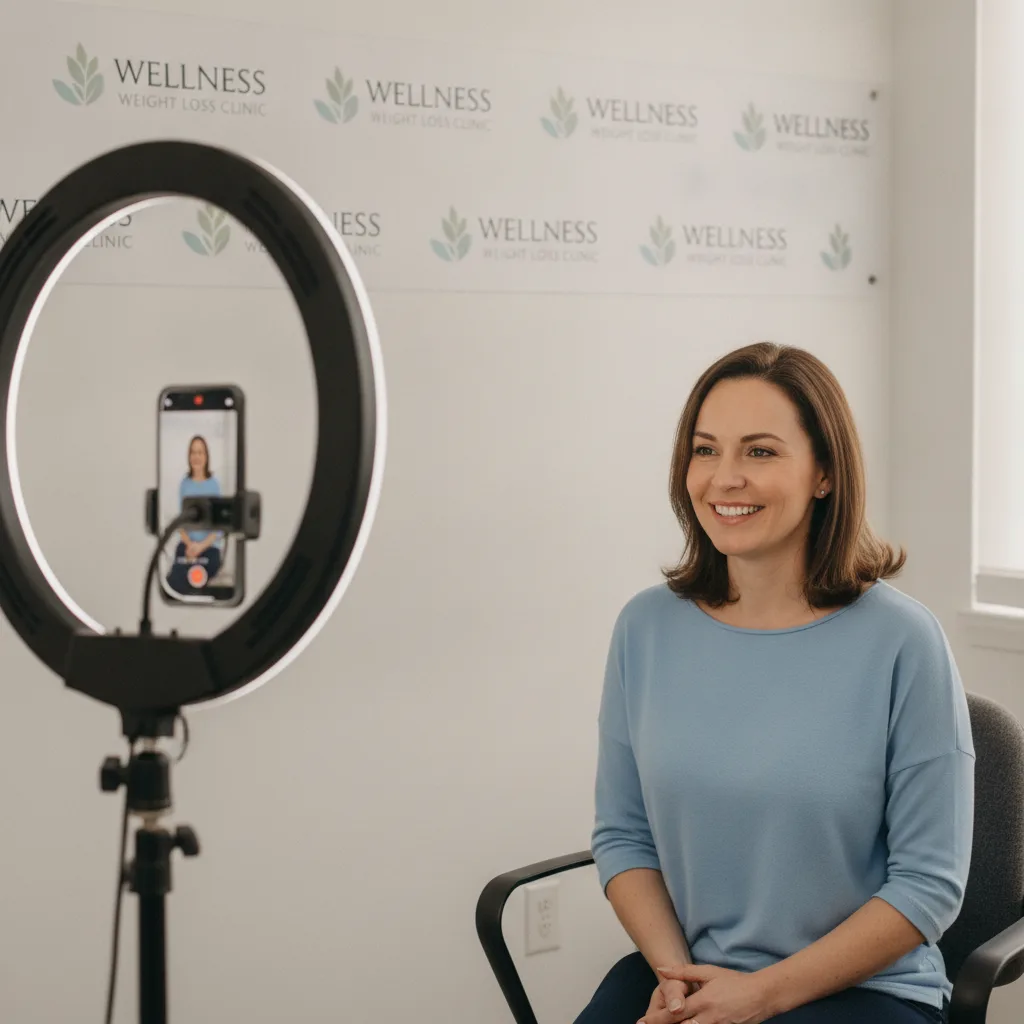
Shoot in your clinic, not at a patient's home. A clean, branded background with your logo visible positions the video as a professional endorsement. Shoot on a Sony ZV-E10 or an iPhone 15 Pro in Cinematic mode with a single ring light at 45 degrees — total equipment cost under $400. Export a 90-second version for YouTube and the landing page, a 60-second cut for Facebook and Instagram, and a 30-second cut for TikTok and Instagram Reels. Each cut needs its own closed-caption file before publishing. Ensure every video featuring a patient has a signed photo-and-video release on file before you publish anywhere.
Sony ZV-E10 mirrorless camera
$749 (body only)
Compact, clinic-friendly mirrorless camera with excellent low-light performance and a flip screen — no dedicated videographer required after the first session.
Descript
$24/mo (Creator plan)
Edits video by editing a transcript, auto-generates captions, and exports platform-specific cuts in one workspace — reduces post-production time from hours to 20 minutes.
Wistia
$19/mo (Plus)
Hosts video testimonials with heat maps, CTA overlays, and conversion tracking built in — tells you exactly which testimonial video drives the most consultation form submissions.
Place Reviews and Testimonials Where They Cut Cost Per Inquiry
Most weight loss clinic websites convert at 1 to 3% of organic and paid traffic; well-optimized sites convert at 5 to 8%. The gap is almost always testimonial placement. Displaying reviews on a weight loss clinic website can boost conversions by up to 270%, and video testimonials on landing pages increase conversion rates by up to 80%. Three to five short written testimonials placed within scrolling distance of the primary CTA — not in a separate reviews tab — lift homepage conversions by up to 34%. The work to increase these numbers is not more ad spend; it is where you put the social proof you already have.
Follow this placement plan across your site: put your highest-converting video testimonial — the one with the clearest before-and-after weight loss narrative — directly above the consultation booking form on your primary landing page. Place a rotating Google review widget, pulled live via Birdeye's embeddable widget or EmbedSocial, in the site's header area or immediately below the hero section. Add a patient testimonial card section using first name, last initial, headshot if photo consent is on file, program name, and pounds lost between your program description section and your pricing transparency section. Pricing transparency sections alone increase landing page conversions by 30 to 40%; pair them with adjacent testimonials and the lift compounds.
On paid search landing pages, the rule is simpler: one video testimonial above the fold, three written testimonials below it, and your average-results FTC disclosure under every single one. Do not send paid clicks to your homepage. Build a dedicated landing page for each program — GLP-1 supervision, meal plan coaching, medically supervised diet — with testimonials specific to that program. A patient who lost weight on a GLP-1 program and is hungry for guidance on how to maintain muscle mass wants to hear from someone on the same journey, not a general weight loss story.
EmbedSocial
$29/mo
Embeds a live-updating Google review widget on your website with automatic FTC-compliant star display — no developer work required after initial setup.
VWO
$199/mo (Growth)
Runs A/B tests on testimonial placement and CTA proximity without touching your core codebase — identifies the highest single-variable lift before a full page rebuild.
A/B test this first
Before rebuilding your entire landing page, run a 30-day A/B test with a single change: add your best video testimonial above the consultation form on the current page. A 2 to 4x conversion improvement is achievable over 6 to 12 months of iterative CRO; video placement is consistently the highest single-variable lift in the first test round. Start there, then follow the data.
Maintain Review Velocity and Build a Transformation Content Library
Review velocity is not a one-time push — it is a monthly operational metric, the same as consultation volume or revenue per patient. Clinics that institutionalize their review system generate 8 to 25 new Google reviews per month; clinics without one generate 1 to 4. After Google's March 2026 update, a business that pauses review collection for even 18 days can drop Local Pack positions measurably. Assign one staff member as the review owner, set a monthly target of at least 10 new reviews, and review the number in your weekly marketing meeting. Make sure that person has the time and the tools to respond to every piece of feedback within 24 hours.
Pair your review velocity work with a transformation content library on Instagram and Facebook. Active weight loss clinics report that social transformation content drives 20 to 40% of new patient consultation requests. The plan does not need to be complex: one patient success video per month from your Step 4 workflow, one Reel showing what patients actually eat and how they plan their day-to-day diet and exercise routine, and two educational posts per week covering topics like how GLP-1 medications affect metabolism, how to maintain muscle mass while losing weight fast, and why patients feel less hungry on a medically supervised program than on a solo diet. These posts answer the exact questions prospective patients type into Google and ask AI tools like ChatGPT and Perplexity — which increasingly pull from clinic content when answering queries about what weight loss program actually works and which programs are the most reputable.
Audit your GBP and social profiles every 90 days: check that your review count, response rate, and most recent review date are all moving in the right direction. Flag any negative reviews for a private patient outreach call before writing a public response. A 4.7-star rating with 60 reviews and a 100% response rate outperforms a 4.9-star rating with 25 stale reviews and no owner responses — in Local Pack rankings and in the minds of prospective patients who read every review before they ever contact your clinic. Your job is to make it easy for people to find and trust you before they pick up the phone.
Birdeye (review monitoring dashboard)
$299/mo (Starter)
Centralizes review alerts from Google, Healthgrades, Zocdoc, and Facebook into one inbox with response drafts and monthly reporting.
Later (social scheduling)
$25/mo (Starter)
Schedules Instagram and Facebook transformation content 30 days in advance, with built-in analytics to track which post format drives the most link clicks to your consultation page.

Do Not Let One Bad Review Sit Unanswered for More Than 24 Hours
After Google's March 2026 core update, owner response rate is one of the top two review signals for Local Pack rankings — ahead of raw review volume. A single unanswered one-star review sitting for two weeks signals to Google's algorithm the same thing it signals to every prospective patient who reads it: this clinic does not pay attention. Assign a named staff member to check the review inbox every morning. Keep a response template that thanks the reviewer, acknowledges their concern without admitting fault or disclosing any health details (HIPAA applies to public responses too), and invites them to call the clinic directly. Clinics with a 100% response rate and 32 reviews consistently outrank clinics with 80 reviews and a 40% response rate in competitive Texas markets as of October 2026.
The $11.94 billion US weight loss market and 12 million Americans now on GLP-1 medications mean your clinic is treating more patients achieving real, life-changing results than at any point in the industry's history. The clinics that capture those results in a compliant, systematic way — signed HIPAA releases, FTC-accurate disclosures, automated SMS requests, video on landing pages, and monthly review velocity targets — are the ones that appear in the Google Local Pack, fill consultation calendars at a $3,000 cost per inquiry instead of $7,500, and become the most reputable weight loss program in their market. The ones that skip this work are collecting wins in a paper chart while competitors build a review library that answers every question a prospective patient types into Google or asks an AI. This system takes one week to stand up. Run it this month.
Frequently Asked Questions
Ready to get started? Contact Geek Powered Studios today.