
Winning the Google Map Pack for "chiropractor near me" requires fixing four things in order: your Google Business Profile primary category (set it to "Chiropractor," not "Wellness Center"), your NAP consistency across the top 15 directories, your review velocity (3–5 new reviews per month beats a one-time burst), and your chiropractic website's condition-specific pages. GBP signals account for roughly 32% of Map Pack ranking weight, making the profile your single highest-leverage asset. Specialty keywords like "NUCCA chiropractor [city]" or "spinal decompression [city]" can rank in 6–8 weeks — far faster than chasing the head term in a competitive metro where 30+ practices are fighting for three spots.
-
32% of Map Pack weightGoogle Business Profile signals outweigh all other local ranking factors
-
Fix GBP category firstThe step that unblocks every other ranking gain
-
3–5 reviews per monthSteady velocity beats a one-time burst every time
-
Condition pages before blog postsReady-to-book intent converts faster than research intent
-
6–8 weeks to first specialty winsTechnique keywords rank far faster than city-level head terms
-
NAP consistency is silent ranking fuelOne mismatched suite number dilutes trust signals across every directory
Most chiropractic practices doing $2M–$5M annually already have some marketing in place. The website exists. Google Ads may be running. A few reviews have trickled in over the years. But the Google Map Pack — the three results that capture over 46% of all local healthcare search clicks — stays stubbornly out of reach. The practices holding those three spots aren't doing anything exotic. They've executed a specific lever hierarchy: Google Business Profile category and completeness first, NAP consistency second, review velocity third, condition-specific pages fourth. This guide walks through each step in order, with the tools, timelines, and chiropractic-specific failure modes that most generic local SEO guides miss entirely.
Before you start
- Verified Google Business Profile with ownership access — not just manager access, which can't change the primary category
- A chiropractic website you can edit directly or have a developer update; WordPress or Webflow both support the condition-page architecture this strategy requires
- Access to at least one keyword research tool — Google Keyword Planner is free; Semrush or Ahrefs gives keyword difficulty data alongside volume
- Google Analytics and Google Search Console connected to your site and pulling live data
- A system to collect patient contact info post-visit — needed for the review request workflow in Step 3
- A list of your top 10–15 directory listings where your practice name, address, and phone number currently appear
Fix Your Google Business Profile Category and Core Fields First
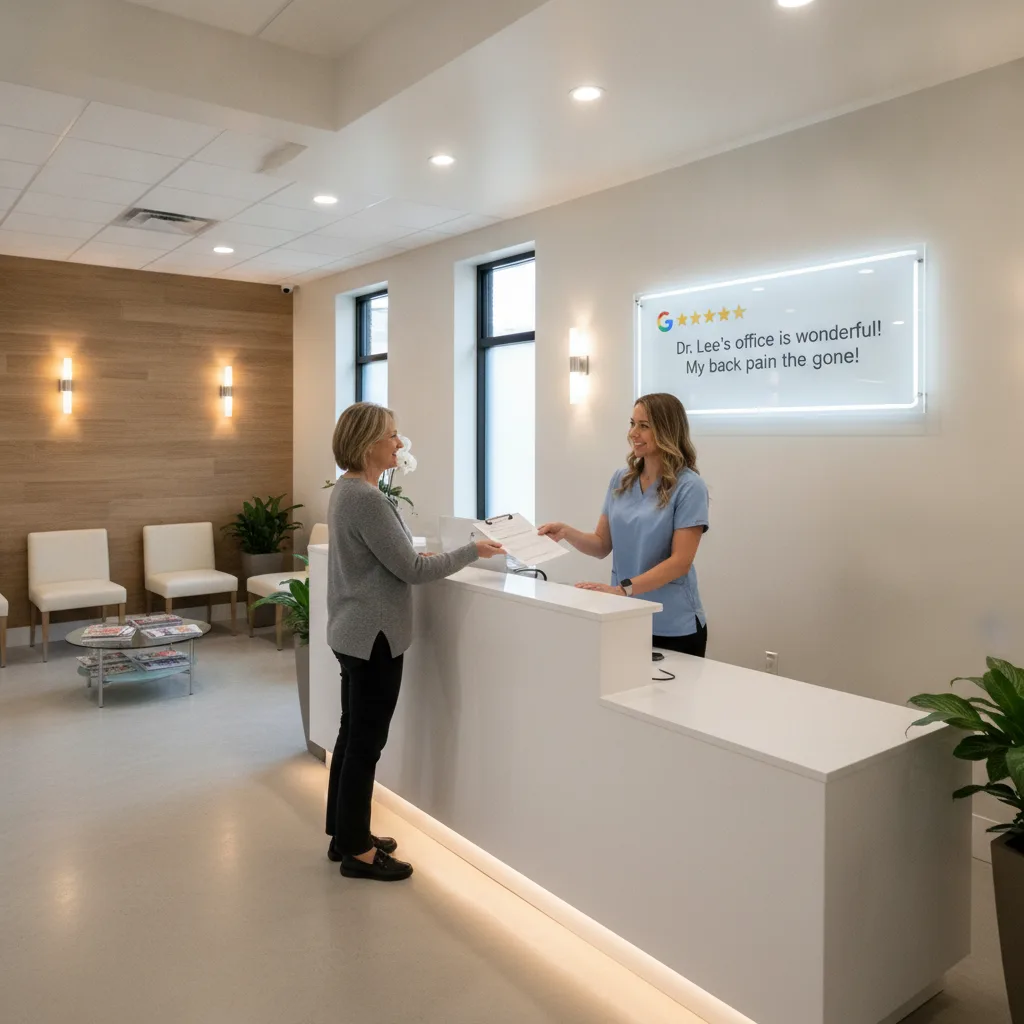
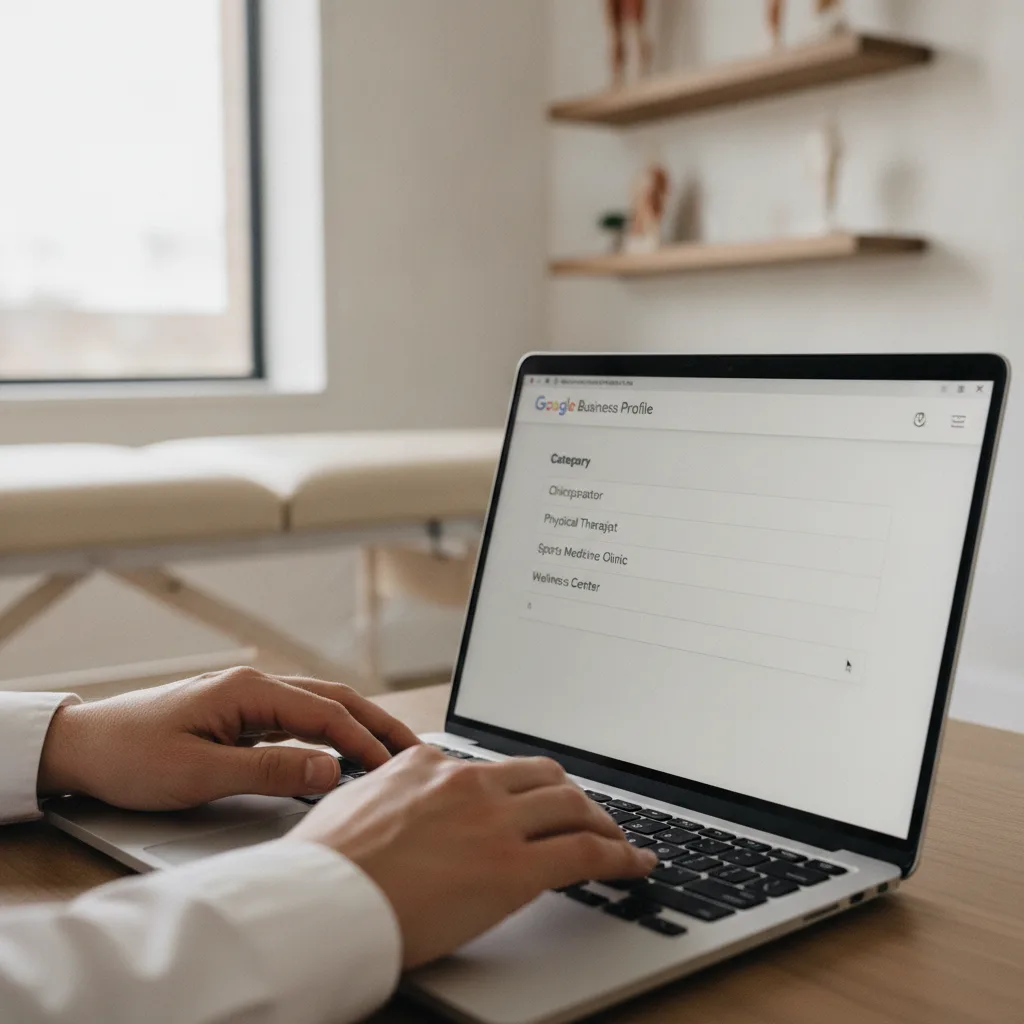
Google Business Profile signals account for roughly 32% of Map Pack ranking weight — more than reviews, on-page content, or backlinks on their own (Whitespark 2026 Local Search Ranking Factors). That makes your GBP the single highest-leverage asset in your entire chiropractic SEO strategy, and the primary category field is the most important setting inside it. Set it to 'Chiropractor' — not 'Wellness Center,' not 'Pain Control Clinic,' not 'Health and Beauty.' Practices using softer categories lose ranking weight on every chiropractic search in their service area. Category corrections alone have moved practices four to six positions in the local pack within weeks of propagation.
After locking in the primary category, complete every core field without shortcuts. Your business name should match your legal or DBA name exactly — no keyword stuffing like 'Dr. Smith Chiropractor Back Pain Austin.' That violates Google's guidelines and is the easiest thing a local competitor can report. Suspended profiles take weeks to restore, and you won't be booking chiropractic appointments while you wait. Fill in your hours, service area, appointment link, and business description using natural language that includes your main chiropractic keywords and city name. Google My Business — now officially Google Business Profile — treats the description field as a relevance signal for local search results, so write it for the patient, not just the algorithm.
Secondary categories are valid only for services you actually offer. If you have a licensed massage therapist on staff, adding 'Massage Therapist' as a secondary category is legitimate. Adding irrelevant secondary categories to chase broader traffic is a documented ranking suppressor that most practices miss. Add photos of your front desk, treatment rooms, and staff — profiles with 10 or more photos consistently see higher engagement from potential patients browsing the local pack, and photo count is a soft prominence signal in Google's local ranking algorithm.
Google Business Profile Manager
Free
The only place to manage your primary category, hours, description, photos, and the booking link that drives chiropractic appointments directly from the Map Pack.
GBP Spy (Chrome extension)
Free
Reveals the exact primary and secondary categories your top local competitors are using — useful for validating your category selection against the practices currently holding the top 3 Map Pack spots.
Common mistake
Don't make multiple major GBP edits in one session and expect instant results. Category changes propagate within days to a few weeks. Make the primary category fix first, let it settle, then layer in description and photo updates.
Audit and Clean Up NAP Consistency Across Your Top Directory Listings
NAP inconsistency — mismatched Name, Address, and Phone number across directories — is one of the most silent ranking suppressors in local SEO for chiropractic practices. Small variations like 'St' vs. 'Street,' suite number format differences ('Ste 200' vs. 'Suite 200'), or a phone number listed with and without a local area code all dilute the trust signals Google uses to verify your practice. Keeping your NAP consistent across your top 10–15 directory listings produces measurable ranking improvements within 60–90 days of completing the cleanup.
Start with the directories that carry the most weight for a chiropractic practice: Google Business Profile itself, Yelp, Healthgrades, Zocdoc, WebMD, Facebook, Apple Maps, and Bing Places. Pull your current listing from each one and compare every field against a single master NAP document. The master version should match your GBP exactly — character for character. Then work down to general directories like Foursquare, Manta, and YellowPages. Most practices find 6–10 discrepancies they didn't know existed, and each one is quietly dragging down local search rankings.
If the volume of corrections feels unmanageable, Yext or BrightLocal's Citation Builder can push consistent NAP data to 50-plus directories from a single platform. That's worth the time savings for a busy chiropractic practice. But for the core healthcare-specific directories, log in and update them manually — automated tools occasionally format suite numbers or phone numbers differently than the platform expects, creating new inconsistencies instead of fixing old ones. The goal is a practice online presence where every listing tells the same story.
BrightLocal Citation Tracker
$39/mo
Scans 50-plus directories and shows every NAP variation so you can prioritize which listings to fix first without manually checking each one.
Yext
$199+/yr
Pushes consistent NAP data to a broad publisher network from one dashboard — useful for practices with many directory inconsistencies to correct at once.
Pro tip
Create a locked master NAP document in Google Docs that every team member references before submitting any new directory listing or updating an existing one. One source of truth prevents the drift that causes NAP inconsistency in the first place.
Build a Review Velocity System That Satisfies Google's Recency Signal
Review signals account for roughly 20% of Map Pack ranking weight, and recency matters as much as total count. Practices with 200-plus online reviews and a 4.8-plus average rating consistently dominate local 3-packs, but a steady flow of 3–5 new reviews per month outperforms a one-time burst of 30 reviews followed by silence. BrightLocal's 2026 research identifies review velocity as a key local ranking signal — Google interprets consistent volume as an active, trusted chiropractic practice. A profile that collected 40 reviews in January and nothing since looks stagnant to both Google and potential patients browsing local search results by summer.
The highest-converting method to encourage satisfied patients to leave a review is a post-visit text message with a direct Google review link, sent within 2 hours of the appointment. The front desk script makes it even more effective: at checkout, staff says, 'If you're happy with your visit today, a Google review would mean a lot to us — I'll send you a quick link.' That verbal prime dramatically increases the percentage of satisfied patients who open the text. Tools like Podium and GoHighLevel automate the text send and include a direct link that drops the patient straight into the review composer — no extra clicks, no friction. Both integrate with most practice management software, which keeps the front desk workflow simple.
HIPAA compliance creates a specific risk at the review response stage that most chiropractic practices miss entirely. Confirming someone is a patient — even in a public reply to a glowing review — is a potential protected health information disclosure under HHS Office for Civil Rights guidance. Safe responses never confirm the reviewer is a patient, reference their condition, or mention treatment details. A response like 'Thank you for sharing your experience — we're glad you found the chiropractic care you were looking for. We'd love to see you again soon' works without crossing the line. Train your front desk and office manager on this protocol before any responses go live, because a well-intentioned reply can create real legal exposure.
Podium
From $399/mo
Automates post-visit review request texts with a direct Google review link — the highest-converting delivery channel for encouraging patients to leave a review.
GoHighLevel
From $97/mo
Handles review request automation inside the same platform as appointment reminders and follow-up sequences — fewer tools for the front desk to manage.
HIPAA warning
Never confirm someone is a patient, reference their condition, or mention treatment details in a public review response. Even a positive, well-intentioned reply can constitute a PHI disclosure under HHS OCR guidance. When in doubt, keep responses warm but generic.
Target Chiropractic SEO Keywords for Specialty and Technique Searches First
'Chiropractor near me' pulls 246,000 searches per month in the US (Semrush, 2026) — and in most metros, 30-plus practices are fighting for three Map Pack spots to capture that traffic. Chasing that head term before you've built domain authority and review volume is the long game. The faster path to early wins is specialty and technique keywords specific to what your chiropractic practice does. Chiropractic SEO keywords like 'NUCCA chiropractor [city],' 'Webster technique [city],' 'spinal decompression [city],' or 'workers comp chiropractor [city]' can rank in 6–8 weeks vs. 6–12 months for the head term in a competitive local area.
The reason specialty chiropractic keywords move faster: most practices only target the professional title keyword, leaving technique-specific and condition-specific search terms almost completely uncontested. There's almost no competition on those chiropractic SEO keywords, and the searcher using 'NUCCA chiropractor Austin' is far more ready to book than someone typing 'back pain relief.' These are higher-intent, lower-competition terms that bring in qualified leads. Use Google Keyword Planner or Semrush to identify which technique and condition terms in your city have search volume — even 50–200 monthly searches for a term no local competitor is targeting is worth a dedicated page and a GBP service entry.
Map your keyword list to your GBP services section, your chiropractic website pages, and your blog content calendar. GBP lets you add individual services with names and descriptions — add each technique and condition you treat as a separate service entry, using the exact search terms patients use. This signals relevance to Google for those specific queries without requiring any website changes. Use relevant keywords in service descriptions that reflect your clinical care offerings — spinal decompression, sciatica treatment, neck pain, prenatal care — and update the list as your services expand.
Google Keyword Planner
Free
Finds search volume for technique and condition-specific chiropractic keywords in your target city — the starting point for identifying fast wins without paying for a premium tool.
Semrush
From $139/mo
Shows keyword difficulty alongside volume, so you can identify which chiropractic SEO keywords are genuinely low-competition vs. which ones just look that way on the surface.
Build Condition-Specific Pages on Your Chiropractic Website Before Adding Blog Posts
A single generic Services page on a chiropractic website cannot rank for back pain treatment, sciatica, neck pain, spinal decompression, and disc herniation simultaneously — Google reads it as a diluted signal for all of them. Condition-specific landing pages, one per high-demand condition, consistently outrank a bundled services page because each one targets a lower-competition query with higher booking intent. 'Back pain relief treatment [city]' often faces less competition than 'chiropractor [city]' because most practices only target the professional title keyword, leaving condition searches wide open for a chiropractic practice willing to build the pages.
Publish condition pages before you start blog posts. The sequencing matters because condition pages carry ready-to-book intent — a patient searching 'sciatica treatment Austin' is in pain today and wants a chiropractic consultation. A blog post on 'what causes sciatica' carries research intent. Both serve the chiropractic SEO strategy, but the condition page books patients faster. Priority order for condition pages: back pain, sciatica, neck pain, disc herniation, sports injury, auto accident recovery, spinal decompression, headaches, pregnancy care (if you're Webster-certified), and workplace injury. Structure each H1 as 'Sciatica Treatment in [City]: Chiropractic Care That Works' — location-specific, condition-specific, and benefit-specific in one line. Tools like Surfer SEO help close content gaps by showing exactly what word count, heading structure, and keyword coverage your page needs to compete with the top local results.
Once your core condition pages are live and indexed, add two blog posts per month. Write them to answer the research-stage questions patients search before they're ready to book: 'How long does chiropractic care take for sciatica?' or 'Is chiropractic safe during pregnancy?' Blog content written in plain, conversational language that addresses natural language questions gets cited by Google AI Overviews, ChatGPT, and Perplexity — extending your visibility beyond the classic search results into AI-generated answers. AI Overviews now trigger on an estimated 35–45% of back pain queries, higher than the general health average. Two blog posts per month plus eight condition pages covers roughly 80% of chiropractic search demand inside 18 months.
Surfer SEO
From $89/mo
Analyzes what's on the top-ranking condition pages in your city and tells you the word count, heading structure, and keyword coverage your page needs to compete — closes content gaps before they cost you rankings.
Webflow or WordPress
Varies
Both support the page-by-page content architecture required for condition-specific SEO — critical for a chiropractic website that needs separate, rankable URLs for each condition and location.
Content gap to fix first
Before creating new condition pages, check whether your current site already has thin or duplicate content on these topics. Consolidating two weak pages into one well-built condition page almost always outperforms publishing a third thin one. Google's YMYL quality standards apply directly to health content — thin pages can actively suppress your site's overall organic search performance.
Track the Metrics That Reflect New Patients Booked, Not Just Search Rankings
Search rankings are a leading indicator, not the outcome. The number that matters is new patients booked from organic search — calls, form submissions, and appointment requests that trace back to Google Search or Google Maps. A chiropractic practice ranking in the top 3 of the local pack in a moderately competitive metro typically generates 20–40 new patients per month from search alone. If your search rankings are improving but calls aren't moving, the problem is usually the chiropractic website itself: slow load time on mobile devices, no clear call-to-action on condition pages, or a booking form buried three clicks from the homepage. Fix those conversion problems before adding more SEO services or ad spend.
Connect Google Analytics and Google Search Console to track which pages are generating organic search traffic and which chiropractic keywords are driving clicks. In GBP Insights, monitor calls, direction requests, and website clicks from the profile — these are direct signals of Map Pack-driven patient actions. For call tracking, CallRail lets you assign a unique phone number to your GBP listing vs. your website, so you can see exactly how many calls each source generates per month without guessing. That attribution data is what separates a real cost-per-lead calculation from a rough estimate. If Google Ads are running alongside organic, track both separately so your budget decisions reflect real channel performance.
Set a 90-day review cadence: Month 1 focuses on GBP and NAP fixes. Month 2 adds review velocity and condition page publishing. Month 3 evaluates which specialty chiropractic keywords have started producing Map Pack appearances and which condition pages are generating form submissions. Consistent optimization each month is what separates chiropractic practices that hold their Map Pack positions from those that slip back after an initial bump. Link building and local content creation — guest posts on local wellness sites, sponsorships of community events, or profiles in local business directories — are the next layer to add once the core local SEO infrastructure is stable and producing measurable results.
Google Search Console
Free
Shows which chiropractic keywords are generating impressions and clicks on your site — the ground truth for whether your content is reaching patients in organic search results.
CallRail
From $45/mo
Assigns unique tracking numbers to GBP, your website, and paid ads separately, so you can attribute calls to specific channels and understand true cost per lead from each source.
Google Analytics 4
Free
Tracks form submissions, appointment clicks, and page-level engagement so you can see which condition pages are converting visitors into booked chiropractic consultations.
Realistic timeline
Expect first Map Pack movement on low-competition specialty terms within 60–90 days of GBP optimization and citation cleanup. Competitive city-level terms like 'chiropractor [city]' typically take 5–6 months of consistent optimization. SEO compounds — month 6 results are built on months 1–5, which is why stopping after a short run rarely pays off.

The One Mistake That Gets Practices Suspended Overnight
Keyword-stuffing your GBP business name field — adding 'Back Pain' or 'Chiropractor' after your practice name — is a direct Google guideline violation. It's also the easiest thing a competitor can report. Profile suspensions from this mistake take weeks to resolve, and your chiropractic practice goes invisible in the local pack the entire time. Keep your business name exactly as it appears on your signage and legal documents. Put your keywords in your description, services entries, and chiropractic website — not your name field.
Most chiropractic practices are invisible to nearly half their potential patients — over 46% of local healthcare search clicks go to the top 3 Map Pack results, and 85% of chiropractic patients start with local search terms. The practices winning those spots aren't doing anything exotic. They have the right GBP category, consistent NAP data, a steady review velocity, and condition pages built for booking intent rather than a single generic services page. That's a chiropractic SEO strategy, not magic. At Geek Powered Studios, we've applied this exact multi-channel discipline to healthcare practices like Lakeway Cosmetic Dentistry (105% increase in ad leads, 133% conversion rate increase) and San Antonio Eye Specialists (196% more PPC leads, record-breaking sales months within six months). A custom chiropractic website is included with every retainer — built SEO-forward from day one, no long-term contract required. If your practice isn't showing up where patients search, book a free strategy session and we'll show you exactly where the gap is.
Frequently Asked Questions
Ready to get started? Contact Geek Powered Studios today.