
Custom dental websites ($8,000–$30,000 upfront) are the right call once your practice competes for high-value local search terms like "dental implants [city]," runs multiple locations, or needs deep online booking integration with Dentrix, Eaglesoft, or Open Dental. Template sites ($2,000–$8,000 upfront plus $100–$400 per month ongoing) are a legitimate starting point for a single-location general dentistry practice that needs to be live fast and isn't yet hitting the walls of a rigid layout. The critical question isn't design preference — it's whether you own the domain and site files if you leave. Most practices on vendor-licensed templates don't. That ownership gap, combined with the conversion math (moving from 2% to 4% conversion on 1,000 monthly visitors means 20 more booked appointments per month), is where custom dental web design earns its premium.
-
Audit firstKnow your speed score and ownership terms before deciding anything
-
$2,800 real gapThree-year cost difference between a mid-tier template and a custom build
-
Growth stage gates the choiceTemplate for stage one; custom once you compete for specialty keywords
-
Treatment pages, not homepagesDedicated pages convert 3–5x better than a generic service list
-
Own what you pay forConfirm domain and content ownership before any vendor renewal
-
62–71% of dental searches are mobileMobile page speed is a search ranking requirement, not a nice-to-have
-
Multi-channel contact winsPhone plus online booking plus text generates 41% more patient inquiries
The question of whether to build a custom dental website or stay with a template isn't really a design debate — it's a business decision with a three-year price tag attached. Template dental websites are genuinely good for some practices and genuinely wrong for others, and the difference comes down to growth stage, market competitiveness, and a contract clause most practice owners skip entirely. This framework walks you through seven concrete steps: auditing what your current site is actually doing, running the real cost math, matching your build type to your practice's growth stage, building treatment pages that convert, integrating online booking properly, loading patient trust signals where they do real work, and making the final call. By the end, you'll know which path fits your practice — and what it will actually cost you if you stay where you are.
Before you start
- Basic familiarity with your current website platform (WordPress, a proprietary dental vendor CMS, Webflow, or similar)
- Access to your current website analytics — even a basic Google Analytics view or a monthly traffic estimate from your vendor
- Your current website contract or vendor agreement, specifically the ownership and termination clauses
- A rough sense of your monthly new patient goal and your average procedure value — you'll need both for the conversion math in Step 4
- A list of the specialty procedures you want to rank for locally (dental implants, cosmetic dentistry, teeth whitening, Invisalign, etc.)
- Your Google Business Profile login — you'll reference it in Step 6

Audit Your Current Site: Speed, Mobile, and Ownership
Before you decide what to build next, get an honest read on what your current site is actually doing. Pull your dental website into Google PageSpeed Insights (free) and run it on mobile. A site that scores below 50 on mobile performance is already losing patients — 53% of mobile visitors abandon a page that takes longer than 3 seconds to load, according to Think with Google data. Given that 62–71% of all dental searches happen on mobile devices, a slow site isn't a cosmetic problem. It's a lead problem.
Next, dig out your vendor contract and find the ownership clause. This is the step most practice owners skip, and the one that costs them most. Many template sites from dental-specific vendors are licensed, not owned. You're renting the design, the domain in some cases, and all the content the vendor wrote for you. After three years of monthly fees running $100–$400 per month, you can easily pay more than a custom build would have cost — and walk away with nothing portable if you leave. If your contract says the vendor retains rights to the site design or content, write that down. It changes the ROI math completely.
Finally, check whether your dental office site uses the same layout as other practices in your city. Template platforms frequently reuse the same design across dozens of dental offices. If a prospective patient visits your site and your competitor's site and they look nearly identical, that's a trust signal failure before they've read a word. Document your speed score, ownership terms, and design differentiation. That's your baseline for every decision that follows.
Google PageSpeed Insights
Free
Measures Core Web Vitals including LCP (target: under 2.5 seconds) and mobile performance score — the two signals Google uses most heavily for search rankings.
GTmetrix
Free (paid plans from $5/mo)
Gives a waterfall view of exactly which scripts and plugins are slowing your load — especially useful for identifying code bloat on dental vendor templates.
Watch out
Some dental vendors register the domain in their own name, not yours. Check WHOIS at lookup.icann.org right now. If the registrant isn't you or your practice, that's a critical issue to resolve before you invest any more in SEO or ads pointing to that domain.
Understand the Real Three-Year Cost of Each Path
Template dental websites look inexpensive upfront: $2,000–$8,000 to launch, then $100–$400 per month in ongoing fees for hosting, support, and platform access. Custom dental websites start at $8,000–$30,000 for a single-location practice, reflecting the 80–150 hours of design, development, copywriting, and SEO architecture work involved. Those headline numbers are where most comparisons stop — and where most practices make a bad decision.
Run the three-year math. A template at $5,000 upfront plus $250 per month in ongoing fees costs $14,000 over 36 months. A custom build at $15,000 upfront with standard hosting at $50 per month costs $16,800. The gap is roughly $2,800 — not the $10,000-plus difference the sticker prices suggest. And that math flips entirely once you factor in what each path delivers: a licensed template you don't own versus a custom asset that is yours to take anywhere, modify freely, and build on indefinitely. When a dental practice on a vendor template asks for a fixed price to migrate to a new platform, they usually find they own nothing — no exportable design, no portable content, no transferable domain in some cases.
The honest nuance: a well-optimized, fast-loading template will outperform a bloated, neglected custom site. The build method matters less than speed, mobile layout, clear calls to action, and patient trust signals. What custom dental web design earns its premium on is competitive local SEO, multi-location architecture, deep online booking integrations, and specialty treatment pages — not the design alone. A practice that launches a clean template, keeps it fast, and updates the content regularly will outperform a practice that spent $25,000 on a great dental website and then never touched it again.
Pro tip
Ask any vendor two questions before signing: (1) Who owns the domain and site files if we leave? (2) What is the cancellation process and do we get a full export of our content? Their answers tell you more about the real cost of that relationship than any pricing page.
Map Your Dental Practice Growth Stage to the Right Build Type
Template sites are a legitimate fit for a single-location general dentistry practice that needs a fast, credible online presence and isn't yet competing aggressively for specialty procedure keywords. If your dental practice is newer, focused on general dental care, and your local market isn't saturated with well-funded multi-location groups — a well-built template gets the job done. The key phrase is 'well-built': responsive design, fast load, clear contact details, and real photos of your team and office, not stock imagery.
Custom dental websites earn their cost once any of these conditions apply: you're competing for high-value keywords like 'dental implants [city]' or 'cosmetic dentistry [city]'; you have or plan to add a second or third location; you want deep online booking integration with platforms like LocalMed or NexHealth rather than a widget bolted on; or your current template's rigid page structure won't let you build dedicated pages for every procedure you offer. These aren't edge cases — they're the growth levers that separate a $2M dental practice from a $5M one.
Think of it as a growth stage gate. Stage one: you need a dental website, a modern layout, and to be found in local search. A clean template works. Stage two: you're competing for specific procedures and local search rankings. A template's shared content libraries, rigid page structures, and limited SEO architecture become real constraints. Stage three: multiple locations or a specialty-focused practice. Custom is the only build type that scales without fighting the platform every step of the way.
Build Dedicated Treatment Pages for Every Dental Service You Offer
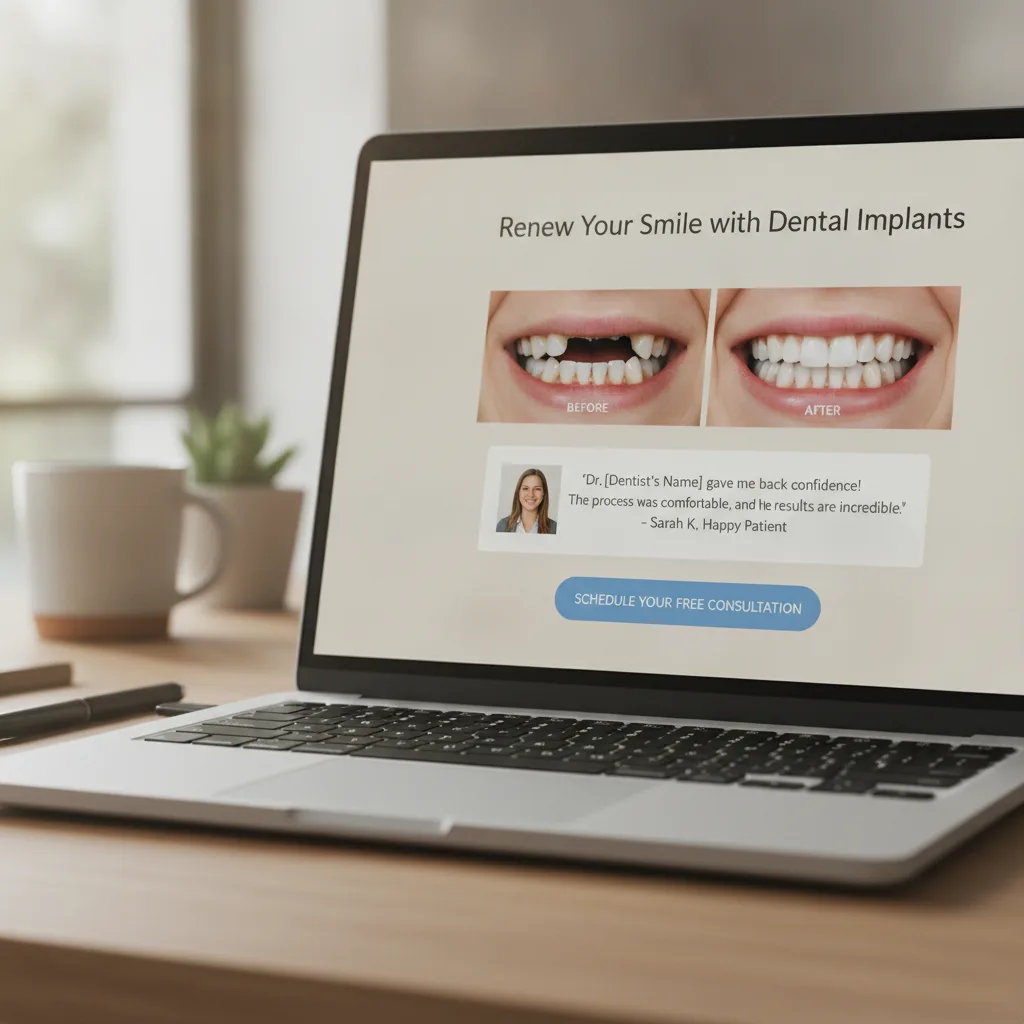
Treatment-specific landing pages outperform a generic homepage by 3–5x in conversion rate. That's not a formatting preference — it's a structural fact about how dental patients search and decide. A patient searching 'teeth whitening near me' or 'dental implants Austin' has already decided they want that procedure. They need to land on a page that speaks directly to it: the process, the cost range, before-and-after photos, patient testimonials specific to that treatment, and a booking button. A generic homepage that mentions teeth whitening in a bulleted list of dental services will not convert that patient at the same rate as a dedicated page built for that exact search.
Custom dental websites are built to support this architecture from day one. Each treatment — dental implants, cosmetic dentistry, teeth whitening, Invisalign, emergency dental care — gets its own URL, its own meta descriptions, and its own content written around the specific search terms dental patients use in your city. Template sites often have rigid page structures that limit how many treatment pages you can add, force them into a predefined layout, or pull from shared content libraries that duplicate across other practices on the same platform. Duplicate content across multiple sites on the same template system is an active local SEO penalty risk. Detailed service pages built on a custom platform avoid this entirely.
Here's the conversion math that makes this concrete. The average dental website converts 2–4% of visitors into booked appointments. Top-performing, conversion-optimized custom sites reach 8–12%. For a dental practice with 1,000 monthly website visitors, moving from 2% to 4% doubles new patient bookings without spending another dollar on ads. At a $500 average procedure value, that's an additional $10,000 per month in production. The dental website pays for itself inside two months at that math. Treatment pages with strong patient trust signals are where most of that conversion lift originates.
Important
Each treatment page needs its own unique content — not a rewrite of the same 300 words with the procedure name swapped in. Google's Helpful Content system is very good at detecting thin, templated treatment pages in the dental industry. Keyword research before you write, real patient questions addressed on the page, and local city references are what separate a treatment page that ranks from one that doesn't.
Integrate Online Booking and Patient-Facing Forms Properly
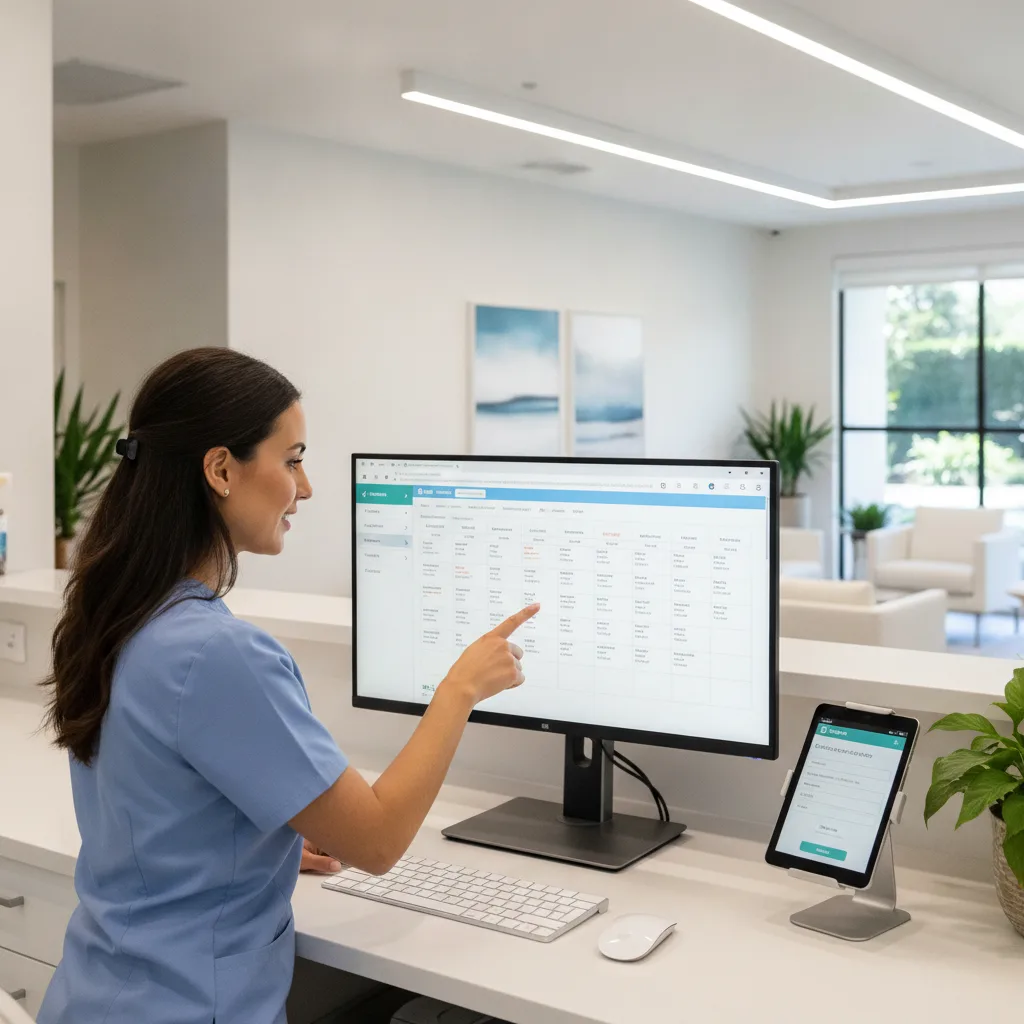
77% of dental patients want to book appointments online, but only 26% of dental practices currently offer it — that gap is a direct competitive opportunity, and your dental website is where it either gets captured or lost. Online booking integration isn't just adding a 'Request an Appointment' button. It means connecting your site to a scheduling platform (LocalMed, NexHealth, or your practice management system like Dentrix, Eaglesoft, or Open Dental) so a potential patient can see real availability and confirm an appointment without calling the office. Healthcare providers who make this easy to access attract more new patients from search than those who don't.
Custom dental websites support deep integrations with these platforms — custom booking flows, procedure-specific scheduling, insurance verification at the booking step, and new patient forms that pre-fill the chart before the visit. Most template sites support booking only through third-party widgets with limited customization. That usually means a pop-up iframe with generic fields that doesn't match your site's design, can't be pre-populated with treatment context, and may not pass data back into your practice management system cleanly. A 2024 analysis of 500 dental practice websites found that sites offering phone, online booking, text messaging, and contact forms generated 41% more patient inquiries than those providing only phone and email.
One HIPAA-critical point: patient forms that collect protected health information must be handled on HIPAA-compliant infrastructure. This applies whether you're on a template or a custom site. Make sure any form builder, booking widget, or patient intake platform your site uses has a Business Associate Agreement (BAA) in place. Compliance here is a contract question to ask your vendor directly — not something you can assume from a checkbox in a settings panel. This applies to all healthcare providers, not just dental practices.
LocalMed
Contact for pricing (typically $200–$400/mo)
Integrates directly with Dentrix, Eaglesoft, and Open Dental to show real-time availability and confirm appointments — not just a request form.
NexHealth
Contact for pricing
Full patient engagement platform covering online booking, digital patient forms, automated reminders, and two-way texting — reduces front-desk phone volume significantly.
Podium
From $399/mo
Adds text-to-pay, webchat, and review generation to your site — the multi-channel contact layer that drives 41% more patient inquiries according to the 2024 analysis.
Build Patient Trust Signals Into Every Page of Your Dental Web Design
Patient trust signals — high-quality photos of the actual team and office, before-and-after photo galleries, patient testimonials, and Google reviews prominently displayed — drive conversions more than any other single design feature. Practices with 50+ Google reviews average 23% higher conversion rates. The structural problem with most template dental web design is that trust signals get placed where the template designer decided, which is usually below the fold on the homepage. A prospective patient who visits on mobile and bounces before scrolling never sees them, which is a direct conversion loss.
Strong dental website design puts these elements where they do the most work: in the header area of treatment pages (a testimonial from a real patient who had that specific procedure), in the sidebar of contact pages, and in the booking flow itself. Team photos and doctor bios belong on every treatment page, not only an 'About Us' page that most website visitors never click through to. Before-and-after photo galleries for cosmetic dentistry and teeth whitening are among the highest-converting page elements on dental sites when they're built as proper photo galleries with named real patients (with consent) — not generic stock comparisons. Educational content that addresses common patient questions on those same pages adds further credibility.
Your Google Business Profile is a parallel trust asset that feeds directly into your dental website's local search performance. Keep the profile current — accurate address, hours, dental services offered, and a steady stream of positive reviews — because Google uses profile completeness and review velocity as local ranking signals. Consistent NAP (name, address, phone) information across every page footer connects your site to your profile. For multi-location dental practices, each location needs its own Google Business Profile and its own location pages on the site, with unique content. Template sites typically can't handle this architecture cleanly, which is a direct search engine optimization gap for growing groups.
Quick win
If you have 20+ Google reviews but they're not visible on your website, add a Google Reviews widget (EmbedSocial or Elfsight work on most platforms) this week. You don't need a full site rebuild to surface existing social proof — but a custom dental web design will architect this from day one so it's always current and prominently displayed.
Make the Final Call: Custom Dental Websites vs. Template — the Decision Checklist
Template sites are the right starting point if: you're a single-location general dentistry practice that needs to be online fast, you're not yet competing for specialty procedure keywords, your market isn't saturated with well-funded multi-location groups, and you have a vendor contract that confirms you own the domain and can export your content when you leave. The template works as a vehicle as long as the platform is fast, mobile-responsive, and you're not hitting its walls yet. A good dental web design on a template beats a neglected custom site every time.
Custom dental websites are the right call if any of these apply: you want to rank for high-value local search terms like 'dental implants [city]' or 'cosmetic dentistry [city]'; you have or plan multiple locations and need location pages with unique content; you want real online booking integration with Dentrix, Eaglesoft, or Open Dental rather than a pop-up widget; your current template won't let you build dedicated pages for every procedure in your dental practice; or you've been with a vendor for two or more years and don't own anything you've paid for. That last point is the most common situation we see — practices that have spent $15,000–$20,000 over three years on a licensed template and are starting from zero the moment they want to move. The best dental websites at a growth-stage practice aren't the prettiest ones — they're the ones with the fastest load times, the deepest treatment page architecture, and a user-friendly layout that encourages visitors to book.
The dental marketing equation is straightforward: a site that ranks for the right local terms, loads fast on mobile devices, gives potential patients a friction-free path to book, and surfaces real trust signals on every page will generate more new patients than a site that checks only some of those boxes. The build method — custom or template — is the vehicle. What matters is whether the vehicle can get you where you need to go. For most growth-stage dental practices competing in mid-to-large markets, that answer is custom. A strong dental website design matched to the right platform is a long-term asset. It should be built, owned, and maintained like one.
Don't Pay for a Site You Don't Own
The single most expensive mistake dental practices make with their website isn't choosing the wrong design — it's signing a vendor contract without reading the ownership clause. If you can't answer yes to these three questions, get answers before your next renewal: Do I own the domain? Do I own the site files and content? Can I export everything and move to a new host without penalty? A dental website is a long-term asset. It should be yours.
The proof is in the production numbers. Lakeway Cosmetic Dentistry came to us competing in one of the most saturated dental markets in Texas. We built a custom dental website engineered for local SEO, with dedicated treatment pages for cosmetic dentistry and procedure-specific conversion flows. The result: plus 80% organic leads year over year, plus 105% leads from ads, and a plus 133% conversion rate increase. That last number is the one that matters most — the same traffic, more than twice the booked appointments. If your current site isn't converting at that level, the platform you're on may be the ceiling. We include a custom website — built on Webflow or WordPress, SEO-forward, and fully owned by you — with every retainer, at no extra cost. No long-term contracts. Book a free strategy session and we'll audit your current dental website, show you exactly where it's losing patients, and lay out what a rebuild would actually deliver for your practice.
Frequently Asked Questions
Ready to get started? Contact Geek Powered Studios today.