
For most plumbing companies, the right budget order in 2026 is: Local Services Ads first, standard Google Ads (Search) second, and organic SEO running in parallel from day one. LSA averages $57 per lead based on 230 tracked accounts, which is roughly half the $167–$183 cost of non-branded Google Search Ads. LSA also sits at the very top of search results, above both Google Ads and the Map Pack. Standard Search campaigns fill the gaps LSA can't reach: specific services like water heater replacement, tankless installation, sewer camera inspection, and gas line work. SEO builds the long-term asset that eventually undercuts both paid channels, delivering leads at $25–$45 each at the 12-month mark. The honest answer: these channels aren't competing for the same budget slot. They serve different timelines and together form the most cost-efficient lead machine available to plumbing businesses right now.
-
$57/leadAverage LSA cost per lead for plumbing in 2026
-
$167–$183/leadNon-branded Google Search Ads average cost per lead
-
$25–$45/leadOrganic SEO cost per lead at 12-month maturity
-
LSA first, Search second, SEO parallelBudget order that fits most plumbing companies
-
2–5 weeksGoogle Verified badge approval timeline for LSA
-
$1,500–$3,500/month minimumGoogle Ads budget needed to generate actionable data
-
20–40% of ad spend wastedBudget lost before negative keywords are built out
-
Only 26% of plumbing companies invest in SEOOrganic search is far less contested than paid auctions
The honest answer for most plumbing companies is that Local Services Ads and Google Ads for plumbers don't compete for the same budget slot — they serve different clocks. LSA is the fastest and cheapest paid lead available to plumbers right now at roughly $57 per lead, based on 230 tracked accounts. Standard Google Search Ads (what most people still call Google AdWords for plumbers) fill the service-specific gaps LSA misses, and organic SEO builds the asset that eventually undercuts both. The recommended order: LSA on day one, Search campaigns once LSA is producing, and SEO running in parallel so the three channels converge into a self-sustaining lead machine at the 12-month mark.
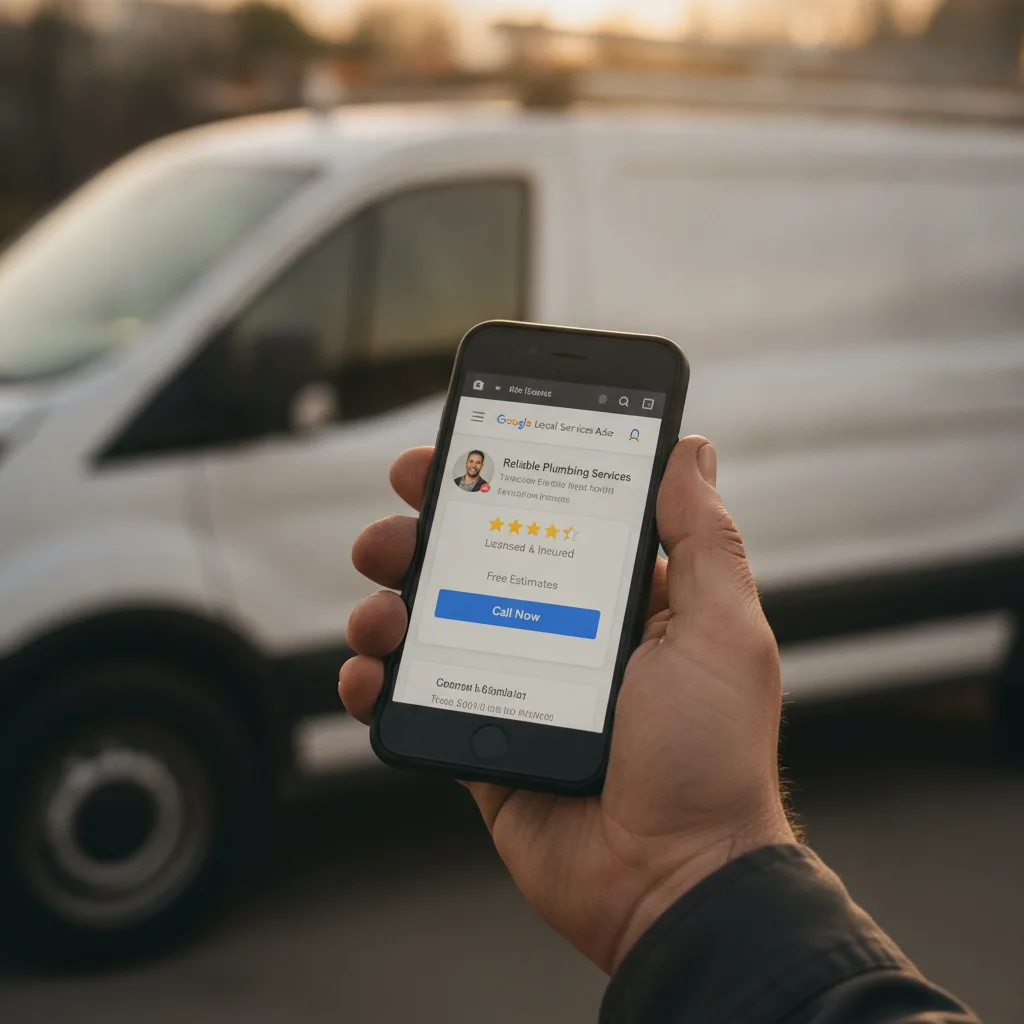
Option A
Local Services Ads (LSA)
The fastest, cheapest paid lead available to plumbers right now
- Top placement: LSA appears above Google Ads and the Map Pack — the very top of Google search results.
- Pay per lead, not per click: Google charges only for valid leads and credits invalid ones automatically.
- Google Verified badge: Requires a state plumbing license, $1M+ general liability insurance, background check, and a verified Google Business Profile.
- Ranking factors: Review volume, response time, and dispute rate — not bid amount — determine your LSA position.
Option B
Organic SEO
The long-game asset that eventually undercuts every paid channel
- No ad spend: Monthly SEO retainer replaces per-click costs; leads compound in value over time.
- Local 3-Pack dominance: The Map Pack captures 44% of all clicks on plumber searches — more than organic positions 4–10 combined.
- Low competitive landscape: Only about 26% of plumbing companies actively invest in SEO, leaving organic results far less contested.
- Long-term cost per lead: At 12-month maturity, organic leads run $25–$45 each — the lowest of any channel once rankings hold.
How Google AdWords for Plumbers and Local Services Ads Actually Work (and When Each Fits)
Local Services Ads sit above every other ad format in Google search results — above standard Search ads, above the Map Pack, and above all organic listings. That placement is why LSA generates qualified leads at roughly half the cost of non-branded Google Search Ads. The model is pay-per-lead rather than pay-per-click: Google charges only when a potential customer calls or messages directly through the ad, and the automated credit system refunds leads it judges invalid. For a plumbing business, that means less waste than a traditional click-based campaign where you pay whether the visitor converts or not.
To run LSA, a plumbing company must earn the Google Verified badge — the single badge that replaced the old Google Guaranteed, Google Screened, and License Verified badges in October 2025. The requirements did not change with the consolidation: a valid state plumbing license, at least $1 million in general liability insurance with Google listed as Additional Insured, a background check through Pinkerton, and a verified Google Business Profile. The process takes 2–5 weeks, so filing for the badge on day one is essential for any plumbing company that needs immediate visibility.
Standard Google Ads campaigns (the channel most plumbing owners still call Google AdWords) run on a pay-per-click model and sit one step below LSA in search results. They give far more control over targeting: specific keywords, location radius, ad schedule, device targeting, and bid strategy. That control is what makes Search campaigns the right tool for planned-service jobs — water heater replacement, tankless installation, sewer camera inspection, leak repair, and pipe repair — where LSA's job-type selection isn't precise enough to match the specific intent.
Emergency plumbing keywords deserve their own Google Ads campaigns. Searches like burst pipe repair, sewer backup, and 24-hour plumber convert at 20–30% on Search ads — roughly three to four times the blended account average of 7.6%. That conversion rate justifies the higher CPC of $12–$22 for emergency terms, and it's why call-only ads work well for this segment: they skip the landing page entirely and connect potential customers directly to a dispatcher on mobile devices. For planned plumbing jobs, dedicated landing pages matching the specific service outperform the homepage every time.
Campaign structure matters as much as budget. Mixing emergency and planned-service keywords in one campaign creates conflict: the bid strategies, ad copy, and landing pages needed for a sewer backup call are completely different from those needed for a scheduled water heater replacement. Separate campaigns for each intent type also make it easier to review the search terms report and build out the negative keyword list that keeps job seekers, DIY researchers, and parts shoppers from consuming ad spend. Automated bidding strategies like Target CPA only become reliable once the account has collected enough conversion data — typically after two to three months of consistent spend at $1,500–$3,500 per month.
How Organic SEO Builds a Lead Machine for Plumbing Companies
Organic SEO for a plumbing business starts with the Google Business Profile, not the website. GBP improvements can show measurable Map Pack movement in 2–4 weeks — faster than any other SEO lever — and the Local 3-Pack captures 44% of all clicks on plumbing searches. A fully built-out GBP with accurate service categories, photos, and a consistent review cadence through a tool like Podium is the highest-return first step in any plumber marketing program.
Service-specific landing pages are what convert organic traffic into real calls. A single generic plumbing page will not rank for drain cleaning, sewer camera inspection, water heater replacement, gas line work, and leak repair simultaneously. Each service needs its own dedicated page with location-specific content, a clear call button, and a phone number visible immediately. Plumbing companies that build five to ten of these pages in months two and three create a foundation that compounds over the following year.
Organic SEO leads cost $25–$45 each at the 12-month maturity mark, compared to $57 for LSA and $167–$183 for non-branded Google Search Ads. That gap only exists because the investment in content, citations, and reviews was made months earlier. The timeline is non-negotiable: meaningful organic traffic builds over months 4–6, with top-3 Map Pack placement possible in 3–6 months and full ranking stability at 9–12 months. Plumbing businesses that try to skip the paid channels during this ramp often watch call volume stall while they wait.
The competitive opportunity in organic search is real. Only about 26% of plumbing companies actively invest in SEO, which means a plumbing business committing to consistent SEO is competing against far fewer well-optimized sites than it would face in the Google Ads auction. Word-of-mouth referrals plateau; a well-ranked plumbing site generates leads from potential customers who have never heard of the company before. That reach doesn't stop when you pause a campaign — it keeps generating revenue generated from past SEO work as long as rankings hold.
LSA vs. Organic SEO for Plumbers: The 8-Dimension Comparison
| Dimension | Local Services Ads (LSA) / Google Ads | Organic SEO |
|---|---|---|
| Cost Per Lead | LSA: ~$57/lead, $128–$168/booked job. Google Search Ads: $167–$183/lead non-branded. | $25–$45/lead at 12+ months maturity — lowest of any channel once rankings hold. |
| Time to First Lead | LSA: leads within days of approval (2–5 week badge setup). Google Ads: leads within 48–72 hours of launch. | Meaningful traffic at months 4–6. Map Pack movement possible in 2–4 weeks with GBP work. |
| Ad Spend Required | LSA: pay per valid lead, no minimum. Google Ads: $1,500–$3,500/month minimum to generate actionable data. | No ad spend. Monthly SEO retainer replaces per-click costs. |
| Placement in Search Results | LSA appears at the very top of search results — above Google Ads and the Map Pack. Google Ads appear directly below LSA. | Targets Local 3-Pack (44% of all clicks on plumber searches) and organic listings below ads. |
| Lead Quality & Intent | LSA: Google pre-screens and credits invalid leads. Emergency plumbing keywords convert at 20–30% vs. 7.6% blended account average. | Organic searchers show high intent, especially on service-specific pages. Lower urgency mix than emergency paid traffic. |
| Control Over Targeting | Google Ads: precise keyword, location radius, ad schedule, and device control. LSA: service area and job-type selection only. | Control through content strategy: specific service pages (drain cleaning, water heater replacement, sewer camera inspection) and neighborhood landing pages. |
| Long-Term ROI | Stops generating leads the moment you pause ad spend. ROAS improves with optimization but never compounds independently. | Compounds over time. A well-ranked plumbing site generates leads at $25–$45 each whether or not ads are running. |
| Setup Complexity | LSA: Google Verified badge (license, $1M+ GL insurance, background check, verified GBP). Google Ads: campaign structure, negative keywords, call tracking, dedicated landing pages. | GBP optimization, service pages, local citations, review strategy, and consistent content — 4–6 month ramp before rankings stabilize. |
The 5 Costliest Google Ads Mistakes Plumbing Companies Make (and How to Fix Them)
1. No negative keywords: 20–40% of your monthly budget goes to job seekers, DIY researchers, and parts shoppers before you build an exclusion list. Block "jobs," "salary," "how to," "DIY," "school," "parts," "supplies," "free," and "rental" on day one. 2. Sending all traffic to the homepage: a drain cleaning ad that lands on a generic homepage loses the conversion. Each service needs its own landing page. 3. Not tracking phone calls: emergency plumbing campaigns generate 60–70% of their results via phone call, not form fill. Set up CallRail before you spend a dollar. 4. Mixing emergency and planned-service keywords in one campaign: emergency intent (burst pipe repair, sewer backup) and scheduled work (water heater replacement, tankless installation) have different bid strategies, landing pages, and ad copy — they should never share a campaign. 5. Using broad match without automated bidding strategies: without Smart Bidding, broad match keywords burn budget on low-intent queries fast. Use exact and phrase match until the account has enough conversion data to run Target CPA reliably.
Run LSA and Google Ads for Plumbers First If Any of These Apply
Paid search earns your first dollar when the phone isn't ringing and time is the constraint. LSA is the right starting point for most plumbing businesses because it delivers immediate visibility at the lowest paid cost per lead, and it requires no minimum monthly ad spend to test.
- Your phone isn't ringing and you need qualified leads within the next 30 days.
- You're a single-location plumbing company with a monthly budget of at least $1,500 for Google Ads — LSA can start for less.
- You haven't gotten your Google Verified badge yet: file for it immediately, since LSA sits above every other ad format in search results.
- Emergency plumbing is your primary revenue source — burst pipe repair, sewer backup, and same-day service calls convert at 20–30% on Search ads, far above the 7.6% blended account average.
- You're in a competitive Texas metro like Houston or Dallas where LSA lead costs run at the high end but still land at roughly half the cost of non-branded Google Search Ads.
The main tradeoff: every lead you generate through paid channels costs money every month. The moment your plumbing company spend stops, so does the call volume. That's why starting paid ads without a parallel SEO investment leaves you permanently dependent on ad spend to keep trucks rolling.
Prioritize SEO If Your Plumbing Business Looks Like This
SEO earns priority when you're already generating paid leads and want to build an asset that cuts your cost per lead over time. It also makes sense when your plumbing business has the runway to invest through the 4–6 month ramp before organic traffic becomes meaningful.
- You're already running LSA or Google Ads and want an asset that reduces your cost per lead over time — organic leads at maturity run $25–$45 each versus $57 for LSA.
- Only about 26% of plumbing companies actively invest in SEO, so you're competing against far fewer well-optimized sites than you'd face in the paid ad auction.
- Your Google Business Profile is weak or unverified — GBP improvements can show Map Pack movement in 2–4 weeks, faster than any other SEO lever.
- You're running three or more trucks and need a channel that scales without a proportional increase in monthly ad spend.
- Word-of-mouth referrals have plateaued and you need a predictable lead source that doesn't stop when you pause a campaign.
The main tradeoff: months one through five produce thin call volume from organic. Plumbing companies that go SEO-only during the ramp often struggle to sustain the investment before rankings produce real results. Running LSA as a bridge during the SEO build solves this problem cleanly.
Compelling Ad Copy, Conversion Tracking, and Campaign Structure: The Operational Details That Separate Profitable Accounts
Compelling ad copy for plumbers follows a simple rule: match the search, state availability honestly, and give one clear next step. An ad for a sewer backup call should reference the exact moment the homeowner is in — a blocked drain, standing water, an urgent situation — and name the service area. Generic headlines like 'Professional Plumbing Services' lose to ads that say '24-Hour Plumber in Austin — Licensed, Insured, Same Day Service.' The specificity is what converts a searcher into a real call.
Conversion tracking is non-negotiable before you spend a dollar on Google Ads campaigns. Emergency plumbing searches convert primarily through phone calls, not form fills — 60–70% of results for emergency campaigns come via call. Set up CallRail to track calls by keyword and campaign, and import those conversions into Google Ads so the account's automated bidding strategies have accurate data to optimize against. Without call tracking, you're managing the account without knowing which keywords are generating real customers and which are burning budget.
Call extensions and call-only ads deserve attention in any plumbing Google Ads campaign. Call extensions add a click-to-call button directly to a standard text ad, which matters on mobile devices where most emergency plumbing searches happen. Call-only ads go further: they eliminate the landing page entirely and connect the searcher directly to your phone line. For emergency calls on mobile, call-only ads produce $35–$80 cost per call — roughly half the cost of standard Search on the same intent. Use them for emergency campaigns and preserve landing page traffic for planned services like water heater replacement and tankless installation.
Budget Guide by Revenue Stage: Which Channel Fits Your Plumbing Business Right Now

Best for: Plumbers ready to build a long-term lead asset
Scenario: The Plumber Who Runs SEO and Wins the Organic Game
A two-truck plumbing company in San Antonio has been running on word-of-mouth referrals for five years. Leads are inconsistent, slow in January, and the owner knows a few competitors have started showing up in the Map Pack for 'drain cleaning San Antonio.' He doesn't have $3,000 a month for Google Ads campaigns, but he can commit $1,200 a month to SEO. Month one: GBP gets fully built out with photos, service categories, and a review request system using Podium. Months two and three: five service-specific landing pages go live for drain cleaning, water heater replacement, sewer camera inspection, leak repair, and pipe repair.
By month six, two of those pages rank on the first page of organic results. By month nine, the GBP is in the Local 3-Pack for three core plumbing searches — and the 3-Pack captures 44% of all clicks on those searches. At the 12-month mark, the site generates 40–50 organic calls per month at a cost per lead approaching $35. That's straight margin compared to what he'd have spent keeping Google Ads running. The catch is months one through five — calls are thin, and the owner has to either trust the process or supplement with LSA during the ramp.
Best for: Most plumbing companies with a real marketing budget
Scenario: The Full Stack — LSA Plus Google Ads Campaigns Plus SEO in Parallel
This is the sequence that successful plumbing businesses use in 2026. Day one: apply for the Google Verified badge and set up LSA. While the 2–5 week verification runs, build two Google Ads campaigns — one for emergency keywords (burst pipe repair, sewer backup, 24-hour plumber) using call-only ads, and one for planned-service keywords (water heater replacement, tankless installation, sewer camera inspection) using dedicated landing pages. Set a monthly budget of $2,000–$3,500 split between the two campaigns. Use CallRail for call tracking from day one so no phone call goes unmeasured. At the same time, start SEO: GBP optimization, five core service pages, and a review cadence through Podium.
By month three, LSA is producing qualified leads. Google Ads campaigns are generating emergency plumber calls at a sustainable cost once negative keywords — jobs, salary, DIY, how to, parts, supplies, school, free, rental — are locked in. By month six, organic traffic is building. By month twelve, the site has 30–50 organic leads per month. At that point, the plumbing company can cut Google Ads spend significantly and redirect that savings to margin. Stan's Heating, Air, Plumbing & Electrical followed a version of this playbook and hit 150+ first-page keywords and a 300% increase in organic leads. The paid channels bought time while SEO compounded.
The key to making this work is conversion tracking across all three channels. Know your cost per booked job on LSA, your cost per lead on each Search campaign, and your organic call volume in Google Business Profile Insights. Own your numbers so every budget decision is based on actual revenue generated, not on assumptions.
Best for: Plumbers who need leads now, not in six months
Scenario: The Plumber Who Leads With LSA and Google Ads for Immediate Phone Calls
A plumbing company in Austin opens a second location and needs calls within 30 days — no time for SEO to ramp. The right move: get the Google Verified badge filed immediately (license, $1M+ general liability insurance with Google as Additional Insured, background check through Pinkerton, verified GBP). While that 2–5 week verification runs, launch Google Ads campaigns with a $2,000 monthly budget targeting emergency plumbing searches. Split the campaigns: one for emergency calls (burst pipe repair, sewer backup) using call-only ads, one for planned plumbing jobs (water heater replacement, drain cleaning, gas line work) sending traffic to dedicated service landing pages — not the homepage.
Once LSA is live, response time becomes the single biggest lever. Plumbers who answer LSA leads within five minutes book at 8x the rate of those who respond after 30 minutes. That means an answering service or dedicated dispatcher for every business hour the ads are running. With both channels active and negative keywords blocking job seekers, DIY researchers, and parts shoppers, a well-structured account on a $2,500 monthly budget can generate 15–25 booked plumbing jobs per month in a mid-size Texas market. The tradeoff: the moment the ad spend stops, so do the leads.
Stan's Heating, Air, Plumbing & Electrical came to us without a dominant digital presence. Through sustained SEO and a multi-channel paid strategy, they hit 150+ first-page keywords, a 300% increase in organic leads, and a 23% lift in conversion rate — turning a single-location plumbing and HVAC business into a household name in its market. That's what happens when LSA and Google Ads keep the phone ringing while SEO builds the long-term asset underneath.
The plumbing industry rewards the company that builds both clocks at once. Paid advertising efforts buy time and generate real customers now. SEO builds the foundation that makes those advertising efforts less necessary over time. Run them in parallel, track every phone call with CallRail, and review your search terms report weekly for the first 60 days. The plumbing companies that treat digital marketing as a system — not a one-channel bet — are the ones that hit the 12-month mark with more trucks, lower cost per lead, and competitors wondering what happened.
We build custom websites (an $8K–$15K value) included with every retainer, and we work month-to-month — no long-term contracts. If your plumbing company's marketing efforts aren't generating the qualified leads your trucks need to stay full, let's look at your numbers together. Get Your Free Strategy Session and we'll show you exactly where your marketing budget should go first.
Frequently Asked Questions
Ready to get started? Contact Geek Powered Studios today.