
A complete electrician marketing plan for 2026 sequences channels by cost per booked job: start with Google Local Services Ads at $39 per lead and a 43.4% booking rate, add Google Search Ads on panel upgrade and EV charger keywords, compound organic leads through local SEO at $8–$15 per lead over 12 months, and track everything through CallRail and GA4. Budget 5–10% of gross revenue, with 60–70% allocated to paid channels. The plan takes 3–4 hours to build and 30–60 days to fully activate. Measure cost per booked job by channel every 90 days, not cost per lead, and reallocate away from any channel where cost per booked job exceeds 15% of average job ticket.
-
5–10%Of gross revenue is the defensible marketing budget baseline for electrical businesses
-
$39Average LSA cost per verified lead — the highest-ROI paid channel in the stack
-
43.4%LSA booking rate across 112 tracked electrician accounts (SearchLight Digital, 2026)
-
$8–$15Long-run organic cost per lead once local SEO and quality content compound
-
July +26%Peak month for "electrician near me" searches — hold budget, don't cut
-
391%Conversion lift from responding to a lead in under 60 seconds (CallRail, 2026)
-
$90 vs. $1,000Cost per booked job: Google LSA versus HomeAdvisor shared leads
-
90 daysThe right review interval for budget reallocation decisions — not 30 days
A profitable electrician marketing plan for 2026 is not about generating maximum lead volume. It is about filtering for profit: LSA for emergency and service work at $39 per lead, Google Search Ads for panel upgrades and EV charger installation at controlled cost per click, local SEO as the compounding base that drops cost per organic lead to $8–$15 over 12 months, and a seasonal calendar tied to how homeowners actually search — not recycled HVAC playbooks. The U.S. electrical market reaches $347.5 billion in 2026 across 262,000 businesses, with electrician employment growing 9% through 2034. That growth intensifies digital competition every quarter. This seven-step plan sequences channels by cost per booked job, sets a defensible budget baseline, and builds the measurement system that turns marketing decisions from guesswork into a repeatable growth process. Budget 3–4 hours to build the plan and 30–60 days to fully activate all channels.
Before you start
- An active Google Business Profile (GBP) with at least 25 verified reviews. LSA rank is driven by review count, recency, and response time — not bid amount. Fewer than 25 reviews will suppress LSA performance from day one.
- A Google Ads account and a Local Services Ads account linked to the same GBP. Since July 2025, all LSA reviews are managed through GBP, making the two systems a single interdependent unit.
- CallRail or an equivalent call-tracking platform configured with dynamic number insertion so every channel gets a unique tracking number before a dollar of ad spend goes live.
- GA4 installed and firing conversion events (form submit plus call click) on every service landing page. As of 2026, 39% of electrician websites have no analytics installed — which means no data to optimize against.
- A defined service area and a list of your three highest-margin electrician services. Panel upgrades, EV charger installation, and whole-home rewires are the standard anchors for 2026 electrical marketing strategies.
- Your gross revenue for the trailing 12 months. You need this number to set a defensible marketing budget before choosing any channel mix.

Set Your Electrician Marketing Budget Around Gross Revenue, Not Gut Feel
The right electrician marketing budget is 5–10% of gross revenue, with paid advertising consuming 60–70% of that total. A shop doing $2 million annually should plan for $100,000–$200,000 in annual marketing spend. Sustained spend below 5% signals under-investment; above 12% for more than two consecutive quarters signals broken unit economics — usually a cost-per-booked-job problem, not a volume problem.
Total monthly advertising costs for electricians range from $1,500 to $6,000 depending on market size and channel mix (WatsonCo Marketing, 2026). The practical channel split: 40–50% to Google Ads and LSA combined, 15–20% to SEO and quality content, and the balance to reputation management, website maintenance, and email marketing. New shops under $500K in revenue should start with LSA at $500–$1,500 per month before adding Google Search Ads, which require a minimum floor of $1,500–$3,000 per month to generate enough conversion data to optimize.
Before committing any number, pull your trailing-12-month revenue, multiply by 0.07 (the midpoint of the 5–10% range), and treat that as your planning figure. Then subtract what you already spend on website hosting, field-service software, and any pay-per-lead platforms. What remains is your available marketing budget. If that figure is under $1,500 per month, start with GBP optimization and LSA only — both generate booked jobs at the lowest cost per booked job in the channel stack. Multi-channel electrical businesses using GBP, SEO, Google Ads, LSA, email, and social media capture significantly more leads than single-channel operators, but only after the paid foundation is stable.
CallRail
From $45/month
Tracks calls by channel with dynamic number insertion — essential for attributing booked jobs to the specific ad or page that generated the call.
Google Analytics 4 (GA4)
Free
Fires form-submit and call-click conversion events that feed optimization signals back into Google Ads and LSA campaigns.
Watch Out
HomeAdvisor and Angi shared leads carry an effective cost per booked job of roughly $1,000 because 3–5 contractors receive each lead simultaneously and close rates run only 5–12%. If shared lead platforms consume more than 10% of your marketing budget, reallocate to LSA first — the effective cost per booked job on LSA is $90.
Build Your GBP and Trust Stack Before Activating Any Paid Ads
A fully optimized Google Business Profile is the single highest-leverage zero-cost-per-click asset in an electrician marketing plan. An optimized GBP with real job photos, a visible license number, and weekly posts increases click-through rate from local Map Pack results by 25%, translating to 15–30 extra calls per month for a typical electrical contractor. The top 3 Map Pack positions capture 93% of all local Map Pack clicks, and the number-one position alone earns a 17.8% click-through rate. Local visibility at this level is a direct revenue driver — not a vanity metric.
Start with the trust signals your competitors skip. As of 2026, 56% of electrician websites display no license number and 60% lack HTTPS. Add your state electrical license number to your GBP description, your website footer, and every service page. Install an SSL certificate if you have not already. These two fixes take under an hour and immediately separate your listing from the majority of competing electrical businesses in any local search result. Online visibility built on trust signals is what turns search engine results interest into inbound calls.
Online reviews directly power both GBP and LSA visibility — since July 2025 they share a single review system. Review signals account for 17% of Local Pack ranking weight (Whitespark, 2026). Each new Google review drives an average of 80 additional website visits and 16 phone calls. Aim for a minimum of 50 positive reviews with an average rating above 4.7 before allocating serious budget to LSA. Build a post-job text sequence in Podium or NiceJob that fires automatically within 2 hours of job completion to generate a steady flow of reviews from happy customers. Respond to every review — response time is a direct LSA rank signal.
Podium
From $249/month
Automates review request texts post-job and centralizes all Google review responses in one inbox — the fastest way to accumulate review volume at scale.
NiceJob
From $75/month
Lighter-weight review automation that integrates with ServiceTitan and Jobber — good fit for shops under $1M revenue that need review velocity without Podium's price tag.
Pro Tip
72% of homeowners visit the electrician's website before booking, even after finding the business through LSA. Upload before-and-after photos directly to your GBP weekly, keep business hours current, and add a Services section with separate entries for panel upgrades, EV charger installation, and emergency electrician work — each entry is an additional local search signal that helps potential customers find local businesses like yours.
Activate Google Local Services Ads: the Highest-ROI Paid Channel in Your Electrician Marketing Plan
Google Local Services Ads are the highest-ROI paid channel for electricians in 2026, averaging $39 per verified lead against a $1,434 average job ticket and a 43.4% booking rate across 112 tracked accounts (SearchLight Digital, 2026). That math produces a 7.84x closed ROAS and a cost per booked job of $90 — compared to $1,000 for HomeAdvisor shared leads. No other paid channel in the electrician marketing strategies stack comes close on a cost-per-booked-job basis.
LSA rank is not determined by bid amount. It is driven by review count, review recency, response time, dispute rate, and Google Guaranteed status. An electrical business with 12 reviews loses the LSA auction to one with 180 every time, regardless of budget. Complete Google Guaranteed verification, link your GBP, upload insurance and license documentation, and set your service area tightly before spending a dollar. Start your LSA budget at $500–$1,500 per month; scale only after call tracking confirms your dispute rate is under 5% and your booking rate exceeds 35%.
Speed-to-lead is the single biggest performance multiplier in LSA. Responding to a lead in under 60 seconds lifts conversion by 391% (CallRail, 2026), and 78% of homeowners hire the first electrician who answers. Route all LSA calls to a live dispatcher during business hours. After hours, use an answering service like Ruby or Nexa rather than voicemail — missed LSA calls count against your response-time score and directly suppress your ad rank for the following 7 days. Missing calls is one of the most common missed opportunities in electrician digital marketing.
Google Local Services Ads
$25–$50 per lead (pay-per-lead)
The only Google ad format where you pay per verified lead rather than per click — and where the Google Guaranteed badge appears directly in search results, lifting click-through rate above standard search ads.
Ruby Receptionists
From $235/month
Live answering service that captures after-hours LSA calls and qualifies the lead before it hits voicemail — protecting your LSA response-time score around the clock.
Important
Do not activate LSA until your GBP has at least 25 verified reviews. An account with fewer reviews will appear below competitors in the LSA carousel and generate almost no lead volume regardless of budget — you will spend money training Google's algorithm on poor engagement signals while your competitors collect the bookings.
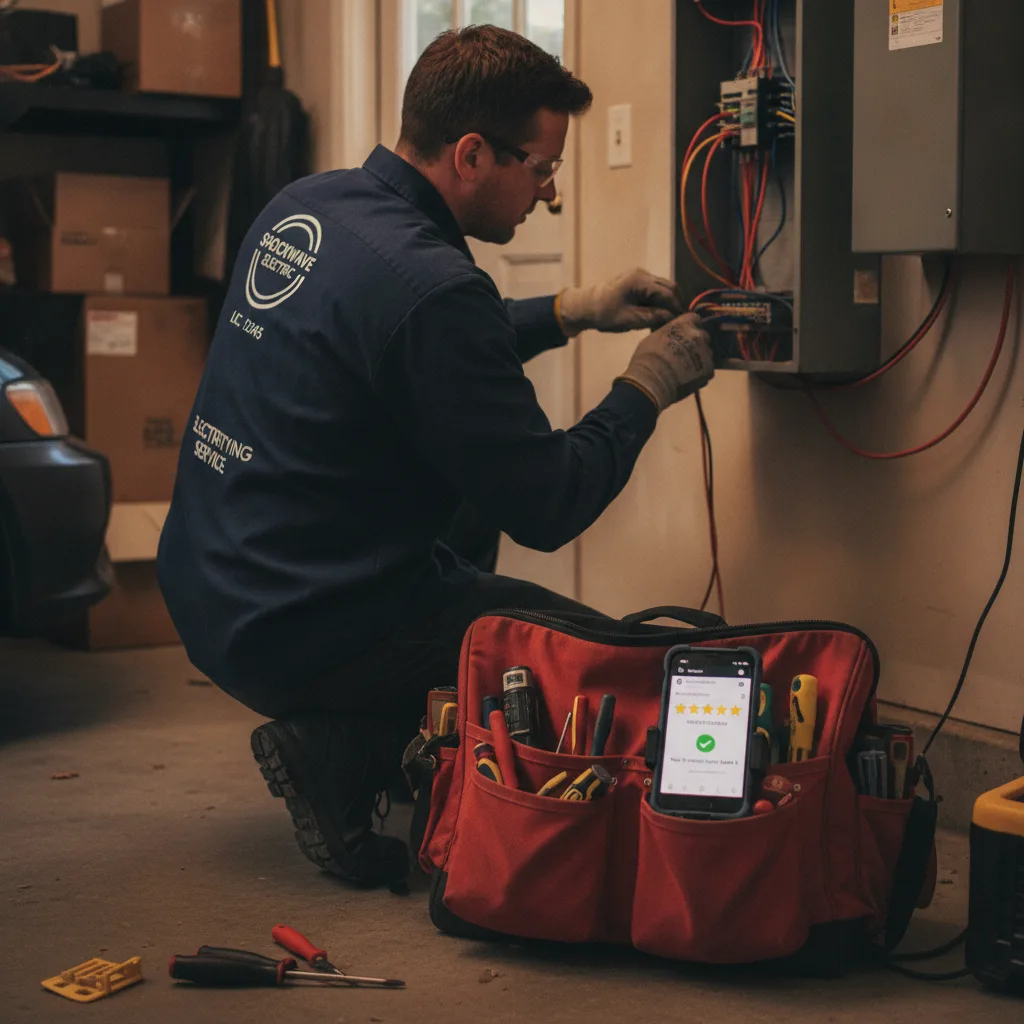
Run Paid Ads on High-Margin Terms, Not Just Emergency Keywords
Electricians carry the highest Google Ads cost per click of any home-services trade at $12.18 average, rising to $19.48 on commercial electrician queries — which is why running paid ads on every keyword burns budget fast. The correct approach is surgical: run PPC ads focused on panel upgrade keywords ($25–$48 CPC, $2,500–$5,500 average ticket) and EV charger installation queries, where the customer is in project-planning mode and conversion rates run 4–7%. LSA handles emergency and service calls. Search Ads handle high-ticket planned electrical work. The two channels are complements, not substitutes.
Panel upgrade and EV charger campaigns need dedicated service landing pages — not your homepage. Each page should carry the license number, a before-and-after photo gallery, a specific city in the headline, and a click-to-call button above the fold. Electrician landing pages convert at 3–8% when traffic is targeted and local intent is matched; generic pages that land on the homepage convert at under 2%. Add 200-plus negative keywords before launch (competitor business names, DIY terms, 'electrician salary,' 'electrician school') to stop the $12.18 CPC from burning on irrelevant clicks. Keep your keyword list tight around relevant keywords that match your service area and target audience.
EV charger installation is the fastest-growing, highest-margin niche in residential electrical for 2026. EV charger leads convert at 10–20% and close at 20–30% because the homeowner already bought the car. Jobs run $500–$2,500 base, with panel upgrade attachments reaching $5,000 or more. Target queries like 'Level 2 EV charger installation [city]' and 'EV charging station home installation' — these keywords cost significantly less than panel upgrade terms and attract buyers who are pre-sold on the job. Social media platforms, particularly Facebook, also work for EV charger demand generation as a secondary channel once your paid search foundation is profitable.
Google Ads
$1,500–$3,000/month minimum ad spend
The only search platform with enough local volume for electrical contractors to generate consistent lead flow on high-ticket planned-work keywords.
Unbounce
From $99/month
Builds and A/B tests service-specific landing pages without developer help — critical for improving the 3–8% conversion rate benchmark on panel upgrade and EV charger campaigns.
Tradeoff
Meta Ads average $2.30 CPC with a 2.1% CTR for home-services contractors. Top-quartile electricians achieve 5–8x ROAS using video creative, sub-5-minute lead response, and Conversion API (CAPI) tracking. Without CAPI, iOS attribution loss runs 30–50% of conversions — making Meta a secondary demand-generation channel for EV chargers and generator installs, not a primary lead source. Add Meta only after LSA and Search Ads are consistently profitable.
Build the Local SEO and Quality Content Base That Compounds Over Time
Search engine optimization (SEO) delivers the lowest long-run cost per organic lead of any electrician marketing channel: $8–$15 per organic lead versus $40–$80 for Google Search Ads. Organic search drives 52.3% of all contractor website traffic, making SEO the single largest traffic source for electrical businesses. The tradeoff is time — expect 4–6 months before measurable ranking movement and 12 months before SEO contributes meaningfully to monthly booked jobs. Electrical marketing strategies that skip SEO entirely trade short-term speed for long-term cost disadvantage.
Local SEO for electricians starts with three infrastructure moves. First, build separate service pages for every high-volume keyword cluster: 'panel upgrade [city],' 'EV charger installation [city],' 'emergency electrician [city],' 'circuit breaker repair [city].' Each page needs 600-plus words, a unique title tag with the city name, the license number, and a structured FAQ section to attract featured snippet placements in search engines. Second, build consistent local citations on Yelp, Angi, HomeAdvisor, Houzz, and the Better Business Bureau — NAP (name, address, phone) must match your GBP exactly. Third, earn backlinks from local suppliers, builder associations, and real estate agent blogs — three to five local links outweigh 50 generic directory submissions for Map Pack rankings.
Quality content that answers specific electrical questions earns AI citations and featured snippet placements in search engine results in addition to traditional organic traffic. Write blog posts that answer 'How much does a panel upgrade cost in [city]?', 'What size panel do I need for an EV charger?', and 'How long does whole-home rewiring take?' Lead every answer with a citation-ready sentence that potential customers and search engines can parse instantly. Content marketing and email marketing together form the lowest-cost compound system in the electrical marketing plan. Electrician SEO retainers run $497–$1,397 per month (BaaDigi) to $1,500–$5,000 per month (AuthoritySpecialist) — the difference is scope, not quality. A marketing team with electrical trade experience closes the gap fastest.
Surfer SEO
From $99/month
Scores service page content against top-ranking competitors in real time — prevents publishing a panel upgrade page that is 400 words short of what Google rewards in your market.
BrightLocal
From $39/month
Tracks local citation consistency, GBP ranking by zip code, and review velocity across all platforms — the reporting layer that shows whether local SEO work is moving Map Pack position.
Shortcut
Panel and outlet queries show only 20–34% seasonal variance year-round — the lowest of any home-services trade (WebFX, 2026). Prioritize these as evergreen SEO targets first to build consistent organic leads before optimizing for seasonal spikes. 'Emergency electrician' spikes +160% and 'circuit breaker repair' spikes +219% during storm and overload season (May–December), but those terms are harder to rank for quickly. Build the evergreen pages first; optimize the seasonal pages by April each year.
Follow a Quarter-by-Quarter Seasonal Calendar Built on Real Electrical Search Data
Electrical demand follows a distinct seasonal pattern that is different from HVAC and plumbing, and building your marketing plan around it is what separates profit-focused electrician marketing strategies from generic contractor playbooks. 'Electrician near me' peaks in July at plus 26% above baseline. 'Emergency electrician' and 'circuit breaker repair' spike plus 160% and plus 219% respectively from May through December. Panel upgrade and outlet queries hold steady year-round with 20–34% variance — the most consistent demand curve in home services. Your seasonal calendar should reflect these search patterns, not copy someone else's.
Q1 (January–March): Launch EV charger installation and generator campaigns while CPCs run 15–25% below peak. Email marketing reactivation sequences sent to previous customers — segmented by job type — generate booked jobs at near-zero cost. A targeted email to past panel customers with a 2026 inspection offer produces responses because the message is relevant, not generic. Build city-specific SEO pages for spring service areas. Property managers and commercial accounts finalize Q2 budgets in February — reach them with LinkedIn outreach and direct mail, not Google ads. Q2 (April–June): Activate emergency electrician and circuit breaker repair paid search campaigns before storm season peaks. Increase LSA budget 20–30% heading into the July surge. Collect before-and-after photos from every spring job and push them to GBP weekly. Follow-ups on Q1 proposals close at higher rates as homeowners finalize spring project budgets.
Q3 (July–September): July is peak month for 'electrician near me' — hold or increase ad budget rather than cutting. The biggest mistake electrical contractors make during peak season is reallocating budget away from digital to offline tactics. Run referral campaigns targeting past customers with a summer discount on surge protection installs. Q4 (October–December): The single biggest mistake electricians make during slow season is cutting budget entirely. Shoulder-season ads capture leads at lower CPCs while competitors go quiet. Run holiday lighting circuit and dedicated outlet campaigns in October and November; shift to generator and heating-load electrical work for December. Email your previous customers a Q1 booking incentive before December 15. Electricians with both residential and commercial accounts have a natural buffer — the two demand curves rarely dip simultaneously — so use Q4 to close property manager relationships if your electrical business is currently 100% residential.
Key Insight
Electricians with both residential and commercial accounts have a natural buffer against slow seasons. If your electrical business runs 100% residential today, use Q4 to close one or two property management relationships. A single property manager with 50 units can replace an entire month of LSA spend in recurring electrical work — and those relationships compound into referrals across the property manager's professional network.
Measure Cost Per Booked Job with Call Tracking, Not Cost Per Lead
Cost per lead is the wrong metric for an electrician marketing plan. The right metric is cost per booked job, tracked by channel. A $39 LSA lead that books at 43.4% produces a $90 cost per booked job. A $15 SEO lead that books at 25% produces a $60 cost per booked job. A $50 Meta Ad lead that books at 10% produces a $500 cost per booked job. Without call tracking mapped to your CRM, all three look cheap at the lead level and the Meta spend quietly destroys margin. Cost per booked job is the metric that drives honest marketing decisions.
Set up CallRail with one unique tracking number per channel: one for LSA, one for Google Search Ads, one for organic GBP calls, one for Meta Ads, and one for your website contact form. In GA4, create a 'Lead Source' custom dimension and push the CallRail source data into it via webhook. In your field-service platform — ServiceTitan, Jobber, or Housecall Pro — tag every booked job with its lead source before dispatching. Run a weekly report: leads by channel, booked jobs by channel, revenue by channel. Cut or pause any channel where cost per booked job exceeds 15% of average job ticket. This is the marketing team discipline that turns an electrical business from a cost center into a compounding growth system.
Review the full channel stack every 90 days, not every 30. LSA and SEO both need 60–90 days of data before optimization decisions are meaningful. The 30-day check is for anomalies: a sudden spike in LSA disputes, a GBP suspension, a landing page that stopped converting. The 90-day review is for budget reallocation. If LSA is generating booked jobs at $90 and Google Search Ads are generating them at $280, shift 15–20% of Search Ad budget into LSA and measure again at the next 90-day mark. Sustainable growth in electrician marketing comes from this compounding reallocation cycle — not from adding new channels before the existing ones are optimized.
CallRail
From $45/month
Routes and records every inbound call by channel with dynamic number insertion — the only way to attribute booked jobs to the correct ad source without manual tagging.
ServiceTitan
Custom pricing (typically $200–$600/month for small shops)
Tags booked jobs by lead source and tracks revenue per channel inside the same platform where dispatchers schedule work — closing the loop between marketing spend and actual revenue.
Looker Studio
Free
Pulls CallRail, GA4, and Google Ads data into a single weekly dashboard so cost-per-booked-job by channel is visible without exporting spreadsheets.
Common Mistake
39% of electrician websites have no analytics installed (Web Tonic, 2026). If you inherited a website without GA4 or call tracking, install both before running a single paid ad. Every week of spend without tracking is budget spent training Google's algorithm on conversion data you cannot see or verify — and those are marketing efforts you cannot recover.

Word of Mouth Alone Won't Scale This Market
The U.S. electrical market reaches $347.5 billion in 2026 across 262,000 businesses, with electrician employment growing 9% through 2034 — classified as 'much faster than average' by BLS. That growth intensifies local digital competition every quarter. Word of mouth marketing and referrals remain valuable for repeat customers and past-job reactivation, but they do not produce consistent lead volume for a shop trying to scale past $1M in revenue. Every electrical marketing plan that relies primarily on referrals will eventually hit a ceiling it cannot break through without a paid and organic digital foundation. Build the foundation first; referrals and word of mouth become the multiplier on top of it, not the base beneath it. A marketing agency with home-services experience can compress the activation timeline, but the strategic sequencing in this plan holds regardless of whether you execute it in-house or with outside marketing solutions.
An electrician marketing plan built for 2026 is not about generating maximum lead volume. It is about filtering for profit: LSA for emergency and service work at $39 per lead, Search Ads for panel upgrades and EV charger installation at controlled CPC, local SEO and quality content as the compounding base that drops cost per organic lead to $8–$15 over 12 months, and a seasonal calendar that follows how homeowners actually search. Execute these seven steps in order, measure cost per booked job by channel every 90 days, and the electrical marketing plan stops being a cost center and starts producing steady growth and sustainable growth in booked revenue. The electrical businesses that win the next three years are the ones that build this foundation before their market gets crowded — not after.
Frequently Asked Questions
Ready to get started? Contact Geek Powered Studios today.