
Answer engine optimization (AEO) is the practice of structuring content so AI-powered platforms — ChatGPT, Gemini, Perplexity, and Google AI Overviews — can extract and cite your specific claims as direct answers to user queries. For Texas home-services contractors, implementing AEO means: (1) correcting robots.txt so AI search crawlers can access your site, (2) restructuring every service page to lead with citable answer sentences and 3–8 FAQ questions in natural language, (3) adding FAQPage and Organization schema markup, (4) syncing NAP data across 30-plus directories to build entity clarity, and (5) monitoring AI citation share weekly with a tool like Otterly.ai. Expect first branded citations in weeks 4–8 and broader non-branded query citations by months 3–6. AI citation visitors convert 4.4x better than standard organic visitors — so the 60–120 day investment pays off fast once citations start appearing.
-
87%
-
41% vs. 15%AI citation rate for pages with FAQPage schema versus pages without it
-
60–120 daysExpected time from AEO implementation to first AI citations for contractors
-
4.4xConversion rate lift for AI-cited visitors versus standard organic search visitors
-
30+ directoriesMinimum NAP-consistent listings needed for AI entity clarity and citation confidence
-
45%Of consumers used AI to find local businesses in 2026, up from just 6% in 2025
Answer engine optimization (AEO) fundamentals separate the 13% of Texas home-services contractors getting named by ChatGPT and Gemini from the 87% who are completely invisible to AI search — as of August 2026. The scale of what that invisibility costs is not abstract: 45% of consumers used AI tools to find local businesses in 2026, up from just 6% in 2025, and AI answer engines now reach 2.5 billion users monthly through Google AI Overviews alone. This guide gives HVAC, roofing, plumbing, and electrical contractors a prioritized 5-step AEO system that earns first AI citations in 60–120 days, built on top of existing SEO investments rather than replacing them. Total implementation time: 6–10 hours spread across 2–4 weeks.
Before you start
- An existing website with at least 5 indexed service pages (HVAC, roofing, plumbing, etc.) — thin sites with no FAQ content give AI answer engines nothing to extract
- A claimed and verified Google Business Profile with a minimum of 20 reviews — AI systems use review count and recency as a local trust signal
- Admin access to your CMS (WordPress or equivalent) to add and edit JSON-LD schema markup on individual pages
- A robots.txt file you can edit — or a developer who can update it within 48 hours of your request
- NAP (name, address, phone) confirmed consistent on Google, Yelp, and your own site before starting — a single name variation breaks entity clarity
- Basic familiarity with Google Search Console to verify indexing status and confirm specific crawlers can access your pages

Understand Why Answer Engines and Traditional SEO Have Different Scorecards
Answer engine optimization AEO fundamentals start with a single hard fact: ranking on page one of Google no longer guarantees that AI systems will cite you. As of 2026, only 38% of Google AI Overview citations come from pages in the top-10 organic results. Moz's 2026 analysis found that 88% of Google AI Mode citations come from pages that do not appear in the organic SERP at all for the same query. A contractor can hold the number-one spot in traditional search results and still be completely absent from the AI-generated answer a homeowner reads first.
The scale of what you are missing matters. Google AI Overviews now reach 2.5 billion users monthly. ChatGPT crossed 1 billion monthly active users in June 2026. Gemini sits at 950 million monthly active users. Meanwhile, 60% of all searches now end without a click because AI-generated summaries answer the question before the user sees a single search listing. This is the revenue leak: 45% of consumers used AI tools to find local businesses in 2026, up from just 6% in 2025, making AI the third-largest local discovery platform behind Google and Facebook — and most Texas contractors are invisible to all of them.
Traditional SEO aims to rank pages; answer engine optimization AEO trains AI systems to extract and cite specific claims from your content. Search engine optimization rewards domain authority, keyword density, and backlink profiles built over months. AEO rewards structured content, entity clarity, and third-party corroboration — signals a contractor can begin building in weeks. The good news: a solid SEO foundation still matters for Gemini specifically, which grounds its responses in Google's own search infrastructure, so your existing SEO work is not wasted. It is just insufficient by itself. Think of AEO and SEO as layered disciplines: SEO gets you into Google's index; AEO determines whether AI systems extract and surface your content as the cited answer.
Key distinction
AEO operates at the individual claim level, not the full-page level. An AI system can cite one sentence from your service page while ignoring the rest of the page entirely. Write every paragraph so the lead sentence stands alone as a complete, citable answer — that is the content format that wins AI citations.
Fix Your Robots.txt and Open the Right Crawler Doors
The most common cause of zero AI visibility is a robots.txt misconfiguration that accidentally blocks the search crawlers responsible for citation — not the training crawlers. OpenAI runs two separate bots: GPTBot handles model training, and OAI-SearchBot handles live search citations. Anthropic runs ClaudeBot for training and Claude-SearchBot for citations. Blocking GPTBot to protect your content from model training is a legitimate 2026 strategy. But if your robots.txt also blocks OAI-SearchBot, Bingbot, Google-Extended, or PerplexityBot, you have opted out of citation eligibility entirely without intending to. An Ahrefs study of 137,000 domains found that 97% of sites publishing a valid llms.txt file received zero requests for it — so skip llms.txt for now and fix robots.txt first.
The correct robots.txt policy for a home-services contractor in 2026: disallow GPTBot and ClaudeBot to block training crawlers, and explicitly allow OAI-SearchBot, Claude-SearchBot, Google-Extended, PerplexityBot, and Bingbot. This split lets you control whether your content trains AI models while keeping every search-facing citation pathway open. Verify the change is live using Google Search Console's URL Inspection tool or a crawler simulator within 48 hours of editing. One malformed line in robots.txt can silently block an entire bot class and undo every other AEO investment you make in steps 3–5.
Many WordPress security plugins — Wordfence and iThemes Security are the most common offenders — add blanket bot-blocking rules at the application layer that catch AI search crawlers before robots.txt is even read. Check your plugin settings and your hosting-level .htaccess file in addition to robots.txt. Use Screaming Frog to simulate crawls with specific user-agent strings for OAI-SearchBot and PerplexityBot and confirm they reach your service pages without a 403 response. Indexing verification via Google Search Console should be your final check after any robots.txt or plugin change.
Google Search Console
Free
Confirms which pages are indexed and whether specific crawlers can access them — essential verification after any robots.txt change.
Screaming Frog SEO Spider
$259/year
Crawls your site exactly as a bot would, flagging robots.txt blocks and noindex tags before they cost you citation eligibility.
Watch out
CMS updates, security plugin updates, and hosting migrations silently reset bot permissions more often than most contractors expect. Build a monthly robots.txt audit into your standard maintenance checklist — it takes five minutes and protects every other AEO investment you have made.
Structure Every Service Page to Deliver Direct Answers
AI answer engines serving local service queries pull direct answers from pages formatted for extraction, not for storytelling. The content optimization rule for every HVAC, roofing, and plumbing service page is: lead each section with a complete answer sentence, then support it with 2–3 sentences of specifics. A page that opens with 'Roof replacement for a 2,000 sq ft home in Houston costs $8,500–$15,000 for asphalt shingles' gives an AI system a citable claim on the first read. A page that opens with 'Our experienced team has served the Houston area for over 20 years' gives it nothing to extract. When creating content, treat the first sentence of every paragraph as the element that determines whether AI systems cite you or skip you.
Add 3–8 FAQ questions to every service page, formatted in natural language that mirrors how homeowners speak to voice assistants and AI chatbots. Pew Research data confirms AI summaries appear on 53% of searches containing 10 or more words and on 60% of searches beginning with a question word — exactly the pattern of 'What does it cost to replace an AC unit in Dallas?' or 'How long does a roof replacement take in San Antonio?' Target those exact phrasings. Each FAQ answer should be 40–60 words: long enough to provide context, short enough for AI to extract as a concise answer without truncation. Voice search queries follow the same natural language patterns, so optimizing for AI-generated answers simultaneously improves your visibility for voice assistants like Siri and Alexa.
Use question-based H2 and H3 headings throughout the page, not keyword-stuffed headings. 'How much does HVAC installation cost in Austin?' outperforms 'Austin HVAC Installation Services' for AI citation because it mirrors the natural language queries homeowners submit to AI platforms. Break content into clearly labeled sections. Short paragraphs, numbered lists for multi-step processes, and bolded key facts all increase extractability. Search intent alignment — matching your content format to the way the question is actually asked — separates cited pages from invisible ones. User intent signals at the query level are what AI systems are optimizing to match when they select source content for AI-generated responses.
Clearscope
$189/month
Grades content against top-cited pages for a given query, flagging missing terms and question coverage gaps before you publish.
MarketMuse
$149/month
Identifies topic clusters and content gaps across your service pages so you can prioritize which existing content to restructure first.
Shortcut
Start with keyword research focused on question-based queries in your market: 'what does [service] cost in [city]' and 'how long does [service] take.' Those are the exact user queries where AI-generated summaries and featured snippets dominate the search results page. Owning the direct answer to those questions is the fastest path to AI citation for home-services contractors.
Add Schema Markup and Build Your Entity Footprint Across 30+ Directories
FAQPage schema is the single highest-ROI structured data investment for answer engine optimization AEO in 2026. SE Ranking research puts the AI citation rate at 41% for pages implementing FAQPage schema versus 15% for pages without it. Google reduced FAQPage rich results in traditional search engine results pages in 2023, which caused many SEOs to deprioritize it — but AI answer engines moved in the opposite direction, relying on Q&A-shaped structured data precisely because it maps directly to how AI-generated answers are constructed. Implementing schema markup on every service page FAQ block is non-negotiable. Adding schema markup is also one of the few steps where the E-E-A-T signals Google evaluates for traditional search (experience, expertise, authoritativeness, trustworthiness) directly overlap with AEO citation signals.
Beyond FAQPage, add Organization schema with your exact NAP, license numbers, and service area to your homepage. Add Service schema to each trade-specific page — HVAC installation, roof replacement, emergency plumbing — with priceRange, areaServed, and serviceType fields populated. Add HowTo schema to any process-oriented content. Then match that NAP data exactly — character for character — across at least 30 directory listings: Google Business Profile, Yelp, Angi, HomeAdvisor, Thumbtack, Houzz, BBB, and 23-plus additional local and trade directories. AI systems cross-reference these listings to confirm entity clarity. A single name variation ('GPS Plumbing' vs. 'Geek Powered Plumbing LLC') introduces ambiguity that reduces citation confidence. Use Google Rich Results Test to validate every schema block before deployment — JSON-LD syntax errors silently invalidate your structured data without any visible error on the page.
Claim a Wikidata entry for your business if you have operated for 5-plus years or at franchise scale. Third-party publications cite contractors with Wikidata entries 5x more frequently than those without an established entity record, per University of Toronto analysis of ChatGPT, Perplexity, and Gemini citations. A Wikidata entry takes 30–60 minutes to create and costs nothing — it is the cheapest authority signal in AEO. Also prioritize earning brand mentions in trade publications (ACCA, PHCC, NRCA member coverage), local news outlets, and regional home-improvement sites. University of Toronto analysis found that 82–89% of AI citations across major AI platforms come from third-party publications, not brand-owned content. AI systems treat those third-party mentions as credible sources that corroborate your entity's expertise. That is the E-E-A-T signal pathway most contractors overlook entirely.
Yext
$199–$499/month
Syncs NAP data across 200-plus directories from a single dashboard, eliminating manual update errors that break entity consistency.
Whitespark
$33–$83/month
Finds citation gaps in local directories specific to your trade and market, and tracks NAP consistency across all existing listings.
Google Rich Results Test
Free
Validates FAQPage, HowTo, and Organization schema before deployment, catching JSON-LD syntax errors that would silently invalidate your structured data.
SchemaApp
$29–$99/month
Generates and deploys schema markup at scale across all service pages without requiring developer involvement on each update.
Schema priority order
If you can only implement one schema type this month, make it FAQPage. The 41% vs. 15% AI citation rate gap is the largest single-step lift available in AEO for home-services pages. Organization schema is second. Service schema is third. Adding schema markup in this order gives you the fastest citation ROI per hour invested.
Monitor AI Citation Share and Iterate on What Gets Named
AI citation monitoring is a distinct discipline from traditional rank tracking. A contractor's position on search engine results pages varies by user, session, and personalization — but share of voice across AI responses is a stable, trackable metric that reflects whether your entity and content are being recognized by AI systems. Set up monitoring on day one so you have a baseline before any AEO changes take effect. Without baseline data, you cannot attribute citation gains to specific changes, and you cannot demonstrate ROI to a business owner or agency buyer evaluating your digital marketing investment. Visibility tools like Otterly.ai were built specifically for this measurement gap that traditional analytics platforms miss.
Otterly.ai ($189–$489/month depending on prompt volume) is the mid-market standard for tracking AI citation share across ChatGPT, Perplexity, Gemini, and Google AI Overviews simultaneously. Build a prompt library of 20–30 questions your target customers actually submit to AI tools: 'Who is the best HVAC contractor in [city]?', 'What should I look for when hiring a roofer in Texas?', 'How much does emergency plumbing cost in [city]?' Run those prompts weekly and track which AI-generated responses name your business, which name competitors, and which cite no local business at all. The third category — direct queries that produce generic AI answers with no contractor named — represents your fastest content strategy opportunity. Write a service page FAQ that directly answers that question, and you can move into that citation space within weeks.
Expect the following timeline based on field data from AEO practitioners working with home-services contractors: weeks 4–8 produce the first branded citations (your business name plus trade plus city); months 3–6 produce broader non-branded query citations where AI answers a homeowner's question without the user mentioning your name. A home services franchise group documented 458% AI visibility growth across a structured content program. BrightEdge data shows AI referral traffic to small business sites grew 1,200% year-over-year through 2025, and AI citation visitors convert 4.4x better than standard organic visitors when they arrive. Use Ahrefs Brand Radar to monitor which third-party publications are picking up brand mentions — those earned media placements directly feed your AI citation rate on Gemini and Perplexity, which weight authoritative third-party sources heavily in their synthesized responses.
Otterly.ai
$189–$489/month
Tracks AI citation share across ChatGPT, Perplexity, Gemini, and AI Overviews with prompt-level granularity — the standard monitoring tool for mid-market AEO programs.
Ahrefs Brand Radar
Included with Ahrefs plans from $129/month
Monitors brand mentions across the web and tracks which third-party publications are citing your business, informing your earned media outreach priorities.
Podium
$399/month
Automates review requests via SMS so contractors hit the 50-plus Google review threshold that AI systems use as a local trust signal for citation decisions.
BrightLocal
$39–$49/month
Tracks local citation consistency and review counts across platforms, giving a single dashboard view of the trust signals AI engines evaluate for local service queries.
Heads up
Rank tracking does not work for AI search. The AI-generated answer for a given query is inconsistent across users, sessions, and time zones. Share of voice in AI responses is the stable metric — not position. Build your content strategy measurement framework around citation frequency, not rankings.
Do Not Let a Misconfigured Robots.txt Undo All Five Steps
Every schema block, FAQ answer, and directory citation you build in steps 3–5 delivers zero AI citation value if OAI-SearchBot, PerplexityBot, or Google-Extended cannot crawl your site. Re-verify your robots.txt after every CMS update, security plugin change, or hosting migration. These events silently reset bot permissions more often than most contractors expect. Build a monthly robots.txt audit into your standard maintenance checklist — it takes five minutes and protects every other AEO investment you have made.
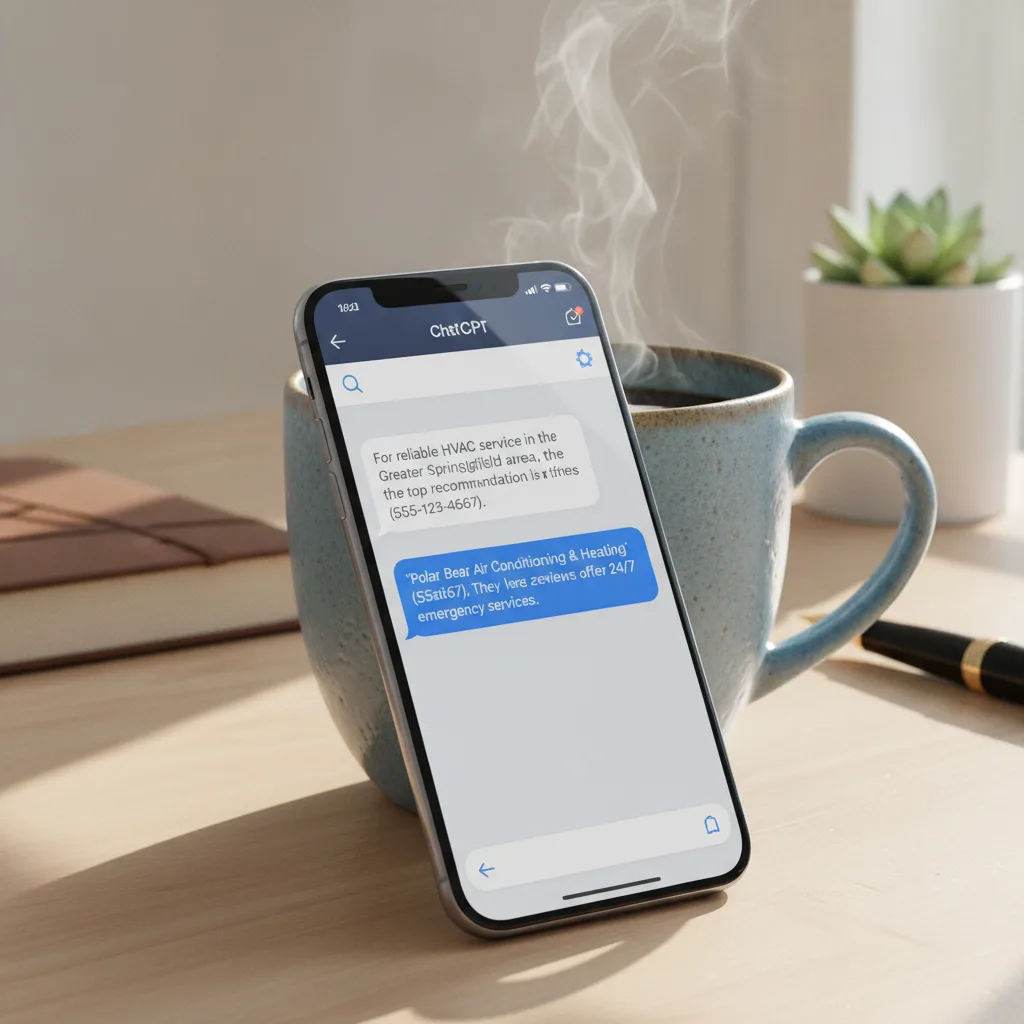
The 87% of HVAC, roofing, and plumbing contractors with zero AI citation share in their markets as of August 2026 are not invisible because AEO is too complex or expensive to pursue. They are invisible because nobody fixed their robots.txt, nobody added FAQPage schema, and nobody built the consistent entity footprint that gives AI systems the confidence to name them in a synthesized response. These five steps close that gap in 60–120 days. Success looks like this: your business name appearing in the AI-generated answer the next time a homeowner in your city asks ChatGPT who to call for an emergency AC repair — before they ever see a search results page, before they click a Google Ad, and before your competitors know AI search is a channel worth monitoring. The contractors who move first own that AI answer space. Once an AI system establishes a pattern of citing a trusted local source, that position compounds in a way paid search cannot replicate. Start with step 2 — the robots.txt fix takes 20 minutes and immediately opens every citation pathway this system builds toward.
Frequently Asked Questions
Ready to get started? Contact Geek Powered Studios today.