Deploying AI tools for plastic surgery marketing starts with a call-leakage audit, then layers in a voice receptionist ($99–$297/month), AI-powered chatbot intake ($97–$297/month), and simulation software ($399–$20,000+/year) in that order. As of 2026, 36% of patients credit AI platforms like ChatGPT with influencing their surgeon choice — surpassing Google at 34%. The full three-layer stack costs $350–$900/month at entry-level pricing, recovers lapsed consultations at a 15–25% rate, and adds structured data so your practice gets cited by AI search engines, not just ranked by Google. Setup takes 3–5 hours; the revenue math clears after one recovered surgical call.
-
35%+Inbound consultation calls the average plastic surgery practice misses
-
$5,250Expected revenue value of each recovered missed surgical call
-
$99–$297/moEntry-level cost of an AI voice receptionist to stop after-hours leakage
-
36%Patients influenced by AI tools like ChatGPT when choosing a surgeon in 2026
-
15–25%Lapsed consultations recoverable through AI follow-up sequences
-
3–5 hoursTotal setup time to deploy all three AI stack layers across your practice
AI tools for plastic surgery marketing have moved from competitive differentiator to revenue-protection requirement. The U.S. cosmetic surgery market reaches $6.4 billion in 2026 and is projected to hit $9.9 billion by 2033 — but that growth concentrates in plastic surgery practices that answer faster, convert better in the consult room, and show up where patients actually search. As of 2026, 36% of patients who actively searched for a plastic surgeon cited AI platforms like ChatGPT and Claude as influencing their provider choice, surpassing Google search at 34% and doctor recommendations at 32%. The practices that capture that shift deploy a three-layer AI systems stack — after-hours voice agents, chatbot intake, and simulation imaging — in the correct order, with structured data optimization on top. This guide gives you the specific tools, exact pricing, and the ROI math to justify each purchase decision before you make it. Setup takes 3–5 hours for initial configuration across all three AI tool categories.
Before you start
- Active Google Business Profile with a verified address and at least 20 reviews — needed for local SEO baseline before AI-powered content optimization produces measurable lift
- A CRM or practice management system (Nextech, PatientNow, or similar) that accepts webhook or Zapier integrations — required for AI chatbot lead handoff
- Existing paid advertising account (Google Ads or Meta) with at least 90 days of conversion data — gives AI follow-up sequences a lapsed-lead pool to recover
- HIPAA-compliant cloud storage or EMR capable of storing pre- and post-op images — prerequisite before deploying any AI simulation or imaging tool
- A dedicated phone number separate from your main line for the AI voice receptionist so call routing and performance data stay isolated from staff lines
- Your practice's before and after galleries in digital format — simulation tools and AI-generated content workflows both require a curated image library as a training and reference asset
Audit Your After-Hours Call Leakage Before Buying Any AI Tool
Plastic surgery practices miss 35% or more of inbound consultation calls, and 78% of prospective patients book with the first practice that responds — which means the revenue problem to solve first is not simulation or chatbots, it is after-hours call leakage. Pull 90 days of call data from your phone system or CallRail account. Count every call that rang more than four times without answer, every voicemail left between 6 p.m. and 9 a.m., and every missed call on weekends. That number is your baseline loss figure.
Attach a dollar value to each missed call before you shop for AI systems. The math is straightforward: if your average case value is $15,000 and your consult-to-procedure conversion rate sits at 35% (the ASPS benchmark), each missed inbound surgical call carries an expected value of $5,250. Missing two calls per week annualizes to roughly $546,000 in lost procedure revenue — a figure that makes a $99–$199/month AI voice receptionist look like an accounting rounding error, not an expense. Document this number in a spreadsheet. Every AI tool purchase decision in the steps that follow should clear this ROI bar first.
This audit also benchmarks your current lead-to-consultation conversion rate by channel. As of 2026, SEO-sourced leads convert to booked consultations at 18.9%, Google Ads leads at 10.7%, and Meta leads at 6.2%. If your numbers are materially lower, the constraint is response speed and availability, not ad quality — and that is exactly what AI-powered voice and intake tools address.
CallRail
$45–$145/month
Call tracking with missed-call logs, recording, and source attribution — gives you the raw data to calculate after-hours leakage before committing to any AI receptionist platform
Do this before demos
Vendors for every AI tool category will quote you conversion uplifts. None of those numbers mean anything without your own missed-call baseline. Run the audit first, then evaluate tools against your specific leak rate — not industry averages.
Deploy an AI Voice Receptionist to Stop After-Hours Revenue Bleeding
An AI voice receptionist answers every inbound call 24/7, qualifies the caller by procedure interest and budget range, and books the consultation directly into your scheduling system — all for $99–$297/month, which is recovered the moment one missed surgical call converts. Ringlyn and AutoMeit are the two platforms with published pricing specific to aesthetic medicine: Ringlyn runs $99–$199/month, AutoMeit's flat plans run $297–$697/month and include CRM sync. Both are HIPAA-aware and support natural language processing well enough to handle pricing and recovery timeline questions without a human coordinator.
Configure the AI voice agent with a script that mirrors your intake coordinator's actual qualification questions: procedure of interest, timeline to surgery, prior consultations elsewhere, and whether the caller has seen your before and after galleries online. These answers feed directly into your CRM as a structured lead record, so when your patient coordinator opens the file the next morning, the lead is already warm and partially qualified. Virtual assistants configured this way reduce coordinator call-back time by 40–60 minutes per day at a typical 30-procedure-per-month practice.
Set the handoff rule explicitly: the AI voice agent books consultations and answers procedural FAQs, but any caller who describes a complication, mentions a prior surgery with another surgeon, or asks for a clinical opinion routes to a human immediately. This is not a courtesy — it is the medico-legal boundary. AI-powered voice systems score 94.54% on safety in peer-reviewed testing but only 11.48% on empathy, confirming they handle intake triage reliably while falling short on the nuanced rapport that surgical candidates require before committing to a procedure.
Ringlyn AI Voice Agent
$99–$199/month
Built specifically for cosmetic surgery and medical aesthetics; handles after-hours call qualification, FAQ responses on pricing and recovery timelines, and direct scheduling integration
AutoMeit
$297–$697/month flat
Flat-rate AI receptionist with CRM sync and multi-location support; plans include SMS follow-up sequences, making it the stronger choice for practices running 50+ consultations per month
Compliance checkpoint
Every AI voice receptionist must be disclosed as automated before the caller shares any personal health information. A one-sentence opening — 'You've reached [Practice Name]. I'm an AI assistant helping schedule your consultation' — satisfies patient confidentiality disclosure requirements and sets accurate expectations. Patient privacy protections under HIPAA apply to every call recording and lead record the system creates. Skipping the disclosure line creates HIPAA exposure that no $199/month tool is worth.
Add AI-Powered Chatbot Intake to Qualify Website Leads Around the Clock
AI-powered chatbots for plastic surgery clinics — Dezyit, Avaamo, and GoHighLevel are the three most widely deployed as of 2026 — automate patient intake, answer pricing and recovery timeline questions, and qualify leads before a human coordinator ever picks up the phone. The chatbot sits on your website and practice's online presence as a persistent widget, captures lead data from the 83% of prospective patients who visit your site before calling, and pushes structured records to your CRM via webhook. Practices that add online scheduling alongside a chatbot convert 27% more leads than phone-only booking setups.
Build the chatbot's knowledge base around the questions your front desk actually fields: rhinoplasty recovery time (7–10 days before returning to non-strenuous work), breast augmentation cost range ($6,000–$12,000 depending on implant type and geographic market), facelift candidacy by age range, and post-op instructions for your most common cosmetic procedures. These are the answers prospective patients search for on answer engines like ChatGPT and Perplexity before they ever reach your website — so your chatbot's response quality directly affects how AI platforms describe your practice when patients search for recommendations. AI-generated content created by your chatbot interactions also feeds back into your content strategy as structured FAQ data for schema markup and patient education materials.
GoHighLevel ($97–$297/month) handles both chatbot and CRM in one platform, which reduces integration friction for plastic surgery practices without a dedicated tech stack. Dezyit is purpose-built for aesthetic medicine and includes procedure-specific conversation flows for rhinoplasty, breast augmentation, facelifts, and liposuction out of the box. Avaamo is the enterprise pick for multi-location plastic surgery clinics with existing EHR systems — it supports HL7 and FHIR integration. Whichever platform you select, configure a hard-stop rule: the chatbot does not interpret photos, does not provide clinical recommendations, and routes any clinical question to a scheduled call with a board-certified plastic surgeon or patient coordinator.
GoHighLevel
$97–$297/month
Combines AI-powered chatbot, CRM, and automated follow-up sequences in one platform — reduces the number of integrations a practice needs to manage and includes SMS drip campaigns for lapsed leads
Dezyit
Custom pricing (contact vendor)
Purpose-built for aesthetic medicine with pre-loaded conversation flows for rhinoplasty, breast augmentation, facelifts, and liposuction — cuts chatbot setup time from weeks to days
Avaamo
Enterprise pricing
Best choice for multi-location plastic surgery clinics that require HL7/FHIR EHR integration and centralized patient data governance across existing systems
Human connection rule
A 2026 peer-reviewed study scored ChatGPT at 11.48% on empathy in cosmetic injection consultations. AI-powered chatbots handle triage and patient education well — they cannot replace the human connection a coordinator builds during a pre-surgical conversation. Set a session-length trigger: any chat exceeding 8 exchanges or touching on medical history should prompt an offer to schedule a live call within one business hour.
Deploy AI Simulation to Control the In-Consult Narrative and Increase Booking Rates
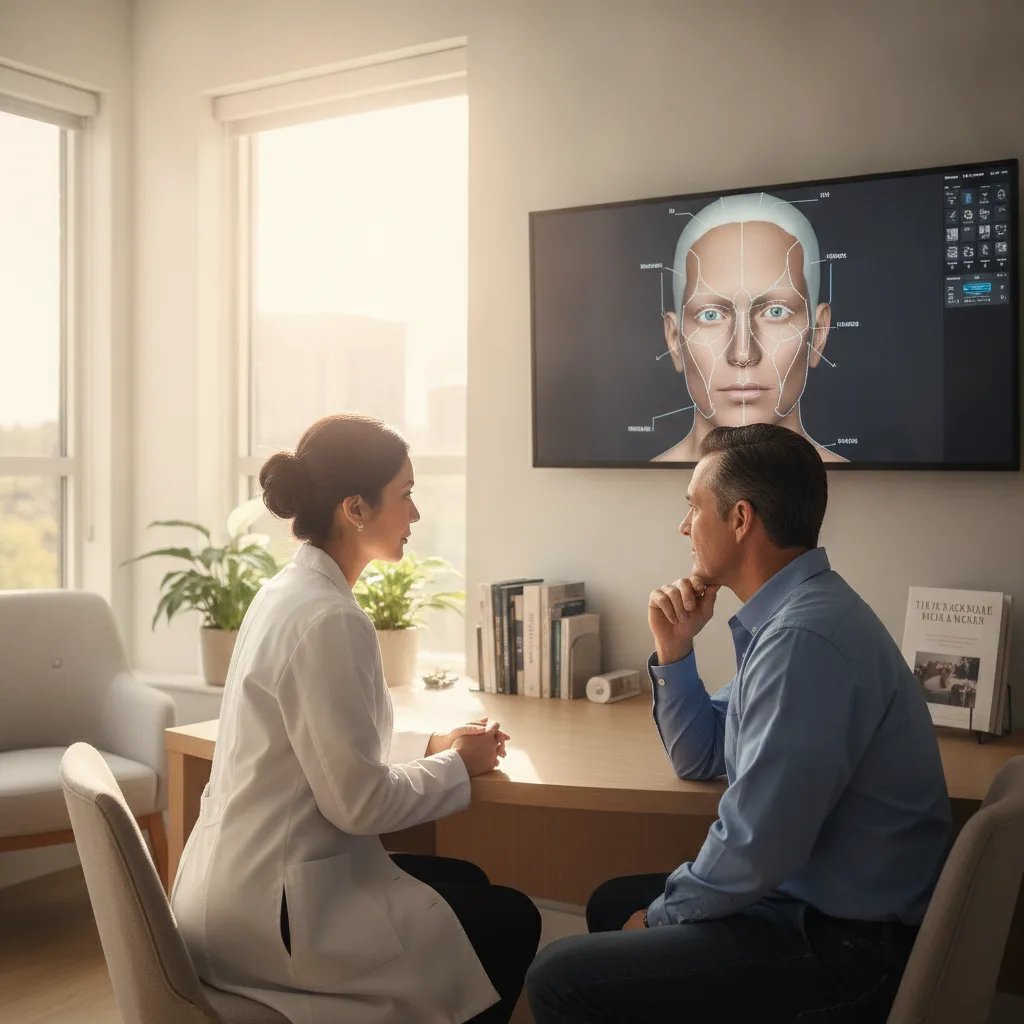
AI plastic surgery simulators generate multiple photorealistic post-operative result variations in under 30 seconds, compared to 10–20 minutes for traditional manual imaging software — and that speed difference is what makes in-consult use practical for the first time. Sixty-three percent of facial plastic surgeons already use computer imaging during rhinoplasty consultations, and a systematic review of 18 studies confirmed that fulfillment of preoperative expectations correlates directly with improved post-surgical patient satisfaction. Adding simulation to your consultation workflow gives the surgeon control of the in-consult narrative before the patient anchors the conversation to a TikTok screenshot — which is the single most common source of expectation misalignment that plastic surgery patients bring into first consultations.
The simulation tool generates an anatomically grounded preview specific to the patient's actual facial or body structure, which the surgeon uses to educate the patient on what outcomes are realistically achievable. This patient education step is the highest-value 10 minutes in a consultation: it replaces social media reference images with the surgeon's own clinical framing, reduces expectation misalignment, and creates a shared visual record that supports informed consent documentation. A deep learning-based breast augmentation simulation published in a 2025 peer-reviewed study produced results that experienced plastic surgeons and residents in training could not reliably distinguish from actual post-operative photographs — confirming that AI-generated simulations are a legitimate preoperative planning and patient communication tool, not a gimmick. Artificial intelligence has reached the threshold where simulation output directly enhances patient outcomes by aligning expectations before the first incision.
Simulation also produces shareable assets. With patient consent, the before-and-after preview becomes content for before and after galleries, social media content, and patient education materials — all generated during a consultation that was already scheduled. AR/VR previews increase patient engagement by 38% according to 2026 marketing benchmark data, and plastic surgery practices that build before and after galleries with simulation-sourced content report stronger online visibility in both Google rankings and AI platform citations. Smart practices fold simulation output into their content creation workflow rather than treating it as a standalone in-office tool.
FaceTouchUp
Month-to-month subscription, all features included, no per-patient fees
Used at 500+ practices worldwide; month-to-month pricing with no per-simulation charges makes it the lowest-risk entry point for practices adding simulation for the first time
Crisalix
$24/simulation (consumer tier); practice plans up to $20,000+/year
The largest simulation dataset in the industry — 4,517 doctors, 229,911 consultations across 111 countries — gives Crisalix's AI models the broadest anatomical training base of any platform
Canfield Vectra 3D
$9,500+ upfront hardware; $500–$1,500/year software maintenance
Gold standard for 3D facial and body imaging; required for practices that want photorealistic 3D simulation rather than 2D photo morphing — the hardware cost is the barrier, not the software
Arbrea Labs
~$399/month
Mid-market 3D simulator with strong breast augmentation and rhinoplasty modules; monthly subscription with no hardware purchase makes it the best value between FaceTouchUp and Vectra
TouchMD
$250–$450/month plus setup
Combines simulation with patient education materials and consent documentation in one platform — useful for practices that want simulation and informed consent managed in the same workflow
Activate AI Follow-Up Sequences to Recover Lapsed Consultations Without Additional Ad Spend
Automated AI follow-up sequences recover 15–25% of lapsed consultations — translating to 7–12 additional procedure bookings per month for a practice with 50 lost leads, at zero incremental ad spend. These sequences run through GoHighLevel or a dedicated CRM automation layer: day 1 sends an SMS with a link to your before and after galleries, day 3 sends an email with a patient education video specific to the procedure the lead inquired about, day 7 triggers a personalized AI-generated content email addressing the most common objection for that procedure category (recovery time for rhinoplasty, implant choice for breast augmentation), and day 14 offers a complimentary virtual consultation slot. The sequence stops the moment the lead books.
Segment your lapsed lead list before launching sequences. Leads who attended a consultation but did not book (warm) respond differently than leads who filled out a contact form but never scheduled (cold). Warm lapsed leads convert at roughly double the rate of cold lapsed leads and deserve a shorter, more direct sequence — three touches over seven days rather than six touches over 21 days. AI systems in GoHighLevel and Conversica can score leads by engagement signal (email open rate, page time on procedure-specific content, return visits to your pricing page) and assign sequence intensity automatically, which keeps your patient care coordinators focused on the highest-probability leads.
Track performance data weekly for the first 60 days: sequence open rate, click-through rate on the before and after gallery link, and booked consultation rate per sequence tier. A well-configured follow-up stack should produce a sequence-to-booking rate of 8–15% on warm lapsed leads. If your rate sits below 8%, the constraint is usually sequence content quality, not send frequency — review the AI-generated content in each email against your actual patient demographics and questions, then rewrite any message that reads as generic rather than procedure-specific. Most plastic surgery practices see meaningful lift within two content revision cycles.
GoHighLevel
$97–$297/month
Runs SMS, email, and voicemail drop sequences from one dashboard with AI-powered lead scoring — eliminates the need for a separate email marketing platform and reduces the number of existing systems your team manages
Conversica
Custom pricing (typically $1,500–$3,000/month for healthcare)
AI-powered virtual assistants purpose-built for lead follow-up; Conversica's two-way conversation capability handles reply objections automatically, which is critical for lapsed surgical leads who respond with questions rather than direct booking
Frequency cap
Cap automated outreach at one touch every 72 hours and no more than six total touches per lead before archiving. Exceeding this cadence on a $15,000 surgical inquiry produces unsubscribes and negative reputation management signals — both of which cost more to recover than the booking was worth.
Optimize Content and Structured Data So AI Search Engines Cite Your Practice
As of 2026, 36% of patients who actively searched for a plastic surgeon cited AI tools — specifically ChatGPT and Claude — as influencing their provider choice, surpassing Google search at 34% and doctor recommendations at 32%. That shift means content optimization for your practice's online presence now requires two parallel tracks: classic Google rankings built on keyword research and schema markup, and AI retrieval built on citability — answer-first paragraphs that AI platforms can lift verbatim and attribute to your practice. Both tracks share the same structured data foundation, which is why this step belongs in the digital marketing and AI marketing strategy, not siloed under a separate SEO workstream. A plastic surgery marketing agency that treats these as separate efforts is behind the current state of patient acquisition.
Publish procedure-specific FAQ pages with schema markup for every high-volume query your chatbot logs. The chatbot data from Step 3 tells you exactly what prospective patients ask before booking — use those questions as your keyword research starting point. Each FAQ answer should open with a complete, standalone sentence that directly answers the question: 'Rhinoplasty recovery takes 7–10 days before returning to desk work and 3–4 weeks before resuming exercise.' That sentence structure is what answer engines pull into AI Overviews and Perplexity citations. Add surgeon credentials, board certification status, and structured data markup — MedicalProcedure, Physician, and FAQPage schema — so AI platforms can verify clinical authority when ranking source reliability. Keyword density alone does not earn AI citations; answer structure does.
Local SEO still matters for the 34% of patients using Google search: verify your Google Business Profile, add procedure-specific service pages for your top five cosmetic procedures, and generate a minimum of two new patient reviews per week through a Podium or Birdeye automated request sequence. Reputation management built on consistent review volume feeds both Google rankings and AI platform trust signals — search engines and LLMs alike weight recency and volume of patient feedback when assessing clinical authority. The plastic surgery practices that rank in classic search results and get cited by AI systems as of 2026 publish educational content at a cadence of two to four posts per month, each structured around a specific patient question, with content creation built around real patient questions rather than general marketing themes. Social media marketing on Instagram and other visual platforms amplifies this content and drives website traffic back to structured FAQ pages where AI platforms can index the answers.
Surfer SEO
$89–$219/month
Content optimization with keyword density targets and structured data recommendations built into the editor — reduces the gap between AI-generated content drafts and search-ready pages
Podium
$299–$499/month
Automates patient review requests via SMS immediately after the appointment — the fastest way to build the review volume that feeds both Google rankings and AI platform trust signals
Semrush
$139–$499/month
Keyword research and competitor gap analysis for procedure-specific content; use the Topic Research tool to surface the exact questions patients search before booking a consultation
AI citation vs. Google ranking
Google rankings and AI search citations are related but not identical. A page can rank on page one of Google and never get cited by ChatGPT if the content is not structured as direct answers. Conversely, a page with strong answer-first formatting and schema markup can earn AI citations even from position 8–15 in Google results. Optimize for both by leading every section with a citable answer sentence, then supporting it with specifics — never bury the answer at the end of a paragraph.
What AI Cannot Do in a Plastic Surgery Practice — and Where Surgeon Judgment Is Non-Negotiable
A 2026 peer-reviewed study scored ChatGPT at 11.48% on empathy during cosmetic injection consultations and 58.3% on professionalism. A separate Frontiers in Surgery meta-analysis of 25 AI studies found pooled diagnostic accuracy of 88% — impressive for screening, insufficient for surgical planning without surgeon oversight. AI systems handle intake triage, follow-up sequencing, and simulation previews reliably. They do not perform clinical judgment, establish medico-legal accountability, assess psychological readiness for elective surgery, or provide the human connection that converts an anxious first-time surgical patient into a booked procedure. Deploy AI-powered automation in the intake and follow-up layers. Keep a board-certified plastic surgeon in control of every clinical recommendation, informed consent conversation, and post-op instruction. Patient confidentiality and patient privacy protections under HIPAA apply to every AI tool in this stack — verify BAA agreements with each vendor before going live. Human expertise is not a gap AI fills; it is the ceiling AI makes possible to reach more efficiently.
The U.S. cosmetic surgery market reaches $6.4 billion in 2026 and is on track for $9.9 billion by 2033. That growth does not distribute evenly — it concentrates in plastic surgery practices that answer faster, convert better in the consult room, and show up where patients actually search, which now means AI platforms as much as Google. The three-layer AI stack in this guide — voice agent, chatbot intake, simulation — costs $350–$900/month at entry-level pricing and addresses the three highest-revenue leaks in the average aesthetic practice: after-hours missed calls, unqualified web leads, and in-consult expectation misalignment. Structured data and content optimization for AI search citation is the fourth layer — the one that makes every dollar spent on the first three compound over time instead of requiring continuous ad spend to sustain. Start with the call audit in Step 1. Every other decision follows from what that data shows.
Frequently Asked Questions
Ready to get started? Contact Geek Powered Studios today.