Home Services SEO: Cost, Timeline and Results Guide 2026
November 25, 2026
💡 Quick Answer
Home services SEO is the practice of optimizing a contractor's website, Google Business Profile, and local authority signals so the business appears at the top of organic search results and the Google Map Pack when homeowners search for services nearby. A legitimate retainer for a single-city contractor in a competitive metro runs $1,500–$4,000 per month. First organic leads typically arrive between months 6 and 9. At maturity, HVAC organic leads cost $18–$30 each versus $75–$150 or more through Google Ads. The most common reason home services SEO campaigns fail is quitting before the six-month threshold or spending below the minimum viable budget.
📊 Key Takeaways
What every home services business owner needs to know before spending a dollar on SEO — distilled from 20 real contractor questions.
$1,500/month minimum
Below $800/month buys fewer than three hours of real account work — not enough to move search rankings for home services.
Leads arrive at months 6–9
Campaigns abandoned before the six-month mark almost never produce measurable results, regardless of work quality in months 1–3.
GBP = 32% of local pack weight
Google Business Profile signals are the single largest local ranking factor — and only 45% of home services businesses have verified theirs.
47 reviews: the local 3-Pack benchmark
Businesses ranking in the top three Google local results average 47 reviews, per Local Falcon's analysis of 50.4 million U.S. search results.
Organic + LSAs = 42% more leads
Running Local Services Ads alongside home services SEO generates 42% more total leads than either channel alone, with a 40% lower cost per acquisition.
Measure calls, not just traffic
An SEO campaign that shows rising traffic but flat inbound calls has a measurement problem — connect CallRail to Google Analytics before month one.
Organic CPL trends toward zero
At maturity, HVAC organic leads run $18–$30 each — well below the $75–$150 range for Google Ads — and the gap widens every month rankings hold.
Stopping is the most expensive mistake
A paused campaign is a sunk cost. A continued campaign is an asset that gets cheaper to operate every month as leads compound.
Home services business owners asking about SEO usually get one of two answers: a vague promise about first-page rankings or a price quote that makes no sense relative to what they're currently spending on leads. Neither answer helps you decide whether the investment is worth it, what you should actually pay, or when to expect the phone to ring. This guide answers the 20 questions contractors actually ask — with specific numbers, honest timelines, and clear explanations of what moves the needle and what doesn't. No hedging, no filler.
What home services SEO actually covers
Home services SEO is the practice of optimizing a contractor's website, Google Business Profile, and local authority signals so the business appears at the top of organic search results and the Google Map Pack when homeowners search for services in their area. This guide covers the 20 questions contractors at the $2M–$5M revenue level actually ask before committing to a campaign: what a legitimate retainer costs, how long results take, how to measure whether it's working, and how SEO fits alongside Google Ads and Local Services Ads. It does not cover e-commerce SEO, national brand campaigns, or DIY tactics for businesses below the revenue threshold where the investment math doesn't yet hold.
Chapter 1 · Cost
Home Services SEO Cost: What Should You Actually Pay?
A legitimate home services SEO retainer for a single-city contractor in a competitive metro runs $1,500–$4,000 per month — anything below $800/month typically buys two to three hours of account time, which produces templated content that rarely ranks. The wide price spread contractors see when collecting quotes isn't random: it reflects four real variables — service area size, number of target services, current site condition, and how competitive local search is in your market. Understanding those variables is the fastest way to cut through vague proposals and spot underpriced retainers before they waste six months of your calendar.
Q1: Why do home services SEO quotes vary so wildly?
Quotes range from $300 to $10,000/month because scope varies that much. A single-trade contractor targeting one metro needs content production, citation cleanup, and Google Business Profile work. A multi-trade company covering five metro areas needs aggressive content production, sustained link building across each market, and ongoing technical SEO — which is why multi-city programs climb toward $4,000–$15,000/month. When a quote seems low, ask the agency to itemize hours: at the average agency billing rate of roughly $99/hour, a $500 retainer buys about five hours of attention monthly — enough for a report and small fixes, not a real home services SEO strategy.
Q2: What is the minimum viable SEO budget for a home service business?
The minimum for a real campaign is $1,500/month for a single-city program, and that threshold exists for a mechanical reason. Below it, an agency can't produce original service page content, build citations, monitor GBP, and do any link outreach in the same month — they have to skip something, and it's usually the work that moves search rankings. For a contractor at the $2M–$5M revenue level, the investment math is straightforward: a single HVAC or plumbing job averages $3,000–$5,000, so a $2,000/month retainer needs to generate fewer than one job per month to break even, long before the campaign reaches full lead volume.
Q3: What does a home services SEO retainer actually include?
A properly scoped retainer covers four work streams every month: on-page SEO (optimizing service pages and location pages), Google Business Profile management, content production (new pages targeting additional services or zip codes), and off-page authority building (citation management, link acquisition). What it should not include: locked multi-year contracts, opaque reporting, or vague deliverables like 'keyword monitoring.' If a proposal doesn't name monthly deliverables by category, that's a red flag worth raising before you sign anything. Professional SEO services at this level are transparent about scope and tie every deliverable to a business outcome.
Q4: What variables make my market more expensive to rank in?
Three factors push home services SEO cost upward: metro size (Austin and Houston have more competitors than a secondary Texas market), service type (roofing and HVAC operate in more competitive local markets than, say, holiday lighting), and your site's starting condition (a site with thin website content and no citations needs a heavier first-quarter investment to build a foundation before rankings move). A contractor with a well-structured site and 100-plus existing reviews in a mid-size market will reach traction faster than one starting from near-zero online presence — and that affects what any responsible home services SEO company needs to charge to do the job correctly.
Single-city, single trade (mid-size market)
$1,500–$2,500/mo
Single-city, single trade (competitive metro)
$2,500–$4,000/mo
Multi-city, 2–3 trades
$4,000–$7,500/mo
Multi-city, 4+ trades or franchise
$7,500–$15,000/mo
Key takeaway
A legitimate single-city home services SEO retainer starts at $1,500/month; below $800/month, the account receives fewer than three hours of real work — not enough to move search rankings for any competitive trade.
Chapter 2 · Timeline
Home Services SEO Timeline: When Do Leads Actually Show Up?
Home services SEO follows a consistent arc: early ranking signals appear within 60–90 days on long-tail terms, meaningful organic traffic movement arrives around months 4–6, and real lead volume shows up between months 6 and 9. That timeline isn't a hedge — it's the mechanical result of how search engines index new content, build authority signals, and weigh behavioral data over time. Contractors who stop within the first 90 days almost never see meaningful results regardless of work quality, which is the single most common reason home services SEO campaigns fail to produce a return.
Q5: What happens in the first 90 days of an SEO campaign?
The first 90 days are foundation work, not ranking work. A competent home services SEO company will audit the existing site, fix technical SEO issues that block indexing, verify and optimize the Google Business Profile, clean up citation inconsistencies across directories, and publish or rewrite the core service pages. Some long-tail keyword rankings — 'emergency water heater replacement [city]' type queries — may appear in search results by day 60. These early signals confirm the campaign is indexed and processing, but they're not yet generating call volume. Business owners should use months 1–3 to review deliverables and ask hard questions, not expect the phone to ring.
Q6: When will I see my first organic leads from SEO for home services?
For most single-city home service companies, the first organic leads from non-branded searches arrive between months 4 and 6, with consistent lead flow building through months 6 to 9. Emergency and near-me search terms tend to rank faster than informational queries because search volume is narrower and search intent is explicit — which is why optimizing for 'AC repair [city]' and 'burst pipe emergency [city]' typically produces the first phone calls. A roofing contractor in Austin competing against established brands with hundreds of reviews and thousands of backlinks will take longer than the same contractor in a less saturated local market.
Q7: What does the month-by-month SEO arc look like?
Months 1–3: Technical foundation, GBP setup and verification, core service pages published, citation cleanup across Yelp, Angi, and Bing Places.
Months 3–6: Long-tail rankings appear, impressions climb in Google Search Console, GBP call volume starts ticking up. Keyword research validates or adjusts the content roadmap.
Months 6–9: Competitive primary terms begin ranking on page one, organic lead volume becomes measurable. Tracking through CallRail confirms which pages drive phone calls.
Months 9–18: Leads compound. Cost per lead drops as search rankings hold without additional spend. The campaign reaches what most practitioners call 'maturity.' At this stage, HVAC organic leads typically run $18–$30 each, compared to $75–$150 or more through Google Ads — and that gap widens every month the rankings hold.
Q8: What kills a home services SEO campaign before it produces results?
Three things account for most failures: quitting before month six, spending below the minimum viable budget, and publishing generic location pages that Google ignores. City-name-swap pages — the same website content template with only the city name changed — are either ignored or penalized; they don't build local authority and they don't produce search results. The other common killer is inconsistent Google Business Profile management. GBP signals now account for roughly 32% of local pack ranking factors (Whitespark 2026 expert survey of 47 local SEO specialists), so an unmaintained or unverified profile undermines every other dollar spent on the home services SEO campaign.
Key takeaway
Home services SEO delivers its first consistent organic leads between months 6 and 9; campaigns abandoned before that threshold almost never produce measurable results, regardless of the work done in months 1–3.
Chapter 3 · Local SEO
Local Search Results and the Google Map Pack: What Controls Your Rankings
The Google Map Pack appears in 98% of home services search queries, making it the dominant real estate on the page — not a nice-to-have. Google Business Profile signals now carry approximately 32% of local pack ranking weight, the highest of any single factor group, ahead of review signals at 20% and on-page signals at 15%. For home service businesses, optimizing GBP and building a steady review pipeline isn't optional infrastructure — it's the core of any effective local SEO strategy. And it's a gap most competitors haven't closed.
Q9: How important is my Google Business Profile for local search rankings?
GBP is the highest-weight ranking signal in local search. Despite that, only 45% of home services businesses have verified their Google Business Profile — the lowest verification rate of any industry tracked as of 2026 — which means most of your competitors are leaving the most powerful local ranking lever on the table. A fully optimized GBP includes accurate NAP (name, address, phone), complete service categories, regularly updated photos, active Q&A responses, and GBP posts at least twice per month. Each of those elements feeds the signals Google uses to decide which three contractors appear in the Map Pack when a homeowner searches for a plumber or electrician nearby. Google Business Profile optimization is also increasingly an AI search visibility play: AI Overviews for local queries pull directly from verified GBP data.
Q10: How many Google reviews do I need to rank in local search results?
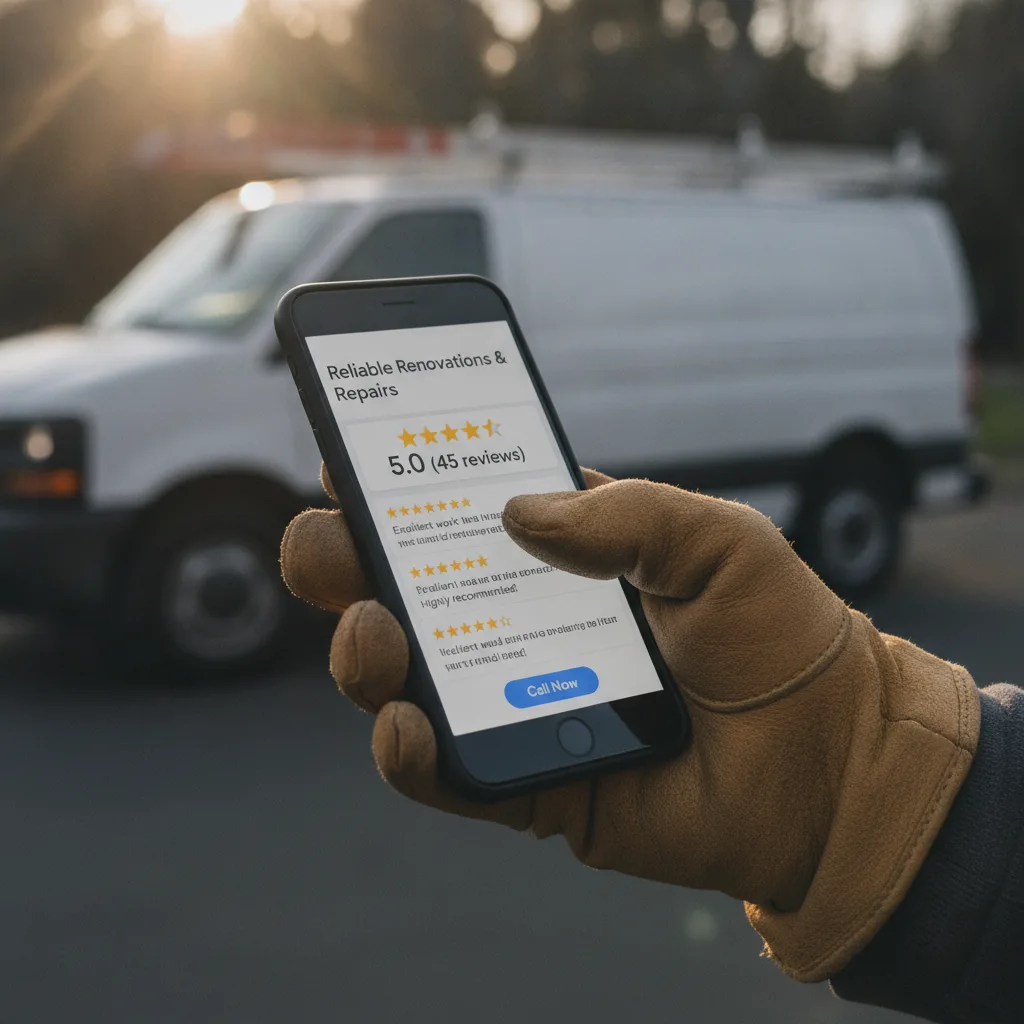
Businesses ranking in Google's top three local results average 47 reviews, per Local Falcon's analysis of 50.4 million U.S. search results from Q4 2025. But the total count isn't the only signal — review velocity matters as much. A 90-day gap in incoming reviews functions as a dormancy signal, and a competitor receiving 3–5 new positive reviews per month will often outrank a business sitting on 100-plus stagnant reviews. As of 2026, 47% of consumers say they will not use a business with fewer than 20 Google reviews, and 74% look for reviews written within the last three months. That makes reputation management — specifically a repeatable post-job review request process via SMS through a tool like Podium — a core local SEO activity, not an afterthought.
Q11: What happens if I skip GBP and focus only on website SEO?
You'll appear in organic blue-link results without showing up in the Map Pack. That's a significant miss: 42% of local search clicks go to the top three Map Pack listings, which sit above most organic results visually. A well-ranked website still generates calls, but a contractor visible in both the Map Pack and the organic listings captures far more of the page and attracts more local customers. The two signal sets also reinforce each other — a GBP with strong engagement and consistent customer reviews builds the trust signals Google uses when deciding organic search rankings as well. Local SEO strategies that ignore GBP cut their own effectiveness roughly in half.
Q12: Does AI search change local SEO for home service companies?
AI tools — ChatGPT, Google AI Mode, Gemini — were used by 45% of consumers to find a local business in the past year, up from just 6% the year before, per BrightLocal 2026 data. Google AI Overviews for local queries appear in roughly 7.9% of local searches and often pull directly from verified Google Business Profile data. That means GBP optimization is now also an AI visibility play. A contractor with an incomplete or unverified profile isn't just missing Map Pack clicks — they're invisible in an AI-generated answer that cites specific local businesses to a homeowner asking 'who's the best HVAC company near me.' Local SEO for home services and AI search visibility are now the same problem.
Key takeaway
GBP signals account for 32% of local pack ranking weight, and only 45% of home services businesses have verified their profile — fixing that single gap often produces faster search visibility gains than months of on-page SEO work alone.
Chapter 4 · SEO Strategy
On-Page SEO and Paid Ads: Building the Right SEO Strategy for Home Services
On-page SEO — specifically optimized service pages and location pages — moves faster than link building and produces the first rankings that generate calls. Paid ads (Google Ads and Local Services Ads) serve a different function: they deliver leads immediately while organic rankings build, making the two channels complementary rather than competing. Contractors who run Local Services Ads alongside a home services SEO campaign generate 42% more total leads and a 40% lower cost per acquisition than single-channel operators. The right SEO strategy for home services uses both — with paid advertising covering the gap while SEO matures.
Q13: What on-page SEO work matters most for home service companies?
Service pages and location pages are the highest-leverage on-page assets. Each major service needs its own dedicated page — not a paragraph on a catch-all page — with specific website content about the service, service area, and trust signals like licenses, warranty terms, and photos of real jobs. Location pages for each city or zip code the business serves should contain genuine local content: neighborhood references, local landmarks, notes on typical permit requirements, or area-specific service details. Generic city-name-swap templates without real local substance are ignored by Google and sometimes penalized as thin content. Keyword research guides both which services get pages and what search intent each page should address.
Q14: Should I run Google Ads while SEO builds?
Yes, and the sequencing matters. The right play for a home services business with no organic presence is to run Local Services Ads while the home services SEO campaign builds, then shift budget toward organic as leads start arriving. LSAs hold position 1 when they appear, deliver leads immediately, and operate on a pay-per-lead model that fits home services economics well. As organic rankings mature and the cost per lead from SEO drops toward $18–$30 for HVAC or $25–$50 for roofing, you can reduce paid ad spend proportionally. Home service companies that build organic typically cut paid advertising spend 50–70% by year two, because organic leads compound while ad costs keep climbing — paid search cost per conversion in home services rose roughly 19% year-over-year in the most recent analysis.
Q15: How is Local Services Ads different from Google Ads for home services?
LSAs show above standard Google Ads and carry a 'Google Screened' or 'Google Guaranteed' badge. They charge per lead, not per click, and they appear inconsistently — a 2026 study of 500 home services searches found LSAs held the top position when they fired, but fired far less consistently than the Map Pack, which appeared in 98% of queries. Standard Google Ads rarely win the top position on home services pages when LSAs are active. For most contractors, the right paid stack is LSAs for immediate lead flow and a GBP-anchored home services SEO campaign for long-term cost reduction. Using both together improves online visibility at every stage of the buying cycle.
Q16: What does a mature home services SEO campaign actually look like?
The GPS case study for Stan's Heating, Air, Plumbing & Electrical defines the ceiling well: 150-plus first-page keywords, a 300% increase in organic leads, and a 23% improvement in the rate at which website visitors convert to calls — over a multi-year engagement that turned organic search into their most reliable lead channel. For a newer home services SEO campaign, 'good at 12 months' means 20–25 organic leads per month, ranking on page one for the top 3–5 primary service terms in your metro, and cost per lead trending toward $25–$50. Serview Home Pros hit $25 per qualified lead at a 6% conversion rate starting from near-zero online presence — that's a realistic benchmark for a well-executed single-city program and a measure of real SEO success.
Key takeaway
Running Local Services Ads alongside home services SEO generates 42% more total leads than either channel alone, and organic SEO eventually cuts paid ad spend 50–70% as search rankings compound — but only if the on-page foundation is built correctly from day one.
Chapter 5 · Results
Measuring SEO Success and Picking the Right Home Services SEO Company
SEO success for a home services business means one thing: inbound calls and booked jobs from homeowners who found you through organic search — not traffic graphs or impression counts. Measuring it correctly requires connecting Google Analytics, Google Search Console, and a call-tracking tool like CallRail so every lead source is attributed. Choosing the right SEO company means evaluating case studies with specific numbers from actual home services clients, not generic promises about first-page rankings. Most SEO agencies will show you what they track; the best home services SEO companies will show you how what they track connects to your revenue.
Q17: What SEO metrics should I actually track?
Three numbers matter most for a home services SEO campaign: organic leads per month (calls and form fills from non-paid traffic, tracked with CallRail and Google Analytics), keyword rankings for primary service terms monitored weekly in a rank tracker, and GBP actions — calls, direction requests, and website clicks from your Business Profile. Those are your SEO performance indicators. Impressions, bounce rate, and domain authority are supporting data; they don't pay for trucks. If your reporting only shows website traffic and rankings without connecting them to inbound phone calls, that's a gap to fix before you can honestly judge whether the campaign is working.
Q18: How do I know if my current SEO campaign is working?
Pull three numbers from the last 90 days: organic sessions from Google Analytics (non-branded, non-direct), inbound calls tagged as organic in CallRail, and GBP actions from your Business Profile Insights dashboard. If all three are flat or declining after six months of active campaign work, the campaign has a problem — either the website content isn't indexed, the GBP isn't optimized, or the site has a technical SEO issue blocking search rankings. A healthy home services SEO campaign shows impressions growing in Search Console in months 2–3 even before calls arrive, so early directional data is available well before the six-month mark. Use that early data to course-correct, not to cancel.
Q19: What red flags identify a low-quality home services SEO company?
Four signals consistently identify providers that won't deliver results. First: they can't show case studies with specific lead numbers from actual home service businesses. Second: their lowest package is under $800/month. Third: they promise first-page results within 30 or 60 days — that's not how search engines work for competitive local terms. Fourth: reporting shows only search rankings and organic traffic, not calls and booked jobs. Most SEO agencies will make promises; the best home services SEO companies are ROI-obsessed and will show you exactly what metrics they track, what the reporting cadence looks like, and how they tie search engine optimization results to revenue. When an agency focuses primarily on digital marketing vanity metrics, treat that as a red flag, not a differentiator.
Q20: Is local SEO still worth the investment in 2026 given AI search changes?
Local SEO for home services is more valuable, not less, because AI search amplifies the signals it already uses. AI tools were used by 45% of consumers to find a local business in the past year, up from just 6% the year before, per BrightLocal 2026 data. Beyond AI, 46% of all Google searches carry local intent, 28% of local searches result in a purchase within 24 hours, and 61% of consumers start a local business search on Google Search or Maps. Those are not shrinking numbers. Organic search remains the only lead channel where the marginal cost per lead trends toward zero over time as search rankings compound — every other channel charges you again for the next lead. For home service companies doing $2M–$5M in revenue, the investment math closes well before a campaign reaches full maturity.
CallRail
Call Tracking
Ties inbound phone calls to specific organic keywords and landing pages — the essential link between SEO rankings and actual revenue in any home services campaign.
Google Analytics
Traffic Attribution
Separates organic sessions from paid and direct traffic so you can see how many website visitors come from non-branded search before they call or submit a form.
Google Search Console
Index Monitoring
Shows which queries trigger impressions and clicks for your site — the earliest indicator of ranking progress, visible in months 2–3 before call volume builds.
Podium
Review Management
Sends post-job SMS review requests that build review velocity — the 3–5 new reviews per month that signal active reputation management to Google's local ranking algorithm.
Local Falcon
Map Pack Rank Tracking
Visualizes Map Pack position across a service area grid so you can see exactly where your business ranks geographically and where competitors are winning specific zip codes.
Key takeaway
A home services SEO campaign is working when organic calls and booked jobs rise month over month — if reporting only shows impressions and rankings without connecting to inbound calls, the measurement system is broken, not necessarily the SEO effort.
Mini-glossary: terms you'll see throughout this guide
Google Map Pack
The block of three local business listings that appears at the top of Google search results for location-based queries. It shows in 98% of home services searches and drives 42% of local search clicks — more than any other element on the page.
Google Business Profile (GBP)
Google's free business listing that controls how a company appears in Maps and local search results. GBP signals account for approximately 32% of local pack ranking factors — the single highest-weight factor group as of 2026 — making Google Business Profile optimization the starting point for any home services local SEO strategy.
Local Services Ads (LSAs)
Google's pay-per-lead ad format for home service businesses that shows above standard Google Ads with a Google Guaranteed or Google Screened badge. LSAs charge per lead, not per click, and appear inconsistently relative to the Map Pack, which shows in 98% of home services searches.
Organic Lead
An inbound call or form submission that arrives through unpaid search results rather than paid ads or shared lead platforms. At SEO maturity, organic leads for HVAC typically cost $18–$30 each — well below the $75–$150 range for Google Ads leads.
Service Page
A dedicated website page built around a single service (such as water heater replacement or roof inspection) that targets specific search intent. Each major service needs its own page to rank independently for that term in search engine results.
Location Page
A webpage targeting a specific city or zip code the business serves. Effective location pages contain genuine local content — not just a city-name swap — to avoid being flagged as thin content by Google's quality systems.
Review Velocity
The rate at which a business receives new Google reviews over time. A steady flow of 3–5 new reviews per month is a stronger predictor of local pack position than a large stagnant review count. A 90-day gap in reviews signals dormancy to Google's ranking algorithm.
On-Page SEO
The practice of optimizing individual website pages — titles, headers, copy, internal links, and page speed — so search engines can accurately index them and rank them for relevant queries. On-page changes typically produce the first visible ranking signals in a home services campaign.
Technical SEO
The work of ensuring a website is correctly crawled, indexed, and loaded by search engines — covering site speed, mobile usability, crawl errors, and URL structure. Technical issues can block even well-written content from appearing in search results.
Local Authority
The collective trust Google assigns to a business based on citation consistency, quality backlinks, GBP engagement, and review signals within a specific geographic area. Building local authority is the primary goal of the first 6–9 months of a home services SEO campaign.
Citation
Any online mention of a business's name, address, and phone number (NAP) on a directory, local site, or industry platform. Consistent citations across directories like Yelp, Angi, and Bing Places reinforce GBP authority and local ranking signals.
Cost Per Lead (CPL)
The total marketing spend divided by the number of qualified inbound leads generated in a given period. CPL is the primary ROI metric for home services SEO campaigns — at maturity, organic CPL should be significantly lower than paid channel CPL and trends toward zero as search rankings compound.
The One Mistake That Kills Otherwise Good SEO Campaigns
Stopping before month six. Home services SEO has a fixed biological clock: Google takes 60–90 days to index and begin evaluating new content, another 60–90 days to measure behavioral signals (clicks, dwell time, call volume from GBP), and then search rankings start moving on competitive primary terms. Contractors who quit at month three — usually because they don't see calls yet — walk away right before the curve bends. The work done in months 1–3 doesn't disappear when you stop, but it also doesn't compound. A paused campaign is a sunk cost. A continued campaign is an asset that gets cheaper to operate every month leads arrive.
Stan's Heating, Air, Plumbing & Electrical didn't become a household name in their market by running a great Q4 campaign. They did it by building a home services SEO foundation that produced 150-plus first-page keywords and a 300% increase in organic leads — over a multi-year engagement that turned organic search into their most reliable lead channel. That's what a mature campaign looks like, and those are the economics that make the investment math work at any reasonable close rate. We build exactly that kind of system for home service companies in Texas and across the Sun Belt — and we include a custom website (an $8,000–$15,000 build) at no extra cost, with no long-term contract. If your leads are drying up or your current agency can't show you a straight line from their work to your phone ringing, let's talk. Book your free strategy session and we'll show you exactly what's blocking your search rankings and what it would take to fix it.
A legitimate single-city home services SEO retainer starts at $1,500/month. At the average agency billing rate of roughly $99/hour, anything below $800/month buys about five hours of account attention — enough for reporting and small fixes, not a real strategy. Multi-city or multi-trade programs climb toward $4,000–$15,000/month, where the scope includes sustained content production and link building across multiple metros. For a contractor doing $2M–$5M in annual revenue, the math closes fast: a single HVAC or plumbing job averages $3,000–$5,000, so a $2,000/month retainer needs to generate fewer than one job per month just to break even.
How long does home services SEO take to produce leads?
The first organic leads from non-branded searches typically arrive between months 4 and 6, with consistent lead flow building through months 6 to 9. The first 90 days are foundation work: technical fixes, Google Business Profile optimization, citation cleanup, and core service page publication. Some long-tail rankings appear within 60 days, but they're not yet generating call volume. Campaigns that stop within the first 90 days almost never produce meaningful results regardless of work quality. The timeline stretches in highly competitive metros like Austin or Houston and shortens for contractors with strong existing sites and established reviews.
What is the Google Map Pack and why does it matter for contractors?
The Google Map Pack is the block of three local business listings that appears at the top of Google search results for location-based queries. It shows in 98% of home services searches, per a 2026 analysis of 500 searches across 100 keywords, making it effectively a fixed feature of every home services SERP. 42% of local search clicks go to the top three Map Pack listings, which appear above most organic blue-link results visually. A contractor visible in both the Map Pack and organic results captures far more of the page than one who appears only in organic listings.
What red flags should I look for when hiring a home services SEO company?
Four signals consistently identify low-quality providers. First: they can't show case studies with specific lead numbers from actual home services clients. Second: their lowest package is under $800/month. Third: they promise first-page rankings within 30 or 60 days — Google doesn't rank competitive local terms that fast. Fourth: their reporting shows only rankings and website traffic, not inbound calls and booked jobs. The best home services SEO companies are ROI-obsessed: they will show exactly what metrics they track, the reporting cadence, and how organic traffic ties to revenue — not just search engine position.
Should I run Google Ads while home services SEO builds?
Yes. The right sequencing for a contractor with limited organic presence is to run Local Services Ads while the SEO campaign builds, then shift budget toward organic as leads start arriving. LSAs hold position 1 when they appear, charge per lead rather than per click, and deliver immediate call volume while rankings mature. Contractors who run LSAs alongside a home services SEO campaign generate 42% more total leads and a 40% lower cost per acquisition than single-channel operators. As organic rankings mature and cost per lead drops toward $18–$30 for HVAC, paid ad spend can be reduced proportionally.
Is local SEO still worth it in 2026 given AI search?
Local SEO for home services is more valuable, not less, because AI search amplifies the signals it already uses. AI tools were used by 45% of consumers to find a local business in the past year, up from just 6% the year before, per BrightLocal 2026 data. Google AI Overviews appear in roughly 7.9% of local searches and often cite specific Google Business Profile data — meaning GBP optimization is now an AI visibility play as well as a maps play. Beyond AI, 46% of all Google searches carry local intent, and 28% of local searches result in a purchase within 24 hours. Organic search is still the only lead channel where the marginal cost per lead trends toward zero over time.
How do I know if my current SEO campaign is actually working?
Pull three numbers from the last 90 days: organic sessions from Google Analytics (non-branded, non-direct), inbound calls tagged as organic in CallRail, and GBP actions from your Business Profile Insights dashboard. If all three are flat or declining after six months of active campaign work, the campaign has a problem — either content isn't indexed, the GBP isn't optimized, or a technical issue is blocking rankings. A healthy home services SEO campaign should show impressions growing in Google Search Console during months 2–3, even before calls arrive, so you have early directional data well before the six-month mark.
What SEO metrics actually matter for a home services business?
Three numbers matter most: organic leads per month (calls and form fills from non-paid traffic, tracked with CallRail and Google Analytics), keyword rankings for your primary service terms monitored weekly, and GBP actions including calls, direction requests, and website clicks from your Business Profile. Impressions, bounce rate, and domain authority are supporting data points — they don't pay for trucks. If your reporting only shows traffic and rankings without connecting them to inbound phone calls, that's the gap to fix first.
Home Services SEO: Cost, Timeline and Results Guide 2026
Senior Digital Marketing Strategist at Geek Powered Studios
Google Ads Certified, Google Analytics Certified, 15+ years in digital marketing, Home Services SEO Specialist
Chris Johnson leads digital marketing strategy at Geek Powered Studios, where he has helped hundreds of home services contractors across Texas grow their businesses through SEO, paid media, and AI-powered lead automation. He specializes in translating complex search-engine changes into practical playbooks that actually move the needle for plumbers, roofers, HVAC, and electrical contractors.