
As of August 2026, only 1.2% of local businesses get recommended by AI search engines like ChatGPT, Gemini, and Google AI Overviews. To earn citations, Texas contractors need to complete seven steps: allow AI crawlers in robots.txt, fully complete their Google Business Profile, build brand mentions across four or more third-party platforms, create answer-first content with named authorship, add LocalBusiness and Service schema, refresh key service pages every 90 days, and track Share of Model weekly across all five major AI platforms. Generative Engine Optimization (GEO) is 80% strategic and 20% technical — third-party trust signals, review recency, and structured content format matter far more than schema tweaks or LLMs.txt files.
-
1.2%Share of local businesses AI engines actually recommend
-
4–6 hoursTotal setup time across all 7 steps
-
85%Of AI brand mentions come from third-party pages, not your site
-
2.8xMore likely to be cited when active on 4+ third-party platforms
-
90 daysMaximum age before Perplexity citation decay begins
-
$29–$129/moBudget range for a dedicated AI visibility tracker
AI search engine visibility for contractors is now a separate discipline from traditional SEO — and 98.8% of local businesses have done nothing about it. As of August 2026, only 1.2% of local businesses get recommended by AI search engines like ChatGPT, Gemini, Perplexity, and Google AI Overviews. Google's AI Mode has a 93% zero-click rate: for queries processed through that interface, your traditional SEO ranking produces zero clicks unless your brand earns a citation inside the AI-generated answer. This 7-step system covers everything a Texas roofer, plumber, HVAC tech, electrician, or general contractor needs to build real AI search visibility — from a single robots.txt fix to a quarterly refresh cadence — in 4–6 hours of initial setup and roughly 2 hours per month to maintain.
Before you start
- A live contractor website with Google Search Console access and the ability to edit your robots.txt file
- A claimed and verified Google Business Profile with owner-level access
- At least one active third-party review platform (Google, Yelp, BBB, or HomeAdvisor) with 10 or more existing reviews
- CMS access to add or edit service pages, FAQ sections, and author bios
- A spreadsheet or project management tool to log Share of Model prompt tests and track results week over week
- A budget of $29–$129/month for a dedicated AI visibility tracker such as Otterly.AI, SE Ranking AI add-on, or Semrush Pro

Unlock Your Site for AI Crawlers in robots.txt
A blocked AI crawler means zero citations before any content or authority work even begins — and fixing it takes under 10 minutes. The four AI crawlers you must allow are GPTBot and OAI-SearchBot (ChatGPT), PerplexityBot (Perplexity), and Google-Extended (Gemini). If your robots.txt disallows any of these AI bots, those engines cannot read your site and will never cite it, regardless of how strong your content is.
Open your robots.txt file at yoursite.com/robots.txt and confirm each bot is either explicitly allowed or not blocked by a blanket 'Disallow: /' rule. Add four lines if they are missing: 'User-agent: GPTBot / Allow: /', 'User-agent: OAI-SearchBot / Allow: /', 'User-agent: PerplexityBot / Allow: /', and 'User-agent: Google-Extended / Allow: /'. Publish the change and verify it resolves at your robots.txt URL before moving on.
Skip the LLMs.txt file entirely. Ahrefs checked 137,210 domains in May 2026 and found 97% of valid LLMs.txt files received zero AI bot requests that month, with 96% of the few requests that did arrive coming from automated crawlers rather than AI models pulling citation data. Adding one wastes time you should spend on Steps 2 through 7.
Quick check
Paste your domain into Google Search Console's URL Inspection tool and check the 'Crawled as' section. Then run a site:yourdomain.com query in Google to confirm your key service pages are indexed. Pages not indexed by Google will not be cited by AI search engines either — fix indexation before anything else.
Fortify Your Google Business Profile for AI Search Results
Your Google Business Profile is the single highest-leverage asset for local AI search visibility — ChatGPT, Gemini, and Google AI Overviews all pull GBP data when generating local contractor recommendations. Google's March 2026 core update tightened the relationship between GBP completeness and local pack visibility: businesses with missing hours, services, photos, or attributes saw disproportionate ranking drops, and profiles not updated in 30 days show dramatic impression declines.
Complete every field without exception: primary and secondary categories, service areas covering all Texas cities you serve, a keyword-rich business description that does not stuff your company name with keywords (Google penalized that pattern in 2026), individual service listings with descriptions, business hours including holiday hours, and all applicable attributes. Businesses with 100 or more photos receive 42% more direction requests and 35% more website clicks versus businesses with fewer than 10 photos — upload real job site photos weekly, not stock images.
Post a GBP update at least once per week and respond to every review within 24 hours. As of 2026, review recency outweighs raw review count in Google's local signals. A roofer in Dallas with 80 reviews but the most recent posted 3 months ago loses ground to a competitor with 40 reviews and 4 posted this week. GBP changes can influence AI Overviews and Maps results within a few weeks — far faster than the several months it typically takes to earn ChatGPT or Perplexity citations from published content.
Google Business Profile Manager
Free
Direct control over the profile data that ChatGPT, Gemini, and Google AI Overviews pull for local contractor recommendations.
Podium
From $399/mo
Automates review request texts after job completion so review recency stays strong without manual follow-up from your office.
NAP consistency warning
Your business name, address, and phone number must match exactly across your GBP, website footer, and every directory listing. Businesses with complete LocalBusiness schema that aligns precisely with GBP data are 2.7x more likely to appear in the local pack (BrightLocal, Q1 2026). Any discrepancy creates citation confidence gaps that reduce how often AI engines mention your brand.
Build Third-Party Brand Mentions Across 4 or More Platforms
Third-party earned media is the primary lever for AI citation — 85% of brand mentions in AI search originate from third-party pages, not brand-owned sites, and brands are 6.5x more likely to be cited through third-party sources than through their own domains (AirOps, 1 billion-plus citations analyzed). For a Texas roofing or HVAC contractor, this means getting your business named on review directories, local news sites, trade publications, and industry forums — not just polishing your own website.
Target a minimum of four third-party platforms: brands active on 4 or more third-party platforms are 2.8x more likely to appear in ChatGPT responses (5WPR research). For home-services contractors in Texas, the four platforms with the highest AI citation value are Google Reviews (covered in Step 2), BBB with an A or A+ rating, Angi (formerly Angie's List), and HomeAdvisor or Thumbtack. Nextdoor business profiles and local chamber of commerce directories round out the ecosystem. Keep your NAP identical across all of them to avoid the citation confidence gaps that reduce AI mention rates.
Earned media from local press outperforms all other third-party signals for AI search visibility. Pitch a story to your local outlet: a summer roofing safety tip, a heat pump rebate update, an electrical code change affecting homeowners. A single mention in the Dallas Morning News, the Houston Chronicle, or a neighborhood blog with real readership can appear in AI-generated answers for months. This is the 80% strategic work that generative engine optimization actually requires, and it is where 98.8% of local contractors have done nothing. Only 11% of domains get cited by both ChatGPT and Perplexity simultaneously — building presence across multiple third-party platforms is the only reliable way to earn citations across all major AI search platforms at once.
Key insight
Google AI Overviews and Google's AI Mode share only 13.7% of their cited URLs with each other. Optimizing for one AI engine does not automatically transfer to the others. Platform-specific citation gaps are real, and the only structural fix is broader third-party presence.
Create AI-Optimized Content That Answer Engines Can Cite
Content formatted as lists, tables, or step-by-step guides has 2.5x higher citation probability than paragraph-only content, and 44% of all LLM citations come from the first 30% of a page — lead with the direct answer, then support it (GetCite, 10,000 pages analyzed). For a Dallas roofer, that means a service page that opens with 'Roof replacement for a 2,500 sq ft home in North Texas costs $9,000–$16,000 for architectural shingles, with labor accounting for 55–60% of the total' beats a page that opens with 'Our family-owned roofing company has served the DFW area for 20 years.' Q&A content has the highest citation probability of any format at 81% (GetCite). Google deprecated FAQ rich results on May 7, 2026, so the expandable accordion snippets no longer appear in Google search results — but the underlying Q&A format remains the most-cited structure in AI answers.
Write a standalone FAQ section on every major service page and answer each question in 2–3 sentences that start with the direct answer: 'How long does an HVAC replacement take in Texas?' 'What permits are required for electrical panel upgrades in Dallas County?' 'Does homeowner's insurance cover hail damage in Fort Worth?' This format is what AI-powered search engines actively scan when generating direct answers. Add statistics and attributed sources to every content piece. Adding statistics boosts AI visibility by up to 40%; adding citations and quotations boosts it by up to 41% (Princeton GEO study, Aggarwal et al., KDD 2024).
Name the author on every page. A named author with a linked bio earns approximately 60% more AI citations than equivalent anonymous content, and 76.4% of AI-cited content has attributed authors. Assign your lead technician or owner as author on your technical service pages and link to a bio that lists their license numbers, years of experience, and Texas-specific certifications. Answer engine optimization at the content level is not about adding keywords — it is about creating content that an AI system can quote verbatim and trust as authoritative. Use strict heading hierarchy throughout: 68.7% of AI-cited pages use H1, H2, H3 in proper order versus roughly 40% of uncited pages (Seer Interactive/BrightEdge). Each service page needs one H1, multiple H2s for service variants or locations, and H3s for FAQ answers.
Frase
From $45/mo
Combines AI visibility monitoring with content gap analysis so you can identify which questions competitors get cited for and close those gaps in one workflow.
Surfer SEO
From $89/mo
Content editor scores your service pages against top-ranking competitors and flags structural gaps that reduce citation probability across both traditional search engines and AI engines.
Format rule
Skipping heading levels or using bold text as a substitute for H2s reduces your citation probability. Every blog post and service page should have a clear hierarchy that an AI model can parse as an outline. Structure is not a style preference — it is a citation signal.
Add LocalBusiness and Service Schema to Key Pages
Schema markup is not required for AI Overviews — Google stated this clearly in its May 2026 AI search guide, and a concurrent study confirmed that adding JSON-LD schema did not measurably increase AI citations for pages already visible in AI Overviews. That said, LocalBusiness schema earns its place for a different reason: businesses with complete schema are 2.7x more likely to appear in the local pack (BrightLocal, Q1 2026), and local pack presence feeds the third-party trust signals that AI search systems read when deciding which contractors to recommend.
For home-services contractors, implement four schema types: LocalBusiness (with your exact NAP matching your GBP, geo coordinates, service area, business hours, and price range), Service (one per major service category — roofing, HVAC installation, electrical panel upgrade), FAQPage on any page with a Q&A section, and BreadcrumbList site-wide. Use Google's Rich Results Test to validate each page after adding JSON-LD. Fix any errors before moving on — a malformed structured data block can cause Google to ignore the entire markup, which defeats the local pack benefit.
Make sure your schema data matches your GBP data exactly. If your GBP lists your address as '4521 Cedar Springs Rd, Suite 200, Dallas TX 75219' and your schema says '4521 Cedar Springs Road, Dallas, Texas 75219,' that inconsistency signals unreliability to AI systems comparing sources. Consistent NAP across schema, GBP, and your top 10 directory listings is the outcome that matters — not the presence of schema alone.
Google Rich Results Test
Free
Validates your JSON-LD schema markup and flags errors that prevent Google from processing your structured data correctly.
theStacc Schema Builder
Free tier available
Generates LocalBusiness and Service schema JSON-LD tuned for local contractors without requiring developer knowledge.
Run a Quarterly Content Refresh to Stop Citation Decay
Pages not updated quarterly are 3x more likely to lose their AI citations entirely, and content updated within 30 days earns 3.2x more AI citations than older content. Perplexity has the strongest recency bias of any major AI platform — content older than 90 days enters a citation decay window. AI-cited content averages 25.7% fresher than content ranking in classic Google results (Ahrefs, 17 million citations analyzed). For a Texas HVAC contractor, this means your 'AC replacement cost in Dallas' page needs a date-stamped update every quarter, not a one-time publish-and-forget strategy.
Set a 90-day calendar reminder for every high-priority service page. A refresh does not require a full rewrite. Update the statistics with current figures, add a new FAQ answer reflecting a question you heard from a customer that quarter, adjust pricing ranges if material or labor costs shifted, and change the 'Last updated' date in your author byline. Perplexity specifically reads date stamps — an 'Updated August 2026' stamp on a page beats an undated page in AI search results every time, even if the underlying content is otherwise identical.
Prioritize the pages that cover your highest-revenue services and your most competitive Texas markets first. A Dallas roofer should refresh hail damage, roof replacement cost, and storm repair pages before anything else. An HVAC contractor in Houston should prioritize AC installation cost, heat pump rebates, and duct replacement. Run a quick prompt test in ChatGPT and Perplexity after each refresh — search 'best [service] contractor in [city]' and note whether your business appears in the AI-generated answer. You should see movement within 4–6 weeks on Perplexity; ChatGPT typically takes longer to reflect fresh content.
Refresh priority order
Refresh in this order: (1) highest-revenue service pages, (2) pages already appearing in AI answers but slipping in frequency, (3) pages targeting your top 3 competitor cities. Do not spend refresh cycles on blog posts older than 12 months that never earned a single citation — archive or consolidate them instead.
Measure AI Search Visibility With Share of Model Tracking
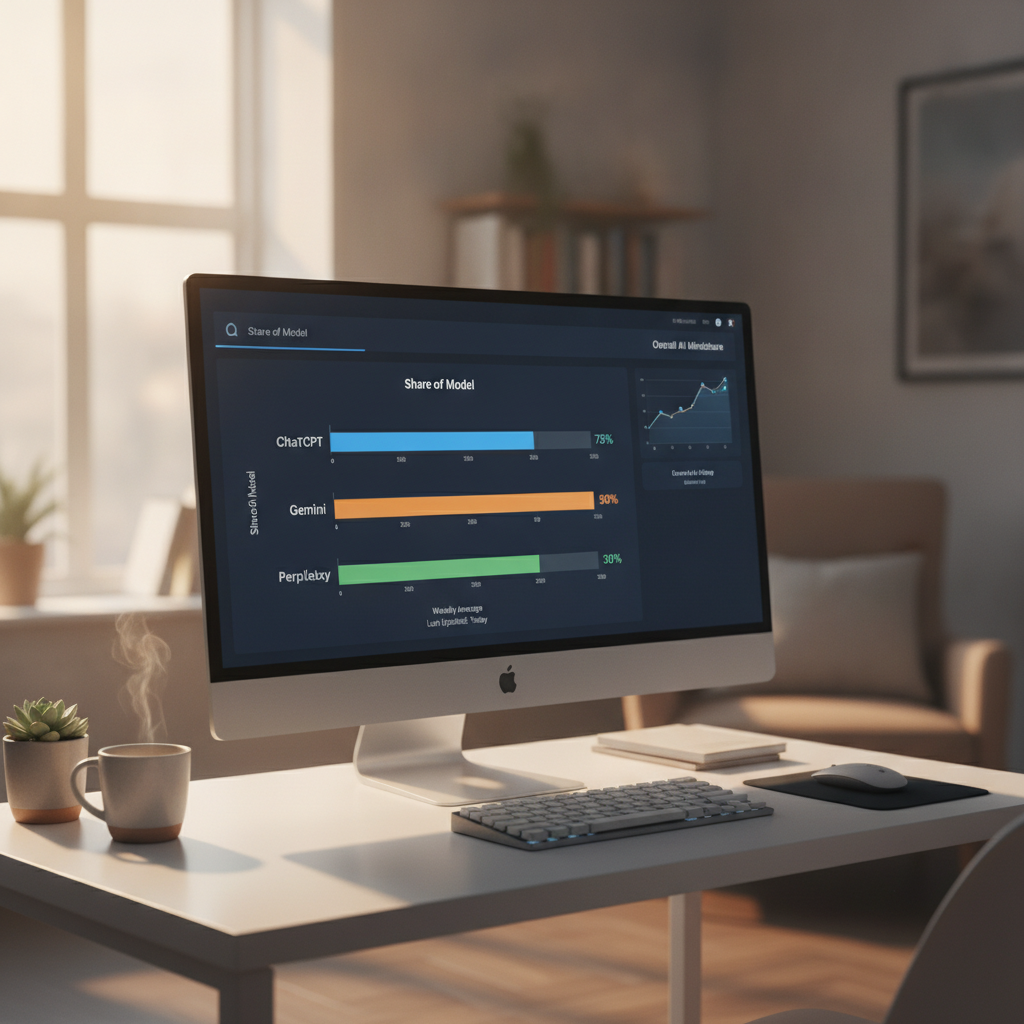
Share of Model is the defining metric for AI search visibility in 2026 — calculated as (your brand appearances divided by total prompts tested) multiplied by 100. Build a set of 20–30 prompts that reflect how a real homeowner in your Texas market would ask an AI for help: 'Who is the best roofer in Dallas for hail damage repair?' 'What HVAC company should I call in Houston for emergency AC repair?' 'Which licensed electrician in Austin handles panel upgrades?' Run these prompts weekly across ChatGPT, Perplexity, Google's AI Mode, Claude, and Gemini. Give the baseline 4–6 weeks before drawing conclusions about which optimization strategies are working.
The market-share reality as of August 2026 demands you track all five AI platforms, not just ChatGPT. ChatGPT leads AI referral traffic at 74.78% of all AI referrals (SE Ranking, 2026), but Gemini grew 231% year over year and Claude grew 320%. Google AI Overviews reach roughly 2.5x more users than ChatGPT because they are embedded in every Google search with near-universal reach. Only 11% of domains get cited by both ChatGPT and Perplexity — platform-specific AI search monitoring reveals where your citations are strong and where you have gaps to close.
Only 16% of brands systematically track their AI search performance (McKinsey, 2026) — which means tracking alone puts you ahead of 84% of your competitors. Use a dedicated AI visibility tracker rather than manual prompt testing at scale. Log your Share of Model score by platform each week, compare it to the previous 4-week average, and flag any drop of more than 10 percentage points as a trigger to refresh the relevant content or build more third-party citations in that service category. An AI visibility score that drops two weeks in a row is an early warning system — act on it before the drop compounds into a 90-day citation gap. An AI-referred visitor is worth 4.4x more than a traditional organic visitor and bounces 27% less often, so the ROI on AI search monitoring is direct and measurable. For teams already using Google Analytics and traditional SEO tools, layer the Share of Model data on top of existing reporting rather than replacing it — branded search traffic from Google Analytics will often show a correlated uptick as AI visibility improves.
Otterly.AI
From $29/mo
Purpose-built AI visibility tracker that monitors brand citations across ChatGPT, Perplexity, and Gemini with automated weekly prompt runs.
SE Ranking AI Overview Tracker
From $49/mo add-on
Tracks Google AI Overview citations alongside traditional rank tracking so contractor teams don't need two separate dashboards.
Semrush Pro
From $129/mo
Best for teams already in the Semrush ecosystem who want AI visibility data, competitive analysis, and traditional SEO reporting in one platform.
Profound
$99/mo (ChatGPT only) or $399/mo (multi-engine)
Enterprise-depth Share of Model reporting with prompt-level visibility data across all major AI platforms — strong for multi-location operations.
Free starting point
Before paying for a tool, run your 20 prompts manually in ChatGPT and Google's AI Mode. Frase offers a free AI Visibility Checker — a search visibility checker that grades individual pages for citation readiness. Use these free tools to establish your Week 1 baseline and calculate your initial AI visibility score, then graduate to a paid AI visibility tracker once you have enough data to justify the monthly cost.
Don't Confuse AI Search Visibility With Traditional SEO — They Measure Different Things
Google's AI Mode has a 93% zero-click rate. That means 93% of queries processed through AI Mode produce zero organic clicks unless your brand earns a citation inside the AI response. Traditional SEO tracks keyword rankings and organic click-through rates. AI search visibility tracks Share of Model: how often your business gets named when someone asks an AI which contractor to call. Being ranked number one in traditional search results while invisible to AI search is no longer a winning position — Google AI Overviews now appear on more than 1 in 5 US Google searches and cut the click-through rate at position one by 58%. The contractors who dominate AI search results in 2026 are the ones who build third-party trust signals, answer-first content, and a consistent review cadence — not the ones who add FAQ schema and call it done. Generative engine optimization and answer engine optimization are 80% strategic and 20% technical. AI-powered search engines reward authority built across the web, not technical configuration on your own domain.
The 1.2% of local businesses that AI engines recommend right now did not get there by accident. They have complete, actively maintained Google Business Profiles, brand mentions spread across 4 or more third-party platforms, service pages written with the direct answer first and an attributed author at the top, and a Share of Model tracking system that catches citation drops before they compound. Gemini's 231% growth and Claude's 320% growth year over year mean the AI search market is not static — contractors who optimized only for ChatGPT in early 2026 are already missing traffic from two of the fastest-growing AI platforms. Run your 20 baseline prompts across all five platforms this week. The gap between you and a competitor who started this process 90 days ago is still closeable. The gap in another 90 days may not be. If you want Geek Powered Studios to run this system for your contracting business, contact us for a Share of Model audit — we will show you exactly where your business appears across AI search engines today and what it takes to improve your AI visibility within 60 days.
Frequently Asked Questions
Ready to get started? Contact Geek Powered Studios today.