
Plastic surgery PPC on Google Ads requires completing two-tier healthcare advertiser verification before launching any campaign, then building procedure-level ad groups with tightly matched keywords, compliant ad copy, and dedicated landing pages. As of 2026, Google's September 2025 update removed mature cosmetic procedures from Sexual Content policy restrictions, but outcome-claim rules, before-and-after photo bans in Search, and personalized advertising prohibitions on advertiser-curated audiences all remain fully in force. Budget floor is $2,500/month in moderate markets and $8,000+/month in major metros. The full setup takes 3–5 hours; meaningful optimization data arrives at 60–90 days. A generalist agency that skips the compliance layer doesn't get a warning — it gets the account suspended.
-
5–10 business daysTime to clear Google healthcare advertiser verification — start on account creation day, not launch day
-
$7.50 avg. CPCAverage plastic surgery Google Ads cost per click as of Q1-Q2 2026; surgical keyword ceilings hit $100+
-
$2,500/mo minimumBudget floor for moderate US markets; major metros require $8,000+/month to generate enough conversion data
-
19.4% vs. 6.2%Consultation-focused landing page vs. information page conversion rate on identical traffic — a 3x gap
-
30 conversions/moMinimum threshold before switching to Target CPA bidding — below this, the algorithm spends erratically
-
3–6 month cycleTypical plastic surgery patient research-to-booking window — default 30-day attribution windows hide real campaign ROI
Plastic surgery PPC is one of the highest-stakes paid advertising disciplines in digital marketing — not because the keywords are expensive (though at $8–$100+ per click, they are), but because the compliance environment can shut a campaign down permanently before it generates a single consultation. Google's three-layer policy framework — platform rules, FTC endorsement standards, and HIPAA — operates simultaneously and independently. Passing one layer does not satisfy the other two. This guide maps every setup decision a plastic surgery practice or PPC management team needs to make in 2026 to build campaigns that run, convert, and stay live. Budget 3–5 hours for initial setup; expect 60–90 days before the data is rich enough to optimize aggressively.
Before you start
- Active Google Ads account with billing verified and business information accurate — discrepancies between your ads account name and your medical license create verification delays.
- Medical license documentation and business registration ready for Google's healthcare advertiser verification submission — digital copies in PDF format.
- GA4 property installed on the practice website with conversion events configured: form submissions and phone calls tracked via CallRail or equivalent call-tracking software.
- A dedicated procedure-level landing page (not the homepage) built and live before launching any ad group — one page per procedure, not one page per practice.
- Ad copy reviewed against Google's Healthcare and Medicines policy and FTC endorsement rules before submission — not after the first disapproval.
- Budget of at least $2,500/month in moderate markets or $8,000+/month in major metros to generate enough click volume for the algorithm to optimize meaningfully.

Complete Google's Two-Tier Healthcare Advertiser Verification Before Writing a Single Ad
Plastic surgery practices must pass two distinct approval levels before any Google Ads campaign goes live: account-level healthcare advertiser verification and individual ad-level creative review. Skipping or rushing the first tier doesn't mean ads run undetected — it means the account gets suspended without warning, no policy email, no grace period. One suspension wipes out months of pipeline. This is not a theoretical risk; it is the most common way that plastic surgery PPC campaigns fail in their first 30 days.
Account-level verification requires submitting medical licenses and business documentation directly through Google's advertiser verification portal. The process typically takes five to ten business days. Start it the moment the Google Ads account is created — not after campaigns are built. Practices that build out full campaign structures first, then discover they can't serve ads until verification clears, lose launch momentum and may push spend into a suboptimal month. Submit the documentation on day one and build campaigns in parallel.
Once the account clears, every individual ad still goes through a second creative review applying stricter standards to specific copy and imagery. Ads that pass account-level verification can still be disapproved at the ad level for outcome-implied language, before-and-after references in headlines, or body copy that Google's system reads as a guaranteed result. Plan for a 24–72 hour review window per creative batch and build that buffer into your launch timeline. Run multiple creative variants per ad group so a disapproved ad doesn't pause the entire ad group while the appeal resolves.
Google Ads Advertiser Verification Portal
Free
Required submission point for medical license and business documentation to pass account-level healthcare verification — this is not optional for plastic surgery advertisers.
CallRail
From $45/mo
Dynamic number insertion for call tracking — essential for attributing phone consultations to specific campaigns and keywords from day one, before verification delays cost conversion data.
Policy Alert
Many Google Ads policy violations in the healthcare category do not trigger email notifications. A plastic surgery campaign can be silently restricted or disapproved and continue burning ad spend on reduced impressions without the advertiser ever knowing. Check the policy manager in Google Ads at least twice per week during the first 60 days — do not rely on email alerts.
Map the September 2025 Google Policy Update — and the Five Restrictions That Did Not Change
Effective September 22, 2025, Google removed mature cosmetic procedures — breast augmentation, buttock implants, and vaginal rejuvenation — from its Sexual Content policy restrictions. Before that date, these procedures were blocked from serving in certain geographies and filtered by SafeSearch settings, cutting legitimate medical advertisers off from a significant share of their target audience. That restriction is gone as of 2026, and plastic surgery PPC ads for these procedures can now reach users across all geographies where the practice serves patients.
What did not change: Google still enforces its nudity restrictions, sexually suggestive content policies, the Healthcare and Medicines policy, and unsubstantiated outcome-claim rules against plastic surgery advertisers. The September 2025 update was not a blanket exemption — it was a single carve-out from one specific policy. Ads for breast augmentation can now display in all search results, but they still cannot show before-and-after photos in standard Search Ads, cannot imply guaranteed results, and cannot use advertiser-curated audience segments for targeting. Additionally, Google's April 2026 enforcement update tightened review on sensitive health and body-image content across Display and YouTube, adding a second layer of creative scrutiny that many PPC ads now face.
The practical implication for plastic surgery PPC campaigns: more geographic reach than 18 months ago, but creative and targeting rules are as strict as ever. Practices that heard about the September 2025 update and assumed the policy environment relaxed broadly are the ones getting disapproved at the ad level or losing retargeting audiences they built incorrectly. The update expanded who the ads can reach. It did not change what the ads can say or how the audience can be assembled.
Key Distinction
Standard in-person plastic surgery — rhinoplasty, facelifts, liposuction, breast augmentation — typically does not require LegitScript certification to advertise on Google. LegitScript applies primarily to telehealth prescription services, online pharmacies, and addiction treatment. Confirming this before launch saves weeks of unnecessary certification work. However, advertising any service that does require certification without obtaining it triggers immediate account suspension, not a warning.
Build a Compliant Keyword Strategy Around the Best Keywords for Plastic Surgeon Campaigns
The best keywords for plastic surgery PPC campaigns are procedure-specific, geo-modified terms at the bottom of the funnel — searches like 'rhinoplasty surgeon Austin' or 'breast augmentation cost Dallas' signal a patient who has already decided on the procedure and is now selecting a provider. These terms cost $8–$25 per click in most US markets as of 2026; high-intent queries like 'best facelift surgeon [city]' can reach $100+ per click in competitive metros. The cost is high because the patient lifetime value for surgical procedures runs $8,000–$15,000+ per case. The paid search economics work when the campaign is built correctly — and fail fast when keyword matching is loose.
Organize campaigns by procedure, not by broad category. One ad group for liposuction, one for rhinoplasty, one for breast augmentation — not a single cosmetic surgery campaign that mixes intent signals and wastes budget on generic search terms. Each ad group needs its own tightly matched relevant keywords, its own ad copy, and its own dedicated landing page. Quality scores drop fast when a 'tummy tuck' keyword routes to a generic procedures homepage, and lower quality scores mean paying more per click for the same search results position. The structure is not a preference — it directly controls how much money the campaign wastes.
Negative keywords are not optional in plastic surgery PPC. Add 'free,' 'how to,' 'medical school,' 'DIY,' 'risks,' 'gone wrong,' and procedure-specific informational modifiers as negatives before the campaign launches. Aggressive negative keyword management reclaims 15–30% of wasted ad spend in documented plastic surgery PPC campaign analyses. Audit search terms weekly for the first 90 days and add negatives in real time. After 90 days of negative keyword refinement, fine tune the list by reviewing actual converting search terms and pausing any keyword variants that drive clicks without consultation inquiries.
Google Keyword Planner
Free (with active Google Ads account)
Procedure-level search volume and CPC estimates by geography — use it to set realistic budget expectations before committing to monthly ad spend.
Microsoft Ads (Bing)
Varies by bid
Imports Google Ads campaigns in minutes and typically delivers plastic surgery clicks at 20–40% lower CPCs, making it a fast secondary channel that drives traffic with minimal added setup overhead.
Strip Out the Audience Targeting That Google's Personalized Advertising Policy Prohibits for Plastic Surgery PPC Ads
Google classifies invasive cosmetic surgery, surgical procedures, and injections as health-sensitive topics in personalized advertising. This blocks the use of advertiser-curated audiences — meaning Customer Match lists, site-based retargeting segments, and remarketing audiences built from procedure-page visitors are all off-limits for plastic surgery PPC campaigns. Advertisers can use predefined Google audiences, but cannot upload or build their own for these categories. This is the policy that catches agencies by surprise when they try to apply standard e-commerce retargeting tactics to a healthcare advertiser.
This is the rule most agencies violate by accident. A retargeting campaign built on 'users who visited the body contouring page' does more than violate platform policy — it can constitute Protected Health Information (PHI) under HIPAA, exposing the practice to regulatory risk that exists entirely independent of whether Google ever flags the campaign. The platform review and the HIPAA compliance question are separate legal obligations. Passing one does not resolve the other. The plastic surgery industry faces more regulatory scrutiny on this point than most other healthcare categories because procedure-specific page visits reveal medical intent with unusual specificity.
The compliant approach: use Google's predefined in-market audiences — cosmetic procedures, health and beauty — as observation layers, not targeting layers. This lets the bidding algorithm see audience signals without building a segment that identifies individuals by their medical interests. Run keyword-targeted paid search campaigns as the primary driver of potential patients, and treat audience signals as optimization data to inform bids rather than gates to restrict who sees the ads. Practices that try to replicate retargeting using compliant audience layers typically see 85–90% of the performance benefit with zero compliance exposure.
HIPAA Risk
Building remarketing audiences based on procedure-specific website behavior — users who visited a 'liposuction' or 'breast augmentation' page — can constitute Protected Health Information under HIPAA. This exposure exists regardless of whether Google flags the audience segment. Before launching any retargeting campaign for a plastic surgery practice, confirm with the practice's HIPAA compliance counsel that pixel and audience configurations do not capture PHI.
Write Ad Copy and Build Landing Pages That Pass Google Review and FTC Rules Simultaneously
Before-and-after photos are prohibited in standard Google Search Ads and cannot appear on landing pages that Google judges as promoting misleading outcomes. They carry more flexibility on Display and YouTube — cosmetic surgeons use before-and-after imagery effectively in YouTube pre-roll and Display campaigns — but even there, each creative requires a policy-compliant review before launch. The practical rule for plastic surgery PPC ads: treat before-and-after photos as a Display and YouTube asset, never a Search or landing page asset. Violating this on a landing page doesn't just disapprove the ad — it can pull approval for the entire domain.
Ad copy for plastic surgery PPC must clear two separate compliance bars at the same time. Google's review flags copy that implies guaranteed results — phrases like 'get your ideal body' or 'look 10 years younger' read as outcome promises to the review algorithm. The FTC's separate enforcement framework flags atypical outcome claims and testimonials without proper disclosure, regardless of what the platform approved. Ad copy that passes Google review can still generate an FTC enforcement action. Write every headline and description line as if both reviewers are reading it simultaneously — because in practice, they are. Compliant phrasing leads with credentials, specialization, and consultation offers rather than outcome promises.
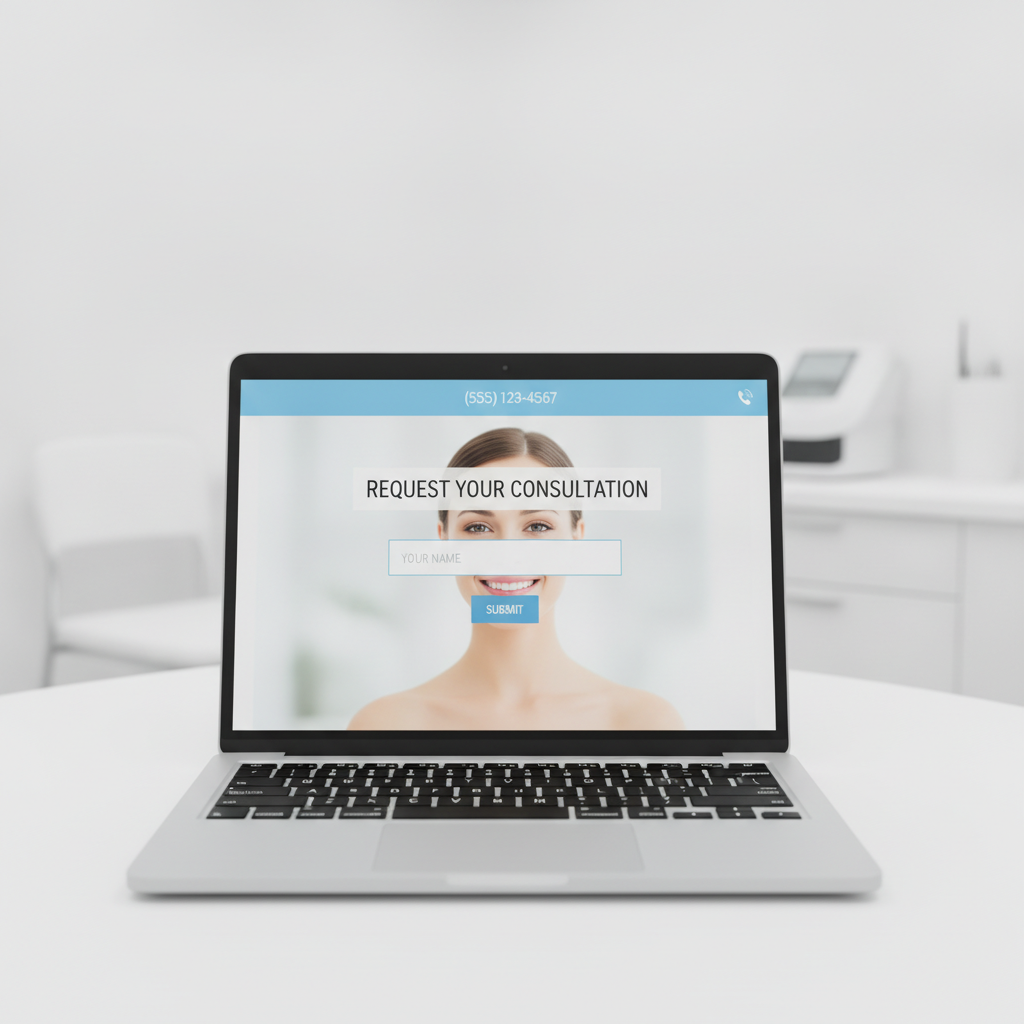
Landing pages convert at dramatically different rates depending on their structure. A consultation-focused landing page converted the same high-intent plastic surgery search traffic at 19.4%, versus 6.2% for a procedure-information page in a documented A/B test with a Dallas practice — a 3x difference on identical paid search keyword traffic. The consultation-focused page led with a free consultation offer, a single form above the fold, phone number in the header, and social proof (board certifications, patient reviews) below. The information page led with procedure detail and anatomy diagrams. The first books appointments. The second educates potential patients and then loses them to a competitor who does book them. Build for the consultation, not the education.
Unbounce or Webflow
From $99/mo (Unbounce) / From $23/mo (Webflow)
Build procedure-specific landing pages without touching the main website — critical for isolating ad traffic, running A/B tests, and keeping page load time under 2 seconds.
Podium
From $399/mo
Routes consultation form leads into a text-based follow-up workflow — plastic surgery patients research for 3–6 months, and fast follow-up on form fills dramatically improves show rates.
Set Budget, Bids, and Local Service Ads Based on Your Market's Real CPC Range
Plastic surgery Google Ads CPCs average $7.50 across the US as of Q1–Q2 2026 (ROA Marketing campaign data), but that average masks a wide range driven by more competition in metro markets. Standard surgical keywords run $8–$25 per click in most markets. High-value queries like 'best facelift surgeon [city]' reach $100+ per click in competitive metros. Below $2,000/month in monthly ad spend, a campaign generates too few clicks to feed Google's algorithm enough conversion data to optimize — the floor for a moderate US market is $1,500–$2,500/month, and major metros require $8,000+/month to compete in paid search. PPC advertising at these budgets is not cheap; it is priced relative to a patient lifetime value of $8,000–$15,000+ per surgical case.
Do not switch to Target CPA bidding until the campaign has logged at least 30 conversions per month per campaign. Below that threshold, Google's bidding algorithm lacks enough data and spends erratically — driving up cost per consultation inquiry while reducing volume. Start on Maximize Conversions with a manual CPC cap, let conversion data accumulate for 60–90 days, then test Target CPA. A well-structured plastic surgery PPC campaign at that stage should yield $80–$200 per consultation inquiry for surgical procedures, and $100–$300+ for high-competition procedures like breast augmentation and facelifts. The bid strategy switch is a data-readiness decision, not a timeline decision — wait for the data.
Local Service Ads (LSAs) for plastic surgeons operate on a separate verification track from standard Google Ads and are worth testing as a complementary paid advertising channel. LSAs display at the very top of search results — above standard pay-per-click ads — and charge per lead rather than per click, which changes the economics entirely. The trade-off: creative control is minimal, and Google's own screening process for LSAs in healthcare categories adds another approval layer on top of standard PPC management. Run LSAs alongside standard paid search campaigns, not as a replacement. The two channels capture different intent signals and different points in the patient research cycle.
Budget Reality Check
Healthcare Google Ads CPCs rose 40–60% over the past three years while conversion rates remained relatively stable. A budget that generated 20 consultation inquiries per month in 2023 generates 12–14 at the same spend in 2026. If a campaign's monthly ad spend hasn't been reviewed in 12+ months, the volume assumptions are almost certainly off — revisit the budget before assuming the campaign is underperforming.
Install Conversion Tracking and Set Reporting Attribution That Matches the Plastic Surgery Patient Cycle
The average plastic surgery website converts 2.3% of all visitors to a consultation inquiry — which means every untracked form submission and unmeasured phone call is invisible revenue loss. Track three conversion events at minimum: form submissions as a GA4 goal event, phone calls over 60 seconds via CallRail with dynamic number insertion, and appointment bookings if the practice uses an online scheduling tool. Without all three, the plastic surgery PPC campaign is optimizing on partial conversion data and making bid decisions based on an incomplete picture of what actually drives booked consultations. Practices that only track forms routinely undercount total inquiries by 40–60%, since phone calls represent that same share of consultation contacts for surgical procedures.
The plastic surgery patient research-to-booking cycle typically runs three to six months. That attribution window means a patient who clicked a Google Ad in February and booked in April looks like an unattributed booking in most default 30-day attribution windows — the campaign appears to underperform while it is actually building pipeline. Set Google Ads attribution to data-driven (if conversion volume allows) or 90-day position-based. Report to the practice on a 90-day rolling window alongside the standard monthly view so the long decision cycle doesn't make campaigns look like they're failing when they're feeding future-month bookings. Enough data to make this judgment requires at least 60 days of live campaign history.
Practices running both Google Ads and Meta Ads (Facebook) see a measurable difference in lead quality by platform: Google Ads converts at 10.7% lead-to-consultation versus Meta Ads at 6.2%, but Meta Ads CPA averages $65 versus Google's $126. The blended CPA across both platforms runs approximately $98. Google paid search captures patients who are ready to book; Meta captures patients earlier in the research phase who need more nurture time before converting. Run both, track both separately via GA4 and CallRail, and report them as distinct channels with different value timelines. Combining the two into a single blended report obscures the difference and makes it impossible to fine tune either channel correctly.
GA4 (Google Analytics 4)
Free
Event-based conversion tracking feeds form submission data directly into Google Ads bidding algorithms — required for any automated bid strategy to function correctly.
CallRail
From $45/mo
Dynamic number insertion ties phone consultation calls to specific campaigns and keywords — essential when calls represent 40–60% of consultation inquiries for surgical procedures.

One Account Suspension Ends Months of Pipeline
Running ads for services that require Google certification without obtaining it doesn't generate a warning. It triggers immediate account suspension — full stop. And because many Google Ads policy violations in the healthcare category don't send email notifications, a plastic surgery PPC campaign can be silently restricted for weeks before the practice notices the consultation volume drop. The three-layer compliance framework — Google policy, FTC rules, and HIPAA — is not optional fine print. It is the operating environment for every plastic surgery PPC campaign running in 2026. A generalist agency that treats plastic surgery like a standard online marketing account will find the landmines by stepping on them. The cost isn't a disapproved ad — it's the pipeline that was never built while the account sat suspended.
Plastic surgery PPC is a compliance-first discipline where the wrong creative, the wrong audience configuration, or a missed verification step shuts the campaign down before it ever demonstrates its value. For practices in the $2M–$5M revenue range, the math is straightforward: a single booked surgical case at $8,000–$15,000+ justifies the cost of running compliant, well-managed plastic surgery PPC services many times over. San Antonio Eye Specialists, a healthcare practice in a similarly competitive market, posted +196% PPC leads and record-breaking months within six months of working with a team that understood the policy environment before the first ad launched — not after the first disapproval. The custom website included with every Geek Powered Studios retainer is built to convert consultation traffic from paid search, not just receive it. If your current plastic surgery PPC campaigns are burning budget on disapproved ads, incorrect audience segments, or landing pages that inform instead of book — that is the problem we solve before we launch. Get your free strategy session.
Frequently Asked Questions
Ready to get started? Contact Geek Powered Studios today.