
To get cited by ChatGPT, Gemini, and Google AI Overviews as a home services contractor, you need to complete seven specific steps: run a baseline AI visibility audit, treat your Google Business Profile as a living entity database, lock down NAP consistency across every directory AI engines pull from, add LocalBusiness entity schema to your website, rewrite key pages using the answer-first content method, earn third-party citations on review platforms and local publishers, and open your site to AI crawlers while setting up ongoing AI visibility tracking. The full setup takes 3-5 hours. AI-referred traffic converts at 14.2% versus 2.8% for Google organic, making each citation worth tracking precisely.
-
87%Of independent HVAC and plumbing contractors with zero AI citation share in their own market (5W PR, Q1 2026)
-
14.2% vs. 2.8%AI referral conversion rate versus Google organic — a 5x quality gap per lead (Opollo, 312 firms, 2026)
-
43–50%Of all U.S. Google searches now show an AI Overview as of mid-2026, up from 15% a year ago
-
4–8 weeksTypical lag between completing GEO fixes and seeing measurable improvement in AI citation share
-
60%Of AI Overview citations come from pages outside Google's traditional top-10 organic results (RankRabbit, 2026)
-
$39–$139/moTotal tool cost range for AI visibility tracking once your baseline is set (BrightLocal + SE Ranking or Semrush)
AI search engine visibility is the new front line of local marketing for home service contractors — and right now, 87% of independent HVAC and plumbing businesses have zero AI citation share in their own market, even with strong Google reviews and years of traditional SEO investment (5W PR AI Visibility Index, Q1 2026). As of mid-2026, Google AI Overviews appear on 43–50% of all U.S. Google searches, up from just 15% a year ago. ChatGPT holds 900 million weekly active users. Gemini reaches 2 billion monthly users through Google Search alone. When a homeowner in Austin asks any of these AI platforms for a 'reliable plumber near me,' the AI either names your business or it names your competitor. There is no middle position. This 7-step guide gives you the exact process to build AI search visibility that earns consistent citations from ChatGPT, Perplexity, Gemini, and Google AI Overviews — with an estimated 3–5 hours for initial setup and 30 minutes of weekly maintenance after that.
Before you start
- Active Google Business Profile (GBP) with owner-level access
- Website admin access (WordPress, Webflow, or similar CMS)
- Google Search Console property already verified
- Bing Webmaster Tools account (free — required for ChatGPT indexing)
- At least 10 Google reviews on your GBP listing
- A spreadsheet or project management tool to track NAP consistency across directories
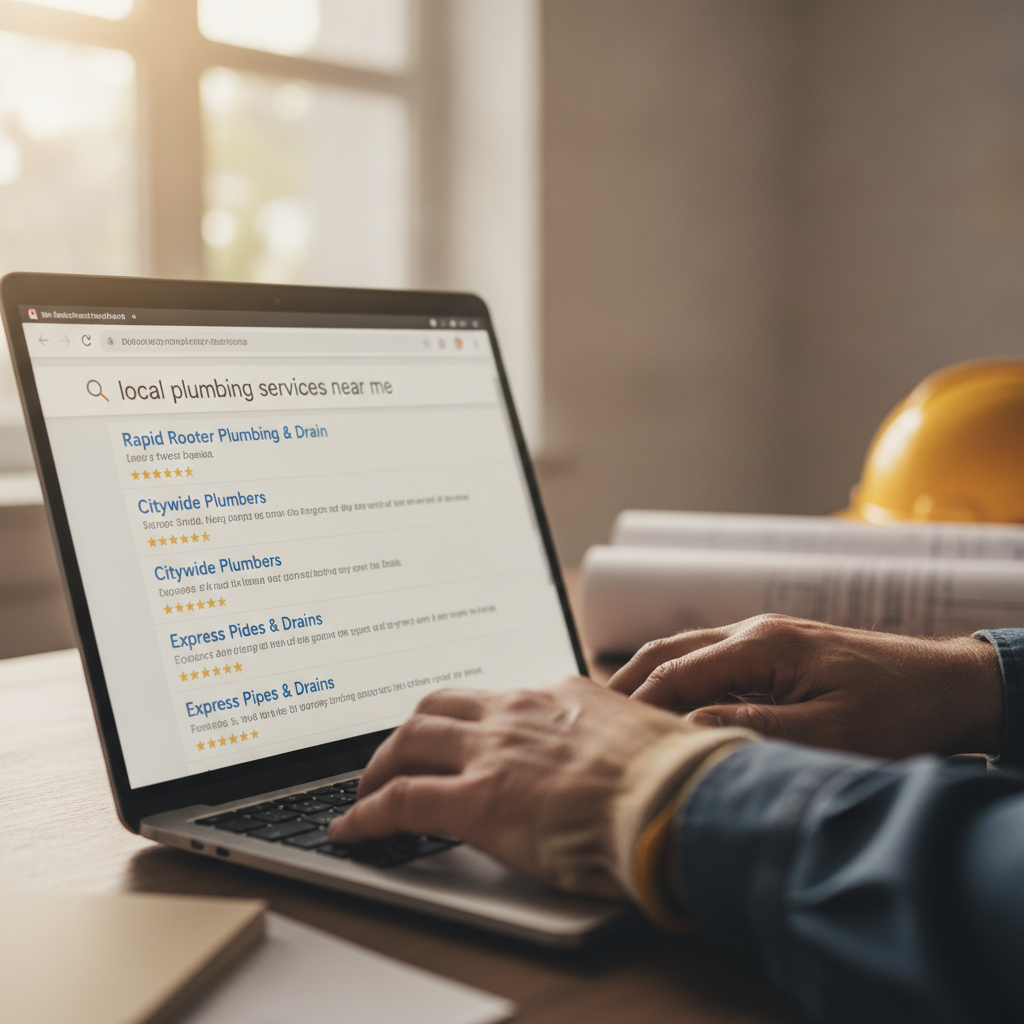
Run a Baseline AI Visibility Audit Before You Change Anything
Your AI visibility audit starts with one honest question: when someone in Austin or Houston asks ChatGPT for a 'reliable HVAC company near me,' does your name appear? Run that exact prompt — and five variations — across ChatGPT, Gemini, Perplexity, and Google AI Mode right now. Screenshot every result. This is your baseline, and you need it before you touch anything else, because changes you make in steps 2–7 can take 4–8 weeks to show up in AI-generated answers.
As of mid-2026, 87% of independent HVAC and plumbing contractors have zero AI citation share in their own market, even with strong Google reviews and years of local SEO investment (5W PR AI Visibility Index, Q1 2026). That number is jarring, but it tells you the gap is not about reputation. It is about entity clarity. AI systems that lack sufficient structured signals about your business skip you and route to national franchise brands instead. Your audit reveals exactly which signals are missing and which AI platforms are the priority targets.
Log your results in a simple spreadsheet: the exact prompt used, which AI engine you tested, whether your business name appeared, and where you were cited (your own site, a third-party directory, a review platform, or not at all). This document becomes your AI visibility tracking baseline. Update it monthly. Tools like Semrush's AI Visibility Toolkit, SE Ranking's AI Search feature, and Perplexity's own search interface can speed up AI search monitoring at scale — but manual prompt testing is free and gives you ground truth before you invest in paid AI visibility tools.
SE Ranking AI Search Tracking
$65/mo and up
Tracks your brand mentions and share of voice across ChatGPT, Gemini, and Perplexity automatically — useful once you have a baseline to compare against
Semrush AI Visibility Toolkit
$139/mo and up
Measures how often your brand appears in AI-generated answers and benchmarks you against direct competitors on the same prompts
Google Search Console
Free
Tracks branded search traffic increases that often correlate with improving AI citation — watch for keyword rankings tied to your brand name growing after GEO work
Gotcha
Do not rely only on ChatGPT for your audit. ChatGPT holds 74% of AI referral traffic share today (SE Ranking, 2026), but Gemini grew 231% year-over-year and Claude grew 320% in the same period. Optimizing for a single AI platform now means missing a growing share of the audience across major AI search platforms.
Treat Your Google Business Profile as a Living Entity Database
Your Google Business Profile is the single most important AI visibility lever for local businesses. ChatGPT pulls GBP data directly into its local answers. Gemini treats GBP as an authoritative data source for every local query it processes. Profiles that go 30 days without an update see measurable impression drops across both Google AI Overviews and Gemini results. This is not a set-it-and-forget-it directory listing. It is the primary entity record that AI systems use to decide if your business is real, active, and relevant.
Fill every GBP field completely: business category (pick one primary, up to nine secondary), service area cities listed individually (Austin, Round Rock, Cedar Park — not just 'Greater Austin'), hours for every day of the week, services with individual descriptions, products if applicable, and a 750-character business description that opens with a sentence naming exactly what you do and where. Add photos weekly. GBP profiles with 100 or more photos see 6.4x more calls than profiles with fewer than 10. Post a GBP update at least once per week to signal freshness to Google's AI systems.
The services section of GBP is underused by most contractors and directly feeds Gemini's local AI answers. Add each service as a discrete line item — 'AC repair,' 'furnace replacement,' 'ductwork cleaning' — with its own description. Do not lump everything under 'HVAC services.' AI engines parse individual service entries to match your business to specific queries. The more granular your service data, the more query variations your brand appears in across AI search engines.
Pro Tip
Set a recurring calendar reminder every 28 days to update your GBP — post a new photo, respond to the most recent review, or publish a brief post about a recent job. This 10-minute task protects you from the 30-day freshness drop that suppresses AI impressions.
Lock Down NAP Consistency Across Every Directory That Matters
NAP consistency — identical Name, Address, and Phone number across every online mention — is a prerequisite for AI citation, not a nice-to-have. Even small format mismatches, like '123 Main St Suite 4' on your website versus '123 Main Street, #4' on Yelp, fracture the trust signal AI systems need to confidently recommend your business. When ChatGPT's data from Bing shows one address and Gemini's data from Google shows another, the AI treats your entity as ambiguous and routes the recommendation elsewhere.
Audit your NAP across the directories that AI engines actually pull from: Google Business Profile, Bing Places, Yelp, Angi, HomeAdvisor, the Better Business Bureau, and any local Chamber of Commerce listings. These are not interchangeable. ChatGPT uses Bing as its primary index, so your Bing Places listing carries direct weight on whether ChatGPT cites you. Gemini cites sources that rank strongly in Google, making GBP the Gemini priority. Perplexity pulls from a combination of both. You need clean data on all of them.
Fix mismatches in priority order: GBP first, Bing Places second, Yelp third, Angi and HomeAdvisor fourth. Use BrightLocal or Whitespark to scan for inconsistencies at scale — manual checking across 40 or more directories takes hours you do not have. After correcting mismatches, verify that your business phone number, legal business name, and physical address match exactly what appears on your website's contact page, footer, and about page.
BrightLocal Citation Tracker
$39/mo
Audits your NAP consistency across 300+ directories and flags mismatches — the fastest way to find the specific listings that are fracturing your entity trust signals
Whitespark Local Citation Finder
$33/mo and up
Identifies which citation sources your top-ranked competitors have that you do not, so you can prioritize where to build new listings
Bing Places for Business
Free
Bing is ChatGPT's primary index — a complete, verified Bing Places listing is a direct prerequisite for appearing in ChatGPT-cited local results
Gotcha
Franchise competitors have an advantage here because their corporate office enforces NAP consistency centrally. As an independent contractor, you have to do this manually. Budget 2–3 hours for the initial audit and correction pass. After that, monthly spot-checks take 15 minutes.

Add LocalBusiness Entity Schema to Your Website
Google's March 2026 core update confirmed that structured data now functions as a trust signal for AI Mode source selection — not just a trigger for traditional rich results. Sites with clean, accurate LocalBusiness entity schema saw measurably improved citation rates in AI Mode answers after the update. For a plumbing or HVAC company, this means adding JSON-LD structured data to your homepage and service pages that explicitly states your business name, address, phone, service area, hours, and the specific services you provide.
The minimum viable schema block for a home services contractor includes: LocalBusiness type (use the most specific subtype available — 'Plumber,' 'HVACBusiness,' 'RoofingContractor'), name, address as a PostalAddress object, telephone, areaServed listing each city individually, openingHoursSpecification for each day, priceRange, and aggregateRating pulled from your actual Google review count and average score. Each service page should carry its own Service schema object linked back to the parent LocalBusiness entity. This connected entity structure is what allows AI systems to understand your business as a coherent, trustworthy entity rather than a collection of isolated pages.
After adding schema, test it in Google's Rich Results Test and verify the JSON-LD renders correctly. Then run your pages through Schema.org's validator to catch any property errors. Errors in schema do not just fail to help — they can actively confuse AI systems about your entity identity. One broken address field in your LocalBusiness schema can undercut the trust signal you have spent months building through GBP and NAP consistency work.
Important Note
The March 2026 update penalized abused FAQ and Review schema on pages where the content did not genuinely warrant it. Only add FAQ schema to pages that actually contain FAQ content. Only add Review schema if you are aggregating legitimate third-party reviews. Clean and accurate beats comprehensive and sloppy every time.
Rewrite Key Pages Using the Answer-First Content Method
The answer-first content method is the primary tactic that increases AI citation probability across ChatGPT, Perplexity, and Google AI Overviews. The rule: place a 40–60 word direct answer at the top of every page and every FAQ entry before any supporting detail. AI engines are built to extract a self-contained answer they can quote. If your page buries the answer in paragraph three after a company history paragraph, the AI skips you and quotes the competitor whose page leads with the direct answer.
For a roofing company in San Antonio, this means your service page opens with: 'AC replacement in San Antonio costs $4,200–$8,500 for a standard 3–5 ton unit installed, depending on brand, SEER rating, and whether ductwork needs modification. Most residential jobs take 4–6 hours.' That opening sentence is exactly what Google AI Overviews and Perplexity cite. It answers the question, names the geography, and attributes the answer — all in under 60 words. This generative engine optimization approach works because AI answer engines are explicitly designed to surface pages that answer directly.
Apply this structure across your five highest-traffic service pages first, then your city landing pages. Add an FAQ section to each page with 5–8 questions written the way a homeowner would actually type or speak them into an AI. Questions like 'How long does a water heater replacement take?' and 'Do you charge for estimates in Austin?' Answer-first content not only captures AI citations but also generates 60% of AI Overview citations that come from pages outside Google's traditional top-10 organic results (RankRabbit, 2026). You do not need to rank first to get cited. You need to answer clearly.
Pro Tip
Run the prompt 'What does [your service] cost in [your city]?' through Google AI Mode and Perplexity. Note exactly what those AI answers say and which sources they cite. Then write a page that answers the same question more specifically and with more local detail than those cited sources. That is your citation target.
Earn Third-Party Citations on Review Platforms and Local Publishers
Over 65% of AI citations come from third-party publishers, review sites, user-generated content, and community discussions — not from a business's own website (SearchMonster, 2026). Your GBP work and on-site schema work alone will not get you cited consistently. AI engines treat independent third-party mentions as validation. When Yelp, Angi, a local Austin news site, and a homeowner forum all reference your business name in connection with the same service, the AI's confidence in recommending you increases substantially.
For home services contractors, the highest-value third-party citation sources as of mid-2026 are: Google Reviews (volume and recency both matter), Yelp business profile with completed Q&A section, Angi Pro with verified reviews, Nextdoor Business Page with neighborhood recommendations, and local press mentions in outlets like the Austin American-Statesman or Houston Chronicle home improvement sections. Getting included in a 'best plumber in Austin' roundup on a local blog carries AI citation weight that dozens of additional on-site pages cannot replicate. AI brand visibility depends on brand mentions across independent sources, not just your own domain.
Run a systematic review generation campaign using Podium or Birdeye to request Google reviews from every completed job. The target: 50 or more Google reviews with an average above 4.7 stars before you push for third-party roundup placements. Reviews are a trust, credibility, and reputation signal that AI citation systems explicitly weigh. AI engines that route local queries to national franchises do so partly because those franchises have national review volume. Closing that gap is a direct tactic for improving your AI visibility score.
Podium
$399/mo
Automates review request texts after job completion — the fastest way to build the Google review volume that AI systems use as a trust signal
Birdeye
$299/mo
Manages reviews across Google, Yelp, and Facebook from one dashboard and identifies which review sources are driving citation frequency
Gotcha
Paying for or incentivizing reviews violates Google's Terms of Service and can result in review removal or GBP suspension. The correct approach: text customers within 2 hours of job completion asking for honest feedback. Timing matters — response rates drop 70% after 24 hours.
Open Your Site to AI Crawlers and Set Up Ongoing AI Visibility Tracking
Many home service websites are unknowingly blocking the AI crawlers that would otherwise index and cite them. Cloudflare's bot protection settings flip this on by default in some configurations — meaning GPTBot (ChatGPT's crawler), ClaudeBot, PerplexityBot, and Google's AI crawlers may all be blocked from reading your pages, even if Googlebot can access them fine. Check your robots.txt file right now by visiting yourdomain.com/robots.txt in a browser. If you see 'Disallow: /' rules for any of these AI bots, or a blanket disallow rule that sweeps them in, you have been invisible to those AI platforms regardless of every other step you have taken.
The fix: edit your robots.txt to explicitly allow GPTBot, ClaudeBot, PerplexityBot, and Googlebot. If you are on Cloudflare, go to Security > Bots and confirm that known good bots are not being challenged or blocked. This single technical SEO fix can produce AI citation improvements within 4–6 weeks as the newly allowed AI crawlers re-index your pages. After fixing crawl access, verify your pages render correctly for bots by using Google Search Console's URL Inspection tool — JavaScript-heavy pages that require client-side rendering can appear empty to AI crawlers even when they display fine in a browser.
For ongoing AI visibility tracking, set up a monthly prompt audit using the same 10–15 prompts you used in your Step 1 baseline. Track your brand's AI citation share across ChatGPT, Gemini, and Perplexity and compare month-over-month. In GA4, create a custom channel group for AI referral traffic by filtering sessions where the source contains 'chatgpt.com,' 'gemini.google.com,' 'perplexity.ai,' and 'claude.ai.' This separates AI-referred visits from standard organic traffic so you can measure conversion rate independently. AI referral traffic converts at 14.2% versus 2.8% for Google organic (Opollo, 312 firms, 2026) — for a $6,000 HVAC job, that difference in conversion quality makes every AI mention worth tracking precisely.
Cloudflare Bot Management (if applicable)
Free to $200/mo
The most common source of accidental AI crawler blocking — verify your settings before assuming your site is crawlable by GPTBot and ClaudeBot
Google Search Console URL Inspection
Free
Confirms how Googlebot actually renders each page and flags JavaScript rendering issues that would make pages appear empty to AI crawlers
GA4 Custom Channel Groups
Free
Separates AI-referred traffic from standard organic so you can measure the actual conversion rate of visitors coming from ChatGPT, Gemini, and Perplexity individually
Important Note
Research published by SE Ranking in April 2026 found that adding an LLMs.txt file to your site has minimal impact on AI citation rates. Domain authority, structured data accuracy, review platform presence, and third-party mentions are the actual drivers. Do not spend time on LLMs.txt until steps 1–6 are fully complete.

The One Mistake That Cancels All of This Work
Every step in this guide builds on entity clarity — the idea that AI systems can find consistent, accurate, and structured data about your business across multiple sources. If your GBP says one phone number, your website says another, and your Bing Places listing shows a suite number formatted differently, AI systems treat your entity as ambiguous and route recommendations to competitors with cleaner data. Run the NAP audit in Step 3 before anything else. One afternoon of data cleanup can unlock AI search visibility improvements that months of content work alone will not produce.
Ready to get started? Contact Geek Powered Studios - Prod today.