
Local SEO for electricians comes down to three signals that together account for over half of Local Pack ranking weight: Google Business Profile optimization (32%), review signals (20%), and on-page service content (15%), according to the Whitespark 2026 Local Search Ranking Factors survey. The highest-leverage move is setting your GBP primary category to "Electrician" (not "Contractor"), then building a review velocity system targeting 8–15 new reviews per month, and creating dedicated service pages for panel upgrades, EV charger installation, and emergency electrical repair. Foundations take 4–6 weeks to put in place; consistent Map Pack movement follows in 3–6 months.
-
32% of Local Pack weightGBP signals are the single largest ranking category
-
Primary category first, alwaysSet "Electrician" — not "Contractor" — before anything else
-
8–15 reviews per monthVelocity beats total count for Map Pack positioning
-
One page per service per cityGoogle ranks pages, not websites — dedicate one to each service
-
Fix NAP conflicts before adding citationsInconsistent business information does more damage than a missing listing
-
3–6 months to consistent Map Pack callsRun Local Service Ads at $39/lead avg. to bridge the ramp period
Local SEO for electricians is not complicated — but most electrical companies are optimizing the wrong things in the wrong order. The Map Pack (the three-business block that captures roughly 42–44% of all local search clicks, according to 2026 click-share data) rewards a specific set of signals, and two of them — your Google Business Profile setup and your review velocity — account for more than half of your Local Pack ranking weight before your website content even enters the equation. This guide covers the six steps that actually move the needle, ranked by leverage, with the tools and tactics that real electrical contractors use to hold the top-3 positions in competitive Texas markets.
Before you start
- A verified Google Business Profile — claimed and accessible via business.google.com
- A website you can edit: WordPress, Webflow, or a similar CMS where you control page creation and on-page content
- Google Search Console and Google Analytics both connected to your site (both free, both required for tracking progress)
- A complete list of every city and ZIP code your trucks actually serve — not where you'd like to serve, but where jobs are currently closing
- A process for collecting customer phone numbers at job completion (this feeds your review velocity system in Step 3)
- GMB Everywhere Chrome extension installed — the free tier gives 10 searches per month, enough to audit your top three competitors' GBP categories before you commit to yours in Step 1
Set Your Primary GBP Category to 'Electrician' — Not 'Contractor'
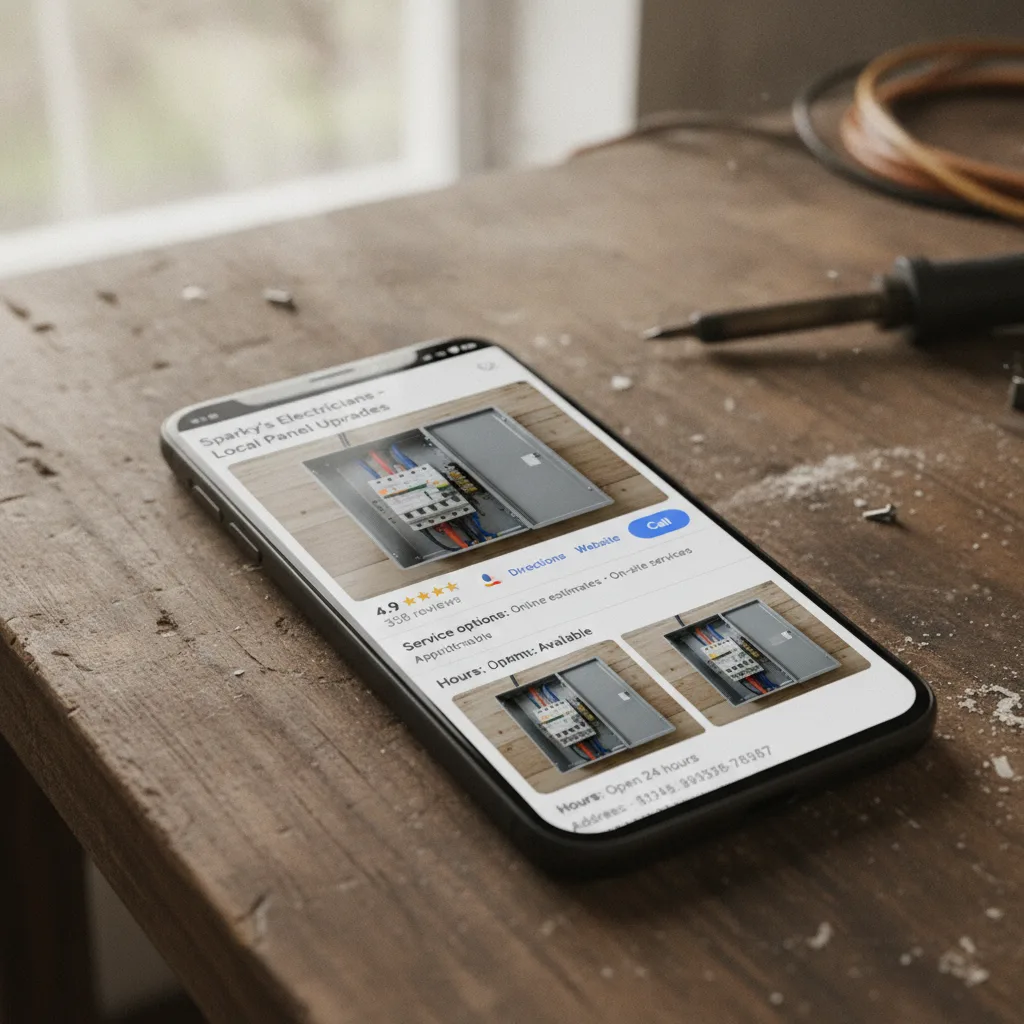
The primary GBP category is the single strongest local SEO signal an electrical contractor directly controls. According to the Whitespark 2026 Local Search Ranking Factors survey of 47 experts across 187 signals, GBP signals account for 32% of Local Pack ranking weight — and the primary category sits at the top of that list. Set it wrong and every other optimization you do fights uphill.
For electricians, the primary category must be 'Electrician.' Not 'Contractor,' not 'Electrical engineer,' not 'Electrical installation service.' Google uses this field to decide which local searches your profile is eligible to appear for, and 'Electrician' is what people type when they need licensed electrical work done. Secondary categories expand your reach from there: relevant options include 'EV Charging Installation Contractor,' 'Generator Shop,' 'Lighting Contractor,' and 'Electrical Installation Service.' You can hold up to 10 total categories, but the primary one does the heaviest lifting and should never be diluted by a more generic term.
Use the GMB Everywhere Chrome extension to pull your top three competitors' category lists before locking yours in. It shows exactly which secondary categories the businesses currently ranking above you are using — copy what's working, then add categories for services they're missing. EV charger installation categories are the clearest gap right now: most electrical companies in competitive markets haven't claimed them, which means an electrician business that adds 'EV Charging Installation Contractor' today is competing against a thin field for that specific local search surface.
GMB Everywhere
Free (10 searches/month)
Shows competitor GBP categories, attributes, and post history directly in Chrome — essential for category research before you commit to your own configuration.
Google Business Profile Manager
Free
The only place to set and update your primary and secondary categories, business description, business hours, and services list.
Don't stuff keywords into your business name
Adding 'Licensed Electrician' or a city name to your GBP business name field is a terms-of-service violation. Google suspends profiles for this. Use your actual registered business name — the one painted on your truck. The relevant keywords belong in your description and on your service pages, not in the name field. Even small differences like an extra word in your business name can trigger a suspension review.
Treat Your GBP as a Weekly Publishing Channel, Not a Static Listing
The biggest mistake most electrical contractors make is treating the Google Business Profile as a one-time setup task. Google interprets regular posts, new photo uploads, Q&A responses, and review replies as signals of an active, engaged business — and active profiles consistently rank above dormant ones with identical category and proximity signals. Google Business profile optimization is not a launch event; it's an ongoing channel.
Build a minimum cadence into your week: one GBP post (a completed project, a seasonal tip, a new service announcement), two to four new photos from real job sites, and a reply to every review within 48 hours. Your GBP description should mention that you're licensed and insured, handle 24/7 emergency electrical repair, offer EV charger installation, and pull permits — these aren't just trust signals for homeowners, they're the exact terms local customers use when they search. The description field has a 750-character limit; use at least 500 of them with service-specific, city-specific language that helps search engines understand what electrical services your business provides.
Photo quality matters more than most electricians realize. Stock images don't build prominence with Google or trust with potential customers. Real job photos — a finished electrical panel upgrade, a Level 2 EV charger mounted in a garage, before-and-after shots of whole-home rewiring work — give Google visual proof that you do what you claim. Geo-tag photos with your service city before uploading when possible, and name the files descriptively rather than leaving them as camera-roll defaults. A file named '200-amp-panel-upgrade-austin-tx.jpg' tells Google something; 'IMG_4892.jpg' tells it nothing.
GoHighLevel
From $97/month
Schedules GBP posts, automates review request sequences, and manages the full CRM pipeline — useful if manual posting feels like overhead your team won't sustain.
Semrush GBP Scheduler
Included in Semrush plans from $139/month
Lets you queue up multiple GBP posts in advance and track post performance alongside keyword rankings in one dashboard.
GBP posts expire after 7 days
Standard GBP posts — not Offers or Events — drop off the visible profile after seven days. Schedule posts weekly rather than monthly, or they'll disappear before most people see them. If your team won't post consistently without a system forcing it, automate the queue. The cadence matters more than any individual post.
Build a Review Velocity System That Runs on Autopilot
Review signals account for 20% of Local Pack ranking weight as of 2026 — up from 16% in 2023, per Whitespark — and the metric Google cares most about is not your total review count. It's velocity: how many new reviews you're generating per week. A competitor sitting on 500 reviews but collecting only two per month will lose local search rankings ground to an electrical business generating 10 or more per month, because Google reads recency as relevance. Satisfied customers who reviewed you two years ago don't help your rankings as much as a steady stream of fresh five-star feedback.
The tactic that actually works is a text message with a direct Google review link sent within 30 minutes of job completion. That specific window converts at 3–4x the rate of an email sent 48 hours later, according to data from electrician-focused SEO practitioners. The customer is still at home, the job is fresh, and the technician just left on a positive note. Set a velocity target of 8–15 new reviews per month for a competitive mid-sized market — that's two to four per week if your trucks are busy, and it's achievable only if the request is automated rather than left to verbal asks at the door.
GoHighLevel is the most common automation tool for this in the trades. The workflow is simple: job marked complete in your CRM triggers a review request text within 30 minutes; if no review appears after 48 hours, a follow-up text goes out. That two-touch sequence can double review volume for most electrical businesses that previously relied on hoping customers remembered to leave feedback. NFC tap cards — physical cards your technicians hand to happy customers that open your Google review page when tapped with a phone — work well as a backup for customers who don't respond to automated texts. Respond to every review, including negative ones: an unanswered one-star review damages prominence signals and tells the next homeowner reading it that you don't engage with feedback.
GoHighLevel
From $97/month
Automates the 30-minute post-job review text and follow-up sequence — the core of a review velocity system that doesn't depend on your team remembering to ask.
Popl or Tapt NFC Review Cards
$15–$30 per card
Physical tap-to-review cards your techs carry on-site — useful backup for customers who don't respond to text automation.
Respond to every review — including negative ones
Unanswered negative reviews damage your GBP prominence signals and cost you the trust of potential customers reading them. A professional, solution-focused reply to a one-star review demonstrates the same active-engagement signal as a five-star response. Keep replies specific to the situation, not templated — the next homeowner reading it will notice the difference, and so will Google.

Build Dedicated Service Pages for Every High-Intent Search
Google ranks pages, not websites — and this single fact is where most electrician local SEO efforts break down. A single 'Electrical Services' page will not rank for 'EV charger installation Austin' or '200-amp panel upgrade San Antonio.' Those are separate searches with separate customer intent, and they need dedicated service pages built to match. This is the on-page signal layer that helps search engines understand which specific electrical services your business provides in which specific cities, and it's where most electrician websites fall short of their ranking potential.
Each dedicated service page needs its own H1 containing the service name and city, a URL structured as /ev-charger-installation-[city]/ or /200-amp-panel-upgrade-[city]/, and body content that directly addresses the customer's search intent: cost range, timeline, permit requirements, and why the job needs a licensed electrician rather than a handyman. For EV charger installation, the page also needs to answer 'do I need a panel upgrade for an EV charger?' — a high-intent question with roughly 28,000 monthly searches nationally that most electrician websites leave completely unanswered. Add your license number to every service page: it's a trust signal for both homeowners and search engines, and it helps Google's AI Overviews confirm you're a verified professional rather than a generic local business.
Prioritize service page builds by search volume and average job ticket: electrical panel upgrades run around 33K searches per month nationally and represent some of the highest-ticket residential electrical work available. EV charger installation is the open door right now — as of 2026, most electrical companies have not built dedicated pages for this keyword cluster, and the field is thin compared to panel upgrades or emergency electrician searches where most competitors already have content. Each service page should use internal links to connect to related pages and back to your main services hub. That internal linking structure helps search engines map the full scope of your electrical services and passes authority across the site.
Google Search Console
Free
Shows which queries are already generating impressions to your site — prioritize service page builds around searches you're close to ranking for first.
Ahrefs or Semrush
From $129/month
Keyword research for electrician-specific service terms and competitor gap analysis — shows which service pages competitors rank for that your site doesn't have yet.
EV charger installation is the open door right now
As of 2026, most electrical contractors have not built dedicated EV charger installation pages. The keyword cluster is growing fast and is under-served locally in most markets. An electrician who builds a strong /ev-charger-installation-[city]/ page today is competing against a much thinner field than panel upgrades or emergency electrician — both of which most competitors already have pages targeting. Use keyword research tools to confirm local search volume before building, then move fast.
Lock Down NAP Consistency and Build Your Priority Citation Stack
NAP — Name, Address, and Phone — is the off-page SEO foundation that makes or breaks local search rankings for electrical businesses. Any mismatch across directories creates conflicting signals that erode the local ranking authority you're building everywhere else. Google cross-references your business information across dozens of sources to confirm you're a real, stable business at a real address. A suite number listed on your website but missing from Yelp, or a call-tracking number that ended up in your GBP instead of your permanent line, are both problems worth fixing before adding any new citations.
Build your citation stack in priority order: your Google Business Profile is the anchor, and everything else should match it exactly — same business name, same address format, same phone number. Then Yelp, Angi/HomeAdvisor, the Better Business Bureau (BBB), your local Chamber of Commerce, and your state electrical contractor licensing board website. That last source matters more than most electricians realize: a citation from the state licensing authority carries extra weight because it's an official, industry-specific source that search engines treat as high-authority verification of your business. Trade association directories — NECA chapters, local electrical contractor associations — function similarly and are worth prioritizing over generic local business directories.
Run your business name through Moz Local or BrightLocal to audit existing citations before adding new ones. You'll often find outdated directory listings from a previous address or phone number that are actively causing problems, not just missing from the picture. Inconsistent business information in existing listings does more damage than a missing listing does — fix the conflicts first, then expand. Once your core stack is clean, add two to three local citations per month: local business directories, neighborhood association pages, community sponsorship mentions, and local press coverage all count and strengthen your prominence signals over time.
BrightLocal
From $39/month
Audits existing citations for NAP inconsistencies and tracks citation growth — the fastest way to find and fix conflicting directory listings without manual searching.
Moz Local
From $14/month
Pushes NAP updates to major aggregators simultaneously, cutting manual citation cleanup time from weeks to days.
Use your permanent business number everywhere — not a call-tracking number
CallRail and similar tools are valuable for measuring which pages generate calls, but never use a tracking number as your GBP phone number. If that tracking number changes or gets ported, your NAP consistency breaks across every directory that has it. Use your permanent business number on GBP and in all directory listings; use tracking numbers only in paid ads and on your website where you can update them quickly without breaking citations.
Add Location Pages, Bridge the Gap With Paid Ads, and Track What's Generating Calls
A single verified GBP address limits your Map Pack visibility to searchers near that address. Location pages — one per city or neighborhood your crews actually serve — extend your reach into surrounding service areas through organic search results. Each location page needs unique content to rank: common electrical issues in that specific area, local code considerations, real project photos from jobs completed there, and reviews from customers who live in that city. Generic copy-paste pages with only the city name swapped don't earn rankings and can get flagged for thin content. A page for 'electrician in Round Rock, TX' should read meaningfully different from one for 'electrician in Cedar Park, TX' — different neighborhoods, different housing stock, different electrical work patterns. That unique content is what helps search engines understand that your electrical business genuinely serves those areas, not just claims to.
Meaningful Map Pack movement for electricians typically starts within 3–6 months: month one covers foundations (GBP audit, citation cleanup, service pages), month three shows ranking movement in Google Search Console, and by month six the phone rings consistently from organic local searches. That ramp is real, and it means you need a parallel lead source to bridge the gap. Google Local Service Ads averaged $39 per verified lead for electricians in a February 2026 study of 112 accounts and $335K in tracked spend (SearchLight Digital / Geek Powered Studios), compared to $93.69 per lead on Google Search Ads. LSAs require a background check and license verification — both are table stakes for any licensed electrical contractor and give your listing the 'Google Screened' badge that increases click-through from homeowners searching urgent searches. Run LSAs during months one through four, shift budget toward Google Ads for high-value service terms as organic rankings improve, and use the organic momentum to reduce your paid advertising cost per lead over time.
Track performance at the call level, not the traffic level. Google Analytics shows sessions and engagement; Google Search Console shows impressions and clicks across search results. But neither tells you which specific pages are generating booked jobs. CallRail gives you call tracking by source and landing page, so you know whether your 'panel upgrade Austin' service page is driving inbound calls or just impressions. Check your local rankings from a searcher's actual location — not from your office, which skews results — using BrightLocal's Local Rank Tracker or a browser in incognito mode with location set to a target neighborhood. Strong local SEO efforts become visible in both tools: Google Analytics shows organic traffic climbing, CallRail shows whether that traffic is converting into calls from potential customers ready to book.
Google Local Service Ads
Pay-per-lead (~$39/lead avg. for electricians)
Fills the lead pipeline during the organic SEO ramp — verified leads from homeowners actively searching, at the lowest tracked cost per lead in the paid electrician channel.
CallRail
From $45/month
Tracks which pages and search queries are generating actual inbound calls — bridges the gap between Google Analytics traffic data and real booked jobs.
BrightLocal Local Rank Tracker
Included in BrightLocal plans from $39/month
Checks your Map Pack and organic rankings from specific ZIP codes and neighborhoods — not from your office location, which inflates results.
For AI search visibility, the rules shift
If you want your electrical business to appear in Google AI Overviews, ChatGPT, or Perplexity answers, GBP signals drop from 32% to just 12% of ranking weight. On-page signals rise to 24% and citation signals to 13%. That means depth on your service pages matters more than your GBP post frequency for AI search visibility. Write full answers to common questions ('how much does a 200-amp panel upgrade cost in Austin?'), earn mentions in local press and community forums, and add schema markup — specifically LocalBusiness schema and relevant service schema — to help search engines and AI tools confirm your business's expertise. The same content that earns AI citations also strengthens your classic search result rankings.
Don't Run This as Five Separate Projects
The six steps above compound when they work together and stall when they run in isolation. A perfectly optimized GBP without dedicated service pages won't rank for panel upgrades. Strong service pages with messy NAP citations send Google conflicting signals that undercut your on-page work. Review velocity without a system behind it drops the moment your team gets busy. The electrical contractors who consistently own the Map Pack top 3 in competitive markets aren't doing more things — they're doing these specific things consistently and in parallel. If your team doesn't have bandwidth to manage all six tracks at once, prioritize in order: Step 1 (primary GBP category) and Step 3 (review velocity system) are the two highest-return moves in the shortest timeframe. Everything else stacks on top of that foundation.
We ran this exact local SEO strategy for Stan's Heating, Air, Plumbing and Electrical — a home services company that now holds 150-plus first-page keywords and saw a 300% increase in organic leads alongside a 23% increase in conversion rate. They've been a client since 2011 and have become a household name in their market. The same multi-channel architecture applies to electricians local SEO: organic local search builds the floor, Google Local Service Ads fill the pipeline during the ramp, and the two compound over time into a lead generation system that doesn't depend on referrals or a single ad campaign to survive. If you want to see exactly where your electrical business stands in the Map Pack and what it would take to close the gap, book a free strategy session and we'll run the audit before the call — no deliverable held hostage to a long-term contract.
Frequently Asked Questions
Ready to get started? Contact Geek Powered Studios today.