
Online reputation management for service businesses after a bad restoration job follows a 7-step process: audit all review sites within 24 hours using BrightLocal, pull the job record before drafting a response, post a compliant public reply within 1–4 hours using the four-element formula, move the complaint offline within one business day, select the right reputation management tool (NiceJob at $75–$125/month for single-location operators, Birdeye at $299–$449/month for multi-location), launch an automated review request campaign targeting 4–10 new reviews per month, and strengthen your Google Business Profile and local SEO in parallel. As of 2026, 68% of consumers require a 4-star minimum before calling a service business. Full rating recovery takes 6–12 months of unbroken effort.
-
24 hoursTime window to complete your full cross-platform reputation audit
-
1–4 hoursMinimum wait before drafting any public response to a negative review
-
150 wordsMaximum length for a compliant, effective public review response
-
$75–$125/moNiceJob cost for single-location restoration contractors (no annual contract)
-
4–10 reviews/moMinimum new review volume target to rebuild rating after a crisis job
-
6–12 monthsFull timeline for restoration contractor reputation repair and Map Pack recovery
-
$45,000Annual revenue at risk when a full-star rating drop hits a $500K/yr contractor
-
76%Share of complainants who update a negative review after acknowledgment and resolution
A single bad restoration job can drop your Google rating below 4.0 stars and cost a $500,000/year company $25,000–$45,000 in annual revenue before you have written a single word in response. As of 2026, 68% of consumers require a 4-star minimum before considering a service business — up 13 percentage points from 2025 — which means falling below that floor makes you invisible to two-thirds of potential customers before the first call. Restoration jobs carry uniquely high complaint risk: water damage jobs run 1–14 days, fire restoration 1 week to 6+ months, and every day the project extends is another opportunity for a stressed, insurance-frustrated homeowner to leave a review that tanks your digital reputation. This 7-step playbook gives restoration contractors — water, fire, and mold — a documented operating procedure for online reputation management for service businesses that stops the rating decline, rebuilds review volume, and recovers Google Map Pack placement within 6–12 months. Total implementation time: 3–5 hours to set up all seven steps. The recovery itself takes months of consistent execution.
Before you start
- A claimed and verified Google Business Profile (GBP) with owner-level access — not manager-level, because you need access to respond to reviews and edit business information.
- Access to your field management software (Jobber, Housecall Pro, or equivalent) so you can pull the signed work authorization, job photos, and all customer communication logs for any disputed job within minutes.
- A BrightLocal account ($29/month, annual billing, Track plan) or an equivalent review monitoring dashboard already pulling real-time alerts from Google, Yelp, Facebook, and Angi.
- A designated staff member or office manager with authority to respond to reviews and escalate complaints to ownership — not a rotating responsibility.
- A written response template approved by ownership before a crisis happens, not improvised per incident.
- Working knowledge of the FTC Consumer Reviews and Testimonials Rule (effective October 21, 2024) so your team never incentivizes or fabricates reviews to paper over a complaint.

Audit Your Digital Reputation Across All Review Sites Within 24 Hours
The first action after a restoration complaint surfaces is a full cross-platform audit — not a response — because you cannot manage an online reputation you have not measured. Pull your ratings from Google, Yelp, Facebook, Angi, HomeAdvisor, and the BBB in a single session. BrightLocal's Track plan ($29/month, annual billing) aggregates 80+ review platforms into one centralized dashboard and fires real-time alerts on every new review, making this audit repeatable rather than a one-time scramble driven by panic.
Document your current star average, total review count, and the exact date the crisis review posted. As of 2026, 68% of consumers require a 4-star minimum before calling a service business. If the bad review drops you below 4.0, you are now invisible to two-thirds of potential customers before the first call. A contractor sitting at 3.2 stars with 80 existing reviews needs 6–12 months of sustained new reviews before the average crosses back above 4.0, because each new review is weighted against existing volume. Knowing your exact starting number is the only way to measure whether the playbook is working.
Cross-reference your social media accounts — Facebook business page, Nextdoor, and any neighborhood group mentions — using Google Alerts set to your business name and the technician's name if it appeared in the review. Social media listening at this stage gives you a map of the full blast radius before you respond publicly. Knowing whether the complaint lives on one platform or six changes your entire recovery strategy and tells you how much of your digital presence is already affected.
BrightLocal
$29/month (annual billing, Track plan)
Monitors 80+ review platforms including Google, Yelp, Facebook, and Angi in a centralized dashboard with real-time alerts — lowest-friction entry point for cross-platform review monitoring after a crisis.
Google Alerts
Free
Catches brand mentions on news sites, forums, and social media platforms outside the major review sites — essential for mapping full complaint spread, including neighborhood forums and local news.
Don't skip this step
Contractors who skip the audit and jump straight to responding often miss a second complaint posted on Angi or a Facebook community thread that is already getting traction. Responding to Google while a Nextdoor thread spreads unaddressed is a recoverable mistake that becomes a compounding one.
Pull the Job Record and Wait Before You Write a Single Word
Responding to negative reviews while emotionally charged is a documented failure mode: a defensive or sarcastic contractor reply reads far worse than the original complaint and can drive away prospects who were about to call. The rule is 1–4 hours minimum before drafting any public response. A calm reply posted four hours after the review outperforms a reactive reply fired off in five minutes. This is not a suggestion — it is the single most cost-effective customer experience decision you will make in the entire playbook.
Use that buffer to pull the job record from Jobber or Housecall Pro: the signed work authorization, the scope of work, any photo documentation from the technician, and all customer communication logs. For water damage jobs (which run 1–14 days) and fire restoration projects (1 week to 6+ months), the paper trail is almost always long enough to clarify what was and was not promised. This documentation does not go into the public response — it informs it, keeps your reply factually grounded, and protects you if the dispute escalates to the state contractor board or the BBB.
Brief the technician or crew lead who worked the job before you draft anything. Their account may reveal an unresolved concern that never reached the office — a call that went to voicemail, a question about drying times that went unanswered, or an insurance supplement dispute that left the homeowner feeling abandoned mid-project. Restoration jobs carry uniquely high complaint risk precisely because homeowners are emotionally distressed and insurance friction runs high. Knowing the full operational picture before responding is the difference between a reply that closes the loop and one that opens a new argument.
Failure mode to avoid
Do not ask the technician to respond directly from a personal account, and do not let a non-owner employee post the first public response without approval. A single unapproved reply that contradicts your public position creates a brand credibility problem that reputation management services cannot easily fix.
Write and Post a Public Response Using the Four-Element Formula
A strong public response to a negative review follows four elements in order: acknowledge the customer's experience, own a specific failure without groveling, offer a concrete resolution path, and keep the entire response under 150 words. As of 2026, Google's AI reads review response content as a local ranking signal — responding to a negative review is both reputation management and an SEO input that affects Map Pack placement. Review signals account for roughly 20% of Local Pack ranking weight, up from 16% in 2023, which makes every review response part of your search engine optimization strategy whether you treat it that way or not.
The response must name the job type without revealing private details, use the customer's first name if it appears in the review, and close with a direct phone number or email address for offline resolution. Example structure: 'Hi [Name] — We hear you, and we are sorry the water mitigation process felt rushed at the drying-check stage. That is not the standard we hold ourselves to. Please call [Owner Name] directly at [number] so we can review the job documentation together and make this right.' Do not mention the insurance claim, do not reference the customer's policy, and do not ask them to update or remove the review in the public post. A consistent brand voice across every response builds trust with the prospects reading that thread, not just the original reviewer.
Businesses that respond to at least 25% of reviews average 35% more revenue than non-responders, and responding to all reviews adds up to an 18% revenue lift. Beyond the revenue data, 76% of consumers would update a negative review to neutral or positive if the business acknowledged and resolved the complaint — and 67% who leave bad reviews return as customers after a speedy response. The public response is not a defense. It is a conversion tool aimed at every prospect reading that review thread, which means every word should address the audience watching, not just the person who complained.
FTC compliance check
The FTC's Consumer Reviews and Testimonials Rule, effective October 21, 2024, authorizes civil penalties for deceptive reviews. Never offer a discount, gift card, or any incentive in exchange for updating or removing a review — not in the public reply, not in a private message, not in a follow-up call. The offer itself is the violation, regardless of whether the customer accepts.

Move the Complaint Offline and Document the Resolution Attempt
After the public response posts, the goal is to get the customer on the phone within one business day — ideally the same afternoon. The owner or a senior manager should make this call, not a front desk staffer. Restoration complaints almost always involve a secondary grievance beneath the stated one: a feeling of being ignored during a stressful insurance claim, confusion about drying timelines, or a perception that the crew left before the job felt complete. Identifying the real grievance on the phone gives you the information to fix the underlying service quality issue, not just the review.
Log every contact attempt and outcome in your CRM or job management software. Date-stamp the call, note what was offered, and record whether the customer accepted or declined. If they accepted a resolution — a return visit, a partial refund, a documented walk-through — follow through within 48 hours and send a written confirmation by email. This paper trail matters for two reasons: it protects you if the complaint escalates to the state contractor board or the BBB, and it gives you accurate information to reference if you request a review update later.
Only after the resolution is complete — and the customer has confirmed satisfaction — is it appropriate to mention, once, that updated reviews are always welcome if their experience has changed. Frame it as an option, not a request. The 76% update rate among resolved complainants makes this follow-up worth doing. The timing and tone determine whether it works. Satisfied customers who feel genuinely heard are far more likely to update a review than customers who sense they are being managed.
Select the Right Reputation Management Tool for Your Business Size
Single-location restoration contractors get the best return from NiceJob at $75–$125/month with no annual contract. NiceJob integrates natively with Jobber and Housecall Pro, automates post-job review requests via SMS and email, and feeds new reviews directly into a centralized dashboard — making it an all-in-one platform for contractors who do not have a dedicated marketing team. For a $500,000/year restoration business, a one-star rating increase translates to $25,000–$45,000 in recoverable revenue per Harvard Business School research. NiceJob's monthly fee pays for itself with one recovered job, which makes it the right online reputation management solution for most small business operators in this trade.
Multi-location operators running two or more service territories should evaluate Birdeye at $299–$449/month per location (annual contract). Birdeye adds sentiment analysis across review platforms, social media listening, and competitive benchmarking by location — the analytics tools a regional operator needs to spot which branch is underperforming before a cluster of negative reviews appears. For multi-location businesses and multi-location brands, that early warning capability justifies the higher price. Podium at $399–$599/month per location (plus 10DLC compliance fees) makes sense only if SMS volume is high enough to justify the all-in-one communication platform. Most restoration contractors do not hit that threshold.
For contractors using Google Local Services Ads, the reputation management tool selection directly affects ad spend efficiency. A star rating above 4.5 measurably lowers cost-per-lead on LSA — businesses above that threshold pay less per verified lead than businesses below it. That connection makes online reputation management services a direct line item in your digital marketing budget, not a brand exercise. If your current review management tool is not surfacing your LSA performance alongside your review data, you are missing the feedback loop that lets you optimize both.
NiceJob
$75–$125/month, no annual contract
Best-fit reputation management tool for single-location restoration contractors; integrates natively with Jobber and Housecall Pro and automates SMS and email review requests post-job.
Birdeye
$299–$449/month per location (annual contract)
Multi-location reputation management with sentiment analysis, social media monitoring, and competitive benchmarking — built for operators managing two or more service territories.
Podium
$399–$599/month per location (annual contract, plus 10DLC fees)
High-volume SMS-first platform combining review requests, webchat, and payment collection — justified only when SMS communication volume is consistently high across locations.
Launch a Systematic Review Request Campaign to Rebuild Volume and Analyze Customer Feedback
A restoration contractor at 3.2 stars cannot outrun a bad review with one great job. Rebuilding review volume requires a repeatable, automated outreach process triggered at job close — not a manual ask that depends on a tech remembering to bring it up. Set NiceJob or Birdeye to send a two-touch sequence: an SMS within 2 hours of job completion, followed by an email 48 hours later if the first message went unanswered. The SMS should link directly to the Google review form — not a landing page with multiple options. Streamline the path to the review form and response rates climb. Add friction and they drop.
As of 2026, 73% of consumers only trust reviews less than 30 days old, and over 80% discard reviews older than 3 months as irrelevant. Review recency is not a soft preference — it is a hard filter that makes continuous outreach non-negotiable for a contractor recovering from a crisis job. Target a minimum of 4 new reviews per month for a single-location operator, with a goal of 10 or more per month to accelerate rating recovery. HVAC and plumbing companies in the same markets average 4.4–4.6 stars. A restoration company below 4.3 stars is already losing jobs to competitors on star rating alone, before a prospect reads a single word of the review content.
Use the review data flowing into your dashboard to analyze customer feedback for operational patterns. If three reviews in 60 days mention communication gaps during the drying phase, that is not a reputation problem — it is a process problem that reputation management tools surface through sentiment analysis. Pipe that customer sentiment output into your weekly team meeting. Anonymized negative reviews used as training material cut repeat complaints faster than any script or response template. Customer feedback is the most actionable data your business generates. Treat it that way.
Volume floor to know
47% of consumers will not use a business with fewer than 20 reviews, and top-3 Local Pack positions average 47 reviews. If your profile is below 20 reviews, prioritizing volume over average score is the right short-term move — a 4.2-star business with 50 reviews beats a 4.8-star business with 8 reviews in both consumer trust and Map Pack ranking signals.
Strengthen Your Digital Presence and Local SEO to Accelerate Map Pack Recovery
Review signals account for roughly 20% of Local Pack ranking weight in 2026, but the other 80% still matters, and a damaged rating recovery stalls without parallel work on your business listings, GBP content, and local SEO fundamentals. Audit your GBP for accurate business information: NAP (name, address, phone) consistency across all directories, current service categories, updated service-area polygons, and recent photos from completed jobs. Inaccurate listings suppress local search rankings independently of your star score and undercut every other step in this playbook.
Publish at least one GBP post per week during the recovery period — job completion photos, before-and-after documentation from water damage or fire restoration work, and brief project descriptions that include city and neighborhood names. This content strategy serves two functions: it signals to Google's local algorithm that the profile is actively managed, and it gives prospects browsing your profile positive content that competes visually with the crisis review. Social media platforms — Facebook and Nextdoor in particular — should carry the same project content to build brand visibility outside the Map Pack. Consistent social media management across these platforms also supports your brand's online reputation by giving the search engines fresh, indexed content tied to your business name.
Connect your reputation recovery metrics to your digital marketing performance dashboard. Track your GBP star average, monthly new review count, Local Pack ranking position for your top 3 service keywords, and LSA cost-per-lead on a 30-day rolling basis. BrightLocal's reporting layer handles all of this at $29–$44/month. Visible rating improvement typically appears within 2–3 months of consistent outreach. Comprehensive restoration contractor reputation repair takes 6–12 months of unbroken effort. Any month you stop sending review requests, that progress stalls. Treat it the same way you treat paying a utility bill — a standing operating expense, not a one-time project.
BrightLocal
$29–$44/month (annual billing)
Tracks Local Pack ranking positions by keyword and location, audits GBP accuracy and business listings, and monitors review volume and recency across 80+ platforms — the reporting layer that shows whether your recovery effort is actually working.
When to bring in a full-service agency
If a high-authority source — a local news article, a regional consumer-affairs segment, or a viral social post — is the origin of the reputation damage rather than a single Google review, DIY recovery will not move it. High-authority negative content can hold page-one search engine rankings for 12 or more months. At that point, you need a full-service agency running a content suppression strategy paired with proactive public relations work, not a review request campaign.
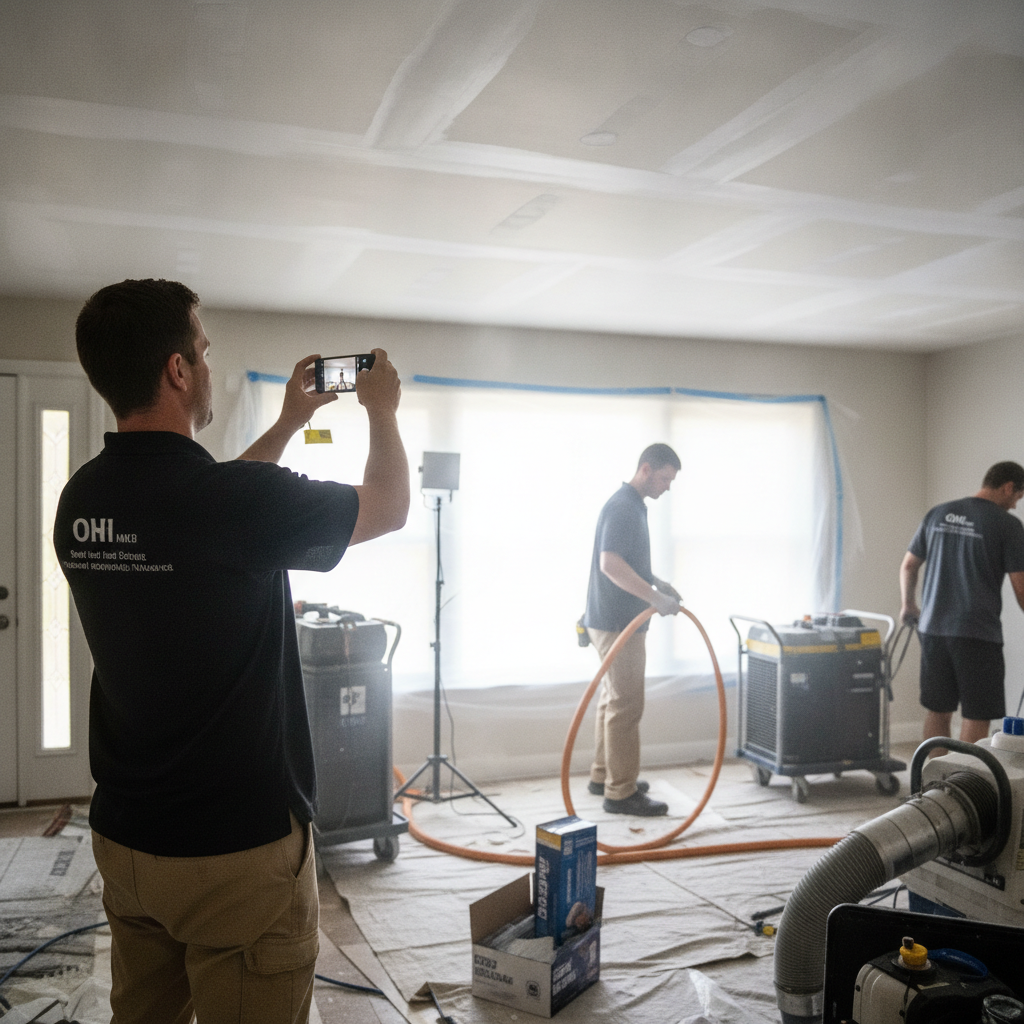
Do Not Buy Reviews to Speed Up Recovery
The FTC's Consumer Reviews and Testimonials Rule (effective October 21, 2024) authorizes civil penalties for buying, incentivizing, or fabricating reviews. A restoration contractor tempted to purchase 20 five-star reviews to paper over a crisis is now facing a federal compliance risk on top of the reputational one. Google's systems also detect unnatural review velocity — a sudden spike of generic five-star reviews from accounts with no review history triggers suppression of the entire profile, which wipes out legitimate reviews along with fake ones. The only compliant path is earned reviews from real customers, requested through a documented, non-incentivized outreach process. Honesty and transparency are not just ethical choices here; they are the only ones that produce durable results.
A single bad restoration job can cost a $500,000/year company $25,000–$45,000 in annual revenue if it drops the rating by a full star — and as of 2026, 68% of consumers filter out any business below 4.0 before making the first call. The 7-step playbook above is not a one-time crisis fix. It is an operating procedure. Assign it to a specific person, connect it to your digital marketing performance dashboard, and run it every month regardless of whether a complaint is active. The contractors who treat online reputation management for service businesses as a standing process — not an emergency response — are the ones who hold their Map Pack position when a bad job inevitably surfaces, protect their brand reputation before it erodes, and turn customer loyalty into a measurable competitive advantage.
Frequently Asked Questions
Ready to get started? Contact Geek Powered Studios today.