
AI-powered content creation works for contractors when you split tasks correctly: use AI tools like Jasper ($49/month) or ChatGPT Plus ($20/month) to draft FAQ pages, service area pages, social media posts, email drip sequences, and ad copy. Write case studies, local pricing guides, post-job recaps, and any content targeting GEO citations in AI answers yourself. Hybrid content — AI-drafted, then heavily rewritten by a human — ranks 34% higher than raw AI output. A 400–600 word brand voice document fed into every AI session is the single variable that separates content that ranks from content that flatlines. Build a three-role pod (strategist, AI operator, subject-matter expert), refresh every piece older than 13 weeks, and track AI referral sessions separately in GA4 — they convert at 14–17% compared to Google organic's 1.76%.
-
8xMore likely to hold Google #1 — human vs. pure AI content
-
34%Ranking boost from hybrid content over raw AI output
-
$84/monthMinimum tool cost: ChatGPT Plus + Jasper Creator + Frase Solo
-
13 weeksMax content age before GEO citation decay risk kicks in
-
14–17%AI referral traffic conversion rate vs. Google organic's 1.76%
-
30%Share of content that should never be automated — write it yourself
AI-powered content creation cuts first-draft time by 60% and saves marketing teams 11–13 hours per week — but pure AI content earns 8 times fewer Google #1 rankings than human-written pages and flatlines at 52 monthly visits by month five. The technology is not the problem. The deployment model is. This 6-step framework tells home-services contractors exactly which content tasks belong to AI tools and which belong to you, so you publish faster without sacrificing the E-E-A-T signals Google's May 2026 core update now actively cross-checks. The full setup takes 3–4 hours. Each content piece after that takes 30–45 minutes.
Before you start
- Active Google Business Profile and a CMS — WordPress or similar — where you publish service pages and blog posts
- At least one AI writing assistant account: Jasper ($49/month Creator plan) or ChatGPT Plus ($20/month) to run drafts
- A Surfer SEO ($49/month Discovery) or Frase ($15/month Solo) subscription for keyword research and content briefs
- A documented brand voice guide covering your service areas, pricing ranges, tone, and 3–5 customer pain points specific to your trade
- Access to at least 3 real completed job examples — photos, addresses, scope, and cost range — to use as raw material for human-written content
- Basic familiarity with Google Search Console so you can track impressions and clicks per page after publishing

Understand Why AI-Powered Content Creation Fails Without a Human Filter
Pure AI content earns 8 times fewer Google #1 rankings than human-written content, and by month five those pages stagnate at 52 visits per post versus 283 for human-led posts — according to a Semrush study of 42,000 top-ranking pages published in 2026. That gap is not a Google penalty on AI tools or artificial intelligence in general. Google penalizes thin content published at scale without genuine value, triggered by velocity spikes, missing expertise signals, and sameness — not by the tool used to write it.
The real problem is deployment, not the technology. As of 2026, 74% of all new web content includes AI, but only 19% of SEOs report that it actually improves content quality. The gap exists because most contractors treat AI as the writer and humans as the proofreader. The winning model is the reverse: humans set the strategy, provide the job-specific data, and write the content that requires first-hand experience. AI handles the repetitive scaffolding. Hybrid content — AI-drafted then heavily rewritten by a human — ranks 34% higher than raw AI output. That single number is the business case for every step in this framework.
Google's May 2026 core update deepened this enforcement by cross-referencing author credentials, professional bios, and real-world expertise against structured data signals. Bare AI bylines with no author entity now carry measurable ranking risk. For a roofing contractor in Katy, TX, that means your service pages need a named estimator or project manager as the credited author — not 'Admin' or no byline at all. Unlike traditional search engines that relied on keyword density alone, the current algorithm reads authorship context as a quality signal.
Key Benchmark
Save this number: hybrid content — AI draft plus heavy human rewrite — ranks 34% higher than raw AI output. Sites that rely on 100% AI writing average a 23% lower median ranking position across all keyword difficulties.
Map Your Content Types to the Automate-vs-Write-Yourself Decision Table
The content creation process for a home-services contractor breaks into two clean buckets. Automate with AI tools: FAQ pages, service area pages, Google Business Profile post captions, email drip sequences, social media posts, meta descriptions, review-response templates, and ad copy variations. These formats are structurally repetitive, benefit from keyword research scaffolding, and do not require first-hand job experience to be useful. AI content creation tools like Jasper or ChatGPT can produce solid first drafts for all of them in minutes — with minimal effort once your context document is loaded.
Write yourself — or have your subject-matter expert write: case studies with real job photos and addresses, local pricing guides with your actual material costs, post-job recap blog posts, any content targeting GEO citation in AI Overviews or ChatGPT answers, and crisis or reputation communications. Approximately 30% of what content teams try to automate should not be automated. Brand voice on sensitive announcements, original point-of-view development, and expert interviews all require human creativity and judgment that prompt engineering cannot replicate. For a plumber, that means a blog post titled 'What We Found Under a 1960s Slab Foundation in Cedar Park' cannot be faked by any AI model — it requires you to remember something from a job site.
A practical rule for every piece of content: if it could be true for any plumber in any city, AI can draft it. If it requires you to recall a specific job, write it yourself. Run every content idea through that filter before you assign it. Most popular AI tools are excellent at structuring and drafting the first category — they fall flat on the second.
Jasper
$49/month (Creator), $69/month (Pro with SEO mode)
Best AI writing assistant for contractors who need consistent brand voice templates baked in — feed it your service area, trade specialty, and tone guide once, and it maintains on-brand content across service pages and social media posts
ChatGPT Plus
$20/month
Most flexible AI tool for brainstorming FAQ structures, drafting email drip campaigns, and generating multiple ad copy variations quickly — use Custom Instructions to load your brand context automatically
Frase
$15/month (Solo, 4 articles/month); $115/month (Team, unlimited)
Most affordable SERP research and content brief tool — use it to generate keyword research-backed outlines before handing a topic to Jasper or ChatGPT, so every draft is built around what search engines already reward
Feed AI Tools Your Brand Voice and Business Context Before Writing a Word
AI output quality improves dramatically when models operate with brand voice guidelines, proprietary business context, and audience-specific parameters — this single variable separates content that ranks from content that collapses. Most contractors skip this step entirely and wonder why their AI-generated content sounds generic. Before you run a single prompt, build a context document of 400–600 words that includes: your company name and founding year, your primary service area cities (not just 'DFW' but 'Plano, Allen, McKinney, and Frisco'), your three most common job types with typical price ranges, your warranty or guarantee specifics, and two or three customer objections you hear on every estimate call.
Paste that document into every AI session as the first message. In Jasper, save it as a brand voice template so it loads automatically. In ChatGPT, use a Custom Instruction. This context primes AI models to write about 'a 2-ton Lennox heat pump installation in a 1,800 sq ft home in Round Rock' instead of a vague reference to 'HVAC services.' The specificity is what search engines reward — and what distinguishes your content from the thousands of generic service pages produced at scale without brand context. Natural language processing in these AI-powered tools gets far more useful output when it has real, specific inputs to work with.
Do not skip the pricing context. Google increasingly rewards contractor sites that publish honest pricing specificity. A page that says 'roof replacement typically costs $8,500–$15,000 for a 2,000 sq ft home using 30-year architectural shingles in central Texas' will outperform one that says 'pricing varies by project.' Feed that range to your AI writing assistant and instruct it to reference those figures naturally in relevant content. Consistent brand voice starts with consistent data, not just tone.
Common Mistake
Never run a prompt like 'write a 1,500-word post about roof replacement' without loading your context document first. Articles produced from bare prompts index fine but rank nowhere — not penalized in the technical sense, just invisible. The context document is the difference between invisible and ranking.
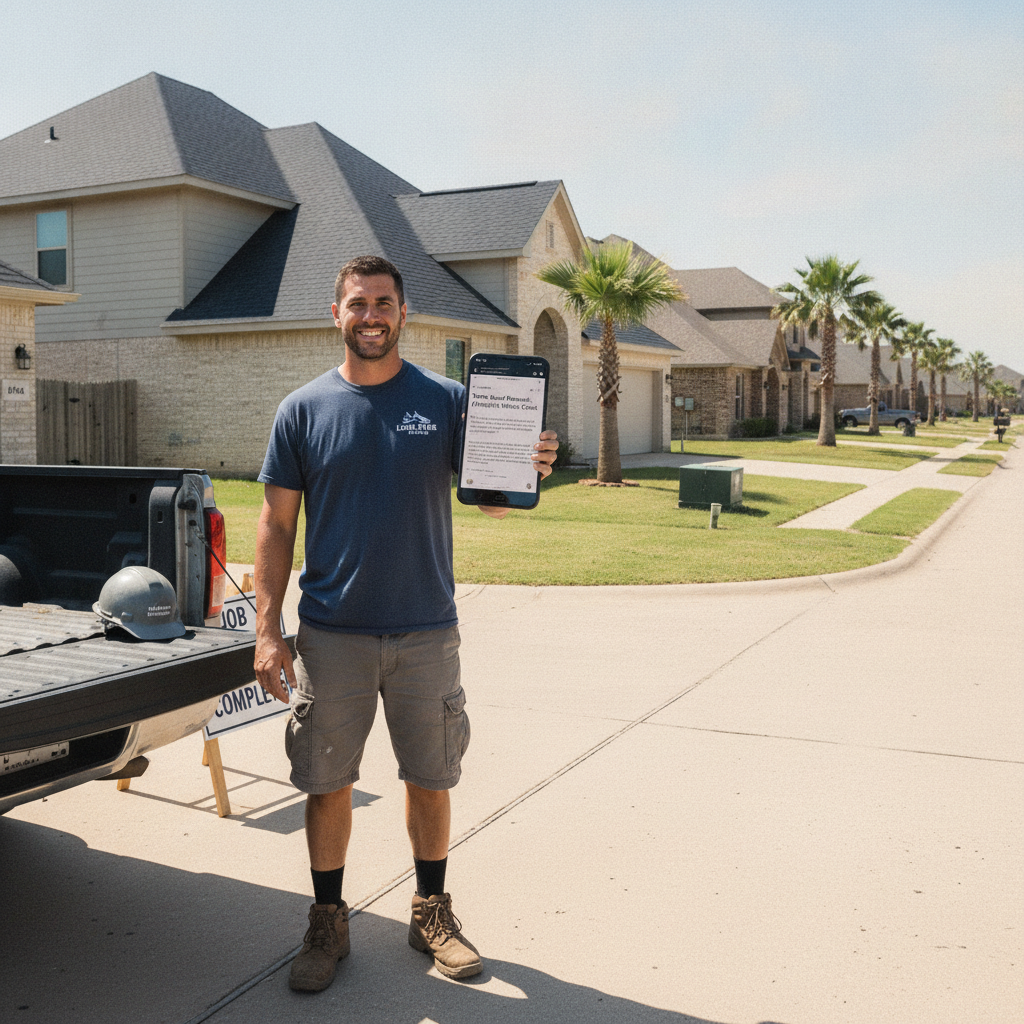
Streamline Content Creation Workflows With the Right AI Tools and a Three-Role Pod
High-performing content teams in 2026 run a three-person pod to streamline content production: one strategist who owns keyword research and the content calendar, one AI operator who writes prompts and manages the drafting pipeline (this role replaces the junior copywriter), and one subject-matter expert — your lead technician, estimator, or owner — who reviews every piece before publish. This model lets contractors produce 4.1 times more published content per marketer per month while cutting production cost by 42–65%. The 'content factory' model of anonymous mass production, powered by most AI tools without human oversight, is obsolete.
For a solo contractor or small team, compress this to two roles: you or your office manager as AI operator using Jasper or Frase to draft and optimize, and you as the subject-matter expert who reads every draft and adds two to three sentences of real job experience before it goes live. That human review step takes 15–20 minutes per piece and is the single highest-ROI task in the entire content creation process. Skipping human oversight is the mistake that turns a potentially ranking page into one stuck at 52 monthly visits.
Use Surfer SEO ($49–$182/month) or Clearscope ($129–$350/month) to streamline content workflows and optimize long-form content after the human rewrite. These AI-powered tools align your on-page content with what search engines confirm is relevant for your target queries — they are not AI content generators but optimization layers that tell you which supporting terms to include. Run the optimization pass after your human edits, not before, so the tool scores a piece that already has your real expertise embedded in it. Both are free to trial for one document before committing to a paid plan.
Surfer SEO
$49/month (Discovery); $99/month (Standard); $182/month (Pro) — billed annually
Best AI-powered content optimization tool for contractors — use it to score existing pages and brief new ones against top-ranking competitors for your target service keywords; the free tools tier lets you audit one page before subscribing
Clearscope
$129/month (Essentials, 10 reports); $350/month (Business)
Preferred for editorial teams of 5 or more — unlimited users on the Essentials plan makes it cost-effective when multiple team members need to optimize content across service lines
Write the Content That Builds Your Target Audience's Trust and Earns GEO Citations
AI-referred traffic converts at 14–17% compared to Google organic's 1.76% — making content cited in ChatGPT, Perplexity, and Google AI Overviews the highest-converting channel available to home-services businesses as of 2026. But the overlap between Google's top-10 organic results and content cited in AI answers has dropped from roughly 75% in mid-2025 to 17–38% in early 2026. Ranking on Google no longer guarantees AI visibility. You need to create content specifically for GEO citation, and that content cannot come from a bare AI content generator prompt.
The Princeton and Georgia Tech GEO study published at KDD 2024 found that adding statistics to content boosts AI citation visibility by up to 40%, and adding source citations and quotations boosts it by up to 41%. For a home-services contractor, that means your blog post about 'when to replace vs. repair an HVAC unit' needs a real statistic — your local replacement rate, a manufacturer lifespan spec with model numbers — a real quote from your senior tech, and a clear source. AI content creation tools can scaffold that structure around a statistic you supply, but they cannot invent the statistic or the quote. Those must come from you. Human writers provide the proof; AI provides the structure.
50% of content cited in AI answers is less than 13 weeks old, which means content decay is an active GEO risk. Set a quarterly refresh schedule: every 90 days, pull your top-performing service pages and case studies, add one new real job example, update any pricing references, and republish with a current date. Comparison articles lead all content types with 32.5% of AI citations as of 2026 — 'repair vs. replace' guides, equipment brand comparisons, and 'permit required vs. not required' breakdowns are your highest-priority human-written pieces. Draft the structure with AI, fill in the specifics yourself, and target your audience's most direct buying questions.
GEO Priority Content Types
Comparison articles lead all content types with 32.5% of AI citations as of 2026. For contractors, that means 'repair vs. replace' guides, equipment brand comparisons, and 'permit required vs. not required' breakdowns are your highest-priority human-written pieces. Draft the structure with AI; fill in the specifics yourself.
Measure Content Quality and Adjust the Automate-vs-Write Ratio Every Quarter
Track four metrics monthly to maintain content quality and keep your framework calibrated: Google Search Console impressions and clicks per page, average ranking position per page, AI referral sessions in GA4 (filter traffic by source to isolate sessions from chatgpt.com, perplexity.ai, and claude.ai), and conversion rate by content type. The goal is a clear split: AI-drafted service area pages should drive impressions and volume; human-written case studies and pricing guides should drive AI referrals and conversions. Google Search Console and GA4 are both completely free tools — run them before spending anything on paid analytics platforms.
Adjust your automate-vs-write ratio based on performance data. If a fully human-written post earns 5 AI referral sessions per week and a pure AI service page earns zero, that data tells you where your subject-matter expert's time pays off. Most contractor content teams in 2026 land at roughly 70% AI-assisted with human review and 30% fully human-written — the 30% handles GEO citation targets, reputation-sensitive announcements, and anything requiring a real project photo or real pricing disclosure. Producing content at scale without this split is where most generative AI tools fail contractors.
Set a quarterly content audit on your calendar. Pull every page older than 13 weeks, check its impression trend in Search Console, and decide: refresh it with new job data, leave it, or redirect it to a stronger page. Content marketing teams that run this audit produce 4.6 times more effective content per marketer than teams that publish and forget. The audit takes two to three hours per quarter and delivers more ROI than any single new piece you could publish instead. At the end of each audit, also check whether your AI audio, short-form videos, and video content creation formats are tracking separately in GA4 — those channels increasingly appear as referral sources as AI-powered platforms integrate more media types.
Google Search Console
Free
Only source of truth for impression data, click-through rate, and average position per page — run this before any paid tool to identify which pages need human rewrites vs. which just need optimization
GA4 (Google Analytics 4)
Free
Use the Traffic Acquisition report filtered by source to isolate AI referral sessions from ChatGPT, Perplexity, and Claude — the only free tool that shows whether your GEO content strategy is generating actual traffic

The Single Biggest Contractor AI Mistake — And What It Costs You
Treating AI as the writer and humans as the proofreader inverts the model that actually ranks. Sites that publish 100% AI-generated content without genuine human input average a 23% lower median ranking position across all keyword difficulties and stagnate at 52 monthly visits per post by month five. At that traffic level, a contractor with a 3% lead conversion rate generates roughly 1.5 leads per month from that content — not enough to justify the hosting costs, let alone the time spent producing and publishing. The fix is not to use less AI. It is to use AI for the scaffolding and reserve human writing for anything that requires a job photo, a real price, or a named expert. That boundary, applied consistently, is what separates content that compounds in traffic from content that flatlines.
The contractors who win with AI-powered content creation in 2026 are not the ones publishing the most. They are the ones who have drawn a clear line: AI drafts the repetitive formats, humans write the proof. A single well-written case study about a $14,000 roof replacement in League City — with real photos, permit numbers, and material costs — will earn more AI citations and convert more leads than 20 generic service pages produced from bare prompts. Build the framework once, run the three-role pod, refresh every quarter, and your content operation will compound while your competitors' flatlines. Your next step: write that 400–600 word brand voice document today and paste it into your first Jasper or ChatGPT session before you draft anything else.
Frequently Asked Questions
Ready to get started? Contact Geek Powered Studios today.