
The best dental marketing agency for your practice is the one that owns its accountability in writing — your Google Ads account, GA4 property, and Google Business Profile belong to you on day one, monthly reports lead with new patients booked (not impressions), and the contract has a real exit door. As of 2026, 73% of dentists are dissatisfied with their marketing ROI despite spending an average of $50,000 per year. The 10 questions in this guide are designed to surface structural red flags before you sign: account ownership, contract termination language, call tracking, HIPAA compliance, local SEO depth, Google Ads benchmarks, and real patient acquisition costs. Complete the vetting process in 45-60 minutes per agency and walk away knowing which one will actually fill chairs.
-
5 monthsIndustry-average dental marketing agency retention before practices leave
-
$72.972026 benchmark cost per lead for dental Google Ads (LocaliQ/WordStream)
-
$12,000–$15,000Average dental patient lifetime value — the real cost of every patient you don't acquire
-
5:1Minimum acceptable LTV-to-acquisition-cost ratio for profitable patient growth
-
$75/monthCallRail starting price — the non-negotiable call tracking tool for dental attribution
-
45–60 minTime to complete this full vetting checklist per agency candidate
Choosing a dentist marketing agency is a financial decision worth $50,000 a year on average — and as of 2026, 73% of dentists are dissatisfied with what that money produces. The average dental marketing agency relationship lasts only 5 months, which means most practices either pay exit penalties or tolerate bad performance because leaving costs more than staying. This guide runs you through 10 specific due-diligence questions to complete before you sign any contract. Each question is designed to expose a structural failure mode — account ownership traps, vanity metric reporting, missing call tracking, HIPAA gaps, weak local SEO, and bad contract language — that never appears in the sales pitch but shows up by month three. Budget 45 to 60 minutes per agency candidate and complete this checklist across your full shortlist before making a final decision.
Before you start
- A shortlist of 2–4 dental marketing agency candidates already past the initial sales call
- Your current monthly marketing spend and channel breakdown, or a target budget in hand (benchmark: 5–8% of gross revenue for a growing practice)
- Access to your existing Google Ads account, GA4 property, and Google Business Profile so you can verify ownership claims in real time
- A copy of any contract you have been asked to sign, including the termination and auto-renewal clauses
- Basic familiarity with the difference between cost per lead and cost per acquired patient — they are not the same number
- Your practice's gross annual revenue — needed to benchmark the proposed marketing spend as a percentage

Ask: Who Owns the Accounts When I Leave?
The single biggest structural trap in dental marketing is an agency that builds your digital assets inside its own accounts and takes them when you leave. The correct ownership structure is non-negotiable: your Google Ads account, Google Business Profile, GA4 property, and website domain are created under your practice's ownership, with the dental marketing agency granted manager-level access. Get this confirmed in writing before the contract is signed.
Some dental marketing companies build the practice website on agency-controlled hosting, run Google Ads from a master agency account, and manage the GBP from an agency login. When the relationship ends, all of it disappears — no campaign history, no Quality Scores, no GBP review equity. That is not a vendor relationship. It is a hostage situation. A digital presence you cannot access or transfer is not an asset; it is a liability.
The trustworthy answer to this question is specific: 'Your Google Ads account is created in your name using your billing information. We are added as a standard manager. Your GBP is claimed under your Google account. We can document all of this in the contract.' If the agency hedges, says 'that's how our system works,' or defers to a terms-of-service document, stop the conversation there.
Verify Before You Sign
Ask the agency to screen-share the Google Ads account and show you whose email address owns it. A good agency will do this in 30 seconds. A bad one will change the subject.
Read the Contract Termination Clause Before Reading Anything Else
Dental marketing agencies that lock in 12 to 24 month contracts with early termination penalties are structurally betting the dental practice owner will stay even when results never arrive. The industry-wide average agency relationship lasts only 5 months, which means most practices are paying exit penalties or simply tolerating poor performance because leaving costs more than staying.
The specific clause to find: auto-renewal language. Some contracts auto-renew for a full additional term unless cancelled within a narrow window — as short as 30 days before the anniversary date, in writing, by certified mail. Miss that window by one day and you are locked in for another year. That clause alone is worth flagging to a business attorney before signing. A $150 to $300 attorney review of the termination, auto-renewal, and asset-ownership clauses is the cheapest insurance available before committing $2,000 to $5,000 per month.
The best dental marketing agencies offer month-to-month terms because they earn retention through performance, not contractual obligation. If a 12-month minimum is presented as non-negotiable, ask why. 'We need time to show results' is a legitimate answer for SEO, where 90 to 180 days is a real ramp window. 'Our system requires it' is not an answer — it is a warning.
DocuSign
$10–$15/month
Provides a traceable signature record for the contract and any written addenda covering account ownership and BAA requirements.
Business attorney (30-min contract review)
$150–$300 one-time
A single review session covering termination, auto-renewal, and asset-ownership clauses is the lowest-cost safeguard before committing to a multi-thousand-dollar monthly engagement.
Demand a Report That Leads With New Patients, Not Impressions
A good dental marketing company reports cost per lead and cost per acquired patient every month — not just impressions, click-through rates, and keyword rankings. The tell is simple: if the monthly report leads with impressions, traffic, and social media followers, and you have to dig three pages in to find new patient numbers, the agency is optimizing for your approval, not your practice growth. Ask to see a sample report from an existing dental client before signing.
Specifically look for four data points in that sample report: (1) cost per lead by channel, (2) call volume tracked to source, (3) booked appointments attributed to paid versus organic, and (4) a patient acquisition cost calculation. The 2026 benchmarks: Google Ads cost per lead averages $72.97 (LocaliQ/WordStream, 13,000+ US campaigns), cost per acquired patient runs $150 to $300 for general dentistry via paid ads, and $100 to $200 via SEO. If the agency cannot show you a report with those four elements, they cannot measure whether their marketing services are working.
Vanity metrics are not harmless — they are expensive. With a dental patient lifetime value of $12,000 to $15,000 for general dentistry, every month of reporting that obscures real new patient counts is a month of compounding loss. The best dental marketing agency will show you the LTV-to-acquisition-cost ratio without you asking. A good target: 5:1 minimum. Agencies focused on measurable results lead with that number, not with impressions.
Red Flag Pattern
If the agency's sample report has a section titled 'Brand Awareness' and no section titled 'New Patients Booked,' that report structure reveals an agency that will not be accountable for your revenue.
Confirm They Track Phone Calls, Not Just Form Fills
Phone calls convert to booked appointments at 10 to 15 times the rate of web-form submissions in dental marketing — and 65% of all dental leads arrive as click-to-call interactions, not form fills. An agency that tracks form submissions but not inbound calls is reporting the cheap, low-intent half of your lead volume and hiding the expensive, high-intent half. This is one of the most common structural gaps in dental digital marketing, and it produces reports that look fine while new patient volume stays flat.
The industry-standard tool for dental call tracking is CallRail, starting at approximately $75 per month for the basic plan (5 local tracking numbers, 250 minutes). It uses dynamic number insertion to connect every inbound call to a specific ad, keyword, or organic source. Ask the agency directly: 'Do you use CallRail or a comparable dynamic number insertion tool? Can I see the call data in my own dashboard?' If the answer is 'we use call extensions in Google Ads,' that is insufficient — Google Ads call extensions count clicks on the number, not answered calls or booked appointments.
The full attribution stack a serious dental marketing company uses in 2026: GA4 for web behavior, CallRail for inbound call attribution, and a CRM or practice management system integration for actual appointment outcomes. Podium adds a closed-loop view of lead-to-patient conversion by consolidating review requests, text conversations, and appointment confirmations in one dashboard. Any agency presenting only two of these three layers cannot tell you where your patients actually came from.
CallRail
~$75/month (basic plan)
Dynamic number insertion connects every inbound dental call to a specific ad, keyword, or organic source — the only way to know which channel is actually booking patients.
Google Analytics 4 (GA4)
Free
Core web behavior tracking; required for proper attribution of organic, paid, and direct traffic to your dental website.
Podium
$299–$499/month
Consolidates review requests, text conversations, and appointment confirmations — gives the agency a closed-loop view of lead-to-patient conversion across channels.
Test Their Local SEO Expertise With One Specific Question
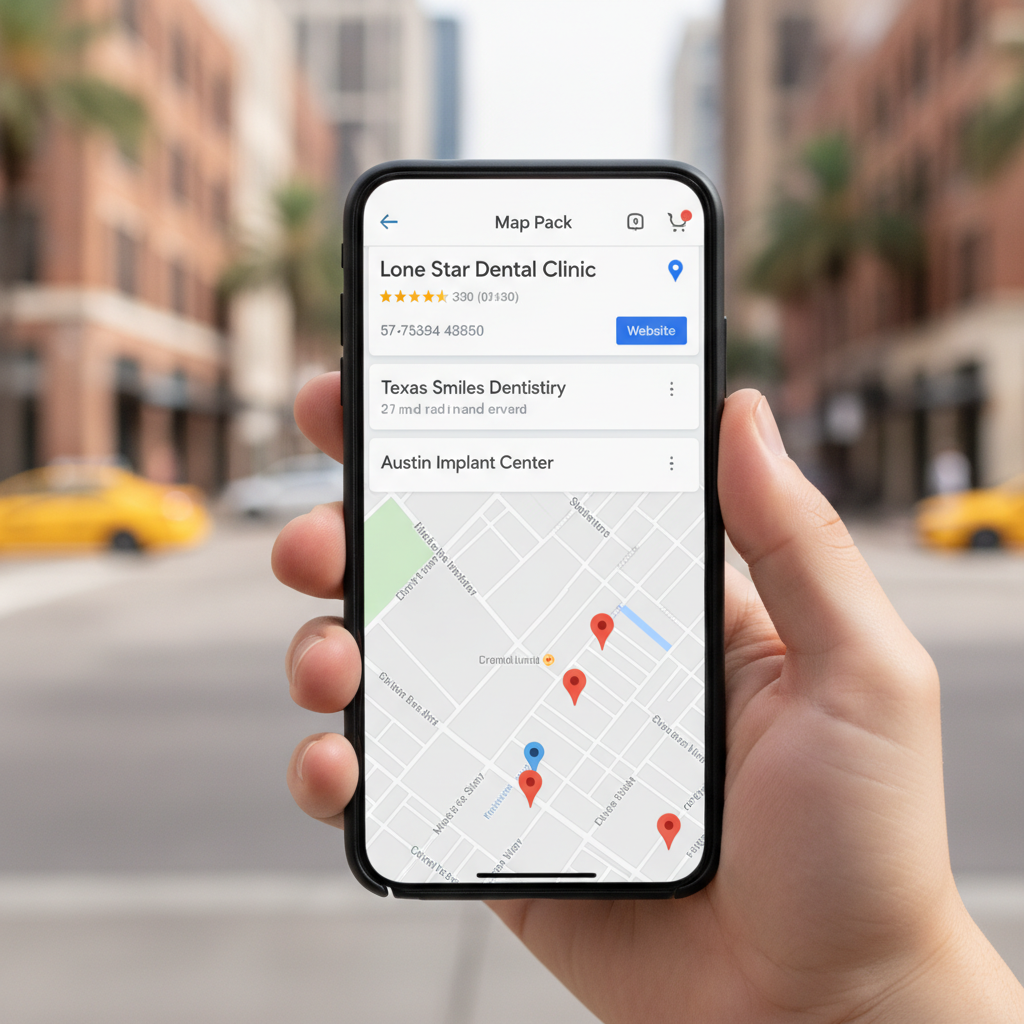
Local SEO expertise is not the same as general SEO experience — and a dental practice lives or dies on the Google Map Pack, not page-one rankings for broad keywords. Ask this question exactly: 'Walk me through how you would improve our Google Business Profile ranking in the next 90 days.' A dental marketing company with real local SEO expertise will name specific tactics: GBP category selection, review velocity strategy, citation consistency across 50-plus directories, proximity signals, and service-area page structure on the dental website.
A general digital marketing agency will talk about 'optimizing your profile' and 'building backlinks.' Those answers are not wrong, but they are thin. Agencies that reliably move Map Pack rankings cite specific signals: GBP posting cadence (3 to 4 posts per week minimum), photo upload frequency, Q&A section management, and review response rate. As of 2026, AI Overviews are cutting traditional organic click volume by 15 to 25%, which makes GBP visibility more critical than ever — patients search online for a dentist near them and increasingly act on the Map Pack result without clicking anything else. Search visibility in that three-pack is not a nice-to-have; it is the core patient acquisition channel.
Mid-market dental SEO retainers run $1,500 to $5,000 per month in 2026. Agencies at $500 to $1,500 almost always use templated content, offshore labor, or both — producing generic service-page content that Google's Helpful Content systems now actively deprioritize. Ask for a sample SEO deliverable from a current dental client in a similar market. If it reads like it could describe any dental office in any city, it will not rank in yours. Well-executed dental SEO still delivers a 3x to 10x return on investment, but only if the content production strategy accounts for how patients now search.
Green Flag Answer
An agency that asks for your practice's current GBP audit data, review count, and competitor Map Pack positions before proposing an SEO strategy is doing the job correctly. One that quotes a monthly price before seeing your market is guessing.

Ask for Dental-Specific Google Ads Benchmarks — Then Check Their Numbers
Any dentist marketing agency worth hiring should quote the 2026 dental Google Ads benchmarks without hesitation: average CPC of $8.00, CTR of 5.66%, conversion rate of 10.67%, and cost per lead of $72.97, based on the LocaliQ/WordStream 2026 report covering 13,000-plus US campaigns. If the agency quotes numbers significantly better than these without explaining what drives the variance, they are either cherry-picking a best case or using a different definition of 'conversion.' Push them on it.
Procedure-level CPCs matter more than category averages. Dental implants run $12 to $25 per click; Invisalign, $8 to $15; emergency dentist, $6 to $15; cosmetic dentistry, $5 to $12; and general dentistry, $3 to $8. An agency claiming a $4 CPC on implant campaigns is either running on off-peak hours, low-quality placements, or broad-match keywords that won't convert at the claimed rate. Paid advertising strategies that generate real results for high-value cases require procedure-level campaign structure, not one-size-fits-all ad groups.
Most established general dental practices running Google Ads in 2026 spend $2,500 to $6,000 per month on ad spend alone, separate from the agency management fee. In competitive urban Texas markets — Houston, Dallas, Austin, San Antonio — that floor often rises to $3,000 to $5,000. An agency that tells a practice in a dense city market it can generate meaningful new patient volume on $1,000 per month in ad spend is either running brand-awareness campaigns that don't fill chairs or significantly underselling what online advertising requires to compete.
The Implant Math Check
A $1,000 acquisition cost for a full-arch implant case worth $8,000 to $20,000 is a rational investment. The same $1,000 acquisition cost for a $99 emergency exam is a disaster. Ask the agency whether they structure campaign strategy around procedure economics or just total new patient volume.
Verify HIPAA Compliance and Demand a Signed BAA
A dental marketing agency becomes a HIPAA business associate the moment it creates, receives, maintains, or transmits protected health information on behalf of your practice — and that threshold is crossed more often than most agencies acknowledge. Web forms that collect patient names and symptoms, CRM integrations with your practice management software, and analytics platforms that track appointment booking behavior all cross into PHI territory. Under 45 CFR § 164.504(e), the agency must sign a Business Associate Agreement before handling any of that data.
Ask this question in the first substantive conversation: 'Are you a HIPAA business associate, and will you sign a BAA before we start?' A knowledgeable dental marketing company will say yes without hesitation and will have a standard BAA template ready. An agency that says 'we don't handle patient data' while also managing your web forms, remarketing pixels, and CRM integrations is either uninformed or deliberately avoiding the compliance obligation. Both are problems for your dental practice.
The BAA is not just legal paperwork. It establishes the agency's responsibility to implement Security Rule safeguards, train staff who access PHI, and sign downstream BAAs with any subcontractors — ad platforms, CRM tools, hosting providers — that also touch patient data. HIPAA violations carry penalties from $100 to $50,000 per violation, with annual caps up to $1.9 million per violation category. The agency's convenience is not worth that exposure.
Non-Negotiable
No BAA means no contract. Require a signed BAA before work begins, regardless of what the agency says about the scope of patient data they handle.
Ask How Many Dental Practices They Currently Serve — and Request a Reference
At minimum, a dental marketing agency should have demonstrable, verifiable experience with 5 to 10 active dental practice clients before you trust them with your patient acquisition budget. Dental professionals operate in a niche with specific seasonality (January resolutions, back-to-school, year-end insurance spending), a distinct insurance versus cash-pay dynamic, and procedure economics that vary by $8,000 or more per case type. A general digital marketing agency helping practices across unrelated industries will face a learning curve that costs your practice real time and real money while they figure it out.
Ask for two or three references from dental clients in a similar market type: a suburban general practice if that's what you run, not a specialty implant center with a $400,000 monthly budget. Contact those references directly and ask three questions: Does the monthly report show actual new patient numbers? Did the agency respond within 24 hours when something went wrong? Would you sign with them again? As of 2026, 87% of consumers — including patients evaluating healthcare providers — use Google reviews to evaluate local businesses. An agency that cannot point you to verified client reviews has a social proof gap worth noting.
The best dental marketing agencies will also tell you what they cannot control: your front desk's answer rate, your case acceptance rate, your hours, and your review response habits. An agency that claims full ownership of your patient acquisition outcomes without acknowledging these variables is either overselling or has never worked through a failed launch. Increase case acceptance and improve show rates are outcomes the agency influences but does not own. Any agency that says otherwise has already told you something important.
Stress-Test Their Content Marketing and Website Design Process
A dental website that converts visitors to patients is built around a specific structure: a clear value proposition above the fold, a click-to-call button visible on mobile without scrolling, procedure pages that address insurance and cost questions directly, and patient testimonials that match the services you most want to grow. Ask the agency to show you three dental websites they built in the last 18 months and load each one on your phone. If the click-to-call button requires scrolling, the site will underperform on mobile — and as of 2026, more than 70% of dental appointment searches happen on mobile devices. Website design is not a branding exercise; it is a patient conversion system.
Content marketing for dental practices in 2026 means more than blog posts. It means procedure pages optimized for AI Overview citations, FAQ content structured for voice search and featured snippets, and location-specific service pages for multi-location practices. Ask the agency: 'How do you structure content to appear in Google's AI Overviews?' An agency without a clear answer is behind the structural shift that cut traditional organic click volume by 15 to 25% this year. Social media marketing and social media ads should be part of that content conversation too — Instagram and Facebook campaigns that build patient trust and drive appointment bookings belong inside the same strategy as SEO, not siloed as a separate add-on managed by a different team.
Reputation management belongs inside this conversation as well. Online reviews are not a separate service — they are a conversion signal that affects both paid ad performance (Google Ads Quality Score rewards landing pages tied to high-rated GBP profiles) and local SEO ranking (review velocity and rating are confirmed local ranking signals). Ask specifically how the agency integrates review generation into the broader digital marketing workflow. Podium, at $299 to $499 per month, automates review requests via text immediately after appointments — the fastest way to build review velocity on Google and Healthgrades simultaneously. An agency that treats reputation management as an optional upsell has not thought through how the full patient acquisition funnel actually works.
Podium
$299–$499/month
Automates review requests via text immediately after appointments — the fastest way to build review velocity on Google and Healthgrades simultaneously, with a direct impact on local SEO and paid ad Quality Scores.
Calculate the Real Cost of Getting This Wrong Before You Sign
The best dental marketing agency decision is a financial decision, not a gut-feel decision — and the numbers make the stakes clear. The average dental practice spends $50,000 annually on marketing. As of 2026, 73% of dentists report being dissatisfied with their marketing ROI despite that spend, and 64% of practices that switch agencies within 12 months cite poor results despite seemingly reasonable costs. Low price is not a safeguard. It is the most expensive mistake a practice can make, because a low-fee agency that produces zero measurable results still costs you 5 months of momentum, a contract exit penalty, and the patients your practice will never meet.
Run this calculation before signing with any agency. Take your average patient lifetime value — general dentistry runs $12,000 to $15,000 per Dental Economics, or $6,700 by Dental Marketing Guy's 2026 estimate — multiply by the number of new patients you expect per month, and compare that to the agency's total monthly fee plus ad spend. A practice paying $3,000 per month in management fees plus $4,000 per month in ad spend needs roughly 5 to 6 new patients per month at $12,000 LTV just to hit a 5:1 return. An agency that cannot show you that math in plain numbers is not ready to be accountable for your practice growth.
Dental practices should budget 5% of gross revenue on marketing at baseline, with actively growing practices running 8 to 10%. If an agency's proposed budget falls dramatically below those benchmarks for your revenue level, ask what they are cutting to get there. It is usually content production, call tracking, or local SEO depth. Marketing campaigns built on a below-benchmark budget may generate new leads on paper while producing zero net new patients — because the channels that drive high-intent, appointment-ready patients (Google Ads for high-value procedures, Map Pack for near-me searches) require adequate spend to compete in your market.
Final Checklist Before Signing
Confirm in writing: (1) you own all accounts from day one, (2) the contract is month-to-month or has a clearly defined, penalty-free exit window, (3) a BAA is signed before work begins, (4) monthly reporting includes cost per lead and cost per new patient, and (5) call tracking via dynamic number insertion is included in the scope.
The 5-Month Warning: Red Flags Don't Show Up in the Sales Pitch
The industry-wide average dental marketing agency relationship lasts only 5 months — and the red flags that end those relationships almost never appear during the sales process. They show up in the third or fourth monthly review, when the data stops looking impressive and the dental practice realizes it is locked into a contract it cannot afford to exit. The 10 questions in this guide are designed to surface those patterns before you sign, not after you are stuck. Ask every question. Require written answers to the ownership and BAA questions. Walk away from any agency that treats transparency as a negotiation.
Choosing the best dental marketing agency for your practice is not about finding the most impressive pitch deck or the lowest monthly retainer. It is about finding a dentist marketing agency that owns its accountability in writing — one where your accounts belong to you on day one, your monthly report leads with new patients instead of impressions, and the contract has a real exit door. With a dental patient lifetime value of $12,000 to $15,000 and the average practice spending $50,000 a year on marketing, the cost of getting this wrong is not a line item — it is the patients your practice will never meet. Use these 10 questions as a filter, not a formality. The agency that answers all of them clearly and specifically is worth a second conversation. The one that hedges, deflects, or says 'that's not how we work' has already told you everything you need to know.
Frequently Asked Questions
Ready to get started? Contact Geek Powered Studios today.