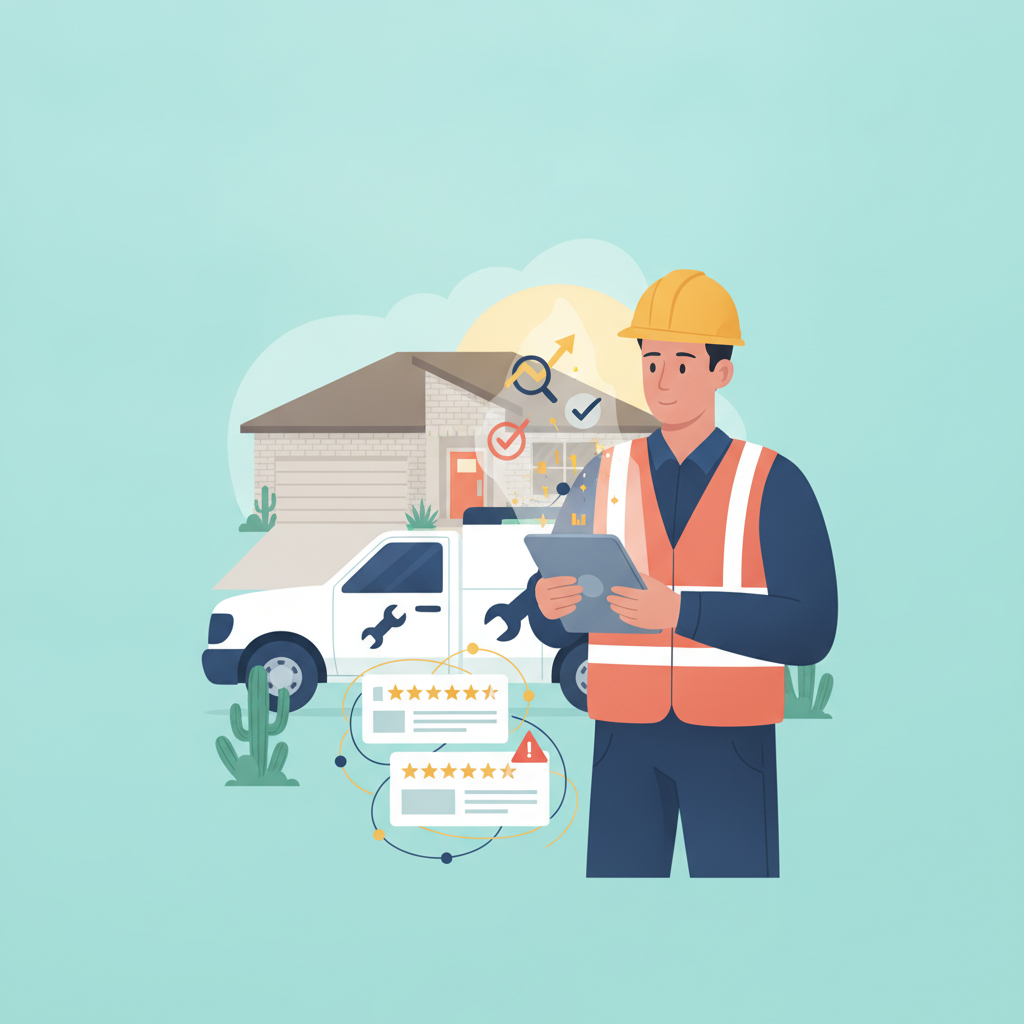
Generative Engine Optimization (GEO) is the practice of structuring a business's online presence so AI engines like ChatGPT, Perplexity, Google AI Overviews, and Gemini name the company by name when a homeowner asks a service question. As of August 2026, Google AI Overviews appear on more than 80 percent of local service queries, and 87 percent of independent HVAC and plumbing contractors have zero AI citation share. The 4-step GEO framework for Texas home-services contractors covers: understanding GEO as a discipline distinct from traditional SEO, auditing your citation gap by market, locking down entity signals and your third-party citation footprint across 100-plus directories, and restructuring service pages so AI systems can extract and cite your answers verbatim. Executed correctly, contractors see consistent AI citations within 4 to 6 months. Start with a free NAP audit in BrightLocal this week.
-
87%HVAC and plumbing contractors with zero AI citation share in their own market
-
80%+Local service queries where Google AI Overviews now appear
-
73% vs. 31%AI-referred lead close rate versus Google organic close rate
-
59.6%AI citations pulled from pages NOT in the top-20 Google results
-
4-6 monthsRealistic timeline for consistent AI citation across all three major platforms
-
$39/moCost of BrightLocal audit — the fastest first step any contractor can take today
Generative Engine Optimization (GEO) is the practice of structuring a business's online presence so AI engines like ChatGPT, Perplexity, Google AI Overviews, and Gemini name the company by name when a homeowner asks a service question — earning a recommendation, not a ranked link. As of August 2026, 87 percent of independent HVAC and plumbing contractors have zero AI citation share in their own market, including firms with hundreds of five-star Google reviews (5W PR AI Visibility Index 2026). Google AI Overviews now appear on more than 80 percent of local service queries, and 60 percent of users never scroll past them. The 4-step framework in this guide addresses each layer of the GEO gap — from understanding GEO as a discipline separate from traditional SEO, to locking down entity signals, to restructuring service pages for AI extraction — with concrete tools, realistic timelines, and specific actions a Texas contractor or their agency can execute in the next 90 days.
- An active Google Business Profile claimed and verified for your primary service area
- Listings on Yelp and Angi claimed with login access to edit NAP data
- Access to your website's CMS to edit service pages and add FAQ sections
- A baseline of at least 20 Google reviews so AI engines have review signal to read
- A spreadsheet with your exact business name, address, phone number, and service area cities — this becomes your NAP master record
- Familiarity with basic SEO concepts: what a heading tag is, what schema markup does, and what a service page is
Understand What GEO Is and How It Differs from Traditional SEO
Generative Engine Optimization (GEO) is the practice of structuring a business's online presence so AI engines like ChatGPT, Perplexity, Google AI Overviews, and Gemini name the company by name when a homeowner asks a service question — earning a recommendation, not a ranked link. The term was coined by Princeton University researchers (Aggarwal et al.) and presented at ACM SIGKDD 2024. Their GEO-bench benchmark tested 10,000 queries across nine datasets and confirmed that targeted content optimization can boost AI visibility by 22 to 41 percent by adding statistics, source citations, and direct quotations to existing content.
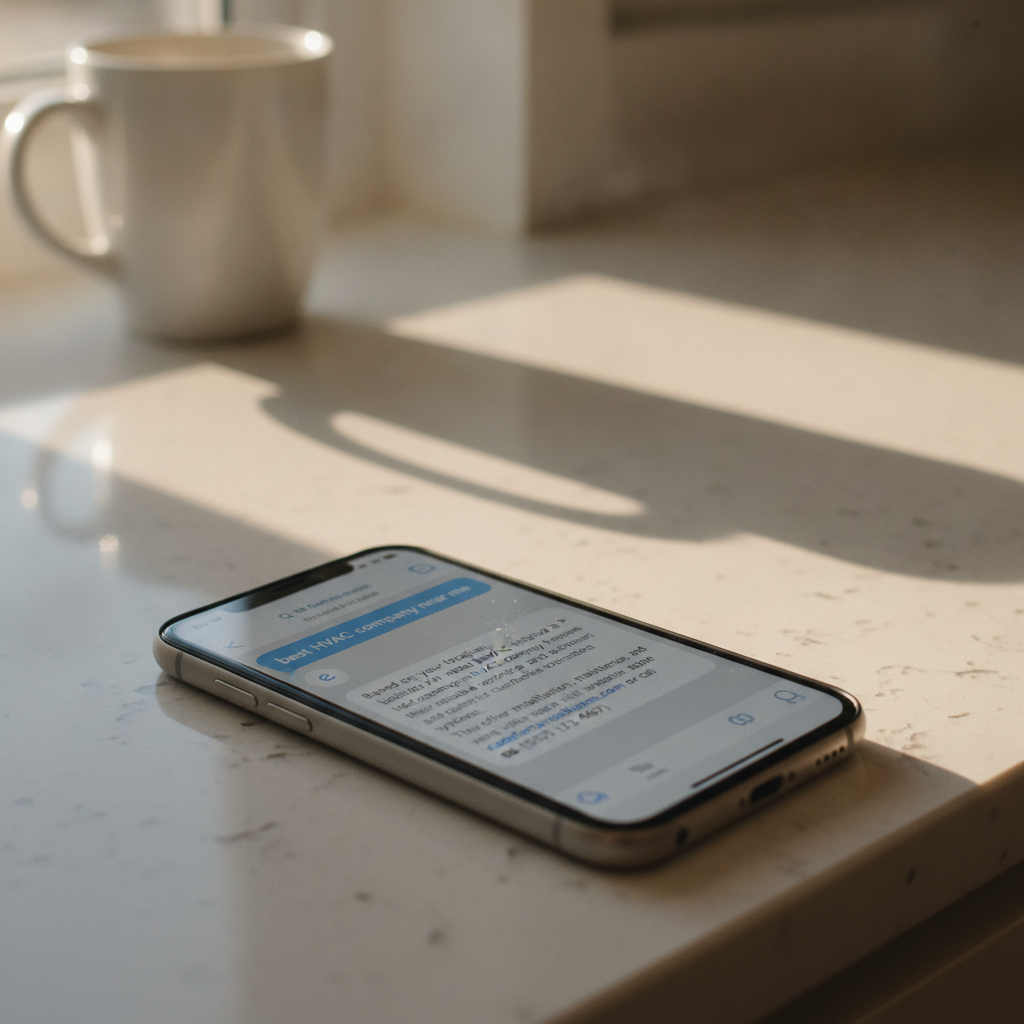
GEO and traditional SEO share some foundational inputs — high-quality content, site authority, structured data — but they optimize for completely different outputs. Traditional SEO targets a ranked position in Google's blue-link search results. GEO targets inclusion in an AI-generated answer. Google confirmed this distinction in 2026 by releasing official documentation titled 'Optimizing your website for generative AI features on Google Search,' treating AI search optimization as a separate strategic discipline with its own best practices. The goal in GEO is not a click — it is having your business's name, service, and location included in the AI's synthesized response when a homeowner types 'best HVAC company near me' into ChatGPT or Perplexity.
The shift matters because the search experience has changed at scale. As of August 2026, Google AI Overviews appear on more than 80 percent of local service queries, up from roughly 20 percent in early 2024. When an Overview is present, users are 60 percent less likely to scroll to traditional search results. At position 1 in classic Google SERPs, click-through rate has dropped from 7.3 percent to 2.6 percent (Ahrefs, 2025) because AI-generated answer boxes absorb the query before a user reaches organic links. Gartner projects a 25 percent decline in web traffic from search engines in 2026 primarily because generative AI features handle queries without sending users to websites. For a contractor who built their lead flow on organic Google rank, that is not a future problem. It is a current-year revenue leak.
Answer Engine Optimization (AEO) is an older term focused on winning featured snippets and answer boxes in classic Google search results. GEO is broader: it covers all generative AI platforms, including ChatGPT Search, Perplexity, and Gemini, which operate outside Google's index entirely. The strategies share some principles but are not the same. A contractor optimized only for AEO will still have gaps in ChatGPT and Perplexity citation pools.
Quantify the Gap: Why Home Services Is the Most Exposed Vertical
As of 2026, 87 percent of independent HVAC and plumbing contractors have zero AI citation share in their own market — including firms with hundreds of five-star Google reviews — because their listing data is inconsistent or their content is not structured for AI extraction (5W PR AI Visibility Index 2026). That number is not an abstraction. When a homeowner in Dallas opens ChatGPT and asks 'who fixes AC units in my neighborhood,' generative AI answers name 1 to 3 businesses per query in a winner-take-most structure. Eighty-seven out of 100 local contractors are not in those 1 to 3 slots.
Consumer behavior accelerated this problem faster than most contractors noticed. AI usage for finding local services jumped from 6 percent in 2025 to 45 percent in 2026, according to MarketingCode's May 2026 consumer behavior report. One in three homeowners under 45 used AI to find a home service provider in the last 90 days. ChatGPT alone handles 250 to 500 million weekly queries and holds approximately 60.7 percent of global AI-chat assistant share (Similarweb, January 2026). These are not future users. They are current customers typing queries your competitors are answering because you are not in the AI's citation pool.
The financial stakes are concrete. AI-referred leads close at a 73 percent rate compared to 31 percent for Google organic leads, based on Green Owl Systems client tracking through 2026. AI-referred homeowners arrive pre-informed about the contractor's services, location, and reviews — they have already been pre-sold by the AI's recommendation. At that close-rate delta, a contractor receiving 20 AI-referred leads per month instead of 20 Google organic leads captures roughly 8 additional closed jobs from the same lead volume. For an HVAC company averaging $2,800 per job, that is $22,400 in additional monthly revenue from the same marketing spend. AI search traffic converts at 14.2 percent compared to Google organic's 2.8 percent, making each AI-referred session roughly five times more valuable per visit.
ChatGPT, Google AI Overviews, and Perplexity share only 12 percent of citation sources as of May 2026 (MarketingCode). A contractor cited in Google AI Overviews may be completely absent from ChatGPT, even with strong organic search rankings. Each platform requires separate optimization — there is no single fix that covers all three AI-driven search engines simultaneously.
Lock Down Your Entity Signals and Citation Footprint
The fastest GEO win for a home service contractor is standardizing the business name, address, phone number, and service area identically across Google Business Profile, Yelp, and Angi — and inconsistent NAP data is the primary reason 87 percent of contractors have zero AI citation share to begin with. AI language models build an entity confidence score for every local business by cross-referencing NAP data across dozens of directories. A single mismatched suite number or an old phone number on Yelp introduces ambiguity that causes the AI model to discount or omit the business from generative AI responses. Run a free NAP audit using BrightLocal's Citation Tracker before touching any content.
Third-party sources drive 85 percent of brand mentions in AI answers — not the business's own website (Omnibound AI Search Statistics 2026). Review platforms, local directories, trade association listings, and local news mentions are responsible for the majority of how AI systems learn about a local contractor. A Texas plumber needs active, recent, and consistent mentions on Google Reviews, Yelp, Angi, the Better Business Bureau, local Chamber of Commerce directories, and ideally one or two local newspaper mentions. Each new third-party source that names the business consistently adds to the citation footprint that AI models pull from when generating local service recommendations. Social media marketing profiles on Facebook and Nextdoor, kept current with service-area posts, contribute additional third-party citation surface area.
Quality backlinks from trade directories and local citations also reinforce entity authority in AI models that use web crawl data as part of their retrieval systems. Prioritize listings on PHCC (Plumbing-Heating-Cooling Contractors Association), ACCA (Air Conditioning Contractors of America), NRCA (National Roofing Contractors Association), and NECA (National Electrical Contractors Association) depending on your trade. These association pages carry domain authority that generic directories do not, and AI systems treat industry-association mentions as high-confidence entity signals. Each association listing is structured content that large language models can index cleanly — a meaningful advantage over a generic citation on an aggregator site.
Pages not updated in more than three months are 3x more likely to lose AI citations than recently updated pages (Omnibound, 2026). Schedule a quarterly content refresh on every service page — even minor updates to pricing ranges or FAQ answers reset the freshness signal AI systems track. This is a maintenance task, not a one-time project.
Restructure Your Service Pages for AI Extraction
Pages with sequential heading structures and schema markup have a 2.8x higher AI citation rate than unstructured pages (Omnibound, 2026), and 44.2 percent of all LLM citations are pulled from the first 30 percent of a piece of content — the introduction (SparkToro, January 2026). Rewrite every service page to lead with a direct, specific answer sentence in the first paragraph. For a roofing company: 'Roof replacement for a 2,000 sq ft home in Austin costs $8,500 to $15,000 for architectural shingles, with most jobs completed in 1 to 2 days.' That one sentence, placed above the fold, is what ChatGPT and Perplexity extract when a homeowner asks the cost question. A vague intro paragraph about 'providing quality roofing solutions' earns zero citations from generative AI.
Add a structured FAQ section at the bottom of every high-margin service page, using H3 headings for each question. Target the exact natural-language queries homeowners type into AI assistants: 'How long does a water heater replacement take in San Antonio?', 'What does an AC tune-up cost in Houston?', 'Do I need a permit to replace my electrical panel in Dallas?' Each FAQ answer should be 40 to 80 words, written as a self-contained response the AI can extract verbatim. The Princeton GEO study confirmed that adding statistics, specific quotations, and source citations within content produces up to a 41 percent improvement in AI visibility — so include real numbers and attribute them. 'Per the Texas State Board of Plumbing Examiners, all water heater replacements require a permit in Texas' performs better in generative search than 'permits may be required.'
Add LocalBusiness schema markup and FAQPage schema to every service page. Structured data gives AI systems machine-readable information they can parse without ambiguity — it is the technical complement to the entity signals you are building in Step 3. The schema should include the business name exactly as it appears on Google Business Profile, service area cities listed individually rather than as 'greater Houston area,' phone number, and aggregate review rating. Pages not in the top 20 Google organic results account for 59.6 percent of all AI citations (Omnibound, 2026) — meaning the Princeton equalizer effect is real: a contractor at position 22 in Google SERPs can out-cite the position-3 competitor in ChatGPT simply by having cleaner content structure and stronger schema. The equalizer effect is most pronounced at position 5, where the Princeton study found a 115 percent visibility improvement from GEO optimization alone.
AI systems process content updates on different timelines: listing standardization can influence ChatGPT and Perplexity within weeks, while Google AI Overviews typically take 60 to 120 days to reflect content changes. Full, consistent AI citation across all three major platforms takes 4 to 6 months even when executed correctly. Set that expectation with your team or client on day one — not after three months of impatient questions.

GEO Is Not a Set-and-Forget Project
Only 23 percent of marketers currently invest in GEO measurement as of 2026 (Incremys, 2025). The contractors who build a measurement habit now — tracking AI citation share monthly in Semrush, running manual Perplexity audits for their top 10 service queries, and monitoring Google Search Console's AI Overviews report — will have a 12-month head start on every competitor who treats GEO as a one-time content update. AI systems recalibrate citation pools continuously. A page earning citations in September can lose them in November if a competitor publishes fresher, more structured content. Assign a monthly GEO audit to someone on your team or your agency. Thirty minutes per month is enough to catch citation losses before they become lead losses.
Ready to get started? Contact Geek Powered Studios today.