
AI marketing for dentists in 2026 delivers the fastest ROI in two categories: AI call handling (payback under 30 days when your PMS supports bidirectional booking) and AI-driven patient reactivation ($12 per reactivated patient versus $312 for a new one). Review automation via Birdeye or Podium is a prerequisite for local SEO and AI citation visibility, not an optional upgrade. Google Ads AI bidding cuts cost per new patient 45-70% only when first-party PMS data powers the audience signals. AI content tools help as a draft layer under licensed dentist review, but unreviewed AI-generated content published at scale collapsed from 28% to 3% top-100 visibility in recent Google updates. Start with your missed-call audit. That number tells you exactly where AI pays back first.
-
32-38%Dental calls missed during business hours — your AI ROI floor
-
26xCost gap between new patient ($312) and reactivated patient ($12)
-
14:1Average ROI on AI-driven recall at $350-$600/month investment
-
$72.97Benchmark dental Google Ads cost per lead — cut 45-70% with first-party data
-
28% to 3%SEO visibility decay for unreviewed AI dental content (SE Ranking data)
-
$50,000+HIPAA penalty per incident for AI review responses referencing patient treatment
AI marketing for dentists in 2026 is a $460 million category full of tools that look identical in a demo and perform completely differently in a live dental office. As of 2026, 41% of US dental practices are using or piloting at least one AI tool — but most owners buying those tools have no framework for separating the ones with calculable payback periods from the ones that create staff tasks instead of booking patients. This guide gives you that framework across six steps: audit your missed-call baseline, deploy AI call handling, run patient reactivation before spending more on new patient acquisition, automate review generation, apply AI to paid campaigns correctly, and use AI content tools conditionally. Each step includes specific tools, confirmed pricing, and the failure mode that kills ROI before the first invoice arrives. Estimated time: 25-35 minutes to read and score each category against your practice's current situation.
Before you start
- Active Google Business Profile with a claimed and verified listing — required for local SEO and AI citation visibility
- 30 days of inbound call data from your phone system or CallRail, including total calls, answered calls, and missed-call rate
- Your practice management system (PMS) identified: Dentrix, Open Dental, Eaglesoft, or NexHealth — PMS compatibility is the single biggest purchase filter for any AI tool
- A baseline monthly marketing budget of at least $1,500 if you plan to run Google Ads alongside AI tools — below that threshold, Smart Bidding cannot optimize effectively
- HIPAA compliance baseline confirmed: know which vendors currently have signed Business Associate Agreements (BAAs) with your practice
- A rough count of lapsed patients (no visit in 18+ months) pulled from your PMS — this number determines whether reactivation AI pays back in weeks or months
Audit Your Missed-Call Rate Before Buying Any AI Tool
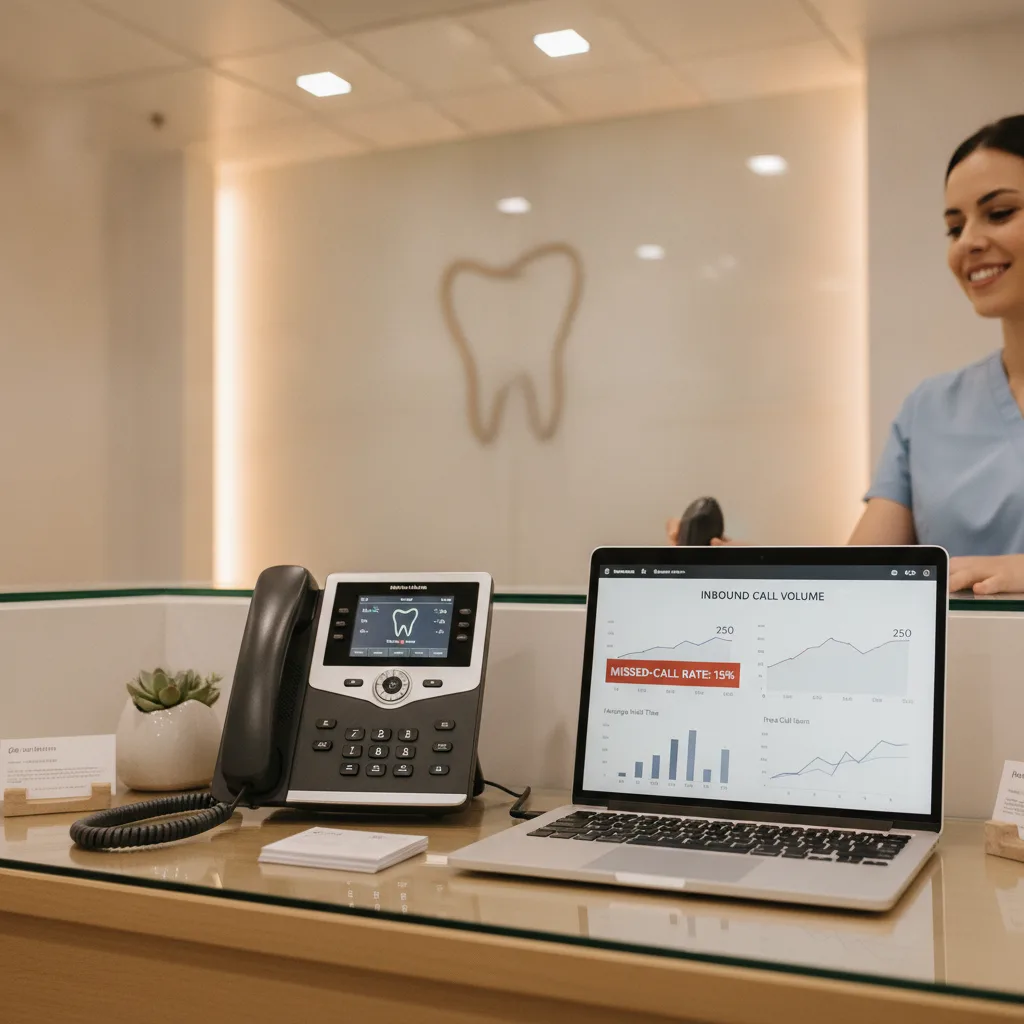
Dental practices miss 32-38% of incoming calls during business hours, and 67% of patients who cannot reach a practice immediately call the next one on the list — making call handling the fastest-payback AI category in dental marketing before you spend a dollar on anything else. Pull 30 days of call data from your phone system or CallRail. If your missed-call rate is above 20%, AI call handling will deliver ROI faster than any other dental marketing tool on this list. This audit is not optional setup — it is the number that frames every other AI purchase decision you make.
Each missed call carries an estimated $850 in immediate revenue and $8,000 or more in patient lifetime value. A dental office fielding 200 calls per month and missing 35% of them walks away from roughly $595,000 in lifetime patient value every year. That math resets the priority order for every tool category that follows. Nothing else in dental marketing has a payback period measured in weeks.
Log total inbound calls, answered calls, and after-hours requests — industry data shows 28% of appointment requests arrive outside business hours. The gap between calls received and calls answered is your AI call handling ROI floor. Bring that number to every vendor conversation. It tells you what the tool needs to recover in month one to justify its cost, which is a far more useful question than asking a vendor for a case study.
CallRail
$45-$145/month
Call tracking with recording and missed-call reporting — establishes your baseline before any AI receptionist purchase
Before you buy
If your PMS is Dentrix, Open Dental, Eaglesoft, or NexHealth, confirm bidirectional write access before signing any AI receptionist contract. An AI that cannot write appointments directly into your schedule is automated voicemail — it creates a staff task instead of booking a patient. This is the most common failure mode in AI call handling for dental practices.
Deploy AI Call Handling — the Highest-ROI Dental Marketing Tool in 2026
AI call handling is the highest-ROI AI marketing tool category for dental practices in 2026, with payback periods under 30 days when real-time PMS integration is in place. The only version worth buying writes appointments directly into Dentrix, Open Dental, Denticon, or NexHealth in real time — not a message-taking bot that creates a callback task for your front desk team. AI-driven platforms that handle inbound patient communication, two-way texting, and missed-call text-back in one system are the standard to evaluate against. Front desk performance problems do not get solved by tools that add a step to the queue.
Weave earns a 4.6 out of 5 G2 rating across 426-plus verified reviews and was named 2026 Best Healthcare Software by G2 — it covers inbound patient communication, two-way SMS, and missed-call text-back in one platform. NexHealth runs approximately $350 per month per location (Starter tier) with confirmed bidirectional PMS booking; for multi-location dental groups, it scales to $1,050 per month for three locations and connects patient data across sites. RevenueWell starts at $189 per month base with a $149 per month add-on for two-way texting — lower cost entry point, but evaluate whether the texting module matches your after-hours patient inquiry volume before committing.
AI chatbots at the entry level start around $40 per month (Hyperleap) and can deflect 30-50% of routine inbound volume — insurance verification questions, hours, directions — freeing your desk team for higher-value patient interactions. The evaluation filter is simple: does it write to your schedule, or does it take a message? Automating routine tasks is only useful if those tasks do not reappear in your front desk team's queue two minutes later. Integrating AI tools that lack scheduling write access adds cost without improving desk performance.
Weave
Custom pricing; mid-market range ~$400-$600/month
G2's top-rated dental communication platform for 2026 — covers AI call handling, two-way SMS, and missed-call text-back in one system
NexHealth
~$350/month per location (Starter)
Confirmed bidirectional PMS booking into Dentrix, Open Dental, and NexHealth's own system — the benchmark for real scheduling AI
RevenueWell
~$189/month base + $149/month two-way texting
Lower cost entry point for smaller practices focused on patient communication and recall with lighter scheduling needs
Compliance flag
Every AI receptionist with call recording introduces a wiretap compliance question, as flagged by the Lisota v. Heartland Dental and RingCentral case filed in 2025. Confirm your vendor provides state-specific call recording disclosures built into the call flow — not bolted on afterward — and that a signed BAA covers all recorded patient interactions before go-live.
Run AI-Driven Patient Reactivation Before Spending More on New Patient Acquisition
Reactivating a dormant patient costs $12 versus $312 to acquire a new one — a 26x cost difference that makes AI-driven recall campaigns the highest-ROI growth lever for most single-location dental practices in 2026. Pull your lapsed patient count from your PMS now: anyone with no visit in 18 or more months is a reactivation target, and the average single-location practice has 800-1,500 of them. Before running any new patient acquisition campaign, calculate your reactivation pool size: lapsed patients multiplied by a 15% reactivation rate, times average visit value. If that number exceeds your current paid ads spend, start recall first.
AI-driven recall campaigns reactivate 15-25% of lapsed patients versus a 5-8% rate for manual callbacks. A practice investing $350-$600 per month in automated recall sees an average 14:1 ROI, recovering $5,000-$8,500 per month and $35,000-$60,000 per year from existing patients who already know the practice. No-show rates drop 20-35% within 60 days of implementing automated appointment reminders — without adding staff. Automated reminders also recover the $110,000-$240,000 in annual revenue that ADA data shows the average dental practice loses to no-shows alone. That is patient care revenue already earned in the relationship, not new patient acquisition cost.
Build recall sequences by patient segment rather than blasting the full lapsed list. Segment by hygiene overdue, incomplete treatment plans, and cosmetic dentistry consultations separately. Personalized patient experiences in these sequences lift response rates measurably — practices treating every lapsed patient identically leave 30-40% of reactivation revenue unrealized. Platforms like NexHealth and RevenueWell pull last-visit data directly from your practice management system and fire recall sequences automatically, with no manual list exports required. Strong patient relationships built through timely, relevant follow-ups are what convert a lapsed record back into a loyal patient.
NexHealth Recall Automation
Included in ~$350/month Starter plan
Pulls last-visit data directly from your PMS and fires recall sequences automatically — no manual list exports required
RevenueWell Recall Campaigns
Included in $189/month base plan
Solid recall automation for general dental at a lower price point; two-way texting add-on ($149/month) enables patient responses to trigger scheduling
ROI shortcut
Most practices hit a positive reactivation ROI in under 60 days. Calculate your reactivation floor before your next vendor call: lapsed patients x 15% x average visit value. That number is the minimum the tool needs to return to justify its cost in year one — and most practices find it covers the annual contract in the first recovered patient segment alone.
Automate Review Generation to Hit 4.8 Stars and Feed Local SEO and AI Citations
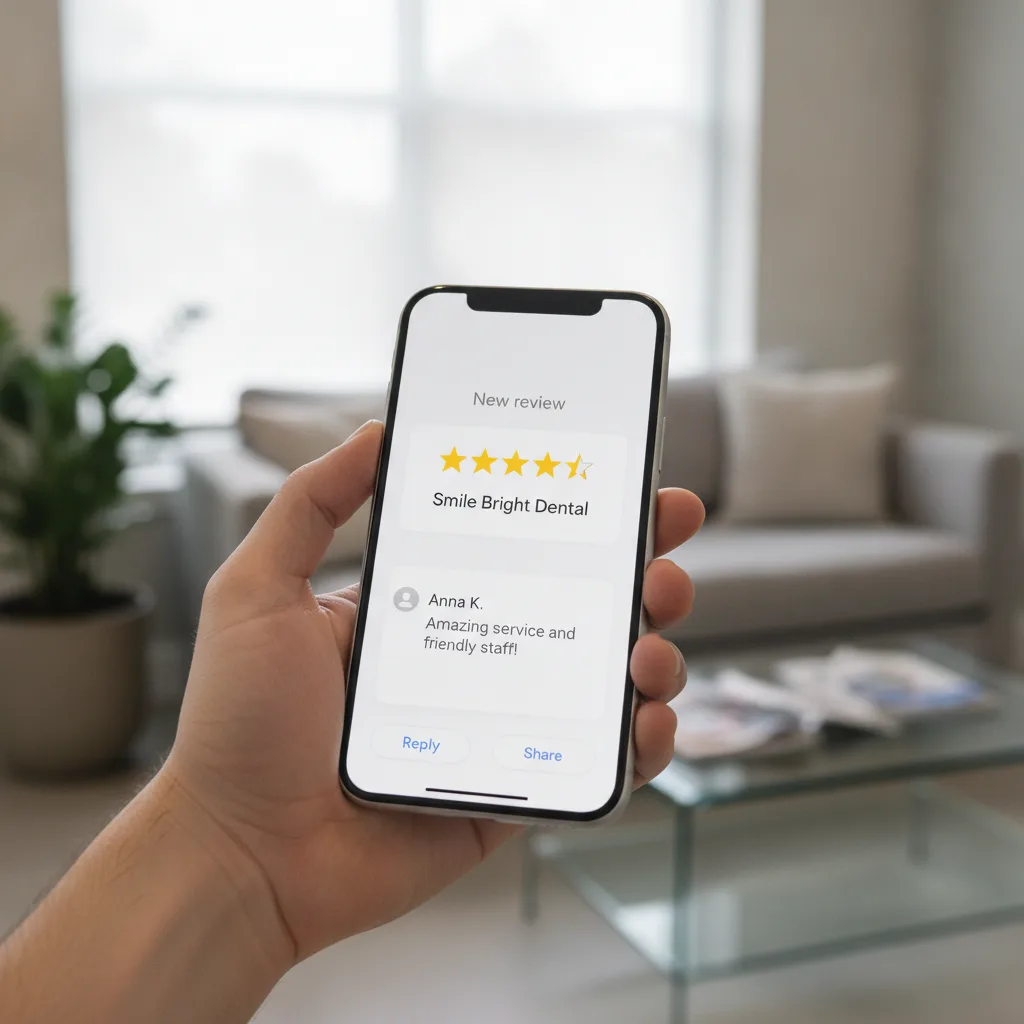
Only 7% of satisfied dental patients leave a Google review without being asked, and 90% of patients check online reviews before booking — meaning automated post-visit SMS review requests are not optional for dental practices competing in local search in 2026. Practices below a 4.2-star rating on Google lose potential patients before the phone ever rings. Automated review requests via platforms like Birdeye or Podium increase monthly review volume by 300-500% and can lift a practice to a 4.8-plus star average within 6-12 months. Patient testimonials generated through this system compound over time and become one of the most durable trust signals in dental marketing.
The local SEO and AI citation implications are direct: as of 2026, Google's AI Overviews and AI Mode results favor dental practices with consistent ratings across both Google and Healthgrades. A practice with a 4.9 Google rating but a weak Healthgrades profile gets bypassed in AI answers in favor of a competitor with 4.7 on both platforms. Cross-platform rating consistency — not peak Google rating — is what triggers AI citation. Your Google Business Profile is the starting point, but Healthgrades, Yelp, and Zocdoc need active monitoring alongside it. 81% of all dental reviews post to Google, so that remains the primary target, but ignoring other platforms in 2026 costs AI visibility in search engines that pull cross-platform signals.
Birdeye holds 3,600-plus verified G2 reviews and ranked number one enterprise in 12 G2 Spring 2026 categories — it handles multi-platform review distribution and response automation across Google, Healthgrades, and Yelp from one dashboard. Podium starts near $399 per month and skews toward practices that want reviews plus SMS marketing in a single tool. For multi-location dental groups, Birdeye's enterprise tier aggregates online reputation data across locations and lets you monitor review velocity, sentiment trends, and response times at the group level. Reputation management at this level feeds online reputation signals that current and potential patients search before making patient decisions.
Birdeye
Custom pricing; enterprise-tier benchmark ~$300-$500/month per location
Number one enterprise G2 ranking in 12 Spring 2026 categories — covers Google, Healthgrades, and Yelp review automation with multi-location rollup reporting
Podium
Starting ~$399/month
Strong for practices that want reviews and patient SMS messaging in one tool; simpler setup than Birdeye for single-location offices
HIPAA hard stop
Never let AI auto-publish review responses without a licensed staff member approving each one. A response that references a patient's procedure — even a thank-you that mentions 'your root canal' — is a HIPAA violation. HIPAA penalties reach $50,000 or more per incident. All review responses must be generic until a staff member confirms they contain zero treatment-specific identifiers.
Apply AI to Google Ads and Paid Campaigns — With First-Party Data, Not Broad Targeting
Google Ads for dental practices carry an average CPC of $8.00 and a 10.67% conversion rate, producing a benchmark cost per lead of $72.97 in 2026 — but AI Smart Bidding and Performance Max reduce required manual management from 10-15 hours per week to under 2 hours. The time savings are real, but the ROI gains only appear when AI bidding runs on first-party patient data, not generic demographic targeting. Dental marketing strategy built on broad demographic signals produces expensive leads. First-party data produces seated patients at a fraction of the cost.
Connecting your PMS and CRM patient data to Google Ads via Customer Match cuts acquisition costs 45-70% compared to broad targeting — now that Google has deprecated Similar Audiences, first-party patient data is the only audience signal that reliably reduces cost per new patient. For dental implants and specialty services, CPCs range $15-$80 per click on 'dental implants near me' queries; the cost per seated specialty patient runs $200-$400. The minimum effective monthly Google Ads budget for a single-location Texas general dental practice is $1,500-$3,000. Below that threshold, Smart Bidding algorithms do not collect enough conversion data to optimize effectively. Marketing campaigns below that floor are funding data collection, not patient acquisition.
Pair Google Search Ads with Google Local Services Ads (LSAs) to hold two positions in dental search results simultaneously. LSAs produce leads at $35-$90 each, below the $72.97 Search benchmark, and carry Google's 'Google Screened' badge — a trust signal that affects patient decisions before they click. The AI-managed stack of LSA plus Smart Bidding Search is the paid marketing strategy generating the most consistent new patient volume per dollar in this market as of 2026. Social media paid ads on Meta serve a secondary awareness role for cosmetic dentistry and Invisalign services, where treatment acceptance decisions follow longer consideration cycles than general dental bookings. Teeth whitening and Invisalign campaigns on social media platforms can generate engagement, but conversion to seated patients requires retargeting with first-party data layers to be efficient.
Google Ads with Smart Bidding and Customer Match
$1,500-$3,000/month minimum ad spend (single location, Texas general dental)
AI bidding on first-party PMS data cuts cost per new patient 45-70% vs. demographic targeting; requires 30-plus conversions per month to fully optimize
Google Local Services Ads (LSA)
$35-$90 per verified lead (pay-per-lead model)
Below-benchmark cost per lead with Google Screened badge; pairs with Search Ads to hold two positions in dental search results simultaneously
KPI shift
As of Google I/O 2026, AI Mode results are personalized per user — two patients searching the same query get different answers. The classic 'we rank number one' screenshot is now a meaningless marketing KPI. Track booked appointments and seated patients, not SERP position screenshots. Google's AI Mode and AI Overviews cite the same URL only 13.7% of the time, which means ranking in one does not guarantee visibility in the other.
Use AI Content Tools for Dental SEO Conditionally — Unreviewed Copy Will Tank Your Rankings
AI-generated dental content published at scale without licensed dentist review lost ground dramatically in the 2025-2026 Google updates: one SE Ranking experiment tracked fully AI content decaying from 28% to 3% top-100 visibility. Google does not penalize AI involvement in dental marketing content — Ahrefs data shows 86.5% of top-20 dental search results contain some AI content — but unreviewed volume publishing at scale triggers E-E-A-T quality signals that collapse rankings over 6-12 months. The content itself may look correct to a non-clinician. Google's dental SEO quality signals score clinical authority, and generic AI-generated content does not carry it.
The correct workflow: use dental-specific AI marketing tools ($50-$300 per month) to generate first drafts of service pages, blog posts, FAQ content, and social media posts, then route every piece through a licensed dentist for review before publishing. This hybrid approach saves 5-8 hours of manual content and marketing work per month compared to doing it entirely by hand — and at a dentist owner's $200-$400 hourly rate, that time recovery alone justifies the tool cost. The reviewing dental professional's credentials, license number, and clinical citations attached to published content are what Google's dental SEO quality signals score. Managing AI-generated content this way protects practice growth over the 6-12 month content compounding window.
For dental SEO and local SEO, the AI tools that add real value are keyword clustering and content gap tools: Surfer SEO at $89-$219 per month and Ahrefs at $129 per month identify which service pages your competitors rank for that you do not yet have. AI-drafted content structured around those gaps, reviewed by your dentist, and published with consistent local citations across your Google Business Profile, Healthgrades, and dental directories compounds into practice growth over 6-12 months. Dental AI marketing tools built specifically for the category — not generic content platforms — understand YMYL content standards, HIPAA constraints, and dental service terminology. Dentplicity ($50-$150 per month) is built for this use case and reduces the prompt engineering required versus generic ChatGPT for dental professionals producing marketing content. Data-driven content decisions combined with licensed review are what make effective dental marketing in the AI content era.
Surfer SEO
$89-$219/month
Content editor scores dental service pages against top SERP competitors in real time — tells you exactly what a licensed-dentist-reviewed draft needs to rank
Ahrefs
$129/month (Lite)
Identifies content gaps between your site and competitors for dental SEO; pairs with AI drafting tools to prioritize which pages to build first
Dentplicity
$50-$150/month
Dental-specific AI content tool built for HIPAA constraints and dental terminology — reduces prompt engineering required vs. generic ChatGPT
The compliance layer every AI vendor skips
Every AI vendor with access to protected health information (PHI) is a third-party HIPAA risk requiring a signed Business Associate Agreement (BAA) before any patient data flows through their system. This applies to AI receptionists, review response tools, recall platforms, and content tools that pull patient names or treatment history. Request the BAA before the demo, not after the contract.
The BAA Checklist Every Dental AI Buyer Skips — Until a $50,000 Fine Reminds Them
Before any AI marketing tool goes live in your dental practice, run this four-item compliance check. First: does the vendor have PHI access? If yes, a signed BAA is legally required before data flows — no exceptions. Second: does the platform record calls? If yes, confirm state-specific wiretap disclosure language is built into the call flow, not bolted on afterward. Third: does the tool auto-publish review responses? If yes, build a human approval gate before any response goes live — one AI response that mentions a patient's treatment constitutes a HIPAA violation at $50,000 or more per incident. Fourth: does any AI-generated content reference patient names, procedures, or outcomes? If yes, a licensed dentist must review and approve it before it leaves your system. The Lisota v. Heartland Dental and RingCentral case (filed 2025) is an early enforcement signal, not a fringe event. Compliance infrastructure is not optional once AI tools touch patient data.
The ROI ranking for AI marketing tools in dental practices in 2026 is not close: AI call handling and patient reactivation return investment in weeks, with calculable payback periods tied to real numbers you can pull from your PMS today. Review automation is a prerequisite for local SEO and AI citation visibility, not a luxury add-on. Google Ads AI bidding cuts costs significantly — but only when first-party patient data powers the audience signals. AI content tools are conditional: useful as a draft layer under licensed dentist review, actively damaging when published at scale without it. The practices winning with AI marketing are not buying the most tools. They are buying the right tools in the right sequence, with compliance infrastructure in place before anything touches patient data. Start with your missed-call audit. The gap you find there tells you exactly where AI pays back first — and what the rest of your dental marketing strategy needs to support.
Frequently Asked Questions
Ready to get started? Contact Geek Powered Studios today.