
AI marketing for plumbing services works best when you fix revenue leaks in order of magnitude. Start with AI phone answering to capture the 27% of inbound calls that go unanswered — worth up to $125,000 per year per shop. Layer in automated review requests via NiceJob or Podium to build the 230-plus Google reviews that ChatGPT and Perplexity require before citing a contractor. Add AI-assisted scheduling to cut booking time from 47 minutes to under 3 minutes. Then connect Google Ads Smart Bidding to real revenue data from your field service management platform. Finally, build the AEO and GEO foundation — LocalBusiness schema, NAP consistency across 17-plus directories, and FAQ markup — that gets your plumbing company cited by AI assistants even when competitors have better websites. Total stack cost: $398–$2,500 per month depending on truck count.
-
$125,000/yrRevenue lost annually to missed calls per plumbing shop
-
27%Share of inbound plumbing calls that go unanswered
-
Under 3 minutesTime from first contact to booked job with AI scheduling
-
$57 CPLAverage Local Service Ads cost per lead vs. $183 non-branded
-
87%Plumbing contractors with zero AI citation share as of Aug 2026
-
$398–$698/moMinimum viable AI stack cost for a 1-truck plumbing operation
AI marketing for plumbing services has a sequencing problem: most plumbing companies buy writing assistants and general-purpose AI chatbots before fixing a $125,000 annual missed-call leak that no content tool can touch. Only 19% of plumbing contractors were using AI tools as of April 2026, up from 7% in 2024 — but the 66% who save time with AI and the 43% who actually see increased revenue are not the same group. The gap between efficiency and revenue is almost always a tool-selection-order problem. This guide walks through the seven steps to audit, prioritize, and build a plumbing AI marketing stack that moves bookings — not just hours saved per week — starting with the highest-ROI fix and building from there. Budget 3–5 hours to audit and configure the core stack. Expect measurable booking lift in 2–4 weeks.
Before you start
- Active Google Business Profile with at least 50 reviews and admin access
- A field service management platform (Jobber, Housecall Pro, or ServiceTitan) already in use — you will connect AI tools directly to it
- Call tracking via CallRail or a similar platform with at least one tracked number per campaign
- Google Ads account with conversion tracking enabled and admin-level access
- Admin access to your website CMS to add LocalBusiness and FAQ schema markup
- A list of your current monthly tool subscriptions and their costs — you will cut at least one before this process ends

Audit Your Missed-Call Revenue Before Touching Any AI Tool
The average plumbing business loses up to $125,000 per year to missed calls, and 27% of inbound calls to plumbing companies go unanswered — making call capture the single largest revenue leak in AI marketing for plumbing services. Before evaluating any AI platform, pull your call tracking data from CallRail or your phone system and calculate exactly how many calls went unanswered in the last 30 days. Multiply that number by your average job value. That figure is your baseline — the revenue floor you're defending.
Plumbing converts at 12–16%, the highest conversion rate in home services, because emergency calls are not comparison-shopping situations. A homeowner with a burst pipe or sewer backup is booking the first licensed plumber who answers. That urgency is why 78% of leads commit to the first business that responds, and why sub-90-second AI response is the primary conversion driver for plumbing leads — not ad spend, not website design. Plumbing demand spikes during high demand periods like winter freezes and summer storms, which amplifies the missed-call cost further.
Run this audit before spending another dollar: log into CallRail, filter for missed and abandoned calls in the last 60 days, and tag them by time of day. You will almost certainly find that 40% or more occur after 6 PM or on weekends — exactly when your office staff is offline. This data tells you whether AI phone answering is your highest-leverage first move or whether a different leak is bigger. The call recording and call volume data you generate here also feeds directly into your Google Ads optimization in Step 5.
CallRail
$45–$145/mo
Call tracking and recording with missed-call reports segmented by campaign, time of day, and call source — essential for sizing the revenue leak before any AI purchase.
Don't skip this step
66% of contractors using AI save at least 3 hours per week, but fewer than half report improved profitability (47%) or increased revenue (43%). The gap between efficiency and revenue is almost always traced to buying writing assistants and chatbots before fixing the phone. Run the missed-call audit first — the number you get is the ROI target every subsequent tool must beat.
Deploy AI Phone Answering to Capture Emergency Calls Around the Clock
AI phone answering is the most common entry point for AI marketing in plumbing — adopted by 13% of contractors as of 2026 — because it solves a named problem with a clear dollar figure attached. Services like Sameday AI and Smith.ai answer every inbound call in under 90 seconds, collect job details, confirm the service area, and push a booked appointment into your dispatch board without waking up your office staff. The monthly cost runs $15–$700 depending on call volume and features, compared to $300–$1,500 for a traditional call center with comparable after-hours coverage.
Emergency calls account for roughly 28% of all plumbing inquiries but generate 42% of total plumbing revenue due to premium emergency pricing. A three-truck Austin plumbing company added AI chatbot coverage for after-hours calls and captured 89 qualified emergency leads in its first month from conversations that previously went to voicemail — generating an estimated $23,000 in additional emergency service revenue. For a shop of that size, that result covers 12–18 months of AI tool costs. Emergency plumber, burst pipe, and sewer backup calls are exactly the high-urgency, high-value jobs where answering calls before the next plumber does is the entire conversion strategy.
Set the AI answering service to hand off to a live dispatcher for any call involving active flooding, gas-adjacent plumbing, or sewer backup situations requiring immediate triage. Everything else — water heater replacement quotes, drain cleaning estimates, scheduling non-emergency service calls — the AI handles without escalation. Configure this triage logic in the tool's call flow before going live, not after. Verify the two-way sync with your dispatch board in a live test call: a confirmed appointment must appear in your field service management platform within 60 seconds of the AI booking it.
Sameday AI
$199–$499/mo
Purpose-built for home service contractors; handles inbound call answering, job intake, and appointment booking with direct integrations to Housecall Pro and ServiceTitan.
Smith.ai
$240–$600/mo
Hybrid AI plus live-agent backup for after-hours escalations; useful for plumbing shops that want a human available for complex emergency calls without a full call center contract.
Watch out
Generic AI chatbots that cannot pull your real-time availability from your dispatch board create a broken customer experience — they collect contact info but cannot confirm a time slot, which forces a callback and loses the lead. Only deploy an AI answering tool that has a live integration with your field service software. If a vendor cannot demonstrate the confirmed appointment appearing in your board during the sales call, do not buy the tool.
Automate Review Requests to Compound Every Captured Lead
AI-powered review automation turns every closed job into a trust signal without adding any manual work for your office team. NiceJob at $75/month connects directly to Jobber or Housecall Pro and fires an SMS review request within minutes of a job closure, delivering a 2–4x increase in review volume. A benchmark 6-tech plumbing shop running NiceJob went from 8 reviews per month manually to 47 per month automated, added 0.7 stars to its average rating, and attributed 12 new inbound calls per month directly to that review lift. That volume improvement also directly benefits plumbing customers who rely on recent reviews to choose between competing shops.
Review volume matters for AI citation as much as it does for local SEO. Contractors that ChatGPT, Gemini, and Perplexity recommend share a consistent profile: 230-plus Google reviews at a 4.5-plus average, plus breadth across Yelp and BBB. In 3 of 10 U.S. markets tested in July 2026, Perplexity recommended a plumbing company with no website at all — pulling entirely from Yelp and BBB data. Your review count is more important to AI citation than your website quality. Plumbing specifically has one structural advantage here: the emergency-driven customer journey creates strong emotional resolution after a job well done, which translates to above-average review response rates when the request arrives quickly.
For plumbing shops with 6 or more technicians and a need for unified customer communication, Podium at $399/month adds AI-powered SMS automation and a single inbox that consolidates calls, texts, and review requests. Podium SMS sequences convert at 23–31%, versus NiceJob's 18–26% — a meaningful difference once you're running 50-plus jobs per month. Solo operators and 1–2 truck shops should start with NiceJob and upgrade to Podium only when call volume justifies the cost jump. Run both in parallel for 60 days if you're on the fence — the SMS conversion rate data will make the decision for you.
NiceJob
$75/mo (Reviews) or $125/mo (Pro with AI review replies)
Best entry point for review automation in plumbing shops — integrates with Jobber, Housecall Pro, and ServiceTitan; no annual contract required.
Podium
~$399/mo (Core); annual contract
Unified inbox plus AI SMS automation for multi-tech plumbing operations; higher SMS conversion rates make it worth the cost above 50 jobs per month.
Cut Booking Time to Under 3 Minutes with AI-Assisted Scheduling
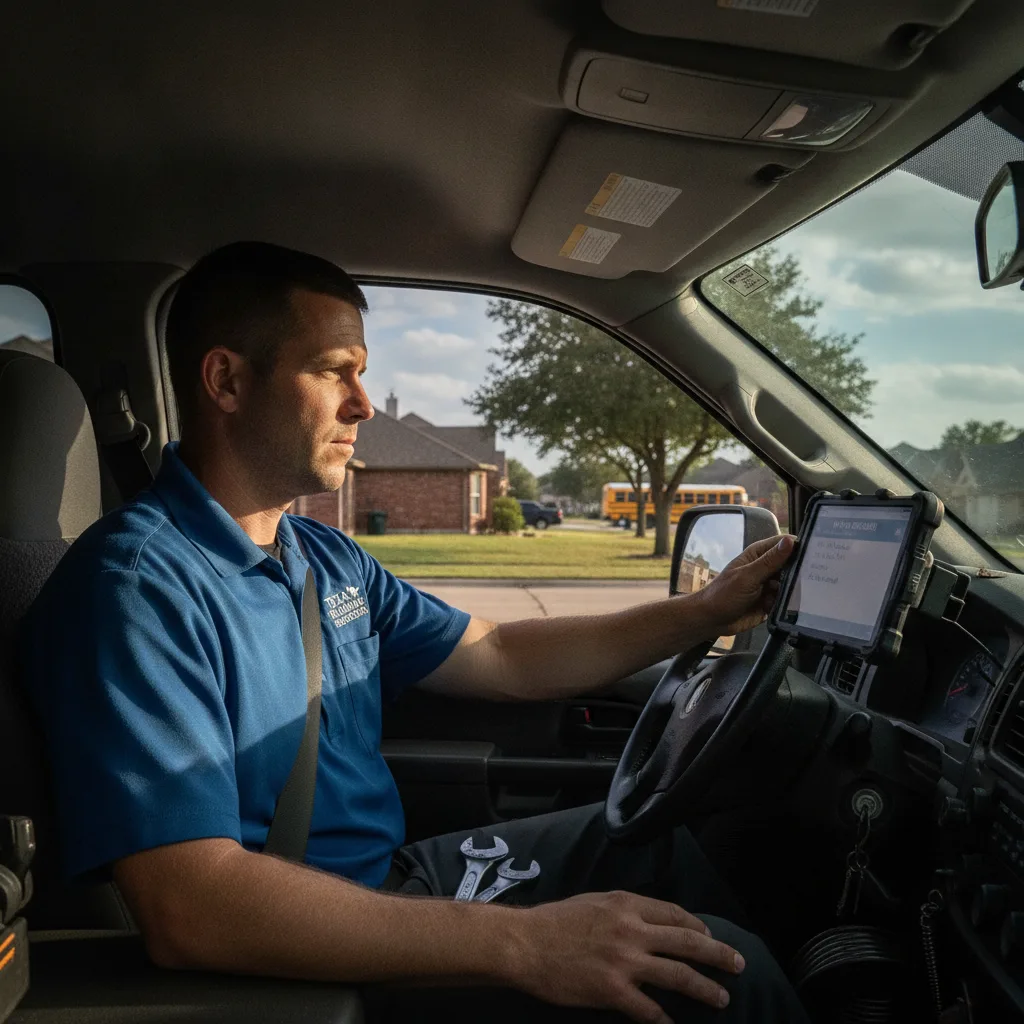
AI-assisted scheduling cuts first-contact-to-booked-estimate time from 47 minutes to under 3 minutes, based on data from 312 client deployments in 2025 and early 2026. That 44-minute compression matters most for plumbing because 78% of leads commit to the first business that responds — a competitor who answers and books in 3 minutes wins the job even if you answer 10 minutes later with a better price. Speed is the conversion lever. The estimate conversation matters, but only after you've secured the booking.
For plumbing operations already on Housecall Pro, the built-in online booking widget handles non-emergency scheduling without staff involvement. Pair it with Housecall Pro's AI-suggested scheduling, which analyzes technician location, job history, and drive time to slot new bookings into existing routes efficiently. For ServiceTitan users, Atlas — the AI copilot launched in late 2025 — lets dispatchers pull schedule gaps and assign jobs in plain English commands rather than navigating multiple screens. ServiceTitan's Dispatch Pro AI routing module generates 10–15% more revenue per technician by minimizing windshield time between service calls. At average plumbing ticket values, that lift typically adds $8,000–$15,000 per month at a 6-truck shop.
One scheduling pattern that consistently fails: deploying a booking widget on your website without connecting it to your live dispatch board. Customers book time slots that are already taken, your office staff manually cancels and reschedules, and the customer experience is worse than a phone call would have been. Before activating any AI scheduling tool, confirm the two-way sync between your booking interface and your field service management platform. Urgent jobs and plumbing emergencies that get re-routed through a broken booking flow go straight to a competitor.
Housecall Pro
$79–$349/mo
Built-in AI scheduling suggestions and online booking for plumbing shops; integrates with NiceJob for seamless post-job review automation.
ServiceTitan (Titan Intelligence: Dispatch Pro + Atlas)
$245–$398/tech/mo + $5K–$50K setup
AI dispatching generates 10–15% more revenue per technician; Atlas copilot handles reporting and workflow management in plain English — justified at 6-plus truck scale.
Shortcut for smaller shops
Running 1–3 trucks on Jobber? Skip ServiceTitan for now. Jobber's client hub and online booking cover the scheduling automation needs of most small plumbing operations at a fraction of the cost. Revisit ServiceTitan when you hit 6 trucks or $1.5M in annual revenue and the Dispatch Pro ROI justifies the setup investment.
Connect AI to Your Google Ads Account to Reduce Wasted Ad Spend
Non-branded plumbing Google Ads averaged $183 cost per lead across $14.6M in tracked spend and 524 contractors in Q1 2026 — but Local Service Ads averaged $57 CPL with a 43.9% book rate for the same period. The gap between those two numbers is where most plumbing companies bleed ad spend. AI bidding in the Google Ads account helps close that gap by feeding real revenue data back into campaign optimization via machine learning, but only if your conversion tracking is set up correctly at the source. Paid advertising without revenue-signal feedback is bidding blind.
ServiceTitan's Ads Optimizer feeds closed job revenue directly into your Google Ads account, letting Google's machine learning optimize toward actual booked revenue rather than form fills and phone calls that may never convert. Without that revenue signal, Google Smart Bidding optimizes toward cost per click or cost per lead — neither of which correlates reliably with profit for plumbing companies. If you're not on ServiceTitan, import closed-job data from Housecall Pro or Jobber into Google Ads via a manual CSV upload or a Zapier workflow monthly. Imperfect, but measurably better than optimizing toward clicks alone. CallRail's Google Ads integration passes call recording data and phone call outcomes back into your campaigns automatically, so Smart Bidding has voice-channel conversion data alongside web conversions.
For paid advertising to work with AI bidding, your campaign structure needs to separate emergency keywords from non-emergency keywords. Emergency plumber, burst pipe, and sewer backup keywords warrant aggressive bid multipliers after 6 PM and on weekends — when 40% of plumbing calls occur and when AI answering is already live to capture them. Water heater replacement, water heaters, and drain cleaning campaigns can run standard bid strategies with lower after-hours multipliers. Keep these as separate campaigns, not ad groups within the same campaign, so AI bidding can optimize each independently. This is the campaign structure that lets artificial intelligence and natural language processing features in Smart Bidding work correctly — mixed intent in a single campaign confuses the model.
Google Ads (Smart Bidding + Local Service Ads)
Budget-dependent; LSA average $57 CPL
LSA at $57 CPL with 43.9% book rate outperforms non-branded search at $183 CPL — run LSA first, then layer non-branded search for additional volume.
ServiceTitan Ads Optimizer
Included in Titan Intelligence tier
Feeds actual closed-job revenue into Google Ads to reduce wasted ad spend and let AI bidding optimize toward profit rather than lead volume.
CallRail (Google Ads integration)
$45–$145/mo
Passes call recording and conversion data into Google Ads so Smart Bidding has phone call outcomes, not just click data, to optimize against.
Build the AEO and GEO Foundation That Gets Your Plumbing Business Cited by AI
87% of independent HVAC and plumbing contractors have zero AI citation share in their own markets as of August 2026, yet Google AI Overviews appear on more than 80% of local service queries. Ranking on Google does not automatically translate to being cited by ChatGPT, Perplexity, Claude, or Gemini — the overlap between Google's top organic results and AI chatbot recommendations for plumbing contractors is less than 35% across 10 U.S. markets tested in July 2026. Local SEO and AEO/GEO require separate, parallel work. Most plumbing companies are putting all their visibility effort into Google organic and getting no AI citation share in return.
Contractors that AI assistants consistently cite share a specific profile: 17 or more directory listings with identical NAP data (name, address, phone number), 230 or more Google reviews at a 4.5-star average or higher, community mentions on Reddit or Nextdoor, LocalBusiness and FAQ schema markup on their website, and location-specific service pages. Sequential heading structure (H1-H2-H3 hierarchy) increases AI citation odds by 2.8x according to AirOps' 2026 AEO study. Every service page on your site needs that heading structure and FAQ schema before you worry about content volume. After-hours coverage from Step 2 and review volume from Step 3 directly feed the citation profile you're building here — these steps compound. An AI assistant acts as a general purpose AI evaluator pulling business data from structured sources, not a general web crawler, which is why schema markup and directory breadth matter more than domain authority.
The directory presence piece is not optional. In 3 of 10 markets tested, Perplexity recommended a plumbing company with no website over plumbing companies with polished sites but thin directory footprints. Use BrightLocal or Yext to audit your current NAP consistency across Google, Yelp, BBB, Angi, HomeAdvisor, Houzz, and Nextdoor, then correct any discrepancies before building new listings. BrightLocal's citation tool covers the minimum 17-directory threshold that Mecha AI's July 2026 research identified as the floor for AI citation eligibility. Predictive maintenance and service history pages that reference past customers and specific service areas — not generic location pages — are the content format most often cited by AI assistants in this vertical.
BrightLocal
$39–$99/mo
NAP audit and citation building across 17-plus directories — the minimum directory count for AI citation eligibility based on Mecha AI's July 2026 market research.
Rank Math or Yoast SEO (schema markup)
Free–$99/yr
Add LocalBusiness and FAQ schema to service pages; sequential heading structure with schema markup increases AI citation likelihood by 2.8x.
The AI content trap to avoid
Publishing 500 AI-generated pages targeting long-tail keywords with no human review is classified as scaled content abuse under Google's Search Quality Rater Guidelines. Google's March 2026 spam update specifically targeted this pattern with deindexation consequences. One well-researched, human-edited service page for 'emergency plumber in [city]' outperforms 50 thin AI pages. Use AI to draft; always edit to add original job data, local landmarks, and specific service details before publishing.
Select Your Full Stack by Shop Size and Lock in Monthly Costs
A 1-truck solo plumbing operation should run the minimum viable AI stack: Sameday AI or Smith.ai for after-hours call answering ($199–$499/mo), NiceJob for review automation ($75/mo), Jobber for field service management and scheduling ($79/mo), and CallRail for call tracking ($45/mo). Total: $398–$698 per month. That stack captures missed emergency calls, builds review velocity, and tracks which marketing sources produce real jobs. Add Local Service Ads before adding any other paid advertising — $57 CPL at 43.9% book rate is the best paid advertising ROI available to most plumbing companies at any scale.
A 3–10 truck plumbing operation adds Podium at $399/mo to replace or parallel NiceJob for 60 days to compare SMS conversion rates, upgrades to Housecall Pro's advanced tier or ServiceTitan for AI-assisted dispatch, and invests in BrightLocal for NAP consistency and citation building. Total all-in: $1,200–$2,500 per month in AI and marketing technology — 8–15% of monthly revenue at this scale, which aligns with the recommended plumbing marketing budget range. At 6 trucks, ServiceTitan's Dispatch Pro AI routing adds 10–15% revenue per technician — typically $8,000–$15,000 per month in recovered efficiency at average ticket values. Plumbing teams at this scale also benefit from ServiceTitan's invoice summary generator and email automation features, which cut office staff time on documentation and customer communication.
A 10-plus truck plumbing operation runs ServiceTitan Titan Intelligence as the operating system: Atlas as an AI assistant copilot for dispatchers and office staff, Ads Optimizer connected to the Google Ads account to reduce wasted ad spend, and AEO/GEO investment as a standing line item alongside traditional local SEO. As of 2026, the top barrier to AI adoption among contractors is not cost — it dropped 12 percentage points to 17% as a reported barrier — but understanding how to use AI effectively (44%) and integrating it with existing software (40%). At 10-plus trucks, hire a dedicated person to own the AI stack internally, or retain an agency that manages integration across ServiceTitan, Google Ads, and the website. The best AI tools for this scale work only as well as their owner's 60-day review process.
Revenue reality check
As of September 2026, 66% of contractors using AI save at least 3 hours per week, but fewer than half report improved profitability (47%) or increased revenue (43%). Time savings do not automatically become revenue. Each tool in your stack needs one owner, one defined success metric, and a 60-day review cycle. If it isn't moving booked jobs, cut it — and apply that budget to the next layer in the sequence.
The Tool That Won't Save You: Generic AI Marketing Platforms
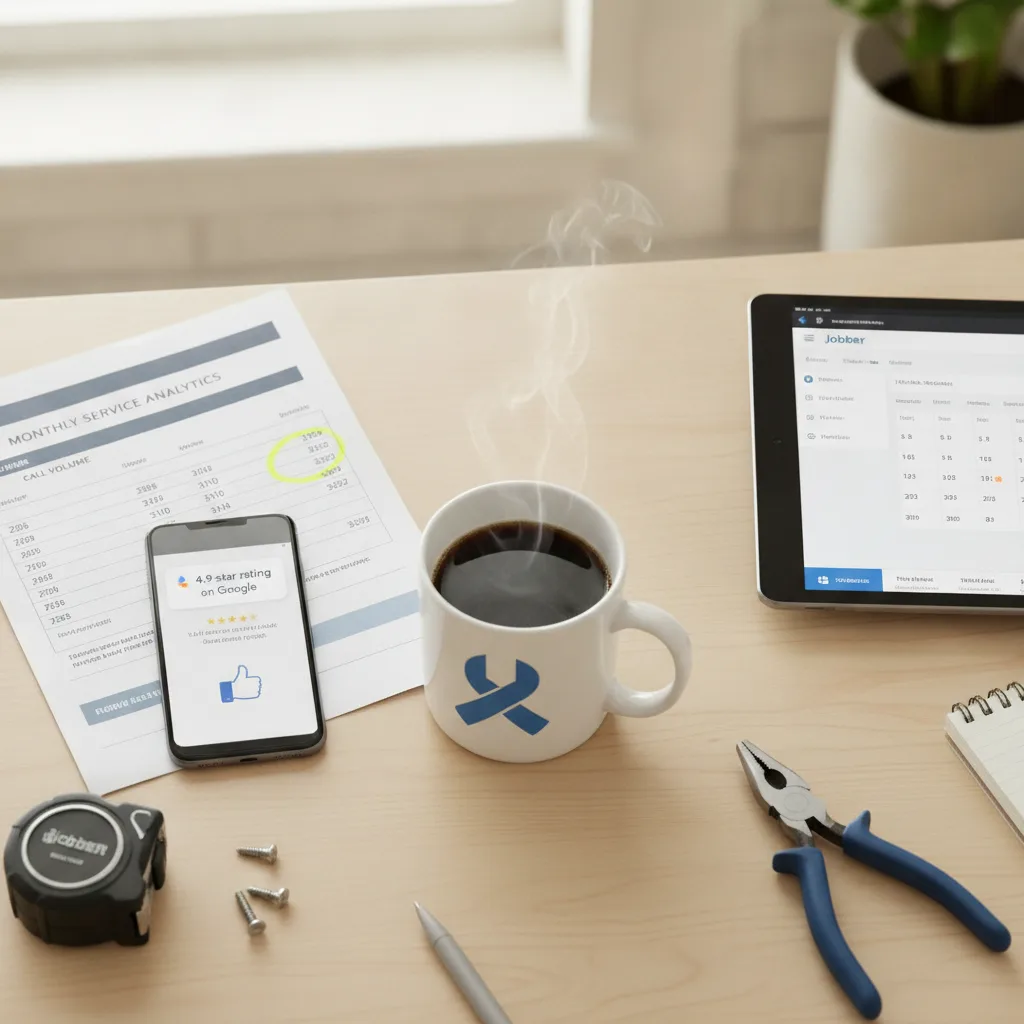
Dozens of $99–$199/month AI platforms targeting plumbing companies are CRMs with a chatbot bolted on. They generate social media captions, send drip emails to cold lists, and produce AI-written blog posts — none of which address the $125,000 missed-call problem or the 27% unanswered call rate that is the real revenue leak for most plumbing shops. Fully automated AI estimating for complex jobs — repipes, full water heater system replacements, sewer line work — also fails in practice. AI platforms don't have access to your local material costs, permit requirements, or job history from past similar properties. Use AI to answer phones, book jobs, and build reviews. Keep a licensed plumber, including a master plumber when code references and permits are involved, in the estimate conversation.
The plumbing companies getting cited by ChatGPT and Perplexity in 2026 are not the ones with the best websites. They're the ones with 230-plus reviews, consistent directory listings across 17 or more platforms, and FAQ schema on every service page — built on a foundation of AI phone answering that captures emergency calls at 2 AM when competitors go to voicemail. Fix the phone first. Build the review engine second. Optimize your Google Ads with real revenue data third. Then lock in your AEO and GEO citation profile. That sequence — not the tool count — is what separates the 13% of plumbing contractors already winning with AI marketing from the 87% still watching leads go to the next plumber who picked up.
Frequently Asked Questions
Ready to get started? Contact Geek Powered Studios today.