
Facebook ads for chiropractic marketing work when you measure cost per booked patient, not cost per like or cost per click. The correct campaign setup uses the Leads objective with native Meta instant forms, a 1% lookalike audience built from 200-plus patient emails, and an automated SMS that fires within 60 seconds of every form submission. As of 2026, chiropractic Facebook lead ads produce a CPL of $12-$25 and a cost per booked appointment of $30-$70. Pair Facebook with Google Ads and an optimized Google Business Profile, and the total cost per new patient drops to $90-$150 for most solo practices. Setup takes 3-5 hours; expect 4-6 weeks before CPL data stabilizes.
-
$12–$25CPL target using Facebook lead form ads — not landing pages
-
60 secondsMaximum time from form submission to first automated SMS reply
-
25–40%CPL reduction when 1% lookalike replaces interest-based targeting
-
$90–$150Target cost per new patient who showed and paid — the only metric that matters
-
4–6 weeksRamp window before campaign CPL data is stable enough to act on
-
8–15%Lapsed patient reactivation conversion rate — near-zero ad cost
Facebook ads for chiropractic marketing can fill a schedule or drain a budget, and the difference comes down to one number: cost per booked patient. As of 2026, chiropractic Facebook lead ads produce a CPL of $12–$25 and a cost per booked appointment of $30–$70. But many practices running ads today are measuring reach, likes, and clicks while their actual cost per new patient sits above $200 — invisible, because nobody built the funnel tracker. This guide walks through the exact seven-step system: audit your current ad spend, set up Facebook lead ads correctly, build lookalike audiences, fix follow-up, layer Google Ads and local SEO, activate lapsed patients and referral programs, and set a budget that gives the algorithm enough data to optimize. Total setup time is 3–5 hours. Expect 4–6 weeks before cost-per-lead data is stable enough to make budget decisions.
Before you start
- An active Meta Business Suite account with a verified Facebook Page for your chiropractic clinic — not just a personal profile
- Access to Meta Ads Manager directly, not the Boost button on your Page (Boost hides campaign objectives and conversion data)
- A patient email list of at least 200 contacts for lookalike audience creation
- A follow-up tool that supports automated SMS — Podium ($399–$599/month) or GoHighLevel ($97–$297/month) both integrate natively with Meta Lead Ads
- A Google Business Profile claimed and verified for your practice location
- A conversion ceiling defined before you launch: cost per new patient of $90–$150 is the working target for most solo chiropractic practices with a care plan value of $800–$2,500
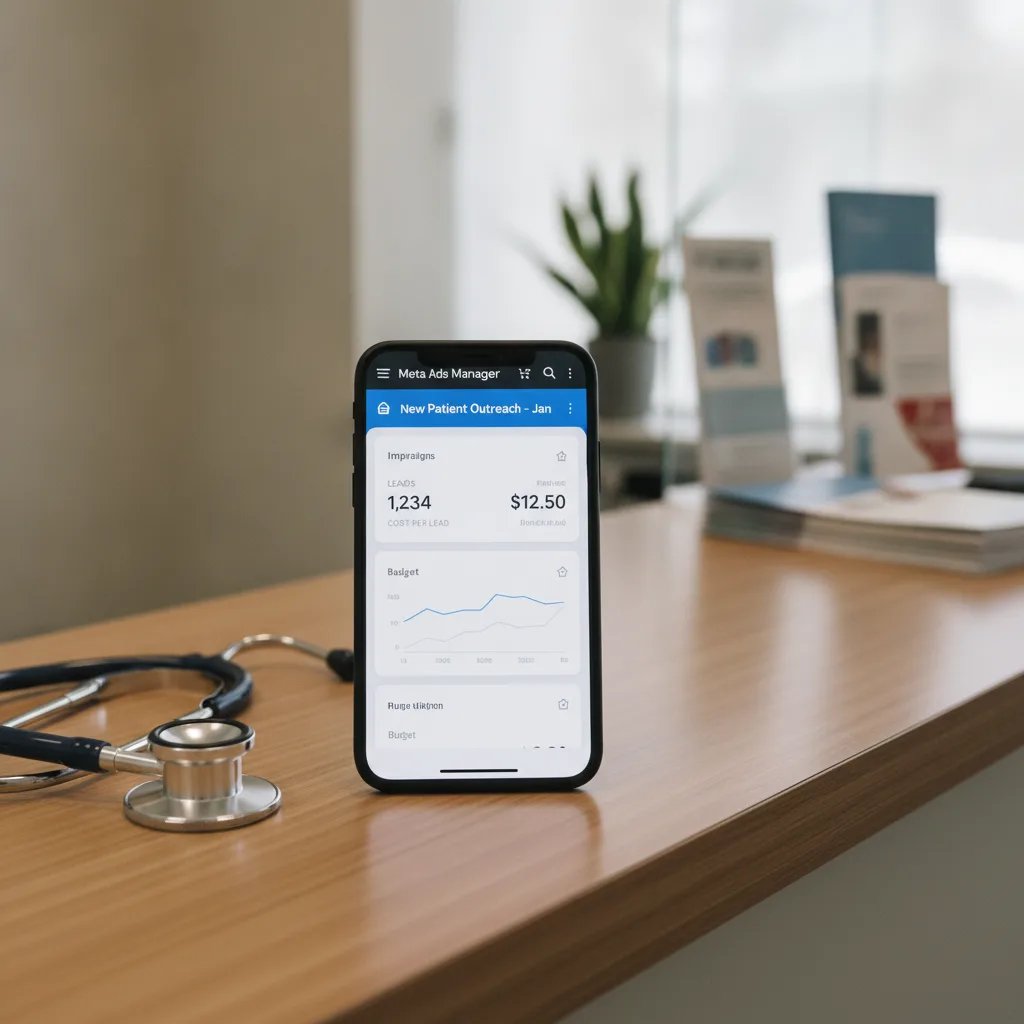
Audit Your Facebook Ad Spend Against Cost Per Booked Patient
Cost per booked patient — not cost per click, not cost per lead, not reach — is the only metric that tells you whether your Facebook ads for chiropractic marketing are working. Pull the last 90 days of campaign data from Ads Manager and build a simple chain: total ad spend divided by total booked appointments. If that number exceeds $150 for a solo practice, the campaign has a structural problem, not a budget problem.
The math breaks down at three points for most chiropractic clinics. First, a $12 CPL sounds excellent until you apply realistic conversion rates: if one in eight leads books and half of those show, your cost per new patient is $192 — above the $90–$150 acquisition ceiling that most practices can sustain. Second, practices running the Traffic campaign objective report spending $1,500 with zero booked appointments, because Traffic sends visitors to a website and calls it a conversion. Third, boosted posts generate likes and comments, not scheduled appointments. Boosted posts are not ad campaigns. Pull them out of your patient acquisition math entirely.
Before touching creative or targeting, confirm which campaign objective your active campaigns use. The correct choice for new patient acquisition is Leads (for Facebook lead form ads) or Conversions (for landing page funnels). If Ads Manager shows Traffic or Engagement as the objective on any campaign meant to generate new patients, pause it today. Ads Manager does not show cost per lead or cost per appointment in its default reporting columns — customize your columns before you start reading the data, or you will be making budget decisions on impressions.
Meta Ads Manager
Free
The only place to audit campaign objectives, CPL, and conversion data — the Boost button on your Page hides all of this.
Google Sheets or Airtable
Free / $20 per month
Build a running funnel tracker: ad spend, leads, booked appointments, shows, new patients, and cost per new patient — all in one view.
Gotcha
Meta's default reporting columns do not show cost per lead or cost per appointment. Customize columns in Ads Manager before reading any data, or you will be making budget decisions on reach and impressions — the metrics that feel good but don't pay the front desk.
Set Up Facebook Lead Ads as Your Cold Traffic Engine
Facebook lead ads — Meta's native instant forms — produce 2–3x more leads than landing page traffic for chiropractic offers, with a CPL of $12–$25 versus $25–$50 for external landing pages. The reason is friction: native forms pre-fill name, phone, and email from the user's Facebook profile, so prospective patients submit in under 10 seconds without leaving the app. Cost per booked appointment through lead forms runs $30–$70, compared to $50–$90 through landing pages.
Create the campaign in Ads Manager under the Leads objective. At the ad set level, set your geographic radius to 10–15 miles around the clinic — tighter in dense urban markets, wider in suburban or rural Texas markets where the nearest competitor is farther out. For the instant form itself, keep it to three fields: name, phone number, and one qualifying question such as 'What is your primary concern?' with options like back pain, neck pain, headaches, or sports injury. Adding a fourth field drops completion rates by 15–20%.
The specific offer attached to the form determines lead quality more than any targeting setting. Free consultations attract browsers; a specific offer like 'New Patient Exam plus X-Ray for $49' attracts people with real intent to pay for chiropractic care. Run one offer per campaign so you can read the data cleanly. Do not run discount-only cold offers with no educational framing — Meta's algorithm deprioritizes low-engagement ads, and stock-photo discount ads draw the wrong audience while risking ad policy flags. Write ad copy around pain relief and education, not treatment outcomes: 'We help patients dealing with chronic back pain' clears policy; 'We cure herniated discs' does not.
Meta Ads Manager (Leads Objective)
Free to use; ad spend is the cost
The Leads objective unlocks Facebook's native instant forms and tells the algorithm to optimize for form submissions, not clicks.
GoHighLevel
$97–$297 per month
Connects directly to Meta Lead Ads via native integration and fires an automated SMS to the lead within 60 seconds of form submission — the single biggest lever on lead-to-booked conversion rate.
Policy Warning
Facebook's healthcare advertising policies flag any ad copy claiming to cure specific conditions or showing dramatic before-and-after images. Ad accounts restricted for policy violations lose all historical audience data and campaign optimization history. Write ad copy around education and relief, not treatment outcomes.
Build a 1% Lookalike Audience From Your Patient List to Cut CPL by 25–40%
A 1% lookalike audience built from a chiropractic practice's existing patient list outperforms interest-based targeting by 25–40% on cost per lead. Upload a minimum of 200–300 patient emails to Meta Custom Audiences. Meta matches those contacts to Facebook profiles and builds a lookalike of the 1% of your local population who most closely resemble your actual patients — by behavior, demographics, and interests — without requiring you to guess which interest categories to layer.
Interest-based targeting for chiropractors — targeting people interested in back pain or fitness and wellness — is the default because it feels logical. It also produces the highest CPLs, because the audience is enormous, generic, and full of people who click on health content but never book appointments. Use interest targeting only during the first two weeks of a new campaign when you don't yet have enough pixel or form data to fuel a lookalike. Once you have 200 form submissions, switch the ad set to the 1% lookalike and expect CPL to drop within 7–10 days.
Retargeting is the third audience layer. Create a custom audience of anyone who visited your website in the last 30 days or engaged with your Facebook Page in the last 60 days, and serve them a patient testimonial video ad. Warm leads who have already seen your brand convert at far lower cost than cold traffic. Keep retargeting ad sets at $5–$10 per day — you don't need volume, you need frequency with the right people.
Meta Custom Audiences
Free (included in Meta Ads Manager)
Creates the customer list custom audience from your patient email export — the seed file for your lookalike.
Meta Pixel
Free
Tracks website visitors for retargeting audiences and feeds conversion data back to the Leads or Conversions campaign objective.
Fix Your Follow-Up System Before Spending Another Dollar on Ads
Lead-to-booked conversion on Facebook chiropractic campaigns runs 32–55%, and that range depends 90% on follow-up speed. Practices without an automated SMS sequence consistently sit at 32% or below. The math is direct: a campaign delivering leads at $15 CPL produces a $93 cost per booked appointment at 55% conversion, but $46 at 55% conversion versus $93 at 32%. The creative and the targeting did not change. The follow-up system did.
Set up a three-touch automated sequence the moment a lead submits a form. Touch one: an SMS fires within 60 seconds — 'Hi [First Name], this is [Practice Name]. We got your request for [Offer]. Reply YES to confirm your spot or call us at [Number].' Touch two: a follow-up SMS at 2 hours if no reply. Touch three: a phone call from a front-desk staff member at 24 hours. Practices that call within 5 minutes of a lead submitting convert at nearly double the rate of those that call the next business day. Podium and GoHighLevel both automate touches one and two natively; the 24-hour call is a human task.
Appointment show rates for chiropractic Facebook leads run 62–78% with proper confirmation automation. A show rate below 60% signals that the confirmation workflow is broken. Add a 24-hour-before reminder SMS and a 2-hour-before reminder. Both should include the clinic address, accurate business hours, and a one-tap cancel-or-reschedule link. A no-show who reschedules is not a lost patient.
Podium
$399–$599 per month
Automates the first SMS reply to Facebook lead form submissions and manages two-way text conversations from a single inbox shared by the front desk team.
GoHighLevel
$97–$297 per month
Full CRM plus automated SMS and email sequences with native Meta Lead Ads integration — fires the first text in under 60 seconds without any manual steps.
Rule of Thumb
If your lead-to-booked rate is below 40%, fix the follow-up before increasing ad spend. Doubling the budget on a broken follow-up system doubles the wasted spend, not the booked appointments.
Layer Google Ads and Local SEO on Top of Facebook for High-Intent Search Traffic
Facebook ads generate demand; Google Ads and local SEO capture demand that already exists. A prospective patient who has seen your chiropractic brand on Facebook 5–10 times before typing 'chiropractor near me' into Google converts at 2–3x the rate of a cold searcher. That makes Facebook a brand-warming channel that actively lowers your Google Ads cost per lead over 3–6 months. Run both together. Do not treat them as competing budgets.
The recommended budget split for most chiropractic practices is 70–80% Google Ads and 20–30% Facebook. For a practice spending $2,000 per month on paid ads, that means $1,400–$1,600 on Google and $400–$600 on Facebook. Google Ads CPL for chiropractors runs $25–$75 — higher than Facebook's $15–$45, but the intent is far stronger: someone typing 'back pain chiropractor Austin' is ready to book today. Google Local Services Ads offer a pay-per-lead model at $20–$80 per lead with a Google Verified badge that appears above standard search results, making LSAs the first Google product to activate for most chiropractic clinics.
Local SEO feeds the same high-intent search traffic at zero per-click cost. An optimized Google Business Profile with consistent 5-star online reviews, accurate business hours, and weekly photo posts pushes your clinic into the local map pack — the three listings that capture the majority of 'chiropractor near me' clicks. Practices in the top 3 of the local map pack see 44% more clicks than those ranked 4th or below. Post to your Google Business Profile at least once per week, seed the Q&A section with the five questions patients ask most often, and send every new patient a direct link to your Google review page via post-visit SMS. A simple system like this builds the review volume that search engines use to rank local businesses.
Google Local Services Ads
$20–$80 per lead (pay-per-lead)
Appears above all Google search results with a Verified badge and charges only for actual leads — the most cost-predictable Google Ads product for chiropractors.
Google Business Profile
Free
The primary driver of local map pack rankings — properly optimized, it generates new patient calls at zero incremental ad cost.
CallRail
$45–$145 per month
Tracks which campaigns — Google Ads, LSAs, Facebook, or organic search — are generating phone calls, so budget allocations rest on actual cost per call rather than impressions.
Activate Lapsed Patients, Local Gyms, Local Sports Teams, and Referral Programs as Near-Zero-Cost Content Engines
Reactivation campaigns targeting chiropractic patients who haven't been seen in 6–18 months convert at 8–15% — at near-zero ad cost compared to cold prospecting. Pull a list of lapsed patients from your practice management software, upload it to GoHighLevel or Podium, and send a personalized SMS: 'Hi [First Name], Dr. [Name] wanted to check in — we haven't seen you in a while. We're offering existing patients a free reassessment this month. Want to grab a time?' Personalized automated outreach pushes reactivation rates up to 35%. This is the highest-ROI campaign most chiropractic practices never run.
Local gyms and local sports teams are your best source of authentic video creative — the format that drives sub-$25 CPLs on Facebook in 2026. Partner with two or three gyms within your 10-mile radius to host free back pain workshops or injury-prevention seminars. Film the event with a smartphone. Post the footage to Facebook and Instagram. That 90-second clip of a real doctor at a real local gym, talking to real community members about common conditions like headaches and back pain, outperforms any stock-photo static ad at a fraction of the production cost. Sponsor a local youth sports team and show up at games with a pop-up assessment station. The content pays for itself three times over as Facebook ad creative, social media posts, and Google Business Profile photos.
A structured patient referral program generates 30–50% more word-of-mouth referrals than relying on organic word-of-mouth alone. The simplest version: give every happy patient two Friend Cards after their third visit, each offering the referred friend a free initial consultation. Track referrals in your CRM and send the referring patient a thank-you text with a small incentive — a free massage add-on or account credit — when their referral books. Post the referral offer to Facebook once per month as an organic post, not a paid ad. It functions as social proof and generates warm leads from existing patients' networks at zero CPL.
Shortcut
Film three 60–90 second videos at your next gym workshop event: one patient testimonial, one clinician explaining a common condition like neck pain or headaches, and one behind-the-scenes walkthrough of the clinic. These three clips can fuel 90 days of Facebook ad creative and cost nothing but the time to hit Record.
Set Your Facebook Ad Budget, Launch the Campaign, and Track Five Numbers Every Week
New Facebook ad budgets below $1,500 at the campaign level rarely produce enough conversion data for Meta's algorithm to optimize, and CPLs in the first two weeks of any new chiropractic campaign run 30–50% above the eventual steady-state target. For most solo or small chiropractic practices, the working budget range is $700–$1,800 per month on Facebook alone. A $500–$750 monthly Facebook budget generates roughly 30,000–40,000 impressions in a mid-sized Texas market — enough for brand familiarity, but not enough conversion volume to exit the learning phase at scale.
Set a 4–6 week ramp window before judging performance. The algorithm needs 50 conversion events per ad set per week to stabilize delivery. During weeks 1–2, review CPL daily but make no structural changes. During weeks 3–4, focus on lead-to-booked conversion rate. By week 6, you should have a reliable cost per booked patient and enough data to compare it against your $90–$150 acquisition ceiling. Growth-stage chiropractic practices running Facebook alongside Google Ads should plan $4,000–$8,000 per month total.
Track five numbers every Monday: total ad spend for the prior week, number of leads generated, number of leads who booked an appointment, number who showed, and cost per new patient who showed and paid. If cost per new patient is above $150 for three consecutive weeks after the ramp period, the problem is one of four things: wrong campaign objective, weak offer, broken follow-up automation, or targeting an audience too broad to be relevant. Fix them in that order. Content marketing — educational videos, patient stories, and clinic updates posted organically to social media — runs alongside paid ads to build the social proof that lowers CPL over time without increasing ad spend.
Meta Ads Manager (Campaign Budget Optimization)
Free to use
CBO distributes budget across ad sets automatically toward the best-performing audiences, reducing manual optimization time during the ramp period.
CallRail
$45–$145 per month
Closes the attribution loop between Facebook ad clicks, phone calls, and booked appointments — critical when ideal patients see the Facebook ad and then call the clinic directly instead of submitting the form.
Digital Marketing Budget Benchmark (2026)
Solo chiropractic clinic: $700–$1,800/month Facebook plus $1,200–$2,500/month Google Ads. Multi-provider or growth-stage clinic: $2,000–$4,000/month Facebook plus $4,000–$6,000/month Google Ads. These ranges assume a $90–$150 cost-per-new-patient target and a new patient lifetime value of $1,500–$5,000.

Don't Scale Facebook Ad Spend Until These Three Systems Are Running
Increasing ad spend on a broken system accelerates the losses — it does not fix them. Before raising your monthly Facebook budget above $1,000, confirm all three of the following: (1) Your campaign objective is set to Leads or Conversions — not Traffic, not Engagement, not Reach. (2) An automated SMS fires to every new lead within 60 seconds of form submission, 24 hours a day, 7 days a week. (3) You are tracking cost per booked patient who showed and paid — not cost per lead, not cost per click. If any of these three are missing, fix them first. The creative, the targeting, and the budget all matter less than the foundation they run on.
Facebook ads for chiropractic marketing are not a standalone patient-generation machine. They are the brand-warming layer that makes every other channel cheaper over time. Prospective patients who see your clinic on Facebook 5–10 times before searching on Google convert at 2–3x the rate of cold searchers. Lapsed patients who receive a reactivation SMS come back at 8–15% with near-zero acquisition cost. Happy patients with a referral program send friends and family who arrive pre-sold. The chiropractic businesses that fill their schedules in 2026 are not running the best Facebook ads in isolation — they are running a coordinated four-channel system where Facebook lead ads, Google Ads, local SEO, and patient referral programs all reinforce each other. Build the system, track the right five numbers every week, and the cost per new patient takes care of itself.
Frequently Asked Questions
Ready to get started? Contact Geek Powered Studios today.