
A foundation repair website that converts below 2% on organic traffic is actively destroying the Google Ads budget paying to feed it. The fix is not more traffic — it is five measurable proof points installed on every service page: a warranty badge (47% conversion lift in A/B testing), PE engineering credentials, before/after photo galleries, a monthly payment financing widget, and a mobile page speed score above 80. A purpose-built site converts at 2–3x the rate of a generic template on identical traffic. For foundation repair contractors spending $3,000–$6,000 per month on paid advertising, closing that gap produces more signed jobs without increasing advertising spend by a single dollar.
-
Below 2%Conversion rate that signals a trust problem, not a traffic problem
-
47% liftConversion gain from adding a warranty badge near the CTA
-
2–3xMore leads from a purpose-built site versus a template on identical traffic
-
20–40%Close rate lift when financing is shown as a monthly payment
-
94% more viewsContent engagement lift from adding before/after photos to service pages
-
80+Minimum mobile PageSpeed score for any page receiving paid ad traffic
-
391%Conversion lift from responding to a form fill within 60 seconds
-
$5,1762026 national average foundation repair cost — why trust signals matter
Foundation repair marketing companies that generate a steady flow of qualified leads share one thing: their websites function as skepticism-reduction machines, not brochures. A foundation repair website that converts below 2% on organic traffic is burning the Google Ads budget paying to feed it. The 2026 national average cost for foundation repair is $5,176, with Texas jobs landing between $3,300 and $9,000 — a price range that sends homeowners to your site already frightened and already skeptical. This 7-step audit installs five measurable proof points — warranty badge, PE engineering credentials, before/after galleries, financing widget, and mobile page speed — that convert that skepticism into booked inspections. Budget 3–5 hours with a developer for implementation; budget 60–90 days for the full post-launch CRO cycle to produce clean data.
Before you start
- Google Analytics 4 and Google Search Console connected to your existing foundation repair website — you need 90 days of session and conversion data before the audit is meaningful
- Access to your Google Ads or Local Services Ads account so you can compare paid traffic volume against actual form fills and qualified calls
- A PageSpeed Insights score already pulled for your homepage and primary foundation repair services pages — mobile score is the one that matters
- At least 10 completed job photos you own the rights to, ideally before-and-after pairs shot from the same angle and distance
- A GreenSky or Synchrony contractor dealer account, or a Wisetack application in progress — required before you can embed a live financing widget
- Your warranty documentation in writing, including transferable warranty language — Texas law requires warranties to be in writing and state all rights in clear language before you display them on the site
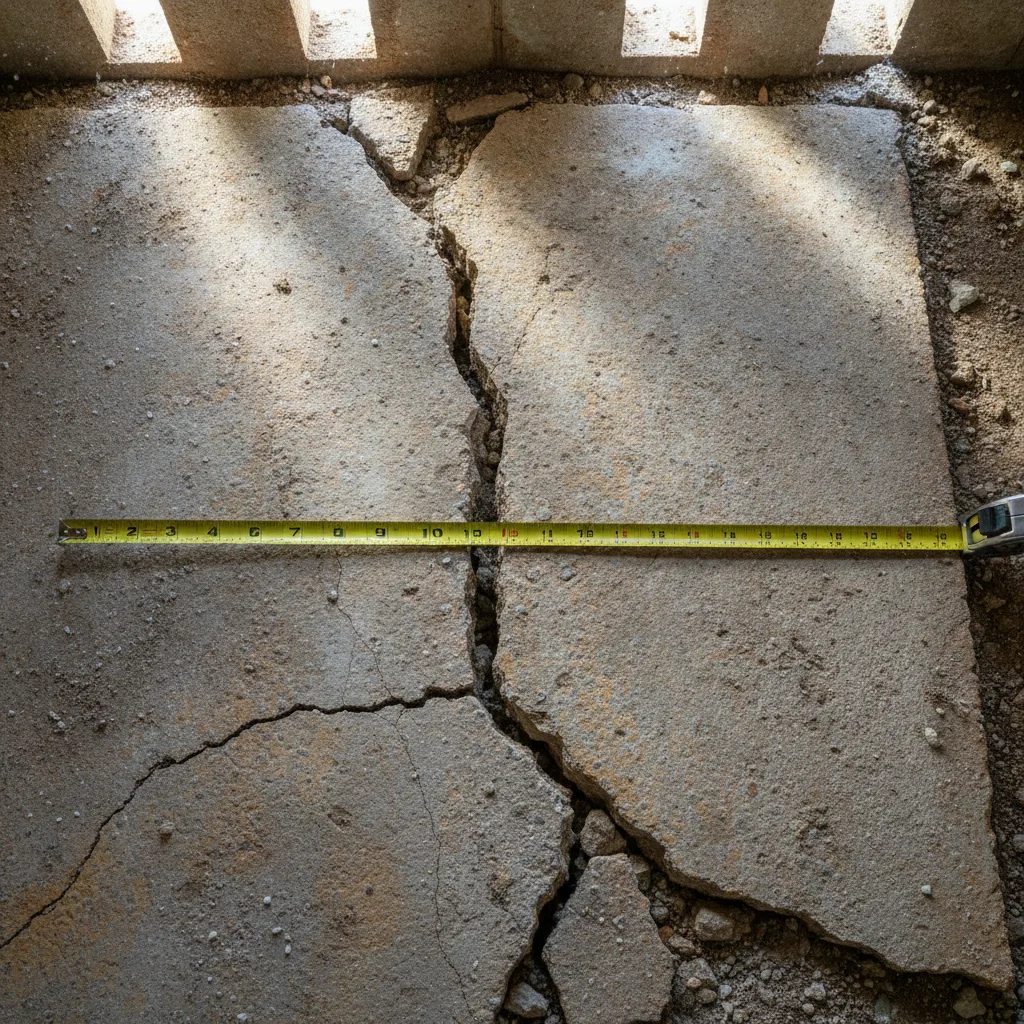
Audit Your Current Conversion Rate Before Touching Anything
A foundation repair website converting below 2% on organic traffic is actively destroying the Google Ads budget paying to feed it. The 2026 baseline: good contractor sites convert 3–5% on organic traffic; above 5% outperforms most competitors; outdated sites running on templates average 1–3%. Pull your GA4 conversion events for the last 90 days, divide total goal completions by sessions, and write that number down. If it is under 2%, every dollar of paid advertising — Google Ads, Local Services Ads, or shared lead platforms — is running through a leaking funnel.
Foundation repair costs average $5,176 nationally in 2026, with Texas jobs landing between $3,300 and $9,000 depending on scope and clay-soil severity. That price range explains exactly why homeowners search 'stair step crack in brick wall' at 9 PM and close the tab before calling. They are not shopping for a $50 part. They are considering a five-figure structural decision on a house they have lived in for years. Your website's job is not to explain what foundation repair is. Its job is to reduce the fear that makes a worried homeowner call a competitor instead of requesting your free inspection.
Before you change a single page element, document three numbers: your current conversion rate, your average cost-per-click from Google Ads, and your monthly paid traffic volume. A foundation repair company spending $4,000 per month on Google Ads at a $12 CPC gets roughly 333 clicks. At 1.5% conversion that is 5 leads. At 4% it is 13 leads from the same $4,000. The audit tells you whether you have a traffic problem or a trust problem. Most foundation repair businesses have a trust problem — and that is entirely fixable without increasing your advertising spend.
Google Analytics 4
Free
Pull session-to-conversion rate by channel so you can separate organic, paid, and direct traffic before making any changes.
Google PageSpeed Insights
Free
Mobile score under 50 is an emergency; 80+ is the minimum for any page receiving paid traffic — run this on every landing page your ad accounts send traffic to.
CallRail
$45/mo
Tracks which pages and campaigns generate phone calls versus form fills, including the 14% of calls that go unanswered and immediately move to the next Google result.
Benchmark Warning
If you are running Local Services Ads alongside Google Ads, pull conversion data for each channel separately in GA4. LSA leads are pre-qualified by Google's screened-contractor badge; organic and paid search leads are not. Mixing them inflates your apparent conversion rate and hides how badly a weak website underperforms on cold paid traffic — which is the traffic your foundation repair marketing budget is actually buying.
Set the Free Inspection as Your Only Primary CTA
The right primary conversion on a foundation repair website is a free inspection request — not a quote request and definitely not a generic 'Contact Us' form. A homeowner who just searched 'stair step crack in brick' is frightened, not ready to buy. Asking them to commit to a quote skips the psychological step they actually need: a low-pressure way to get answers. 'Schedule Your Free Inspection' removes that friction and matches the mental state of someone who suspects a serious problem but has not confirmed it. That CTA label change alone shifts the conversation from sales pressure to service.
Place the free inspection CTA in four locations: the header visible on every page above the fold, a mid-page section on each foundation repair services page, the footer, and a sticky mobile button that follows the user as they scroll. A sticky tap-to-call button on mobile pages lifts call volume 25–40% and requires roughly one hour of development time to implement. That is the highest-ROI hour a developer can spend on a foundation repair website. For foundation repair marketing to generate more qualified leads, the path from intent to contact has to be frictionless on a 5-inch screen at 8 PM.
Keep the inspection form to three fields maximum: name, phone number, and zip code. Every additional field cuts completion rates. The zip code does double duty — it lets your in house team pre-screen service area before the callback, which prevents scheduling inspections outside your coverage zone. For contractors running Google Ads to specific service area landing pages, the zip field also helps CallRail or your CRM tag leads by geography automatically, which feeds cleaner data back into your marketing plan.
Speed-to-Lead Warning
Responding to a website inquiry within 60 seconds lifts conversion by 391% versus a 5-minute delay, which cuts qualifying odds by 80% (as of 2026 CallRail data). Build the form so submissions trigger an immediate SMS to whoever handles scheduling — not a daily email digest. A homeowner who submits an inspection request at 7 PM and gets a call at 9 AM the next morning has already called two competitors and may have signed with one of them.
Display Your Warranty Badge Above the Fold on Every Foundation Repair Services Page
A warranty badge placed near the primary CTA converts at 8.7% versus 5.9% without one — a 47% lift from displaying a single guarantee sentence at the moment a visitor considers calling. That A/B test result, documented on a contractor landing page in March 2026, is the highest single-element conversion gain in foundation repair marketing research available as of September 2026. A transferable lifetime warranty separates a serious foundation repair company from a competitor quoting $2,000 less with nothing in writing.
Texas law requires foundation repair warranties to be in writing, state all rights in clear language, and — for extended warranties — be backed by a warranty trust fund so coverage is honored even if the contractor closes. Displaying the warranty terms on your website is not just a sales move. It is a legal-compliance signal that tells both potential customers and AI search engines like ChatGPT and Perplexity that your foundation repair company has the financial stability to honor long-term obligations. TrueSignal's August 2026 analysis confirms that AI systems specifically evaluate revenue stability for foundation repair contractors because warranty obligations extend years beyond installation — and AI checks whether the company will still be around to honor them.
The warranty display should include three elements: the badge or seal graphic in the hero section of each service page, a one-sentence plain-English summary of what is covered (example: 'Our piering work carries a transferable lifetime warranty — it moves with the house, not the homeowner'), and a link to the full written warranty PDF so skeptical buyers can read the actual terms. Homeowners thinking about resale value will share that PDF with a real estate attorney before closing. Make it easy to find, not buried in a footer link. Review generation through a tool like Podium pairs with the warranty badge to build a two-signal trust stack — guarantee plus social proof — on the same page.
Podium
$249/mo
Automates review generation post-inspection, pairing with the warranty badge to build a guarantee-plus-social-proof trust stack on every service page.
Transferable Warranty Note
If your warranty is not yet transferable, prioritize making it so before promoting it online. A warranty that ends with the original homeowner is a weak trust signal in a market where Texas home turnover averages 7–10 years. Real estate agents actively steer buyers toward homes with transferable structural warranties — that resale-value angle belongs in your warranty copy and makes the credential visible to an entirely different homeowner search intent.

Add PE-Stamped Engineering Credentials to Your About and Foundation Repair Services Pages
PE-stamped foundation repair plans are legally binding technical documents prepared by a licensed Professional Engineer — not contractor estimates — that certify the repair method is safe and code-compliant with load calculations attached. Displaying your PE affiliation or partnership on your website signals a category above unlicensed competitors who hand-write repair specs on a notepad. For a homeowner choosing between two quotes that are $1,500 apart, the PE credential often closes the gap. Most foundation repair businesses that work with a structural engineering firm on a per-job basis at $400–$900 per project can display this credential credibly without an in-house PE on staff.
The credential display should appear in two places: a 'Why Choose Us' section on the homepage with a photo of the engineer or the contractor standing next to stamped drawings, and a dedicated paragraph on each structural repair service page explaining what PE-stamped plans mean in plain language. Stark Foundations' June 2026 guidance suggests framing it this way: 'Our repair designs are reviewed and stamped by a licensed Professional Engineer, which means your repair is documented to code — something your mortgage lender, insurance provider, and future buyer can verify.' That framing answers the skeptical question a homeowner already has before they pick up the phone.
Foundation repair businesses that want AI search engines to recommend them should also list their PE affiliation in their Google Business Profile description and in any structured-data markup on the site. ChatGPT, Perplexity, and Google AI Overviews evaluate engineering credentials as a trust signal when recommending foundation repair contractors. A PE stamp signals both technical accountability and the financial stability needed to carry warranty obligations — and it is the credential that separates a foundation repair marketing agency's best-performing clients from those still competing on price alone. It is also one of the elements that makes foundation repair marketing different from general home service digital marketing, where engineering accountability is not a standard proof point.
If You Do Not Have a PE on Staff
Partner with a licensed structural engineering firm that reviews and stamps plans on a per-job basis at $400–$900 per project. Document that partnership on your website with the engineer's Texas PE license number. That is enough to display the credential credibly, satisfy AI search evaluation criteria, and differentiate your foundation repair company from competitors whose repair documentation is a one-page handwritten estimate.
Build Before/After Galleries Directly Into Each Foundation Repair Services Page
Content with images gets 94% more total views than content without, per Adobe data cited across multiple 2026 foundation repair marketing studies. Before/after photos placed on service pages — not buried in a separate gallery tab — are the single highest-impact visual element for a foundation repair website. A homeowner looking at a page about helical pier installation wants to see a sinking foundation corrected, not a stock photo of a smiling contractor. The visual proof of work is what makes foundation repair marketing effective at the awareness-to-consideration stage, when a frightened homeowner is still deciding whether to call anyone at all.
Shoot both photos from the same angle, same distance, same lighting conditions. Caption each pair with a three-part narrative: the problem (example: '3-inch differential settlement on a 1978 pier-and-beam home in Austin'), the method (example: 'six helical piers installed to 18-foot depth'), and the result (example: 'structure re-leveled to within 1/8 inch tolerance, transferable lifetime warranty issued'). That caption structure does three things: it gives search engines keyword-rich text for local SEO, it gives homeowners a recognizable scenario to match against their own house, and it gives AI systems a citable proof-of-work data point they can surface when a user asks which foundation repair company does helical pier work in a specific Texas city.
Prioritize photos for your three highest-revenue job types: piering and underpinning ($10,000–$40,000 range), basement wall and crawl space repair ($2,000–$12,000), and foundation crack repair ($250–$800 for injection). Also consider crawl space encapsulation and basement waterproofing jobs if your service area includes those. Each service page needs a minimum of three before/after pairs above the fold of the gallery section. '47 completed pier jobs with before/after documentation' is a more persuasive proof point than 'experienced foundation repair company' — specificity is the differentiator that makes foundation repair content marketing work where generic copy fails.
Placement Rule
Before/after galleries belong on the service page they document, not in a site-wide gallery tab. A homeowner on your 'Foundation Crack Repair' page should see crack injection before/afters within two scrolls. Sending them to a separate gallery breaks the trust-building sequence and costs you mobile users who will not navigate back — they will close the tab instead of submitting an inspection request.
Embed a Monthly Payment Widget Next to Every Project Estimate Range
Presenting financing as a monthly payment instead of a lump sum lifts close rates 20–40% on jobs over $5,000, and foundation repair costs average $5,176 nationally in 2026 with Texas jobs frequently clearing $9,000. The majority of your signed jobs clear the threshold where a payment widget changes buyer behavior. A homeowner who sees '$8,200 for pier installation' closes the tab. A homeowner who sees '$187/month for 48 months through GreenSky' calls to schedule the inspection. Displaying the monthly payment widget is one of the highest-ROI web development decisions in foundation repair marketing — and most contractors skip it entirely.
Major foundation repair contractors offer financing through GreenSky and Synchrony at fixed rates of 8.99–14.99% for 3–10 year terms, plus deferred-interest 0% promotional periods of 12–24 months. GreenSky's dealer fee runs 4–7% depending on the promotional program — factor that into your job costing before publishing a payment widget. Display the monthly payment figure next to the job cost range on every service page, and add a financing FAQ at the bottom of the page that addresses the deferred-interest trap: if the homeowner misses the 0% payoff deadline, retroactive interest at 26%+ applies. Disclosing that risk builds trust with potential customers; hiding it destroys it when they find out on their own — typically after they have already left a one-star review.
The payment widget does not need to be interactive on every page to generate more inspections. A static example produces the same 12–20% contact rate lift as a dynamic calculator. Build the dynamic version on your primary piering service page first, then replicate it statically across crawl space repair and other service pages. Wisetack is a third option worth evaluating for jobs under $10,000 — their approval rates are higher than GreenSky on applicants with thin credit, which matters in Texas markets where a homeowner may have strained finances after a major weather event. Wisetack's dealer fee of 3.9–7.9% per funded loan is also competitive. Both options integrate directly with ServiceTitan and Jobber via CRM integration, which keeps your sales process clean.
GreenSky Contractor Portal
4–7% dealer fee per funded loan
Pre-built apply widget embeds directly in a service page; fixed APR financing at 8.99–14.99% for 3–10 year terms with 0% promos available.
Wisetack
3.9–7.9% per funded loan
Higher approval rates than GreenSky on applicants with thin credit — useful for Texas markets where storm-damaged homeowners need foundation repair financing fast.
Fix Page Speed and Mobile Trust Signals to Stop Wasting Your Ad Spend
A site that loads in 5 seconds loses roughly 35% of potential leads compared to a 1-second load on identical traffic, and 53% of mobile users abandon a site that takes longer than 3 seconds to load. Google targets an LCP (Largest Contentful Paint) under 2.5 seconds for high-performing sites. Those are not theoretical numbers — they are the direct mechanism by which 30–60% of a foundation repair marketing budget gets wasted on websites that load slowly, hide the phone number, or skip mobile trust signals. A poor mobile experience cancels every proof point you built in steps 2 through 6 before the homeowner ever scrolls far enough to see them.
Run PageSpeed Insights on your homepage and your top three service pages — the pages you are actually spending money on through PPC advertising and paid ads. A mobile score under 50 is an emergency. The fastest fixes for foundation repair sites: compress all before/after photos to WebP format (cuts image payload 30–50%), eliminate render-blocking third-party scripts by loading chat widgets and review badges asynchronously, and move your phone number into the sticky header so it is visible on every page without scrolling. Google Business Profile optimization also feeds into local SEO and local rankings — NAP consistency between your GBP listing and your website header and footer is a local SEO ranking signal that costs nothing to fix but regularly gets missed by contractors and even some generalist marketing agencies handling their accounts.
The mobile trust-signal checklist for a foundation repair website has six items: sticky tap-to-call button visible on scroll, phone number in the header without scrolling, warranty badge visible on mobile without horizontal scroll or zoom, star rating and review count above the fold on the homepage ('200 five-star Google reviews' beats 'highly rated' because specificity is what reassures a skeptical homeowner), a financing teaser line on each service page, and a one-tap inspection request form that submits to your CRM. A homeowner searching 'foundation cracks Austin TX' on a phone at 8 PM will decide in under 10 seconds whether your site is trustworthy enough to call. All six signals need to load before that window closes. This is what good foundation repair marketing looks like at the infrastructure level — and it is what most agencies skip when they are managing foundation repair businesses as one account among dozens of unrelated home service clients.
Google PageSpeed Insights
Free
Measures LCP, FID, and CLS separately for mobile and desktop — run it on every page you are paying to send traffic to, not just the homepage.
Cloudflare
Free–$20/mo
CDN caching cuts TTFB (Time to First Byte) for foundation repair sites serving multiple Texas metro service areas from a single server.
Missed Call Recovery
14% of home service calls go unanswered as of 2026 CallRail data, and that caller moves to the next Google result immediately. Add an automated SMS response through a CRM like ServiceTitan or Jobber that fires within 60 seconds of a missed call: 'We missed your call — we will call you back within 15 minutes. To schedule your free inspection now, reply YES.' That one automation recovers a meaningful share of the inspection requests your site worked hard to generate and your team did not pick up.
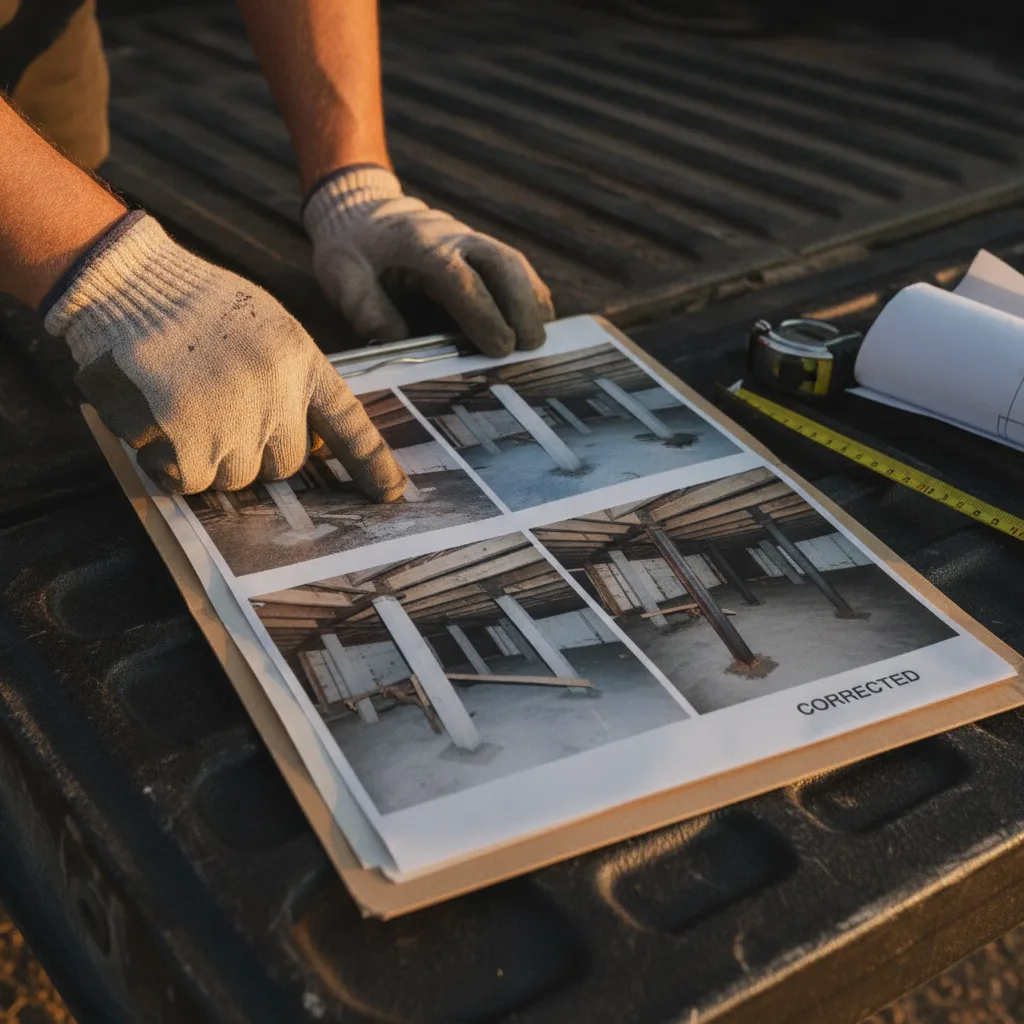
The Shared-Lead Trap That Cancels Every Proof Point You Just Built
Foundation repair marketing companies that rely on shared lead platforms — Angi, HomeAdvisor, Thumbtack — sell the same homeowner's information to three or four foundation repair contractors simultaneously. A homeowner in distress who gets calls from several companies within an hour defaults to two behaviors: they pick the cheapest quote, or they call back whoever reached them first. Every proof point on your website — the warranty badge, the PE credential, the before/after gallery — becomes irrelevant if a lead platform strips the homeowner's context before they ever land on your site. The solution is owning the channel: organic search, Local Services Ads with your Google Screened badge, a content marketing strategy built around search engine optimization, and a purpose-built site that converts 2–3x a template site on identical traffic. Exclusive leads cost more per unit and produce dramatically better close rates because the homeowner chose you specifically — not a form that resold their data to several companies at once. A good agency builds you a marketing system where the channel, the content, and the conversion layer work as one team, not three separate vendors pointing fingers when the pipeline slows down.
Geek Powered Studios builds foundation repair websites as skepticism-reduction machines, not brochures. The five proof points in this guide — warranty badge, PE credentials, before/after galleries, financing widget, and mobile page speed — each carry a measurable conversion number. A foundation repair marketing agency that truly understands foundation repair treats these as the baseline, not the advanced curriculum. What makes foundation repair marketing different from general home service digital marketing is the combination of high ticket prices, long decision cycles, and warranty obligations that extend years past the signed job — and that combination demands a specialist, not a generalist running your account alongside an HVAC company and a countertop installer. If your current marketing partner has not shown you a warranty A/B test result, a financing widget recommendation, or a PageSpeed mobile score for your ad landing pages, you are paying for generalist services on a specialist problem. The right marketing partner — whether that is Geek Powered Studios, Hook Agency, Foundational Marketing Hub, Treehouse Marketing, or another foundation repair marketing agency with a real case study to show you — starts with your conversion rate audit, not your ad budget. Run the numbers from Step 1. If the math is painful, that is the data you need to have a real conversation about what a purpose-built website is actually worth to your foundation repair business.
Frequently Asked Questions
Ready to get started? Contact Geek Powered Studios today.