
Most medical weight loss clinic websites convert organic and paid traffic at 1–3%. Well-optimized clinic websites convert at 5–8%. The gap comes from four structural failures: no pricing transparency, no physician credentialing above the fold, non-compliant intake forms, and no automated follow-up sequences. Fixing those four problems before increasing ad spend cuts effective patient acquisition cost from $900 per consultation to under $350. Each GLP-1 program patient represents $3,000–$8,000 in lifetime value over 12–24 months. The website is the highest-leverage revenue tool in your marketing stack. This 7-step audit takes 3–5 hours to complete and 2–6 weeks to fully implement.
-
1–3% vs. 5–8%Typical vs. optimized clinic conversion rate
-
$900 → $343Cost per consultation after lifting booking rate from 20% to 35%
-
8 secondsMobile credibility window before a visitor bounces
-
$800–$1,500/moGLP-1 program pricing range to publish on your website
-
35% liftConversion rate gain from automated follow-up sequences
-
8–25 reviews/moReview velocity needed to rank in competitive Map Pack markets
-
$40–$120Cost per qualified call via Google Local Service Ads
-
3–5 hoursTime to complete the full conversion baseline audit
The U.S. weight loss industry reached $90 billion in 2026, and the medical weight loss segment is growing at 25% per year — but most medical weight loss clinic websites are converting just 1–3% of the traffic they pay to acquire. Well-optimized clinic websites convert at 5–8%. That four-times gap is not a content problem or an ad budget problem. It is a structural website architecture problem, and fixing it before spending another dollar on ads is the only financially rational sequence. This guide walks through a 7-step audit tailored to medical practices running GLP-1 programs, supervised lifestyle plans, or both. The audit takes 3–5 hours to complete. Full implementation runs 2–6 weeks depending on whether you have an in-house developer or work with a marketing agency. The revenue math at the end of that timeline is compelling: a clinic generating 150 leads per month at $120 cost per lead that lifts its consultation booking rate from 20% to 35% cuts its effective patient acquisition cost from $900 to $343 per booked consultation — against a patient lifetime value of $3,000–$8,000.
Before you start
- Google Search Console access with at least 90 days of data for your clinic's domain
- Admin access to your website CMS (WordPress, Webflow, or similar) to make structural changes
- A HIPAA-compliant web form tool such as Jotform HIPAA, Formstack, or NexHealth — not a standard contact form plugin
- Google Analytics 4 with server-side conversion tracking configured (not a raw Meta Pixel or Google Ads tag firing on intake form pages)
- A documented list of your program tiers and price ranges ($100–$300/month for lifestyle programs; $800–$1,500/month for GLP-1 programs) ready to publish
- At least three patient testimonials cleared for use, with signed HIPAA-compliant release forms on file
Run a Conversion Baseline Audit Before Touching Anything
The average medical weight loss clinic website converts 1–3% of organic and paid visitors; well-optimized clinic websites convert at 5–8%. Before you change a single headline, you need to know exactly where you sit — because fixing the wrong problem first wastes both time and ad budget. Pull your last 90 days of data from Google Analytics 4: sessions by channel, goal completions (consultation requests), and the specific pages where users drop off.
Map the patient decision path your visitors actually take, not the one you designed. Use Microsoft Clarity (free) or Hotjar (from $39/month) to record mobile sessions. You will almost certainly find that 70% of your traffic hits the site on a smartphone, makes a credibility judgment in under eight seconds, and leaves before scrolling past the first screen. That eight-second window is the entire conversion problem framed visually — you can watch it happen in session recordings.
Document four numbers before you proceed: current session-to-lead conversion rate, cost per lead by channel (Google Ads typically runs $80–$300 per qualified consultation request; Local Service Ads run $40–$120 per call), average monthly lead volume, and patient lifetime value (plan on $3,000–$8,000 over 12–24 months for GLP-1 program patients). These four numbers let you calculate what each percentage point of conversion improvement is worth in real revenue — and justify every fix in this guide to your partners or your own P&L.
Microsoft Clarity
Free
Session recordings and heatmaps reveal exactly where mobile visitors abandon your site before booking
Hotjar
From $39/month
Funnel analysis and on-site survey popups identify the specific objection that kills conversions at each step
Google Analytics 4
Free
Channel-level conversion data and user flow reports give you the baseline numbers every subsequent fix must beat
Before you proceed
If your GA4 conversion events are firing via a standard Google Ads tag or Meta Pixel placed directly on an intake form confirmation page, stop. Post-2022 OCR guidance treats that configuration as a potential PHI exposure. Switch to server-side conversion tracking with PII filtering before running another paid campaign — the regulatory risk outweighs any attribution benefit.
Fix the Above-the-Fold Trust Architecture for Medical Weight Loss Marketing
75% of people judge a business's credibility based on its website design, and in healthcare that judgment locks in within the first screen load on mobile. Your above-the-fold section needs to answer three questions before the visitor scrolls: Who is the physician supervising this program? What specific outcomes does the program deliver? How do I take the next step right now? If any of those three answers require scrolling, you are losing patients to competitors who answered them faster.
Surface the medical director's name, board certification (American Board of Obesity Medicine is the gold standard for this category), and a professional headshot above the fold — not in a buried 'Meet the Team' section. This single structural change addresses the core trust deficit driving weight loss patient skepticism. Patients who have tried and failed at multiple weight loss solutions are specifically looking for evidence that a physician, not a wellness coordinator, is running the clinical protocol. Your website design must make that evidence impossible to miss.
Place a single primary CTA button above the fold with friction-removing language: 'Book a Free 15-Minute Consult' outperforms 'Contact Us' by a measurable margin in A/B tests across medical practice categories. Pair it with a secondary text link — 'See Our Program Pricing' — that routes to your pricing section. Both paths serve different stages of the patient decision cycle, and both should be visible on mobile without pinching or zooming. A user-friendly layout at this level is not optional; it is the minimum viable website design for a clinic competing in 2026's digital space.
Compliance note
As of 2026, compliant medical weight loss marketing avoids brand-name GLP-1 product references (no 'Ozempic' or 'Wegovy' in headlines) and focuses on clinical outcomes with appropriate medical supervision disclosures. Have a healthcare attorney review your above-the-fold copy before deploying paid traffic to it — ad platforms police this category aggressively and a disapproved account can cost you 7–14 days of lead flow.
Publish Program Pricing to Kill the Abandonment Problem
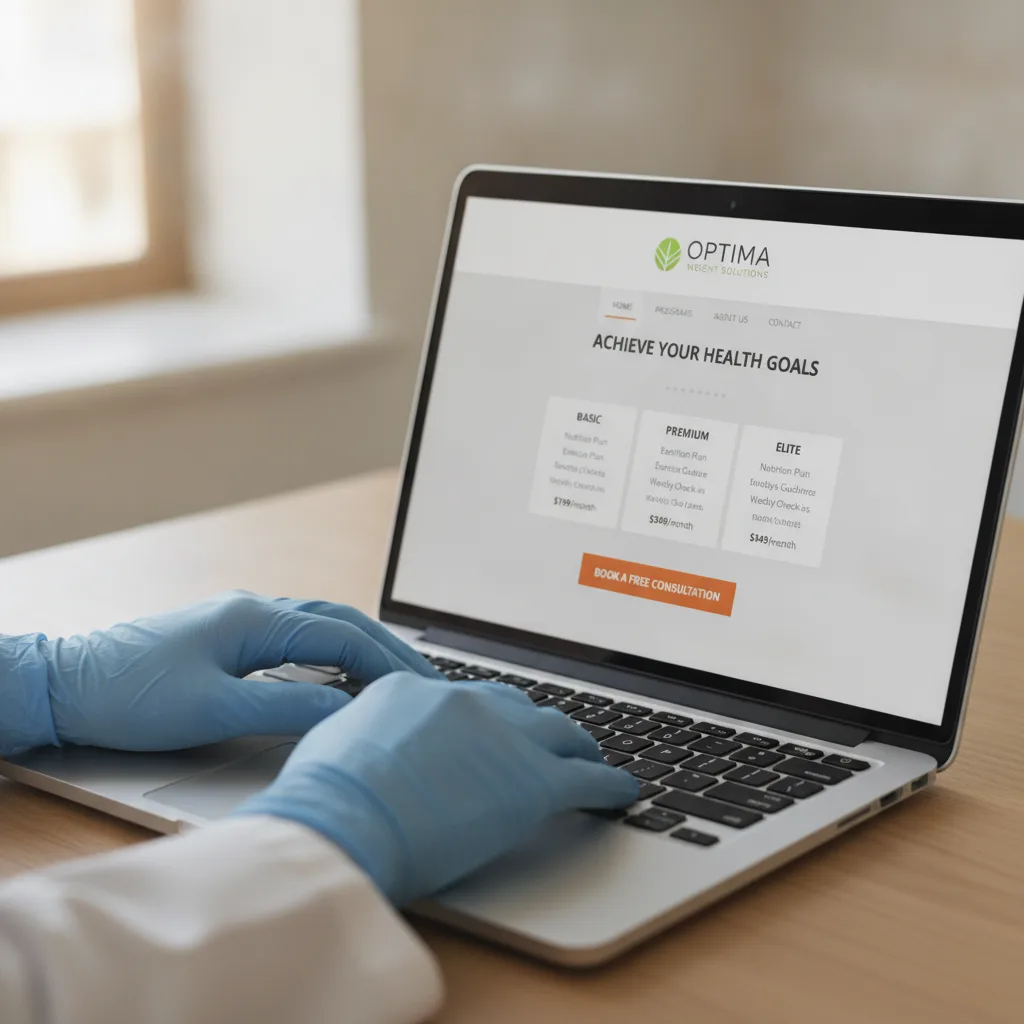
Pricing ambiguity is the most common reason prospective patients abandon a weight loss clinic website without converting — and publishing at least a pricing tier range is the single highest-leverage fix most clinics are not making. The data from dental practice conversion rate optimization is instructive: one practice saw a 28% increase in appointment bookings after adding a simple pricing table to its most popular service pages. The principle transfers directly to medical weight loss marketing. Potential patients searching for professional medical weight loss services will not book appointments if they cannot determine cost on their own terms.
Publish two clear tiers: lifestyle and monitoring programs at $100–$300/month, and GLP-1 programs (semaglutide or tirzepatide with medical supervision and support) at $800–$1,500/month. Note that medication accounts for 60–70% of the monthly cost, with the remainder covering clinical supervision and check-ins. This framing sets accurate expectations, filters out patients who cannot afford the program before they book a consultation, and signals the honesty that builds the patient trust motivating action.
Add a one-paragraph 'Why We Publish Our Pricing' explanation directly below the pricing table. Patients who have been burned by vague 'call for pricing' weight loss clinics will read this paragraph and convert at higher rates because the transparency itself is a differentiator. Frame it around clinical honesty, not marketing — something like: 'We believe you deserve to know what professional medical weight loss costs before you pick up the phone.' That single paragraph does more trust-building work than a page of success stories for the skeptical patient segment, and it positions your clinic as a trusted authority in weight management without a single marketing platitude.
SeedProd or Elementor (WordPress)
From $49/year
Build a clean, mobile-responsive pricing table without a developer in under two hours

Build an FTC-Compliant Before-and-After Gallery and Patient Education Hub
Before-and-after galleries with proper FTC-compliant framing convert visitors at 2–3x the rate of medical weight loss clinics without them — but the implementation details matter as much as the content itself. Every result must carry a typicality disclosure ('Results not typical. Individual outcomes vary based on program adherence, starting weight, and medical history.') and a timeframe label ('12-week result'). Skip the disclaimer and you expose the clinic to FTC enforcement; implement it as a mouse-hover tooltip and it will not satisfy regulators. These success stories are powerful, but only when the legal architecture around them is solid.
Structure your patient education hub around the specific questions your target patients are actually searching for in search engines: 'How does semaglutide work for weight loss?', 'Is medical weight loss covered by insurance?', 'What is the difference between GLP-1 programs and medically supervised diets?', and 'What happens if I stop taking GLP-1 medication?' Write each answer in a question-and-answer format with FAQ schema markup. This structure feeds AI-generated search results on ChatGPT, Perplexity, and Google AI Overviews — and as of 2026, one-third of patients trust AI-generated search results as much as traditional search results. Informative blog posts structured this way also generate more organic traffic from high-intent queries than generic service pages.
A patient education section handles the emotional architecture that weight loss patients require before they book. They need to see evidence that your clinic understands failed diet attempts, takes weight stigma seriously, and treats weight management as a metabolic health issue rather than a willpower failure. Three to five informative blog posts on these specific topics — each 800–1,200 words with FAQ schema — create that credibility layer while generating organic traffic and helping educate patients who are still in the research phase. This content marketing investment is also a powerful way to increase brand awareness in your local market without paid advertising.
Rank Math Pro (WordPress)
$59/year
Adds FAQ schema and MedicalClinic schema markup without custom code, helping search engines and AI models surface your Q&A content in featured results
Yoast SEO Premium
$99/year
Schema breadcrumbs and structured data tools for clinics that need physician and medical organization markup alongside FAQ schema
Content creation shortcut
Your medical director's verbal answers during a recorded 30-minute interview can generate 8–12 FAQ-format content blocks after editing. This approach produces more authentic, engaging content than AI-generated drafts and creates video assets simultaneously — one patient testimonial video drives 10x more engagement than a standard static ad.
Build Local SEO and High-Intent Search Landing Pages for GLP-1 Programs
A well-optimized local landing page titled 'Medical Weight Loss with Semaglutide in [City]' generates 30–80 monthly organic inquiries in markets where competition for this specific page type remains moderate — and most markets outside the top 10 metros are still moderate. Build one dedicated page per service area, not one generic page for all locations. The page needs a distinct H1 with the city name, a Google Business Profile citation consistent with your NAP data, embedded Google Maps, and local schema markup. Search engine optimization for location-specific pages is one of the most cost-efficient ways for weight loss clinics to drive more organic traffic and patient inquiries without ongoing ad spend.
Local SEO for medical weight loss clinics requires a deliberate review velocity strategy alongside the on-page work. Earning 8–25 new Google reviews per month via a systematic post-visit request process — SMS via a tool like Podium or NiceJob, sent within two hours of the appointment — is the benchmark for competitive Map Pack rankings in major Texas metros. A clinic with 200 reviews at 4.7 stars beats a competitor with 40 reviews regardless of how good the on-page optimization is. More than half of patients read at least six reviews before booking a healthcare appointment. Reputation management is not a soft tactic; it is a measurable lead generation lever.
Meticulous keyword research for medical weight loss marketing separates clinics that rank from those that spend. Target three-word and four-word intent phrases: 'medical weight loss clinic [city],' 'GLP-1 weight loss program near me,' 'semaglutide weight loss [city] cost,' and 'board certified obesity medicine [city].' Search engine optimization for this category rewards specificity over volume — a page ranking number one for 'medical weight loss clinic Austin' generates more qualified leads than a page ranking number five for 'weight loss.' Work closely with your SEO team to map each high-intent search phrase to a dedicated landing page, and track organic traffic and patient inquiries separately from paid sources so you can measure sustainable growth from each channel.
BrightLocal
From $39/month
Tracks Google Business Profile ranking positions and citation consistency across directories for each clinic location
Podium
From $399/month
Automates post-visit SMS review requests and centralizes response management — the fastest method for building review velocity in competitive metro markets
Ahrefs
From $129/month
Keyword research and competitor gap analysis to find the specific high-intent search queries your local competitors have not yet targeted
Set Up HIPAA-Compliant Lead Capture and Automated Follow-Up Sequences for Booked Consultations
68% of patients say they prefer a provider with online booking, yet only 2.4% of healthcare appointments get scheduled digitally — that gap exists because most clinic websites route patient intake data through standard contact forms that are not HIPAA-compliant. Replace every web form that collects health information with a HIPAA-compliant alternative: Jotform HIPAA ($39/month), Formstack ($59/month), or NexHealth (from $300/month for full scheduling integration). The Business Associate Agreement (BAA) must be signed with the form provider before any patient data flows through the tool. HIPAA compliance at the form level is the minimum threshold for patient engagement in the digital space — it is not a feature, it is a legal requirement.
Clinics that use automated follow-up sequences see a 35% higher conversion rate than those that reply manually or not at all. Build a three-touch sequence: an immediate automated email confirming the inquiry and setting expectations for response time (within one business hour during clinic hours); a same-day SMS from a platform like Klara or PatientPop with personalized communication using the patient's first name and the specific program they asked about; and a 48-hour email that shares one relevant patient success story with proper FTC framing. This sequence handles the personalized communication layer that turns a form submission into a booked consultation without adding staff hours. Email marketing and SMS together outperform either channel alone for this audience.
Connect your intake form to a CRM — NexHealth, HubSpot (with HIPAA addendum), or Jane App for smaller clinics — so every lead has a documented follow-up timestamp. Track consultation booking rate by lead source. A clinic generating 150 leads per month at $120 cost per lead that converts 35% to consultations spends $343 per consultation. The same clinic converting 20% spends $900 per consultation. The math on that delta, multiplied by a $3,000–$8,000 patient lifetime value, is why the website is the highest-leverage revenue tool in your entire marketing stack — not your ads, not your social media presence, and not your referral network.
NexHealth
From $300/month
HIPAA-compliant online scheduling, intake forms, and automated patient messaging in one platform with EHR integration
Jotform HIPAA
$39/month
Fastest way to replace non-compliant contact forms with BAA-backed intake forms without a full scheduling platform rebuild
Klara
From $149/month
HIPAA-compliant two-way SMS and patient messaging for post-inquiry follow-up sequences without exposing PHI through standard SMS
PHI compliance warning
Running a standard Meta Pixel or Google Ads conversion tag on a booking confirmation page is a potential PHI exposure under post-2022 OCR guidance. Use server-side conversion tracking via Google Tag Manager server-side or a HIPAA-compliant analytics layer like Freshpaint. The compliance cost is $200–$500/month. The alternative is an OCR investigation that can run into seven figures.
Launch Paid Media with Weight Loss Center Digital Marketing Guardrails
Google Ads for medical weight loss clinics delivers first patient inquiries within 7–14 days of campaign launch, making it the fastest path to measurable results for a newly optimized website. Structure campaigns around high-intent search terms rather than broad match: 'medical weight loss clinic near me,' 'GLP-1 weight loss program [city],' and 'physician supervised weight loss.' Google Local Service Ads (LSAs) run $40–$120 per qualified call and should run alongside standard pay-per-click campaigns in competitive Texas metros. Budget $3,000–$6,000 per month across SEO, Google Ads, and reputation management for a growth-tier medical weight loss clinic in a competitive market. This is the range where a full-service marketing agency earns its fee — the channel coordination and compliance oversight alone justify the spend.
Facebook and Instagram ads for this category require a different content strategy than Google because the intent is different. Social media users are not actively searching for weight management solutions — they are being interrupted. Targeted ads that perform in this channel lead with patient transformation stories (using proper FTC disclosures), clinical credibility signals (board certification, number of patients treated), and a low-friction offer (free educational webinar or free 15-minute phone consult). Immediate visibility from paid social builds brand awareness that makes your Google search ads perform better when the same user searches two weeks later. This channel combination is a powerful way to reach the right audience at both the awareness and conversion stage.
Run all advertising language through a healthcare attorney before deployment, not after a platform flags it. Compliant 2026 medical weight loss marketing avoids brand-name GLP-1 drug references in ad headlines, focuses on clinical outcomes with physician supervision framing, and includes required medical supervision disclosures in ad copy. Platforms police this category harder than almost any other healthcare vertical. One non-compliant ad can trigger an account-level review that suspends your entire portfolio of campaigns. The review cost is always higher than the compliance cost. Work closely with your legal team and your marketing agency on every ad before it goes live — this is not a step to skip to save time.
CallRail
From $45/month
Call tracking with keyword-level attribution so you know which Google Ads campaigns generate consultation bookings, not just clicks
Google Local Service Ads
$40–$120 per qualified call
Pay-per-lead format with Google's Screened badge adds instant credibility and delivers lower CPL than standard Google Ads for high-intent local searches
Freshpaint
From $500/month
HIPAA-compliant analytics and ad tracking layer that lets you run Google Ads and Meta campaigns with full conversion data without exposing PHI

The Website Audit You Skip Is the Ad Budget You Waste
Every dollar you send to Google Ads or Meta campaigns lands on your existing website. If that site converts at 1–3%, you are paying $80–$300 per click to send patients to a page that loses 97 of every 100 of them. The seven steps in this guide — conversion baseline, above-the-fold trust signals, pricing transparency, FTC-compliant social proof, local SEO and content creation, HIPAA-compliant lead capture, and compliant paid media — are not a checklist you complete once. They are a measurement system. Run through the audit quarterly. The medical weight loss segment is growing at 25% per year as of 2026, which means your competitors are actively optimizing. A site that converted at 4% in January may convert at 2% by September if three new telehealth competitors launched local landing pages targeting your same high-intent search terms.
The financial case for fixing a medical weight loss clinic website before increasing ad spend is straightforward. A clinic at 150 leads per month and $120 CPL that books 20% of those leads spends $900 per consultation. Lift that booking rate to 35% — through the trust architecture, pricing transparency, and HIPAA-compliant lead capture in this guide — and the same ad budget produces consultations at $343 each. Each patient represents $3,000–$8,000 in lifetime value across 12–24 months of treatment. The website is not a brochure. It is the only asset in your marketing stack that works every hour of every day without additional cost per impression. Get Geek Powered Studios to run a professional medical weight loss website audit against these seven benchmarks and walk away with a prioritized fix list tied to actual revenue numbers, not vanity metrics.
Frequently Asked Questions
Ready to get started? Contact Geek Powered Studios today.