
A high-converting LASIK website follows a four-stage fear-reduction sequence: establish relevance, build credibility, clarify the process, then present one low-friction next action. The three systems that do the most work are a candidacy quiz (converts 40% of starters into leads), a surgeon bio page with a 60–90 second video and documented case volume, and a video testimonial wall filtered to the LASIK service line and embedded directly on the procedure page. Together, these systems convert hesitant patients already visiting your site — without touching your Google Ads budget. A LASIK practice that closes 60% of 30 monthly consultations outearns one closing 35% of 40 consultations by $240,000 per year. The website is where that gap lives.
-
40%Candidacy quiz lead conversion rate — 4x a static contact form
-
$240,000/yrRevenue gap between 35% and 60% consult-to-surgery conversion
-
2.5 secLCP threshold — most ophthalmology sites run 3–5 sec and lose rankings
-
96–99%FDA PROWL patient satisfaction rate — put it in body copy, not a PDF
-
90 secWindow to send first nurture text before conversion probability drops 60%
-
3–12 moLASIK patient consideration cycle — sustained trust-building beats ad spend
LASIK website marketing fails most practices at the same point: the website treats awareness as the problem when fear is the actual barrier. LASIK patients research for 3–12 months before booking, visit 2–3 practices for consultations, and already know the procedure exists. What stops them from booking is not a lack of information — it is anxiety about the surgery itself, uncertainty about who will hold the laser, and doubt that the quoted price matches reality. The seven steps below build a conversion architecture that addresses each fear in sequence, deploys three specific on-site systems (a candidacy quiz, a surgeon bio page, and a patient video testimonial wall), and aligns paid search, local SEO, and reputation management into a single LASIK marketing plan that earns more revenue from the traffic you are already paying for.
Before you start
- Google Search Console and Google Analytics 4 installed and collecting data on your current LASIK website
- At least 5 patient video testimonials filmed — or a plan to film them within 30 days with signed HIPAA-compliant consent forms
- Surgeon headshots, board certification details, fellowship training history, and approximate case volume on hand
- Admin-level access to your CMS: WordPress, Webflow, or a health-specific platform like PatientSites or Officite
- A HIPAA-compliant form tool already configured: JotForm HIPAA, Gravity Forms with encryption, or Doctible
- A quiz-building tool account: Interact ($29/mo) or ScoreApp ($49/mo) for the candidacy quiz step
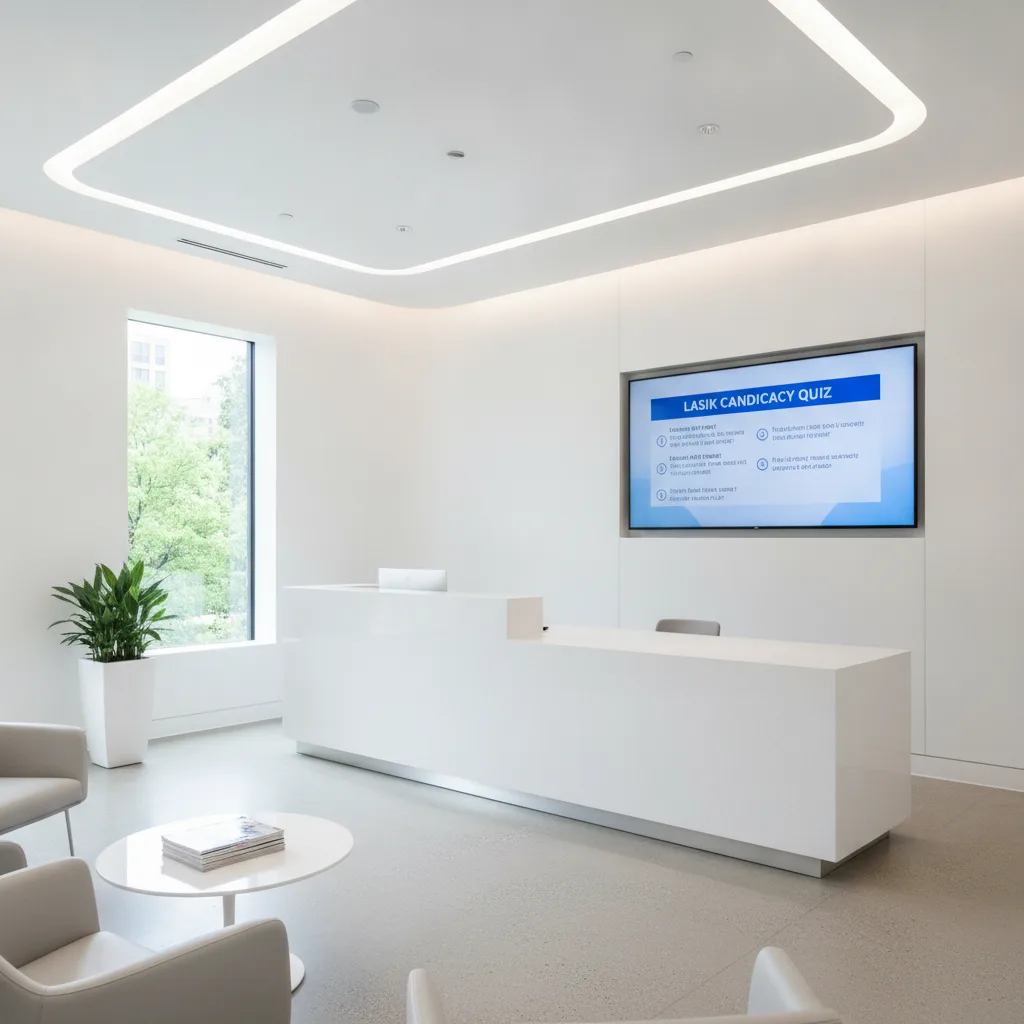
Audit Your Site Against the Four-Stage Fear Sequence
LASIK website marketing fails most often at the sequence level, not the design level. High-performing healthcare web experiences reduce anxiety through a strict four-stage order: establish relevance first, credibility second, process clarity third, then present a low-friction next action. Most LASIK sites open with a hero image and a generic tagline, skipping relevance entirely. Potential LASIK patients who don't immediately see their own situation reflected on screen leave within seconds — and users form a credibility impression in under 50 milliseconds, leaving almost no margin for confusion.
Run this 20-minute audit before touching a single page. Open your LASIK service page on a mid-tier Android phone — a Samsung Galaxy A-series device is the standard proxy for the median U.S. mobile user. Time the page load with PageSpeed Insights. The 2026 Core Web Vitals targets are LCP under 2.5 seconds, CLS under 0.1, and INP under 200 milliseconds. As of 2026, most ophthalmology sites hit 3–5 seconds LCP on mobile. That gap suppresses organic search engine rankings, drops your Google Ads Quality Score, and hands hesitant patients a reason to bounce before reading a word.
Score each page section against the four-stage sequence. Does the above-the-fold copy name the patient's fear — blurry vision, glasses dependence, surgery anxiety — before it names your practice? Does social proof appear within the first scroll, or is it buried below the procedure description? Is there a single, specific next action at the bottom of each section rather than three competing CTAs? Document every gap. This audit map becomes your redesign brief and your benchmark for measuring the digital marketing improvements that follow.
Google PageSpeed Insights
Free
Measures LCP, CLS, and INP against the 2026 Core Web Vitals thresholds on both mobile and desktop — the starting point for any LASIK website marketing audit.
Screaming Frog SEO Spider
Free up to 500 URLs; $259/year for full crawl
Identifies missing title tags, duplicate H1s, and broken internal links that suppress LASIK SEO search engine rankings before you start any redesign work.
Hotjar
From $32/mo
Session recordings and scroll-depth heatmaps show exactly where potential patients abandon your LASIK pages — removes guesswork from the audit.
Speed fix first
If your LCP exceeds 3 seconds, fix image compression and remove render-blocking scripts before any content work. A beautifully restructured page that loads in 4 seconds still loses to a plain page that loads in 2 seconds — in both search engine rankings and conversion rates.
Rebuild the LASIK Service Page as an Answer-First Document
The answer-first page structure converts 15–35% more consult form-fills within 60 days of implementation, based on documented ophthalmology site redesign data as of 2026. The format is specific: a TL;DR capsule at the top (three to five bullet points answering the most common LASIK questions before the patient scrolls), followed by six question-form H2 headings that match how prospective patients type into search engines, a price transparency section, and FAQPage schema markup covering four to six Q&A pairs. Total page length: 1,200 to 2,000 words. Search engine optimization for this page starts with those question-form headings — they are the keyword research applied directly to content structure.
The price transparency section is non-negotiable for FTC compliance and for conversion. LASIK patients researching procedures online already know bilateral LASIK runs $4,000–$7,000+ per case in 2026. Hiding that range does not protect you from price objections — it sends prospective clients to a competitor site that is transparent. Show a price range, explain what affects it (technology tier, surgeon experience, wavefront-guided vs. LASIK flap method), and note that the 2026 FSA contribution limit of $3,400 per individual reduces effective out-of-pocket cost by 20–30% for eligible patients. That one line deflates sticker shock for a significant portion of your target audience without discounting your fees.
Place your FDA safety data in the body of the page, not in a downloadable PDF. The FDA PROWL study confirmed 96–99% LASIK patient satisfaction and more than 97% of participants achieved 20/20 vision. Across more than 20 million U.S. procedures, complication rates sit below 1%. These numbers belong in the page body as cited text, formatted for AI citation and for the Google AI Overviews that appear on most informational LASIK surgery searches as of 2026. An AI engine that cites your page for '96–99% patient satisfaction' sends referral-quality traffic with no additional ad spend — that is search engine optimization and content marketing working simultaneously.
Surfer SEO
From $89/mo
Content editor scores your LASIK service page against top-ranking competitors in real time, flagging keyword density, heading structure, and word count gaps relevant to LASIK SEO.
Rank Math Pro
$59/year
Adds FAQPage and MedicalWebPage schema markup to WordPress pages without custom code — critical for Google AI Overview eligibility and stronger search engine rankings.
FTC pricing rule
The FTC requires that advertised LASIK prices reflect fees available to a substantial number of patients. If your $299/eye promotional pricing applies to fewer than 10% of candidates, do not lead with it. Lead with your actual bilateral range ($4,000–$7,000) and note financing options separately.
Deploy a LASIK Candidacy Quiz as Your Primary Lead Capture Tool
A LASIK candidacy quiz converts 40% of visitors who start it into leads — four times the 10–15% conversion rate of a static contact form or PDF download. As of 2026, interactive lead magnets convert 2.4x higher than static PDF downloads across all healthcare categories. For a LASIK practice spending $80–$200 per lead on Google Ads, replacing a static form with a candidacy quiz on the same page is the highest-ROI single change available without touching your ad budget or your LASIK marketing plan. The quiz is also the most effective way to engage potential patients who are still in the 3–12 month consideration cycle — it makes the site visit feel personalized, not transactional.
Build the quiz with seven to nine questions that mirror what your clinical team asks at a candidacy screening: current prescription range, age, corneal health history (dry eyes, thin corneas, astigmatism), contact lens wear duration, and vision goals. Each question reduces patient anxiety by framing the visit as personalized. End with one of three results screens: 'Great candidate — book your free consultation,' 'Possible candidate — a few questions for our clinical team,' or 'Alternative options may be a better fit — here is what we recommend.' This pre-qualification step filters out non-candidates before they book, protects your team's time, and improves your consultation-to-surgery conversion rate. ScoreApp's global benchmark across 22,000 quiz funnels shows AI-adaptive quizzes averaging 47.3% conversion — above the Interact baseline.
Place the quiz in three locations: as the primary CTA button in the hero section of the LASIK service page, as an exit-intent popup on the service page triggered after 60 seconds of idle time, and as an inline embed midway through LASIK blog posts targeting awareness-stage searches. Track quiz starts, completions, and form submissions separately in GA4 using custom events. If your completion rate drops below 65%, shorten the quiz or reorder the questions — the Interact benchmark shows 65% of users who start a quiz answer all questions when the quiz stays relevant to their actual situation.
Interact
$29/mo (Lite) to $209/mo (Growth)
Purpose-built quiz funnel builder with HIPAA-friendly data handling, native Mailchimp and HubSpot integrations, and prebuilt healthcare quiz templates.
ScoreApp
$49/mo
AI-adaptive quiz logic adjusts question paths based on prior answers — its global benchmark of 47.3% average conversion rate across 22,000 funnels exceeds the Interact baseline.
HIPAA note
Quiz answers that include health information — prescription range, diagnosis history — may constitute PHI under HIPAA if linked to an identifiable individual. Route quiz lead data through your HIPAA-compliant CRM (Kareo, Doctible, or HubSpot with a BAA in place), not a standard email integration.

Build Surgeon Bio Pages That Move Trust From the Brand to the Person
Surgeon-specific booking outperforms generic practice booking on LASIK pages because patients researching elective eye surgery want to confirm who will hold the laser before they schedule. A surgeon bio page is not a staff directory entry — it is a trust document that answers three questions every prospective LASIK patient asks: Is this surgeon qualified? How many procedures have they performed? Do they seem like someone I can trust with my vision? LASIK surgeons with documented case volume and fellowship training on their bio pages generate measurably more initial consultations than those without, and the E-E-A-T authority those pages build supports LASIK SEO over a 6–18 month compounding timeline.
Each surgeon page must include, in this order: a 60–90 second video introduction filmed in the surgical suite or exam room (not in front of a logo wall), board certification and fellowship training prominently displayed in the first paragraph, a stated case volume (for example, '4,200+ LASIK procedures performed'), two to four short patient testimonials specific to that surgeon with first name, last initial, and a real headshot, and a direct booking CTA for that specific surgeon — not a generic 'Contact Us' link. Add Person schema markup with sameAs links to the surgeon's profiles on Healthgrades, the AAO physician finder, and Doximity. Google reads these cross-references as E-E-A-T authority signals, lifting search engine rankings for queries like '[city] LASIK surgeon' and '[surgeon name] reviews.' This is local search engine optimization applied at the physician level.
Surgeon bio pages with board certification, fellowship training, and documented case volume capture prospective patients 2–4 months before they are ready to book — exactly the window that matters in a 3–12 month LASIK consideration cycle. A patient who reads a surgeon's bio in month two of their research and then sees that surgeon's name in a remarketing ad in month five is far more likely to convert than a cold visitor seeing the practice name for the first time. The bio page is both a content marketing asset and a paid search landing page — build it to serve both functions.
Descript
From $24/mo
Edits the surgeon intro video with text-based editing — no video production agency required for a 60–90 second bio clip.
Schema Pro
$79/year
Adds Person and MedicalBusiness schema to surgeon bio pages in WordPress without custom JSON-LD coding — directly supports LASIK SEO and Google AI Overview eligibility.
Build a Video Testimonial Wall and Embed It on the Procedure Page
A single video testimonial on a LASIK page can produce a 32% increase in conversions, and 88% of marketing teams report at least a 10% conversion boost from video as of 2026. Text reviews do not do the same job. A five-star Google review tells a hesitant patient that someone was satisfied. A 45-second video of a real patient saying 'I was terrified going in, but I could read the clock on the wall the moment I sat up' addresses the specific fear that is stopping the conversion. Patient success stories in video form outperform text testimonials in LASIK marketing because the barrier to booking is not doubt about quality — it is fear of the procedure itself. Fear-addressing patient testimonials are the most effective trust signal a comprehensive medical website can deploy.
Collect video testimonials at the one-week and one-month post-op appointments. Patients are emotionally at their peak at these visits — the result is real, the experience is fresh, and they have not yet forgotten the contrast between life with glasses and life without them. Use a tool like GetPureProof or Vocal Video to send a self-recorded video prompt by text message before the appointment. Ask three specific questions: 'What were you most afraid of before the procedure?', 'What surprised you about the recovery?', and 'What would you tell someone who is on the fence?' These three prompts generate fear-addressing content that moves hesitant patients through the decision. They also generate the kind of patient engagement that past patients are proud to participate in.
Build a 'Wall of Love' in GetPureProof or EmbedSocial, filtered to the LASIK service line only, and embed it directly on the LASIK procedure page above the booking CTA. Do not send visitors to a separate reviews page — each click away from the procedure page is a conversion risk. Supplement the wall with your aggregate Google review rating and total review count. As of 2026, 84% of patients check online reviews before booking care, and 59.9% choose healthcare providers based on positive testimonials. Both numbers belong on the page as visible trust signals. Online reputation management is not a separate discipline from conversion rate optimization — they are the same work on a LASIK website.
GetPureProof
From $49/mo
Collects, hosts, and embeds HIPAA-aware patient video testimonials with filtering by procedure type — purpose-built for healthcare practices and LASIK clinics.
Vocal Video
From $49/mo
Sends a text-message video prompt to patients post-appointment, auto-edits the raw clip with captions and branding, and generates an embeddable player in under 10 minutes.
EmbedSocial
From $29/mo
Aggregates Google and Facebook reviews into a filterable wall widget that updates automatically — no manual copy-paste of new patient reviews required.
Consent requirement
HIPAA and FTC rules both apply to patient video testimonials. Obtain written HIPAA-compliant authorization before filming and before publishing. The authorization must name the specific platforms where the video will appear. Have your healthcare attorney review the consent form and the testimonial workflow before you launch the collection campaign.
Configure Automated Nurture Sequences for Every Quiz and Form Lead
Practices with automated nurture sequences convert 35–55% of inquiries to consultations, versus 15–25% for practices relying on manual follow-up alone. That gap is not about staffing — it is about speed and consistency. The first text message or email should fire within 90 seconds of a quiz or form submission. After 30 minutes, the probability of converting a lead on a same-day call drops by more than 60% in most healthcare lead-tracking data. A LASIK practice receiving 30 leads per month and converting at 25% (manual follow-up) versus 45% (automated) is leaving six consultations per month unrealized. At a $5,000 average bilateral procedure value and a 40% consult-to-surgery rate, that is roughly $14,400 per month in recoverable revenue — and the fix is email marketing and SMS automation, not more ad spend.
Build three separate nurture tracks based on quiz outcomes. Track 1 (strong candidate): five touchpoints over 14 days — immediate text confirmation, Day 1 email with surgeon bio link and a calendar booking link, Day 3 email with two patient video testimonials, Day 7 text with a 'your free consultation spot is still available' message, and Day 14 email with the FSA and financing angle plus a direct phone number. Track 2 (possible candidate): same five touchpoints but with an added 'answers to your specific questions' email on Day 5 addressing the concerns flagged in their quiz responses. Track 3 (non-candidate): a single educational email redirecting to PRK or ICL content — never ghost a non-candidate, because they refer friends and family. This three-track approach is a proven LASIK marketing strategy that costs nothing beyond your CRM subscription.
Use CallRail to track which nurture touchpoints produce inbound calls, not just form fills. LASIK patients in the final decision stage almost always call rather than fill out another form. CallRail's conversation intelligence identifies the specific call triggers — financing questions, surgeon questions, fear of pain — so you can refine nurture sequence content over time. Pair CallRail with your CRM (Kareo, HubSpot, or Salesforce Health Cloud) to close the attribution loop between a quiz submission and a booked surgery. This is how a LASIK marketing agency with access to performance data optimizes a campaign — and it is fully replicable in-house with the right tool stack.
HubSpot Marketing Hub
From $800/mo (Professional)
Builds multi-track email and SMS nurture workflows with LASIK quiz data as the branching trigger — supports full funnel attribution from first site visit to booked surgery.
Podium
From $399/mo
Sends HIPAA-aware two-way SMS follow-ups within 90 seconds of a lead submission and routes replies to your front desk team in a shared inbox.
CallRail
From $45/mo
Tracks which nurture emails and ads produce inbound calls, records and transcribes conversations, and feeds call attribution data back into Google Ads for smarter LASIK PPC campaigns.
Align Paid Search, Local SEO, and Reputation Management Into One Conversion System — the Best LASIK Marketing Strategies Combined
LASIK website marketing only compounds when paid search ads, local SEO, and online reputation management feed the same conversion architecture — not three separate campaigns run by three separate vendors. Google Ads for LASIK runs $80–$200 per lead in 2026. Organic LASIK SEO takes 6–9 months to generate measurable consultations and 12–18 months for significant volume, but by month 24 the organic cost-per-lead sits 60–80% below Google Ads. The math argues for running paid search to fill the surgery schedule now while the SEO asset compounds. Targeted marketing strategies that combine both channels consistently outperform practices that rely on a single channel. Keyword research focused on '[city] LASIK surgeon' and 'am I a LASIK candidate' queries feeds both the PPC campaigns and the on-page content strategy simultaneously.
For local SEO, three non-negotiable tasks: a fully completed and actively managed Google Business Profile with procedure-specific service categories (list 'LASIK Surgery' as a primary service, not just 'Ophthalmologist'), location-specific landing pages for every city where you draw patients, and a 90-day review velocity program. Review velocity means consistently generating new patient reviews at a rate that outpaces competitor LASIK providers in your market. Practices that respond to every review — positive and negative — within 24 hours rank higher in Google Maps and convert more patients from the local search pack than practices with higher aggregate ratings but inconsistent response patterns. Use Podium or Birdeye to automate the review request text message at the day-two post-op touchpoint. Local search engine optimization and online reputation management work as a unified system here, not separate disciplines.
For PPC campaigns, match your ad groups to your site's three conversion systems: run candidacy quiz ads (headline: 'Am I a LASIK Candidate? Take the 2-Minute Quiz'), surgeon-specific paid search ads ('Meet Dr. [Name] — 4,200+ LASIK Procedures'), and social proof ads ('96–99% Patient Satisfaction — See Real Results'). Social media marketing on Instagram and Facebook with the same three creative themes reinforces the paid search message for prospective patients still in the research phase, supporting the remarketing campaigns that run through the 3–12 month consideration cycle. Each ad group lands on the corresponding page section, not the homepage. Track conversions at the quiz-start, quiz-completion, and consultation-booked events separately so your Google Ads algorithm optimizes toward leads that actually become surgeries. Leveraging social media alongside paid search ads creates the multi-touchpoint sequence that moves more LASIK patients from first search to booked consult.
Birdeye
From $299/mo
Automates Google and Healthgrades review requests by text and email post-appointment, monitors and responds to patient reviews across platforms, and tracks review velocity against local LASIK competitors.
Semrush Local
$20/mo add-on to Semrush core plans
Syncs your Google Business Profile data, audits local citation consistency, and tracks search engine rankings for LASIK-related keywords across every city you serve.
Google Ads
Self-managed or via agency; LASIK CPL typically $80–$200
Captures high-intent LASIK surgery searches with surgeon-specific and quiz-specific ad groups that feed the conversion architecture built in Steps 2–6.
Attribution warning
Google Ads auto-applies 'optimized' conversion goals by default, which often counts low-quality actions like page views as conversions. Manually set your primary conversion action to 'Consultation Booked' or 'Quiz Completed' only. Optimizing toward cheap clicks instead of real consults is the single most common reason LASIK PPC campaigns appear profitable while the surgery schedule stays empty.

The Revenue Math on Getting This Right
A LASIK practice converting 60% of 30 monthly consultations outearns one converting 35% of 40 consultations by $240,000 per year — with zero increase in ad spend. At $5,000–$7,000 per bilateral procedure, closing five additional patients per month from existing traffic is worth $300,000–$420,000 in annual revenue. Every element in this framework — the quiz, the surgeon bio page, the video testimonial wall, the automated nurture sequences — exists to close that gap. The website is not a brochure. It is the highest-leverage sales asset in your entire LASIK marketing plan, and it either earns that revenue or bleeds it to a competitor who built a better one.
Most LASIK practices do not have a traffic problem. They have a fear problem they are solving with more ad spend. The three conversion systems in this guide — the candidacy quiz that converts 40% of starters into leads, the surgeon bio page that makes the trust relationship personal, and the video testimonial wall that lets past patients address fear in their own words — work on the existing traffic you are already paying for. Fix the conversion architecture first. Then scale the paid advertising. In that order, the math works. A LASIK marketing agency partner or an in-house team with admin access to this 7-step framework can complete the priority changes in 3–5 hours and a full rebuild in 4–6 weeks. Start with the 20-minute audit in Step 1 — it will tell you exactly which of the three systems is leaking the most revenue right now.
Frequently Asked Questions
Ready to get started? Contact Geek Powered Studios today.