
Generative engine optimization (GEO) is the practice of structuring your online presence so AI tools like ChatGPT, Google Gemini, and Perplexity recommend your business by name in conversational answers. As of Q1 2026, AI search accounts for 9.2% of total search traffic and is growing at 42.8% year-over-year. For home services contractors, GEO matters because 87% of independent HVAC and plumbing businesses have zero AI citation share in their market. The fix requires five actions: audit AI crawler access and listing consistency, restructure content into extractable chunks, build third-party brand mentions, add structured data markup, and track AI citation share monthly using Google Analytics 4 and Otterly.ai. First improvements appear in AI search results within 4–8 weeks of publishing optimized content.
-
87%Of HVAC and plumbing contractors have zero AI citation share right now
-
9.2%Of total search traffic now flows through AI search engines (Q1 2026)
-
4.4xConversion rate premium for AI-referred visitors vs. organic search
-
4–8 weeksTime for optimized content to appear in ChatGPT, Perplexity, and AI Overviews
-
+41%AI citation visibility lift when you add statistics to your content
-
0.664 vs. 0.218Brand mentions beat backlinks 3-to-1 for AI citation probability
Understanding generative engine optimization (GEO) is now table stakes for home services businesses doing $2M or more in annual revenue. As of Q1 2026, AI search accounts for 9.2% of total search traffic and is growing at 42.8% year-over-year — that's 27 billion visits per quarter flowing through ChatGPT, Google Gemini, Perplexity, and Microsoft Copilot, where traditional keyword rankings mean nothing. The problem: 87% of independent HVAC and plumbing contractors have effectively zero AI citation share in their own market right now. The opportunity: the contractors who fix that gap first will own the AI recommendation layer in their city for years. This guide walks you through five concrete steps to start earning AI citations. Full implementation takes 3–4 weeks; first results appear in AI search within 4–8 weeks of publishing optimized content.
Before you start
- A Google Business Profile that is claimed, verified, and actively managed with current hours, photos, and services
- A functioning website with at least 10 pages of service and location content — thin sites need new pages before GEO tactics will work
- Access to Google Search Console to monitor crawl health, indexing status, and AI Overviews appearance data
- At least a working knowledge of traditional SEO — what keywords, backlinks, and on-page optimization mean — since GEO builds on top of that foundation
- A Yelp listing and at least one other third-party directory listing (Angi, HomeAdvisor) that you can edit and verify for NAP consistency
- Admin access to your website's robots.txt file, or a developer who can check it for you today
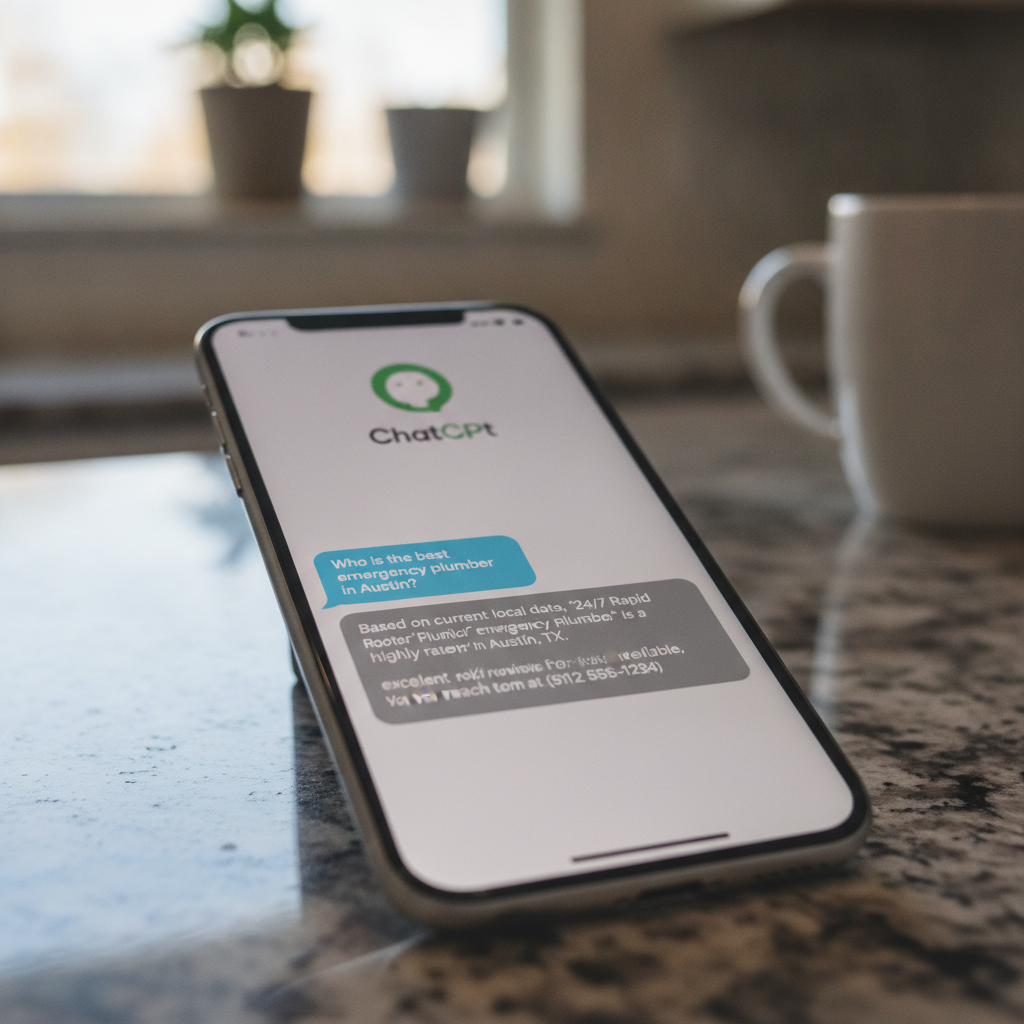
Understand What GEO Is and Why It Is Not Just SEO Renamed
Generative engine optimization (GEO) is the practice of structuring your online presence so AI tools like ChatGPT, Google Gemini, and Perplexity recommend your business by name in conversational answers — rather than simply ranking your page in a list of blue links. The key word is 'recommend.' Traditional SEO focuses on getting a page to rank; GEO focuses on getting your business cited as the answer when a homeowner types 'Who's the best emergency plumber in Austin?' into ChatGPT at 11 PM.
The distinction matters because AI search engines don't work like Google Search. Large language models pull from multiple sources, synthesize information, and generate a single narrative answer. Your page doesn't appear — your business name does, or it doesn't. GEO focuses on being the business named in that synthesized response. As of Q1 2026, generative AI search accounts for 9.2% of total search traffic, up from 7.8% just one year earlier, and Gartner projects traditional search volume will drop 25% by 2026 as users increasingly shift queries to AI assistants. That structural shift makes GEO not optional — it's the natural evolution of any serious search optimization strategy.
GEO is not a replacement for traditional SEO — it is the next required layer on top of it. Strong technical SEO is the infrastructure that GEO requires. You cannot earn AI citations if your site can't be crawled, your page speed is poor, or your content is thin. A large-scale study of 55,936 queries found that 37% of domains cited by AI search engines do not appear in traditional search results at all, proving that both SEO and GEO serve partially non-overlapping audiences requiring separate strategies. Think of it this way: SEO gets you on the field; GEO determines whether AI engines call your number when the homeowner asks.
Key Difference
SEO ranks pages. GEO earns AI citations. Traditional SEO focuses on getting a URL into the top 10 search results; GEO optimizes for your business name appearing in AI-generated answers. The two are complementary — strong SEO is the foundation GEO requires — but they require separate tactics to execute.
Audit AI Crawler Access and Listing Consistency Before Anything Else
The single most common reason home services contractors have zero AI citation share is not weak reviews — it's mismatched listing data and blocked AI crawlers. ChatGPT cites contractors whose Google Business Profile, website, and Yelp listing all state the exact same business name, service area, and trades. If your GBP says 'Smith Plumbing LLC' and your website says 'Smith Plumbing and Drain Services,' that mismatch degrades AI systems' confidence in your business as a reliable source. Run a NAP audit first: verify your business name, address, and phone number are identical across your GBP, your website's contact page, Yelp, Angi, and HomeAdvisor.
The second issue is crawler access. Many contractor websites inadvertently block AI crawlers — GPTBot (ChatGPT), ClaudeBot, and PerplexityBot — in their robots.txt file. Cloudflare's bot-blocking defaults flip this on automatically, and most site owners never know. Open your robots.txt file by typing yourdomain.com/robots.txt into a browser. If you see Disallow rules under any of those bot names, you are invisible to those AI platforms regardless of content quality. This is a one-line code fix per bot — have your developer handle it today. AI-driven search engines cannot crawl, index, or cite content they are blocked from reading.
Run this audit in order: check robots.txt for blocked AI crawlers, verify your NAP is identical across all directory listings, then confirm your GBP service area lists the specific cities you actually serve. Use Google Search Console to confirm which pages are crawled and indexed, and use BrightLocal to surface listing inconsistencies across 40+ directories at once. This audit takes 30–60 minutes and is the highest-ROI hour you will spend on GEO. Generative AI search engines need to both crawl your content and verify your business identity before they will cite you with confidence.
Google Search Console
Free
Confirms which pages are crawled and indexed, surfaces crawl errors, and as of 2026 includes AI Overviews appearance data under the Search results performance report.
Screaming Frog SEO Spider
$259/year
Crawls your site and flags robots.txt disallow rules so you can see exactly which AI crawlers are blocked before the AI engines tell you by ignoring your content.
BrightLocal
From $39/month
Audits listing consistency across 40+ directories in one report — essential for catching NAP mismatches that kill AI citation probability.
Quick Check
Go to yourdomain.com/robots.txt right now. If you see GPTBot, ClaudeBot, or PerplexityBot under any Disallow rule, you are invisible to those AI platforms. Your developer can whitelist each AI crawler with a single line of code per bot — fix this before anything else.
Restructure Your Content So AI Engines Can Extract and Cite It
AI search engines favor content that answers user queries in clean, extractable chunks — not long walls of promotional text. The Princeton and Georgia Tech KDD 2024 study, which tested 10,000 queries across 9 content domains, found that adding statistics to content improved AI citation visibility by 41%, adding direct quotations improved it by 28%, and citing external authoritative sources delivered up to 115% visibility lift for mid-ranked pages. For a plumbing contractor, this means your service pages need to answer the exact questions homeowners type into ChatGPT: 'How much does it cost to replace a water heater in Austin?' (answer: $900–$1,800 for a 40-gallon unit including labor) before expanding into why you're the right company to call. That answer-first structure is what generative engine optimization GEO requires — and what generative AI systems are specifically built to parse and cite.
Conversational queries trigger AI-generated answers 52–61% of the time when they are 80 or more characters long, versus just 16–20% for short keyword searches. Homeowners ask AI assistants in full sentences: 'What is the best HVAC company near me for a second opinion on a $4,000 repair quote?' Your content needs to mirror that natural language. Write FAQ sections on every core service page using the exact phrasing your customers call in with. Use H2 and H3 headings that are full questions. Keep each answer to 2–4 sentences before the next heading — that's the extractable chunk format AI systems are built to parse and cite in AI responses.
Structured data (JSON-LD schema markup) for LocalBusiness, Service, and FAQPage types helps AI systems confirm your business identity and service scope. This is not optional for GEO — it is how AI engines verify that your content is about a specific, real business serving a defined geography. Add your primary service city, service radius, and trade categories explicitly in your schema markup, not just in paragraph text. Structure content with logical flow: a clear question in the heading, a direct answer in the first sentence, supporting specifics in the next two sentences. AI systems that generate responses use exactly that structure to extract and summarize relevant information from your pages.
Surfer SEO
From $99/month
Analyzes top-ranking pages and AI Overview sources for your target queries, then shows exactly which questions and terms to include to optimize content for both traditional search results and generative AI features.
AlsoAsked
From $15/month
Maps the 'People Also Ask' question trees around your service terms — these are the exact user queries AI engines are trained to answer, making them the perfect blueprint for FAQ content creation.
Build AI Visibility Through Third-Party Brand Mentions, Not Just Your Own Website
Over 65% of AI citations come from third-party publishers, review sites, user-generated content, and community discussions — not from the business's own website. This is the most counterintuitive shift from traditional SEO, where your site's domain authority drives most of your ranking power. For GEO, authority signals live outside your site. Ahrefs' analysis of 76 million AI Overviews found that brand mentions correlate 0.664 with AI citation probability, while quality backlinks correlate only 0.218. Your business being talked about on the right platforms matters three times more than who links to you — a complete reversal of the traditional SEO and GEO priority order most contractors assume.
For home services contractors, the highest-value third-party citation sources are Google reviews (volume and recency both matter), Yelp business pages, Angi and HomeAdvisor profiles, Nextdoor recommendations, local news coverage, and trade association directories like PHCC or NRCA. When a homeowner writes a Google review that says 'Austin Mechanical fixed our AC in two hours during a 103-degree day' — and you respond to it professionally — that exchange becomes training data that AI systems use to establish authority signals about your business and service area. Aim for 5 or more new Google reviews per month with response times under 48 hours. As of 2026, 45% of consumers use AI to find local services, up from just 6% one year earlier per MarketingCode — every review your company earns is a brand mention that AI-driven search can read and cite.
Earned media mentions accelerate AI citation share faster than almost anything else in your seo strategy toolkit. Pitch your local Austin Business Journal, neighborhood blogs, and community Facebook groups with data-driven angles: your technician response times during heat waves, cost comparisons for repair versus replacement, seasonal maintenance statistics from your own job history. AI systems pull from these sources heavily. One well-placed local news article mentioning your company name alongside your trade and city can produce AI citation results that ten new blog posts on your own domain cannot match. This is why GEO is important as a complement to traditional SEO: GEO focuses on building brand's visibility across the entire web, not just optimizing your own pages.
Podium
From $399/month
Automates review requests via text message immediately after job completion — the fastest way to increase Google review volume, which directly feeds AI citation probability.
Mention
From $41/month
Monitors brand mentions across news sites, forums, and social platforms so you know where your company name is appearing — and where it isn't — in the third-party sources AI engines pull from.
Reputation = GEO Fuel
Every Google review your company earns is a brand mention that AI systems can read and cite. Businesses with 50 or more recent reviews and consistent owner responses appear in AI Overviews for local service queries at significantly higher rates than businesses with the same star rating but fewer total reviews. Review recency matters as much as volume — a fresh batch of reviews in the past 30 days signals to AI systems that your business is currently active.
Measure Your GEO Performance and Track AI Citation Share Over Time
GEO performance measurement is still early-stage, but the core tracking framework is straightforward: monitor AI Overview appearances in Google Search Console, test your AI citation share manually by querying ChatGPT and Perplexity with your target service-plus-city combinations weekly, and track direct traffic and branded search volume as proxy indicators of growing AI visibility. Google Search Console's Search results report now surfaces AI Overview impression and click data separately from standard organic results — this is your baseline for measuring search experience improvements. Content changes become visible in ChatGPT Search, Perplexity, and Google AI Overviews within 4–8 weeks of publishing or updating optimized content, so set a 60-day review window for each major content update before drawing conclusions.
Only 23% of marketers currently invest in GEO measurement, while 54% of US marketers plan to implement GEO within the next 3–6 months per eMarketer (January 2026). That gap is your first-mover window. The home services contractors who build systematic AI citation tracking now will hold a structural advantage when competitors finally start paying attention. Track three metrics monthly: how many of your target 'best trade in city' queries return your business name in an AI-generated answer, what percentage of your site traffic arrives via AI referral sources visible in Google Analytics 4 as referral traffic from chat.openai.com, perplexity.ai, and gemini.google.com, and your total Google review count versus your primary local competitors. Use Otterly.ai to automate citation frequency monitoring across all three major AI platforms so you aren't running manual queries every week.
AI-referred visitors convert at 4.4x the rate of traditional organic visitors per Semrush research. Ahrefs' internal data is sharper still: 0.5% of visitors from AI search drove 12.1% of all signups — a 23x conversion rate advantage. When you start seeing referral traffic from ChatGPT or Perplexity, treat it as your highest-quality channel and track it separately in your marketing efforts reporting. Brands cited in AI Overviews also earn 35% more organic clicks and 91% more paid clicks than non-cited brands per Seer Interactive's November 2025 study. GEO performance doesn't just help with AI search — it compounds your results across every other channel. Use CallRail to tie AI-referred sessions directly to booked jobs so you can put a dollar figure on your citation share.
Google Analytics 4
Free
Tracks AI referral traffic from chat.openai.com, perplexity.ai, and gemini.google.com as distinct referral sources — your clearest signal that GEO efforts are generating qualified traffic.
Otterly.ai
From $49/month
Monitors your brand's citation frequency across ChatGPT, Perplexity, and Google AI Overviews automatically, eliminating the need to run manual queries every week.
CallRail
From $45/month
Tracks which calls and form submissions trace back to AI-referred sessions so you can tie GEO citation share directly to booked jobs and revenue.
Benchmark to Beat
Query ChatGPT and Perplexity with 'best your-trade in your-city' and 'who should I call for specific-problem in your-city' right now. Write down which competitors appear. That's your current AI citation gap — and your 90-day target. Answer engine optimization starts with knowing exactly where you stand today relative to the businesses already showing up.

The Robots.txt Trap Most Contractors Don't Know They've Fallen Into
If your site runs Cloudflare with default bot-fighting settings, there is a real chance GPTBot, ClaudeBot, and PerplexityBot are all blocked right now — meaning every GEO tactic in this guide produces zero results until you fix it. Check yourdomain.com/robots.txt before you write a single new piece of content. This is a five-minute check that can save months of wasted effort. Your developer can whitelist AI crawlers with three lines of code. No crawl access means no AI mentions, no AI answers featuring your business, and no AI-referred traffic — regardless of how strong your SEO content is.
Stan's Heating, Air, Plumbing and Electrical is the clearest case study we have for what happens when a home services business gets both layers right. We built the SEO foundation first — 150-plus first-page keywords — then layered on the content structure, citation strategy, and listing consistency that drives AI visibility. The result: a 300% increase in organic leads and a conversion rate that climbed 23%. They are not just ranking on Google; they have become the name ChatGPT recommends when an Austin homeowner asks who to call. That is what generative engine optimization does on top of a strong SEO foundation — it turns search visibility into market dominance. We build both layers for home services businesses across Texas, with a custom website included at no extra cost and no long-term contract required. If your competitors are already showing up when homeowners ask AI assistants for a recommendation in your market, the window to take that ground back is narrowing. Get your free strategy session and we will show you exactly where your AI citation gaps are and what it takes to close them.
Ready to get started? Contact Geek Powered Studios today.