
An independent LASIK practice can earn a Maps 3-pack position against LasikPlus, TLC Vision, and The LASIK Vision Institute by executing three structural advantages those chains cannot neutralize at scale: physical proximity to the searcher (which Google's local algorithm weights above domain authority), a single Google Business Profile that can be updated weekly (chains managing 100-plus locations cannot match that cadence), and a credentialed surgeon who can produce physician-authored E-E-A-T content aggregators cannot replicate. The full program — GBP optimization, NAP-consistent citations, and high-quality content — delivers measurable GBP call volume increases in 60 to 90 days and competitive organic search results authority within 9 to 12 months. Total tool cost runs $650 to $730 per month across all seven steps.
-
60–90 daysTime for GBP optimization to produce measurable call volume increases
-
29.3% YoYGBP call volume increase documented in a real NYC ophthalmology case study
-
$4,4922026 national average bilateral LASIK case value — your SEO ROI baseline
-
40%Share of LASIK Google searches that include a location modifier or "near me"
-
9–12 monthsTimeline for physician-authored content to reach full organic search authority
-
3 of top 5AI search visibility factors that are citation-related, per Whitespark 2026
Independent LASIK practices can out-rank LasikPlus, TLC Vision, and The LASIK Vision Institute in local search results without outspending them on ads — because Google's local algorithm is structurally biased toward the advantages a single-location practice holds. As of 2026, LASIK SEO is not a domain authority contest. It is a proximity, cadence, and credibility contest. This playbook covers all seven execution steps, from keyword research through ROI tracking, with specific tools, realistic timelines, and the exact benchmarks a LASIK practice should hit to confirm the strategy is working. Foundational setup takes 2 to 3 weeks; full organic search authority against national chains arrives at 9 to 12 months.
Before you start
- A verified Google Business Profile (GBP) for your practice location — unverified profiles cannot post updates or appear in the Maps 3-pack
- Admin access to your practice website's CMS (WordPress, Webflow, or equivalent) so you can publish and edit pages without a developer ticket
- A Whitespark or BrightLocal account ($30–$40/mo) for citation tracking and Maps rank monitoring across your full service radius
- A CallRail account or equivalent call-tracking software ($45/mo) to measure GBP-driven calls separately from paid search and organic traffic
- At least one surgeon whose credentials, fellowship training, and procedure volume can be documented on-site as the E-E-A-T author
- A clear procedure mix — LASIK, PRK, SMILE, or all three — so keyword research and dedicated pages are built around what you actually perform
LASIK SEO Keyword Research: Map the Full Patient Research Journey
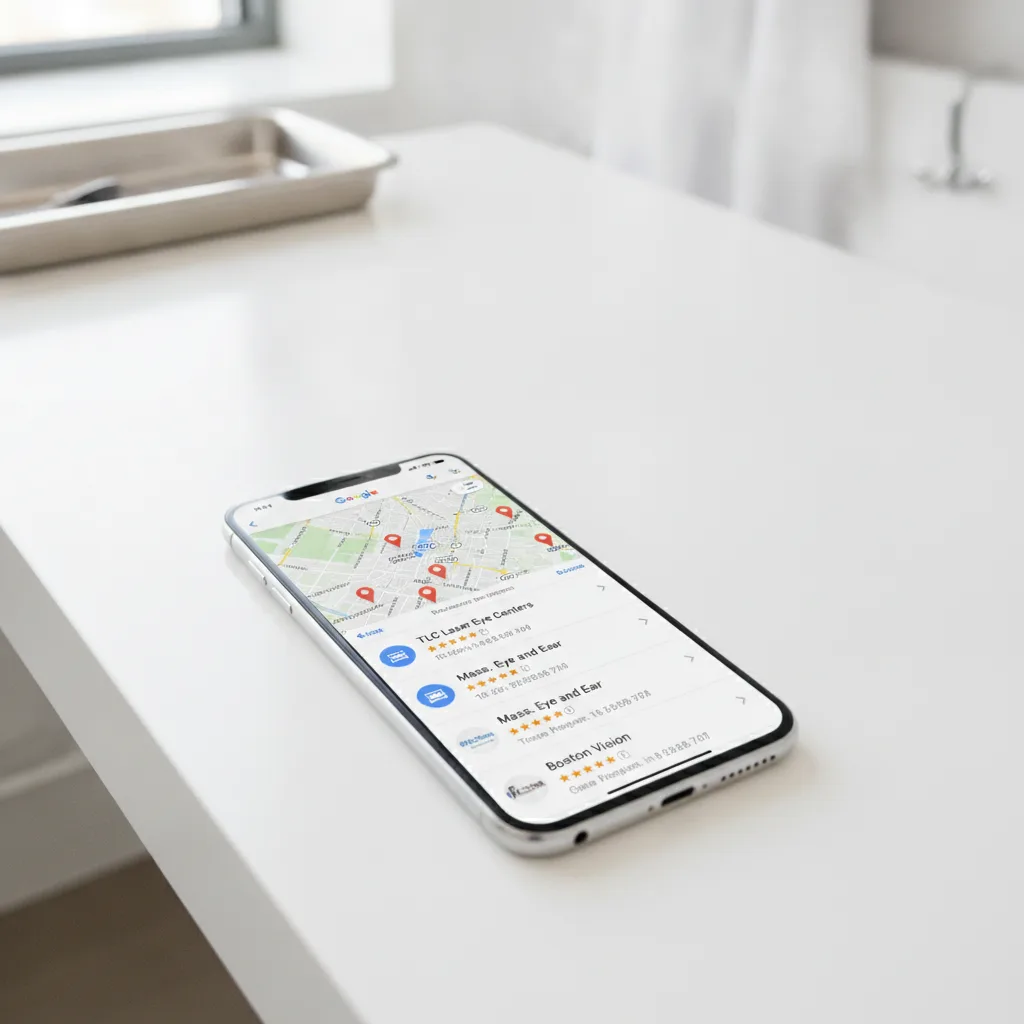
LASIK patients research for 60 to 120 days before booking a consultation, which means keyword research for a LASIK practice must cover three distinct intent layers — not just the bottom-funnel 'LASIK surgeon near me' queries where national chains concentrate their paid ads budgets. The three layers are: informational (candidacy, LASIK vs PRK vs SMILE, recovery timelines), comparison (cost, technology, surgeon credentials), and transactional (book a consultation, LASIK surgeon [city]). Miss the first two layers and your practice is invisible during most of the research window when potential LASIK patients are forming provider preferences.
Approximately 40% of all LASIK-related Google searches already include a location modifier — a city name or 'near me' — which means local keyword targeting captures the largest single block of high-intent search traffic in the category. Build your primary keyword list around five to eight city- or neighborhood-modified transactional terms ('LASIK surgeon Austin TX,' 'laser eye surgery near me,' 'LASIK eye surgery Houston'), then layer in 30 to 50 informational FAQ terms pulled from Google's People Also Ask data. A peer-reviewed analysis of 189 LASIK-related PAA questions found that procedure evaluation questions (26%), recovery timelines (17%), and candidacy questions (14%) dominate — those three topic clusters should drive your content calendar for the first six months.
Use Semrush or Ahrefs to pull search volume and keyword difficulty scores, then prioritize search terms where national chain pages rank but carry thin, non-physician content. Those are your fastest wins: a surgeon-authored 600-word FAQ page with structured data will outrank a corporate aggregator page in 90 days under Google's E-E-A-T standards, even when the chain's domain authority is 10 times higher. Strategic keyword optimization means targeting '[procedure] surgeon [city]' and '[procedure] cost [city]' formats — local proximity and physician authorship are decisive ranking signals at those query shapes.
Semrush
$139/mo
Pulls location-specific LASIK keyword volumes and shows exactly which pages national chains rank with — so you can identify thin-content gaps to target first.
Ahrefs
$129/mo
Content Gap tool identifies LASIK informational keywords your competitors rank for that your site doesn't address yet — the fastest source of new content briefs.
Google Search Console
Free
Shows actual queries driving impressions to your existing pages, including low-hanging search terms sitting at positions 8 to 15 that need one content update to move into the top 5.
Pro tip
Don't target 'LASIK' as a standalone keyword — it's dominated by WebMD, Wikipedia, and national chain homepages. Target '[procedure] surgeon [city]' and '[procedure] cost [city]' formats where local proximity and physician authorship are decisive ranking signals in Google search results.
Optimize Your Google Business Profile to Win the Maps 3-Pack for LASIK Centers
The Google Maps 3-pack receives the majority of clicks for searches like 'LASIK surgeon near me,' and a LASIK practice must appear in the top three results — not the top ten — to be visible on page one for mobile searchers on mobile devices. According to Whitespark's 2026 Local Search Ranking Factors report, the three heaviest-weighted GBP signals are: primary business category, proximity to the searcher, and a keyword in the business name. An independent practice can control all three directly. LasikPlus and TLC Vision cannot update 100-plus profiles simultaneously with the cadence a single-location practice can — that operational gap is your structural advantage in LASIK local SEO.
Set your GBP primary category to 'Ophthalmologist.' Add 'LASIK Surgery Center' and 'Eye Care Center' as secondary categories. Fill every available attribute field: accepted insurance coverage, languages spoken, wheelchair access, parking, and online booking link. Upload a minimum of 20 photos — exterior, interior, equipment, and surgeon headshots — because GBP profiles with 20-plus photos average 35% more direction requests than profiles with fewer than 10. Google's 2026 local ranking algorithm treats a GBP as a live dataset: profiles left untouched for 60-plus days lose search engine rankings automatically. Post one GBP update per week — a patient FAQ answer, a before/after outcome (HIPAA-compliant), or a technology spotlight — to maintain the freshness signal that chains routinely neglect at scale.
The 10-month NYC case study documented in Cataract and Refractive Surgery Today is the clearest available benchmark for what GBP-first LASIK SEO delivers: a 29.3% year-over-year increase in GBP-driven calls, in the most competitive ophthalmology market in the country, without a traditional link-building or blog campaign. That result came entirely from category optimization, weekly posts, and systematic review solicitation. Most independent LASIK practices can replicate those inputs in 30 days and begin seeing measurable growth in the local pack within 60 to 90 days.
Google Business Profile Manager
Free
Direct control panel for all GBP fields, posts, Q&A, photos, and performance data — no third-party layer needed for basic optimization.
Podium
$399/mo
Automates post-visit review request texts to patients, which is the fastest way to build review velocity — the signal that moves a GBP from position 4 to position 2 in the local pack.
Watch out
Choosing 'Eye Doctor' or 'Optometrist' as the primary GBP category instead of 'Ophthalmologist' will suppress your practice's visibility for LASIK and laser eye surgery queries in Google search, because Google's category taxonomy treats those as distinct service types. Verify the primary category matches the surgical scope of your practice before doing anything else.
Build NAP-Consistent Citations Across Medical Directories for AI Search Visibility
Citations are experiencing a measurable resurgence in 2026: three of the top five AI search visibility factors identified in Whitespark's 2026 study are citation-related, meaning consistent Name, Address, and Phone (NAP) data across Yelp, Healthgrades, Vitals, Zocdoc, and medical directories directly determines whether ChatGPT, Gemini, or Perplexity recommends your LASIK surgery practice to a user asking 'who is the best LASIK surgeon in [city].' AI search engines pull structured directory data when assembling local recommendations — a lasik practice with five mismatched NAP variations across directories will not appear in those answers, regardless of how well its practice website ranks in classic Google search results. Local search engine optimization now has two audiences: Google's Maps algorithm and AI search engines. You have to satisfy both.
Audit every existing citation using Whitespark's Citation Finder or BrightLocal's Citation Tracker before building new ones. Fix suite number formatting, phone number format, and business name spelling inconsistencies first — a single extra character in the address field creates a mismatch. Then build or claim profiles on the 10 highest-authority medical directories: Google, Yelp, Healthgrades, Vitals, WebMD Health Services, US News Health, RateMDs, Zocdoc, Castle Connolly, and the American Academy of Ophthalmology's provider directory. Each profile should include a consistent 150-word practice description using your target city and procedure names naturally. Complete this citation foundation before spending on paid search — inconsistent NAP is the most common reason a LASIK surgery practice runs ads that generate calls Google can't associate with its GBP.
Whitespark Citation Finder
$33/mo
Identifies every existing citation for your practice and flags NAP inconsistencies that suppress both Maps rankings and AI search recommendations.
BrightLocal
$39/mo
Manages citation building and tracks ranking positions in the Maps pack across multiple zip codes — essential for practices serving a metro area wider than one city center.
Timeline
NAP corrections propagate through directories in 30 to 60 days. Don't expect Maps ranking movement before that window closes. Build citations in the first two weeks, then shift attention to on-site content while the citation updates index.
Publish Physician-Authored E-E-A-T Content That LASIK Chains Can't Replicate
Physician-authored educational content covering candidacy, LASIK vs PRK vs SMILE comparisons, and recovery timelines consistently outranks content mills and national aggregators for local LASIK queries under Google's E-E-A-T standards — and no national chain can produce it at scale because the author must be the credentialed surgeon performing the procedures at that specific location. This is the single largest content advantage an independent LASIK practice holds. A 600-word page written by Dr. [Name], MD, board-certified ophthalmologist, fellowship-trained in refractive surgery, with 15 years of LASIK outcomes data, will outrank a 2,000-word LasikPlus corporate blog post on every E-E-A-T dimension that search engines evaluate. Surgeon credentials displayed on each page are not a vanity element — they are a direct ranking signal.
Build high-quality content in three tiers. Tier 1: dedicated pages for each vision correction option — LASIK, PRK, and SMILE — each with surgeon attribution, technology specifics (wavefront-guided, topography-guided, ZEISS VisuMax, or whichever platform your practice uses), and a candidacy section covering patient outcomes and complication rates honestly. Tier 2: a pricing transparency page showing the bilateral average for your market (the 2026 national average is $4,492; your local range may vary by $500 to $1,000). Tier 3: a 50-question FAQ library organized by the three dominant patient search clusters: candidacy (14% of PAA volume), recovery (17%), and procedure evaluation (26%). Each FAQ answer should be 80 to 150 words, open with a direct answer sentence, and carry the surgeon's byline. These dedicated pages are a powerful tool for capturing prospective patients early in the research journey.
Add MedicalOrganization and Physician structured data (Schema.org) to every page featuring surgeon credentials. AI Overviews now appear in 48% of all Google queries as of 2026 — up 58% year over year — and structured data is one of the primary signals that surfaces a specific LASIK practice's content inside those AI-generated answers. A lasik surgery practice without schema markup on its surgeon pages is invisible to the AI citation layer even if it ranks on page one organically. Structured data is also the mechanism that connects your on-page content to Google search results with rich snippet treatment, increasing click-through rate from organic search results.
Surfer SEO
$99/mo
Content editor scores LASIK pages against top-ranking competitors in real time, flagging missing search terms and heading structures before you publish — cuts revision cycles in half.
Schema App
$149/mo
Generates and validates MedicalOrganization, Physician, and FAQPage structured data markup without requiring developer resources — critical for AI search citation eligibility.
SEO note
Generic blogs like 'Top 5 Reasons to Get LASIK' generate no measurable local authority signal. Every content piece should be anchored to a specific city, procedure type, or surgeon credential — that geographic and clinical specificity is what separates E-E-A-T content from filler that search engines ignore.
Publish a LASIK Cost Page That Wins High-Volume Informational Queries and Initial Consultation Calls
LASIK cost pages are the highest-traffic informational asset an independent practice can publish, and national chains deliberately withhold pricing to protect their discount positioning — that gap is a direct ranking and conversion opportunity. The 2026 national average for bilateral LASIK is $4,492 ($2,246 per eye), with a range of $3,000 to $10,000 depending on technology and surgeon experience. Publish that range on your site, attribute it to your surgeon, and explain what drives the lasik cost difference between $1,500/eye bladeless LASIK and $3,500/eye custom wavefront-guided SMILE. Search engines and potential LASIK patients both reward transparency: Google surfaces price-transparent pages in AI Overviews, and patients who arrive at a consultation already understanding the price range convert at higher rates than those surprised by cost.
Structure the page in three sections: (1) a national benchmark with citation ('the 2026 national average is $4,492 for both eyes'), (2) your practice's specific pricing tiers by technology, and (3) a financing section covering CareCredit, Alphaeon Credit, and HSA/FSA eligibility — because LASIK eye surgery is not covered by most insurance, and financing friction is the second most common reason a qualified candidate delays surgery. Add an FAQ block at the bottom targeting the exact People Also Ask question 'Is $4,000 a good price for LASIK?' — answer it directly, attribute it to your surgeon, and add FAQPage schema. That single page, done correctly, can generate 15 to 30 inbound consultation requests per month from new patients who had no prior awareness of your practice.
Conversion note
Price-transparent content does not commoditize a premium LASIK practice — it filters out price-shoppers before they book and pre-qualifies patients who value technology and surgeon experience. The consultation-to-procedure conversion rate for practices with transparent pricing runs 5 to 10 percentage points higher than for practices that hide lasik cost until the consult.
Build a Systematic Review Generation Program to Drive LASIK Marketing Results
90% of patients use online reviews to evaluate a healthcare provider before contacting a practice — for LASIK surgery, where the decision involves permanently altering eyesight, that review scrutiny is more acute than in almost any other elective category. Review velocity (the rate at which new patient reviews arrive) is a stronger local ranking signal than total review count, which means a lasik practice adding 8 to 10 new Google reviews per month will outrank a competitor sitting at 200 total reviews but collecting none. The target benchmark for competitive Maps markets is a minimum 4.6-star average across at least 50 reviews on Google, with secondary volume on Healthgrades and Yelp. Below 4.6 stars, click-through rate from the Maps pack drops measurably, suppressing the organic traffic that reviews were meant to generate.
Build the solicitation system in three steps. First, send a post-visit text message within 4 hours of the procedure using Podium or Birdeye — response rates drop by 30% for every 24 hours of delay. Second, include a review link in the post-operative care email at day 3 (when patients typically notice their improved vision and emotional response peaks). Third, train front-desk staff to verbally mention the review request before the patient leaves the office. Practices using all three touchpoints average 3 to 4x the review velocity of practices that rely on signage alone. Post-consultation follow-up sequences using this same infrastructure recover 15 to 25% of leads who attended but did not book — those recovered consultations, at a $4,492 average case value and a 25 to 35% consult-to-surgery rate, represent $17,000 to $40,000 in recoverable monthly revenue for a practice running 40 consultations per month.
Respond to every review — positive and negative — within 48 hours. Responses signal to Google that the GBP is actively managed, which feeds the freshness signal from Step 2. A generic 'Thank you for your review' response adds no value; reference the procedure or outcome specifically ('We're glad your vision is at 20/15 after your wavefront-guided LASIK') to signal clinical specificity to both Google and prospective patients reading the exchange. Consistent response behavior also engages patients who are still deciding — a practice that responds thoughtfully to a negative review converts more local patients than one that goes silent.
Podium
$399/mo
Automates post-visit SMS review requests and consolidates review responses across Google, Healthgrades, and Yelp into a single dashboard.
Birdeye
$299/mo
Alternative to Podium with stronger Healthgrades integration and a patient sentiment analysis layer that flags negative feedback before it posts publicly.
Compliance note
Do not offer incentives for Google reviews — this violates Google's review policies and the FTC's endorsement guidelines for healthcare. Solicit reviews by making the request easy (one-tap SMS link), not by attaching rewards to the ask.
Build Your LASIK Marketing Plan: Integrate Paid Search, Track ROI, and Set Realistic Timelines
LASIK SEO and paid search are not competing channels — they cover different parts of the 60 to 120 day patient research window and should run simultaneously with separate performance benchmarks. Google Ads captures prospective patients in the final 2 to 4 weeks of their decision cycle. Search ads in ophthalmology convert at 18.29% (LocaliQ 2026 benchmark) at a $5.64 average CPC, with LASIK leads running $80 to $200 each. SEO and organic search results capture patients in the first 30 to 90 days of research when they're reading candidacy articles, cost comparisons, and surgeon bios — and organic traffic compounds over time at near-zero incremental cost per lead. Practices that run both channels with a 70/30 split (70% paid, 30% SEO investment) during the first 12 months consistently outperform LASIK providers that wait for SEO to mature before reducing ad spend. Digital marketing for LASIK is most effective when both channels are running simultaneously, not sequentially.
Set timeline expectations before evaluating search engine results. GBP optimization produces measurable call volume increases in 60 to 90 days. Citation corrections and review velocity improvements move Maps pack positions in 60 to 120 days. On-page content and physician-authored authority pages begin ranking in organic search results at 6 to 9 months; full domain authority competing with national LASIK chains arrives at the 9 to 12 month mark. Organic SEO investments compound: a LASIK surgery practice that builds 50 physician-authored FAQ pages in year one will generate organic consultation requests for 3 to 5 years without additional content spend. Google Ads stops the moment the budget does — that asymmetry is why the LASIK marketing plan must include both from day one.
Track three metrics weekly to validate the LASIK marketing plan is working: (1) GBP call volume via CallRail's GBP call tracking integration — the exact metric the NYC case study used to document 29.3% YoY growth; (2) Maps pack position for your top 5 city-modified keywords via BrightLocal's rank tracker; (3) consultation-to-surgery conversion rate from your practice management system. A practice converting 60% of 30 monthly consultations generates $81,000/month in gross LASIK revenue. One converting 35% of 40 consultations generates $62,000/month — $240,000 less per year — despite running more leads. Conversion rate, not lead volume, is where LASIK digital marketing programs win or lose. That is the ROI benchmark an SEO company or internal team should be accountable to from month one.
CallRail
$45/mo
Tracks GBP-attributed calls separately from organic, paid, and direct — the only way to measure exactly what your local SEO investment is generating in appointment requests.
Google Ads
Variable ($5.64 avg CPC, $80–$200 per LASIK lead)
Captures high-intent LASIK patients in the final decision stage at a cost per lead that a $4,492 average case value justifies easily at the industry's 18.29% paid search conversion rate.
BrightLocal
$39/mo
Tracks Maps pack position for local LASIK keywords across multiple zip codes and generates weekly ranking reports that prove SEO progress to practice owners and agency stakeholders.
ROI benchmark
At a $4,492 average bilateral case value and a 25% consult-to-surgery rate, every 10 additional consultation requests generated by SEO adds $11,230 in monthly gross revenue. That math makes a $2,500 to $5,000/month LASIK SEO retainer cash-flow positive in the first quarter for any LASIK surgery practice running more than 20 consultations per month.
The One Mistake That Kills LASIK Local SEO Results Before They Start
Practices that optimize their GBP and publish physician-authored content but skip NAP citation cleanup lose the AI search layer entirely. As of 2026, three of the top five AI search visibility factors are citation-related — meaning ChatGPT, Gemini, and Perplexity will not recommend a practice with inconsistent Name, Address, and Phone data across directories, regardless of how well that practice appears in classic Google search results. Run a Whitespark citation audit before anything else. Fix every mismatch. Then build. Skipping that step means your LASIK SEO strategy works for Google but stays invisible to the 17% of digital queries now running through ChatGPT. A practice's online presence is only as strong as its weakest directory listing.
Independent LASIK practices hold three structural advantages over LasikPlus, TLC Vision, and The LASIK Vision Institute that national chain ad spend cannot neutralize: physical proximity to the searcher (which Google's local algorithm weights more heavily than domain authority), the ability to update a single GBP every week (which chains managing 100-plus profiles cannot match at scale), and a credentialed surgeon who can author high-quality E-E-A-T content that aggregators cannot produce. The practices that execute all three advantages in parallel — GBP cadence, citation consistency, and physician-authored content backed by structured data — will hold Maps 3-pack positions within their service radius within 90 days and competitive organic visibility within 12 months. When you reach that point, the next step is tracking consultation-to-surgery conversion rate as tightly as you track lead volume: that is where LASIK marketing strategies produce measurable growth that compounds year over year.
Frequently Asked Questions
Ready to get started? Contact Geek Powered Studios today.