
Social media marketing for cosmetic surgery works when it connects discovery content to a booked consultation — not just impressions. The system has three required layers: a HIPAA-compliant before/after photo library (30-50 consented cases across your top procedures), a platform strategy that separates Instagram (primary conversion) from TikTok (younger-patient discovery), and a Meta Ads retargeting funnel that converts warmed followers into consultation form fills. As of 2026, 58% of patients choose their surgeon based on social media influence, and 46% used social media before their first consultation. Practices that pair this content system with SEO and a 60-minute lead response SLA book consultations at 2-3x the rate of those that don't.
-
$28,500Average HIPAA penalty per marketing violation in 2026 — up from $14,200 in 2023
-
30–50 casesMinimum consented before/after library before launching paid ads
-
4 Reels/weekPosting cadence that grows followers 2.8x faster than less frequent accounts
-
$65–90 CPLMeta Ads cost per lead for plastic surgery with 6.2% lead-to-consult rate
-
60 minutesMaximum response SLA — practices that beat it convert leads at 2-3x the rate
-
18.9% vs. 10.7%SEO vs. paid search lead-to-consult rate — social warms the traffic that SEO closes
Social media marketing for cosmetic surgery is not an awareness play you bolt onto a Google Ads campaign. It is the top of the funnel — the place where 46% of patients begin their plastic surgery journeys before they ever type a search query, and where 58% of them ultimately choose their surgeon based on what they found. By the time a prospective patient clicks a paid search ad for breast augmentation or rhinoplasty, they have already spent 30-100 hours scrolling before-and-after content on Instagram and TikTok. The practices filling their consult calendars from social media are not posting more — they are posting smarter, with a HIPAA-compliant photo library, a platform strategy that matches content to funnel stage, and a paid retargeting layer that closes the gap between a saved Reel and a booked appointment. This 7-step system shows board-certified plastic surgeons exactly how to build that conversion engine — from photo consent workflow to Meta ad structure to the metrics that actually predict consultation volume.
Before you start
- A library of patient before-and-after photos (minimum 20-30 consented cases across at least 3 procedure types before launching paid ads)
- A signed, HIPAA-compliant photo-release authorization for every patient whose images will appear publicly — separate from any treatment consent form
- An Instagram Business account and a Meta Business Manager with a fully configured Meta Pixel on your practice website
- A TikTok for Business account if targeting patients under 35 or running awareness campaigns for BBL, rhinoplasty, or non-surgical cosmetic procedures
- A dedicated consultation landing page (not your homepage) with a lead capture form, call tracking via CallRail, and a response SLA of 60 minutes or less
- A CRM or pipeline tool — GoHighLevel works well for practices — to track leads from first social touch through booked consultation
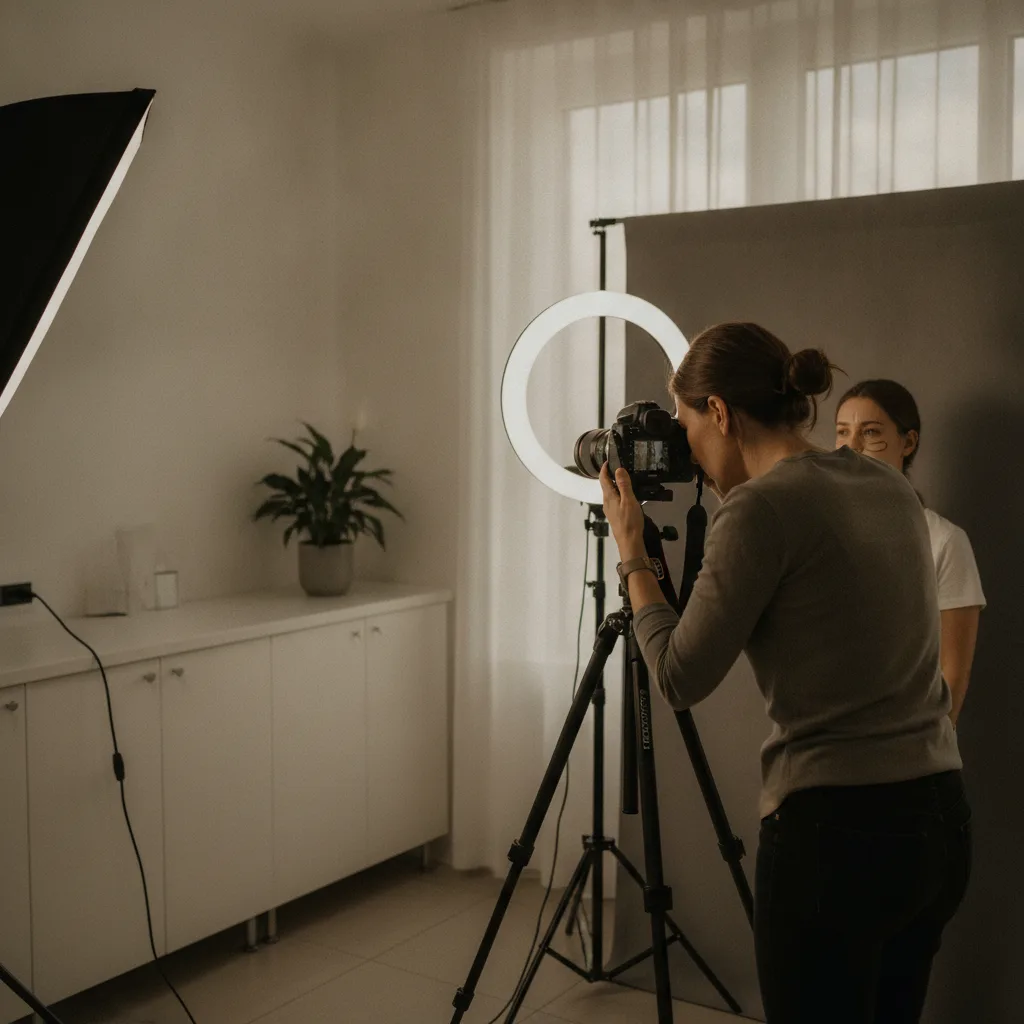
Build a HIPAA-Compliant Before/After Photo Library First
Before-and-after photos are Protected Health Information under HIPAA, and posting them without a channel-specific signed authorization exposes your practice to HHS penalties of $100-$50,000 per violation — with the average marketing violation penalty reaching $28,500 as of 2026, up from $14,200 in 2023. A Florida med spa learned this the hard way: a March 2024 class-action settlement cost them $875,000 after they posted patient before/after photos without proper consent. A generic treatment consent form does not cover public gallery or social media use. Combined FTC and HHS penalties targeting aesthetic advertising violations exceeded $12.3 million as of 2026.
Every photo authorization needs to specify the body areas photographed, the exact media types (Instagram feed, Instagram Reels, TikTok, Facebook, website gallery), and the purpose. Build a separate photo-release workflow into your post-op process — not as an afterthought at checkout, but as a structured touchpoint 2-4 weeks after surgery when patients are happy with early results and most likely to say yes. Aim for 30-50 consented cases across your top procedures (breast augmentation, rhinoplasty, BBL, mommy makeover, dermal fillers) before you run a single paid ad campaign.
Diversity in the library matters as much as volume. A 2024 PRISMA-compliant systematic review of 25 studies with 13,731 participants identified that social media's influence on cosmetic surgery considerations spans young adult women (70% report body dissatisfaction linked to social media) and young adult men (60%) across a wide range of ages, ethnicities, and body types. Patients searching for social proof look for someone who looks like them before the procedure — not just the best-case result from an idealized body type. A library that reflects real diversity across body types, skin tones, and age groups converts at a measurably higher rate than one that showcases only aspirational transformations.
Curve Compliance (HIPAA photo consent workflow)
Contact for pricing
Purpose-built consent and PHI management for aesthetic practices — covers photo authorization language that satisfies HHS enforcement standards.
GoHighLevel
From $97/mo
Automates the post-op follow-up sequence that requests photo consent and collects signed releases without manual coordinator effort.
Compliance Warning
Do not use a patient photo on any social media platform, paid ad, or website gallery until a channel-specific signed authorization is in your file for that patient. Patient safety and practice protection both depend on getting this step right before any content creation begins. When in doubt, consult a healthcare attorney before publishing.
Map Each Platform to the Right Funnel Stage
Instagram outperforms TikTok on full-funnel consultation booking, while TikTok wins on raw engagement and younger-patient discovery — treating them as interchangeable is one of the most common mistakes plastic surgery practices make with their social media presence. Instagram carries the full conversion stack: the Meta Pixel for retargeting, lead forms, paid prospecting, and the before/after gallery that patients screenshot and bring to patient consultations. It reaches 3 billion monthly active users and its ad audience covers 1.74 billion users globally. For practices targeting patients 28 and older considering breast augmentation, mommy makeover, or facial procedures, Instagram is the primary platform.
TikTok's 1.6 billion monthly active users skew younger, making it the right discovery channel for practices actively targeting younger demographics pursuing cosmetic enhancements like rhinoplasty, non-surgical facial contouring, or BBL. A peer-reviewed Aesthetic Surgery Journal Open Forum article established TikTok as a legitimate professional branding channel for plastic surgeons social media presence — not just a consumer entertainment app. TikTok averages $35-60 CPL versus Meta's $65-90, making it an underpriced awareness channel for younger audiences. The tradeoff: TikTok's retargeting infrastructure is significantly weaker than Meta's, which limits its ability to close the funnel on high-consideration surgical procedures.
YouTube plays a separate but important role for high-consideration cosmetic procedures: it builds the deep trust that converts a warmed social audience into a patient who books. A 10-15 minute surgical walkthrough or patient story on YouTube pairs with your Instagram Reels strategy as a mid-funnel trust asset. Practices that push social traffic to YouTube for procedure-specific educational content then retarget those viewers on Meta see materially lower cost per consultation. Most social media platforms serve a distinct function — the mistake is choosing one and ignoring the rest rather than assigning each a specific role in the patient acquisition system.
Platform Rule of Thumb
Instagram: primary conversion platform, all ages 25+, full paid stack. TikTok: awareness and discovery for younger demographics, lower CPL ($35-60 vs. Meta's $65-90), but weaker retargeting infrastructure. YouTube: trust-building for high-ticket procedures. Pick two platforms to do well before adding a third.
Build a Content Creation Cadence That Drives Follower Growth and Consultation Requests
Instagram Reels reach 2.1x more non-followers than static posts, generate 112% higher engagement, and produce 30% more saves — and saves are the signal that a potential patient is seriously considering a procedure, not just passively scrolling. Accounts posting four or more Reels per week grew followers 2.8x faster than those posting less frequently, based on data from 65,000+ accounts. Reels between 60-90 seconds perform best for most social media platforms, and adding captions increases completion rate by 80%. Brands posting Reels three times per week see an average 23% follower growth rate. Post regularly on a fixed schedule — the algorithm rewards consistency over sporadic bursts of high-volume posting.
For plastic surgery practices, a weekly content mix that drives both follower growth and consultation requests looks like this: three to four before/after Reels per week (procedure-specific, captioned, with a CTA to the link in bio), two educational carousel posts covering recovery timelines, realistic expectations, or procedure comparisons, one behind-the-scenes piece featuring the surgeon or OR team (builds personal trust faster than any produced content), and one patient testimonial snippet or story highlight. This cadence addresses the full range of what many patients are searching for — social proof, clinical credibility, and an honest picture of the recovery process.
Educational content that sets realistic expectations is not just ethical practice — it performs. A peer-reviewed PMC study found that before-and-after photos and practice information consistently outperformed surgeon-written articles in patient engagement on most social media platforms. Patients are not looking for academic content. They are looking for specific answers: What does week-two recovery from a BBL actually look like? What are the realistic surgical outcomes for someone my size? What is the difference between natural beauty results and an obvious rhinoplasty? Answer those questions on camera, and a significant share of those viewers will request a consultation — many patients convert directly from educational Reels without ever clicking a paid ad.
Later
From $18/mo
Visual content calendar with Instagram and TikTok scheduling, best-time-to-post recommendations, and Reels analytics in one dashboard.
CapCut
Free (Pro: $9.99/mo)
Fast mobile editing for Reels and TikTok — auto-captions, text overlays, and transitions without needing a video editor on staff.

Address Body Image, Filters, and Ethical Concerns Head-On — Not in a Disclaimer
A survey of 68 plastic surgeons found that social media filters are frequently referenced during patient consultations, influencing expectations and increasing revision surgery rates — and surgeons reported significant ethical concerns along with higher rates of body dysmorphic disorder among these patients. This is not a peripheral issue. It is central to what separates a reputable board-certified practice from a social media content farm that posts aspirational transformations without clinical context. Social appearance anxiety driven by filters, constant comparison to idealized bodies, and celebrity influence on beauty standards shows up in patient consultations every day. The practices that address it publicly build a different kind of social proof.
Social media's influence on body image perception and body dissatisfaction is well-documented in peer-reviewed literature: 70% of young adult women and 60% of young adult men report body dissatisfaction linked to social media use. Participants spending more than 5 hours daily on social media were significantly more likely to pursue cosmetic surgery. Social appearance anxiety — the distress individuals feel about how they appear to others in social contexts — is amplified by selfie culture, filter culture, and the psychological impact of constant comparison to idealized bodies. Acknowledging this dynamic in your content builds clinical credibility and self-confidence in your audience that no before/after photo alone can achieve.
Practically, this means publishing content that addresses body image issues honestly: a Reel where the surgeon explains the difference between what a filter does to facial features and what a rhinoplasty actually achieves, a post acknowledging that unrealistic beauty standards exist across most social media platforms and that consultations start with a conversation about realistic expectations and self-acceptance — not just surgical outcomes. This content also screens out patients least likely to be satisfied post-surgery, which protects the practice. Board-certified plastic surgeons who talk openly about body dysmorphic disorder, emotional well-being, self-compassion, and self-esteem tend to attract patients who are better candidates and who leave stronger patient testimonials. Body positive content is not a disclaimer — it is a conversion asset.
Ethical Note
Content that promotes body positive messaging alongside procedure content is not just ethically sound — it builds the kind of social proof that drives consultation bookings from patients with realistic expectations. Those patients leave better reviews, refer friends, and rarely ask for revisions. Patient safety and practice reputation both improve when self-image conversations happen before the consultation, not after.
Run Meta Ads With a Prospecting-Plus-Retargeting Structure
Meta ads for plastic surgery average $65-90 CPL with a 6.2% lead-to-consult rate — not the lowest CPL on the channel list, but the strongest infrastructure for building a retargeting funnel around your before/after content. An Atlanta plastic surgery practice generated 514 leads in 90 days at a $49 blended CPL on roughly $25,000 in combined Google and Meta spend in Q1-Q2 2026. A multi-location practice achieved a 510% increase in qualified consultations and 7.0x ROAS after a coordinated Google and Meta rebuild. Those results require the right campaign structure — not just targeted ads pushed to a general audience.
Structure Meta campaigns by procedure, not by practice. Run a prospecting campaign for breast augmentation separately from rhinoplasty and BBL — target specific audiences by age range, geography, and interest signals, and use before/after video Reels (60-90 seconds, captioned) as the primary prospecting creative. Budget $50-$100 per day per procedure at the prospecting level. Then build a retargeting layer that hits anyone who watched 50%+ of a prospecting video with surgeon Q&A content, patient stories, and recovery walkthroughs — the educational content that converts a warmed audience into someone who fills out the consultation form. Cosmetic surgery advertisements perform best when the retargeting creative answers the objections the prospecting creative raised.
Instant lead forms on Meta reduce friction but produce lower-intent leads. Use them for non-surgical cosmetic procedures (dermal fillers, Botox) where the decision cycle is shorter. For surgical procedures like breast augmentation or rhinoplasty, drive clicks to a dedicated landing page with a real form, a clear CTA, and social proof in the form of patient testimonials and before/after photos. Track every lead source in CallRail so you know exactly which ad set, which creative, and which procedure is producing booked consultations — not just form fills. Many surgeons based their ad budget decisions on impressions and clicks rather than consultation attribution data, which is why the spend never translates into revenue.
Meta Ads Manager
Free (ad spend separate)
The only platform that runs prospecting and retargeting at scale for plastic surgery practices with full before/after creative support and robust pixel-based audience targeting.
CallRail
From $45/mo
Call tracking and lead attribution by source — connects phone calls back to specific Meta ad sets, organic posts, or Google campaigns so you know what is actually producing consultations.
GoHighLevel
From $97/mo
Pipeline automation and lead nurturing — routes Meta leads into automated follow-up sequences and tracks each lead through to booked consultation.
Connect Social to SEO and Paid Search for the Full-Funnel System
Social media marketing for cosmetic surgery is the discovery layer, but it does not operate in isolation. SEO converts plastic surgery leads at 18.9% versus 10.7% for paid search, and delivers patient acquisitions at roughly $200 each versus $610 through paid search alone — and patients who arrived first through Instagram or TikTok before/after content convert at the top end of those ranges because they already trust the practice before they hit the website. Social media warms the audience; SEO and a well-built website close them. Practices with a strategic social media presence paired with SEO experience up to 40% higher patient conversion rates compared to practices relying on a single channel.
Plastic surgery trends on social media drive direct search volume. When a rhinoplasty Reel picks up 50,000 views, there is a measurable spike in branded and procedure-specific Google searches for that practice in the following 72 hours. Practices with first-page keyword rankings for 'rhinoplasty [city]' or 'BBL surgeon [city]' capture that search demand directly; practices without those rankings send warmed traffic to a competitor. The social and SEO strategies need to be coordinated — not running as separate silos. Staying current with latest trends in plastic surgery content on social and then building out supporting SEO pages for those procedures is how the two channels expand reach together.
Google Ads fill the intent gap: patients who have spent weeks on social media and are now searching 'breast augmentation surgeon Austin' are high-intent and worth the $102-134 CPL that Google Search Ads produce, because that 10.7% lead-to-consult rate is among the highest of any paid channel. Local Service Ads for plastic surgery produce consultation leads at $50-150 CPL and appear above standard paid search results. Run Google Ads for high-intent transactional terms, use Meta for awareness and retargeting, and let SEO capture the organic search demand that social media activity generates. That three-channel structure is what fills a consult calendar consistently — and what gives video calls and consultation request forms a steady flow of pre-warmed potential patients.
Channel Integration Tip
Practices with strategic social media presence paired with SEO and paid search experience up to 40% higher patient conversion rates compared to practices relying on a single channel. The lift comes from potential patients encountering the practice multiple times across different platforms before booking — social, then search, then landing page. Each touchpoint builds self-confidence in the decision and reduces the psychological impact of choosing a surgeon.
Track the Metrics That Actually Predict Consult Bookings
Likes, followers, and impressions do not pay for OR time. The metrics that predict consult bookings are: saves per Reel (the strongest signal that a viewer is seriously considering a procedure), profile visits from Reels (measures how many viewers checked your bio after watching), link-in-bio clicks (how many profile visitors moved toward the consultation CTA), form fills and inbound calls from social traffic (tracked in CallRail and your CRM), and cost per booked consultation by campaign and creative. Track these weekly, not monthly — social media algorithms reward accounts that publish and respond fast, and weekly tracking lets you eliminate underperforming ad sets before they burn through budget. This is where valuable insights separate practices that scale from those that plateau.
Benchmark numbers for a healthy plastic surgery social media funnel as of 2026: Instagram Reels average 1.23% engagement rate (up from 0.70% for static posts), saves should run 1-3% of reach for before/after content that resonates, and Meta ad campaigns should hit a 6%+ lead-to-consult rate once the retargeting layer is active. If you are generating leads but not converting them to consultations, the problem is almost never the social content — it is response speed and follow-up sequence. Practices that respond to consultation requests within 60 minutes convert at 2-3x the rate of those that follow up the next business day. Social media continues to reward practices that treat response time as a crucial role in the marketing system, not an afterthought.
Set a quarterly review cycle where you audit which procedure content produces the most saves and profile visits, which Meta ad creatives are hitting CPL targets, and whether organic follower growth is tracking at the 23%+ benchmark. Replace the bottom 20% of your content mix every quarter based on actual consultation attribution data — not engagement vanity metrics. Plastic surgery trends shift fast on social media; the content cadence that worked in Q1 may need to be adjusted by Q3 based on what procedures are generating significant interest and which before/after formats your specific audience is saving. Sprout Social's cross-platform reporting makes this quarterly audit straightforward for practices managing content across Instagram, TikTok, and Facebook simultaneously.
Meta Business Suite (native analytics)
Free
Tracks saves, reach, profile visits, and link clicks for Instagram content plus all Meta ad performance in one dashboard.
CallRail
From $45/mo
Attributes inbound calls and form fills to specific social media posts or ad campaigns so you know which content is actually booking consultations.
Sprout Social
From $249/mo
Cross-platform reporting that consolidates Instagram, TikTok, and Facebook metrics into a single report — useful for practices managing content across multiple social media platforms.
The Metric That Ends Most Plastic Surgery Social Media Campaigns
The number one reason social media marketing for cosmetic surgery fails is not bad content or the wrong platform — it is a broken lead response process. 46% of patients used social media before their first cosmetic surgery consultation, and 58% chose their surgeon based on social media influence. But a patient who fills out a consultation form after seeing a before/after Reel and does not hear back within 60 minutes will book with whoever calls first. Social media's influence gets potential patients to your landing page. Your response speed determines whether they become a patient. If you do not have a 60-minute response SLA and an automated follow-up sequence in GoHighLevel, fix that before you increase ad spend.
Social media marketing for cosmetic surgery is a full-funnel system, not a content calendar. The practices consistently filling their consult schedules from Instagram and TikTok treat before/after content as a conversion asset tied to a HIPAA-compliant photo library, a paid retargeting stack, and an SEO strategy that captures the search demand their social content creates. That is a significant build — and maintaining it alongside running a surgical practice is where most practices fall short. At Geek Powered Studios, we have built exactly this system for healthcare clients, including practices that saw 196% more PPC leads and record-breaking revenue months within six months. We include a custom website ($8K-$15K value) in our retainer, we work in one market per vertical so your competitors do not get our strategy, and there are no long-term contracts. If your consult calendar is not growing the way your social following is, let us show you exactly where the funnel is leaking. Get your free strategy session and we will map the fix.
Frequently Asked Questions
Ready to get started? Contact Geek Powered Studios today.