
Local SEO and GEO integration means reconfiguring the GBP, citation, schema, and review assets you already have so AI search engines — ChatGPT, Perplexity, Gemini, and Google AI Overviews — cite your contracting business alongside your traditional map pack ranking. As of 2026, less than half of businesses that lead Google local search also appear in AI recommendations, and the average contractor is visible to only 8.24% of AI platforms before taking any action. The 7-step sequence in this guide takes 4–6 hours of setup across 30 days: audit your AI visibility baseline, complete your GBP, stack four schema types, restructure service pages for answer engine optimization, build a review strategy that meets AI citation thresholds, earn third-party authority mentions, and track Share of Model weekly. Most contractors move from under 10% to 30–40% AI visibility within 90 days of completing all seven steps.
-
8.24%Average contractor AI visibility before any optimization
-
30–40%Realistic Share of Model target after 90 days
-
3.2xMore AI Overview citations with complete LocalBusiness schema
-
15.9% vs. 1.76%ChatGPT referral conversion rate vs. Google organic
-
150 reviewsMinimum review floor for AI citation eligibility
-
4–6 hoursTotal setup time across the full 30-day sprint
Local SEO and GEO integration is the highest-ROI digital marketing move available to a home-services contractor in 2026 — and 88% of your competitors have not started. Less than half of businesses that lead Google local search results also appear in AI local recommendations, per SOCi's 2026 Local Visibility Index. That gap means ranking #1 in the map pack no longer guarantees you show up when a homeowner asks ChatGPT, Perplexity, or Gemini who to call for a burst pipe at 11 p.m. This guide shows how to close that gap in 30 days using the GBP, citations, schema, and reviews you have already built. The setup takes 4–6 hours total, then 2–3 hours per month to maintain. The payoff — AI-referred leads that convert at 15.9% versus 1.76% for Google organic — is the best conversion premium in digital marketing today.
Before you start
- An active Google Business Profile with at least 12 months of history and admin access
- A live website with at least 10 indexed pages (service pages, location pages, or blog posts)
- At least 50 Google reviews already collected — 150 is the AI citation floor, so know your number
- Admin access to Google Search Console and Google Analytics 4
- A basic understanding of JSON-LD schema, or a developer who can implement it in about four hours
- A Semrush or BrightLocal account for citation auditing and keyword research
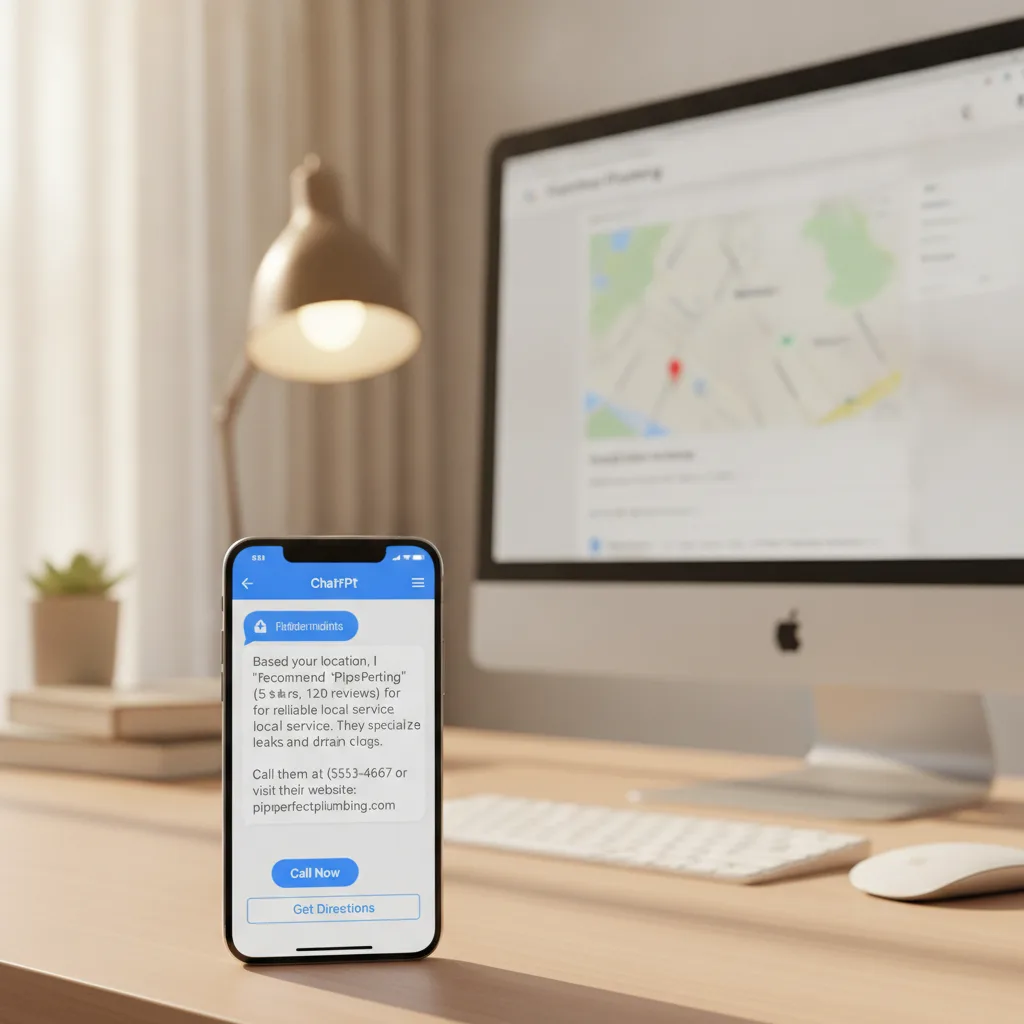
Audit Your AI Search Visibility Score Before Touching Anything
The average local contractor is visible to only 8.24% of AI search engines checked — meaning before any optimization, you are invisible across roughly 92% of AI platforms (Local Dominator, Aug 2026). That number is your baseline. You cannot improve what you have not measured, and contractors who skip this step often optimize the wrong layer first. Run a Share of Model audit before touching a single page or schema block.
Open ChatGPT, Perplexity, and Gemini and run 10 local intent queries a homeowner in your market would actually type: 'best HVAC company in [your city],' 'who fixes water heaters in [zip code],' 'emergency plumber near [neighborhood].' Screenshot every result. Log which AI platforms cite you by name, which cite competitors, and which return no local names at all. This is your Share of Model baseline — the metric that defines your position across the entire AI search ecosystem before you spend a dollar on generative engine optimization.
Tools for automating this: Local Dominator's AI Visibility scanner runs bulk queries across six AI engines and returns a scored report in about 20 minutes. GrowthPro AI's Share of Model tracker sets up weekly monitoring so you see movement after each optimization sprint. Most contractors start below 10% Share of Model; a realistic 90-day target is 30–40%, per Allegiant Digital's 2026 home-services vertical benchmark. Establish your starting point now — the data from Steps 2 through 7 only makes sense relative to this number.
Local Dominator AI Visibility Scanner
$49–$99/mo
Runs bulk AI visibility queries across six engines and returns a scored baseline report — the fastest way to quantify your Share of Model before any optimization.
GrowthPro AI Share of Model Tracker
$79/mo
Automates weekly AI citation monitoring so you can track movement across ChatGPT, Perplexity, Gemini, and Google AI Overviews after each sprint.
BrightLocal
$39–$99/mo
Citation auditing and GBP health scoring that feeds directly into Step 2's NAP cleanup and profile completeness check.
Baseline first, optimize second
A 15-minute manual query session across three AI platforms costs nothing and tells you immediately whether you have a citation gap, a schema gap, or a review-volume gap — each requiring a different fix. Contractors who skip this audit optimize the wrong things and spend 60–90 days on work that does not move their AI visibility score.
Complete and Lock Down Your Google Business Profile
Google Business Profile signals account for 32% of local pack ranking weight and feed data directly to ChatGPT, Perplexity, Gemini, and Google AI Overviews — making GBP the single highest-leverage optimization surface for both traditional SEO and generative engine optimization (Whitespark 2026 Local Search Ranking Factors). A complete GBP converts 3.2 times more often than an incomplete listing, and AI engines use GBP data as a primary entity-verification source. An incomplete profile is not just a local SEO problem; it is an AI citation disqualifier.
GBP impressions per location fell 53.8% in 2026 while customer actions fell only about 5% (Birdeye, Apr 2026). The visitors who still engage with a GBP are extremely high-intent — make every field count. Fill every service category using trade-specific options: Plumber, HVAC Contractor, Electrician, Roofing Contractor. Add services with individual descriptions of 200–300 words each. Upload 15–20 high quality images of your crew, vehicles, and completed jobs — profiles with 10+ photos get 42% more direction requests per Google's own data. Set your service area to specific zip codes and neighborhoods you actually serve, not a radius circle. These geo targets define which AI-mediated local results your business can appear in.
NAP consistency — name, address, phone number — across your GBP, website, and every directory listing removes the uncertainty that AI systems use to disqualify businesses from recommendations. A single address variation (St. vs. Street, Suite 100 vs. Ste 100) is enough for an AI engine to treat two listings as separate entities and split your authority. Use BrightLocal's citation audit to surface every inconsistency, then correct them at the source before moving to schema in Step 3. Google's replacement of the old Q&A section with AI-powered Ask Maps also means your GBP description and service text now feed directly into AI-generated answers about your business — write them as if an AI will quote them verbatim, because one will.
BrightLocal Citation Tracker
$39–$99/mo
Surfaces every NAP inconsistency across 80+ directories in one report — the fastest way to find and fix the entity-confusion issues that suppress AI citations.
Google Business Profile Manager
Free
The primary optimization surface; 32% of local pack ranking weight and a direct data feed to every major AI platform.
AI citation floor: 150+ reviews
Arc SEO Agency's 2026 home-services data puts the AI citation threshold at roughly 150 reviews, a complete GBP, and entity-recognized status. If you are below 150 reviews, run the review sprint in Step 5 alongside this step — the two reinforce each other and build the E-E-A-T signals AI platforms weigh heavily.
Stack Four Schema Types to Unlock AI Search Results
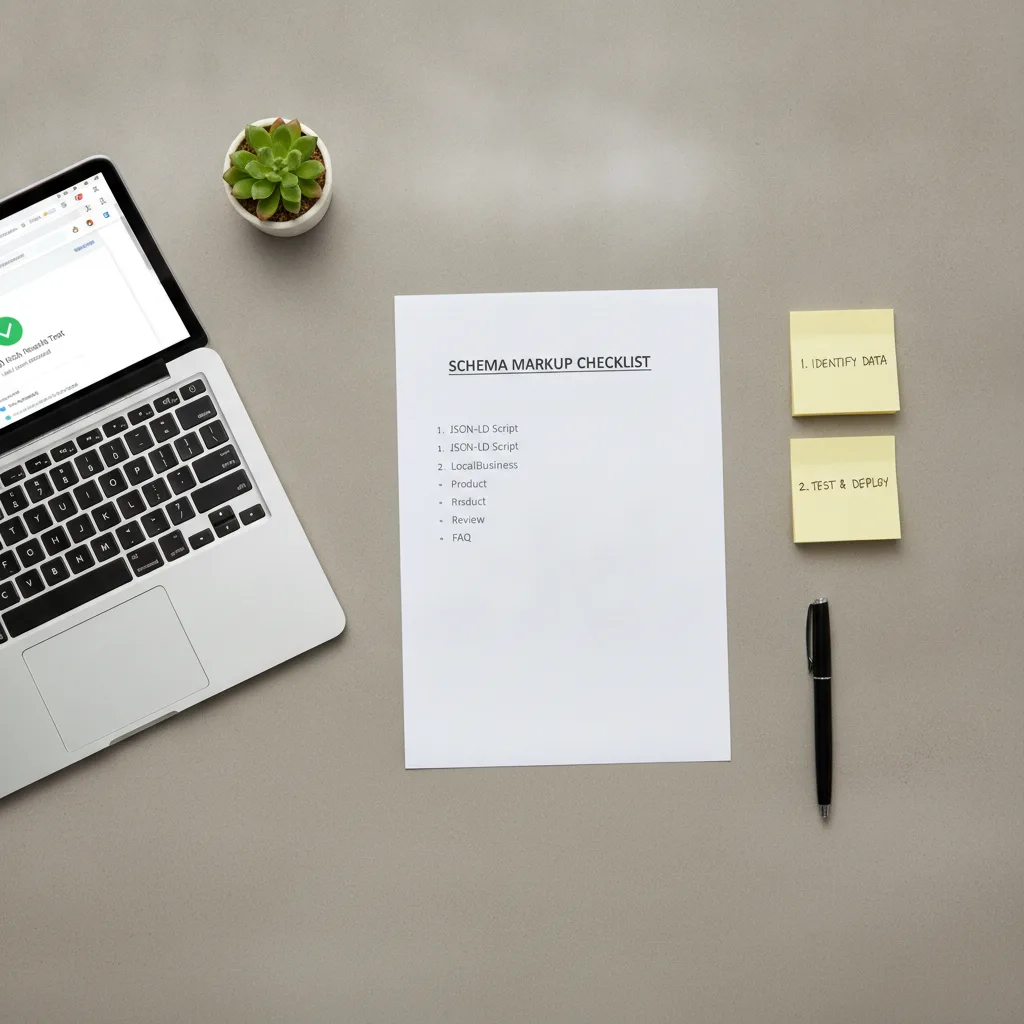
Businesses with complete LocalBusiness schema are 3.2 times more likely to be cited in Google AI Overviews, and pages with three to four stacked schema types earn roughly twice the AI citations of pages with a single schema type (BrightLocal Q1 2026; Atlas Unchained). This is the highest-leverage technical SEO and technical optimization move available to a contractor site in 2026 — and it takes a developer about four hours to implement correctly. The four schema types to stack, in order of priority: LocalBusiness (with your trade subtype), Service, FAQPage, and AggregateRating. Structured data markup is no longer optional for AI visibility.
After Google's March 2026 core update, schema markup shifted from a SERP display trigger to an AI trust and entity verification signal. Google AI Mode now uses structured data to verify that your business is a real, specific, authoritative entity before including it in AI-generated answers. Use JSON-LD format (not microdata), and include the SameAs property pointing to your GBP URL, Yelp profile, BBB listing, and any trade association pages (PHCC for plumbers, ACCA for HVAC, NARI for remodelers). The SameAs array is how AI engines cross-reference your entity across the web and confirm you are who you say you are — this is the semantic search layer that separates cited businesses from invisible ones.
FAQPage schema earns special attention: FAQ schema makes pages 2.8 times more likely to be cited in AI answers, and pages with FAQ blocks plus structured data markup saw a 44% increase in AI search citations per BrightEdge research. Write 6–8 FAQs per service page in direct-answer format — lead every answer with a complete sentence that stands alone as a citable fact. 'A furnace replacement in a 2,000 sq ft Dallas home costs $3,800–$6,500 installed, including labor and permits' is a direct answer an AI will cite. 'It depends on several factors' is not. The semantic structure of a well-written FAQ block is what converts your service page into a content quality signal that AI-powered search platforms can act on.
Rank Math Pro
$99/year
Adds LocalBusiness, FAQPage, and Service schema via WordPress UI — no custom JSON-LD required for most contractor site setups.
Google's Rich Results Test
Free
Validates your JSON-LD schema before deployment so you catch errors that would silently prevent AI citation eligibility.
Schema App
$99–$299/mo
Builds and maintains stacked schema configurations with entity relationships — worth the investment for contractors with 10+ service or location pages.
Schema subtype matters for home services
Use the most specific LocalBusiness subtype available: Electrician, HVACBusiness, Plumber, or RoofingContractor — not the generic Contractor or HomeAndConstructionBusiness. AI engines weigh specificity when matching your entity to a trade-specific query, and using the right subtype is the difference between appearing for 'HVAC company near me' and being passed over entirely.
Restructure Service Page Content for Answer Engine Optimization
Answer engine optimization (AEO) for contractor service pages means writing every page so an AI can extract a direct, citable answer within the first 100 words. Google AI Overviews appear on 68% of local business-type queries as of 2026, but the AI local pack shows 68% fewer businesses than the traditional 3-pack — meaning fewer contractor slots exist in every AI-mediated result. The contractors who win those slots write website content that answers the homeowner's specific question before explaining the company's process. This is a content structure shift, not a full site rebuild.
The content structure that earns AI citations follows a specific pattern. Open with a direct answer sentence: 'A licensed electrician in Austin charges $85–$175 per hour for panel upgrades, with most 200-amp residential panel replacements running $1,800–$3,200 including permits.' Follow with three to four sentences of supporting specificity: what drives price variation, what the permit process involves, how long the job takes. Then add a FAQ block with 6–8 questions that match conversational queries and voice search phrasing. Voice assistants now field 65% of local searches as of 2026, and 76% of smart speaker owners search for a local business weekly — your content structure needs to work when Siri reads it aloud, not just when a human skims it on mobile. Mobile optimization is non-negotiable: 73% of local searches start on mobile as of 2026.
Keyword research for GEO content differs from traditional SEO keyword research in one critical way: the AI citation opportunities live in conversational queries, not head terms. Surfer SEO or Semrush's Keyword Magic tool surfaces the high-volume keywords, but 'who should I call if my AC stops working at night in Houston' is the query that triggers an AI answer with a named recommendation. Use Semrush's Topic Research or AlsoAsked to pull the full question cluster around each service, then write one direct-answer paragraph per question. Google's People Also Ask boxes and the prompts that surface in ChatGPT's auto-suggest reveal exactly what your target customer is asking. Structure your website content around those questions, address each one with specialized knowledge, and AI engines treat your pages as authoritative sources with real topical authority.
Surfer SEO
$99–$219/mo
Content editor with NLP scoring that flags whether your service pages are structured to match search intent and AI citation patterns for your target keywords.
AlsoAsked
$15–$39/mo
Maps the full question cluster around any keyword — essential for building FAQ content that matches voice search and conversational queries.
Semrush
$139–$499/mo
Keyword research, topic clustering, and competitive content gap analysis — the baseline tool for any technical SEO and content creation workflow.
Mobile optimization is not optional
If your service pages load in over 3 seconds on a mobile connection, Google AI Overviews are less likely to cite you — page speed is now an indirect AI citation signal because it feeds into Google's overall quality assessment of the page. Run a Core Web Vitals check in Google Search Console before publishing restructured content.
Build a Review Strategy That Feeds AI Citation Signals
ChatGPT recommends only businesses averaging 4.3 stars or higher; Perplexity's threshold is 4.1 stars; Gemini's is 3.9 stars (SOCi 2026 Local Visibility Index). These thresholds are higher than what traditionally earns a Google map pack slot — AI platforms are more selective, not less. Review volume and review content both matter. The AI citation floor for home-services contractors is roughly 150 reviews, and review signals account for 16–20% of local pack ranking weight per Whitespark's 2026 survey. Small businesses that ignore review strategy in the AI era are ceding their local presence to competitors who answer customer questions in their review responses as well as their service pages.
Review content now directly influences AI citations in a way that star ratings alone do not. A review that says 'fixed our furnace fast on a Sunday night, knew exactly what was wrong within 10 minutes' carries more AI signal value than 'great service, highly recommend' — because the specific language connects your business to a service query ('emergency furnace repair'), a time signal ('Sunday night'), and an expertise signal ('knew exactly what was wrong'). Train your techs to ask for specific reviews: 'Could you mention what we fixed and how quickly we got there?' That instruction is worth more than any review-generation software for building brand authority in AI search results.
For volume, use Podium or Birdeye to automate post-job review request texts — SMS requests convert at 3–5x the rate of email requests for home-services clients. Set the text to fire 2 hours after a job is marked complete in your CRM (ServiceTitan or Jobber both support this trigger). Target Google first for review volume since it feeds the most AI platforms, but also build reviews on Yelp, Angi, and your BBB profile — Perplexity AI and Claude both draw from these third-party authority sources when assembling local recommendations. Per Whitespark's 2026 survey: 'in AI SEO, mentions (citations) are the new link.' Every detailed, specific review on a third-party platform is a citation that AI engines count toward your authority building score.
Podium
$399–$599/mo
SMS-based review request automation that integrates with ServiceTitan and Jobber — converts at 3–5x the rate of email review requests for home-services businesses.
Birdeye
$299–$499/mo
Manages reviews across Google, Yelp, Angi, and BBB from one dashboard — critical for building the multi-platform citation footprint that AI engines cross-reference.
Never incentivize reviews
Google's policy prohibits offering discounts or gifts for reviews, and AI platforms are beginning to detect review pattern anomalies. A sudden spike of 30 five-star reviews in 48 hours can suppress citation eligibility entirely. Aim for 8–15 new reviews per month from real completed jobs — steady, organic growth is what AI engines recognize as trustworthy.
Build Third-Party Authority Across the AI Search Ecosystem
AI search visibility runs on authority building from sources outside your own website. Per Whitespark's 2026 ranking factors survey, 'in AI SEO, mentions (citations) are the new link' — and the entire AI search ecosystem draws from Reddit, industry publications, YouTube descriptions, LinkedIn posts, local news coverage, and curated 'Best Of' lists when assembling recommendations. Getting your business named in those sources is the GEO equivalent of link building in traditional SEO. It is how you build topical authority that AI-powered platforms can verify from multiple corroborating sources.
For home-services contractors, the highest-authority citation sources are: PHCC.org (plumbing and HVAC), ACCA.org (HVAC), NARI.org (remodelers), your local BBB chapter, Nextdoor's Neighborhood Favorites program, Angi's verified license badge, and any local newspaper or TV station that has covered a project or quoted you as an expert. These are the sources ChatGPT, Perplexity, and Gemini treat as trusted third-party authority when they cannot resolve a local business query from their primary data. Aim to earn at least one new mention on a recognized domain per week during your first 90 days of GEO optimization — this consistent pace of authority building compounds faster than any single big placement.
Digital PR is the GEO-era replacement for link building as an seo strategy for contractors. Pitch your local news outlet a story angle tied to seasonal demand: 'Why Dallas HVAC companies are seeing a 40% spike in emergency calls this August' positions you as a quoted expert source, not an advertiser. Submit your expertise to Connectively (formerly HARO) for home improvement and contractor categories — a single mention in a national publication like This Old House or Bob Vila feeds into AI knowledge bases and adds measurable brand authority. 88% of local businesses have no active strategy to appear in AI search results as of 2026. One well-placed media mention puts you ahead of 9 out of 10 competitors in your market.
Connectively (formerly HARO)
$19–$149/mo
Source request platform where journalists ask for contractor expertise — a single citation in a national home improvement publication adds significant AI authority.
Whitespark Local Citation Finder
$33–$83/mo
Identifies the highest-authority local citation sources in your specific market and trade category — prioritizes directories that AI engines actually reference.
Reddit and LinkedIn count
Perplexity AI and ChatGPT both index Reddit threads and LinkedIn posts as source material. Answering contractor-related questions on r/HomeImprovement or r/Plumbing with your business name and city in your profile builds ambient AI authority at zero cost. Spend 20 minutes per week on this — it compounds over a 90-day window and feeds AI-powered platforms that scan public forums for qualified local expertise.
Track Share of Model and Run Your 30-Day GEO Sprint
GEO optimization typically takes 8–12 weeks to produce measurable AI citation improvement, and tracking the right metrics from day one determines whether you are optimizing toward the signals that actually move your Share of Model (Allegiant Digital, May 2026). Traditional search engine optimization tracking tools — Google Search Console, GA4, rank trackers — do not capture AI citation data. You need a parallel measurement stack for GEO. Set it up before you start so you have clean before-and-after data on your AI search visibility score.
The 30-day sprint sequence that produces the fastest measurable AI citation improvement for contractor sites: Days 1–7, complete the GBP audit and NAP cleanup from Step 2. Days 8–14, restructure your top three service pages using the direct-answer content structure from Step 4. Days 15–21, deploy the four-schema stack from Step 3 and validate with Google's Rich Results Test. Days 22–30, run your Share of Model queries again across ChatGPT, Perplexity, and Gemini and compare to your baseline from Step 1. The citation rate for businesses that complete all four layers inside 30 days is measurably higher than those who address only one or two layers — AI engines appear to use a confidence threshold that requires multiple corroborating signals before recommending a local business. Prompt engineering your own test queries (adding 'near me,' specific zip codes, or service-specific language) surfaces citation gaps faster than generic searches.
The payoff for getting this right is not marginal. Organic CTR drops 58% for position-1 search results when AI Overviews appear — but cited businesses earn 35% higher CTR than non-cited competitors (Seer Interactive 2026). ChatGPT referral traffic converts at 15.9% versus 1.76% for Google organic, roughly a 9x gap, because AI has pre-qualified the visitor before they click. AI-referred traffic also generates 37% more revenue per visit and users spend 48% longer on-site (Adobe Digital Insights Q1 2026). Less than half of businesses that lead in Google local search also appear in AI local recommendations per SOCi's 2026 Local Visibility Index. The first contractor in a market to complete this integration claims a slot that competitors cannot take back quickly — because the deep integration of GBP, schema, reviews, and third-party authority that earns AI citations takes 90 days to build and cannot be bought overnight with paid ads.
Local Dominator AI Visibility Scanner
$49–$99/mo
Tracks Share of Model across six AI engines on a weekly schedule — the only way to see whether your GEO sprint is moving your citation rate before the 90-day mark.
GA4 with UTM-tagged AI referral segments
Free
Creates a separate traffic segment for AI-referred visitors so you can measure the 15.9% conversion rate differential versus your baseline Google organic traffic.
Semrush Position Tracking
Included in $139+/mo Semrush plan
Monitors traditional local pack and organic rankings in parallel with GEO tracking — confirms that AI citation work is not cannibalizing map pack performance.
GEO cost ranges by approach
DIY GEO optimization costs $0–$500 per month in tools. Managed agency GEO services for contractors typically run $1,000–$5,000 per month as of 2026. The breakeven question: if AI-referred leads convert at 15.9% and your average job is $2,500, how many additional AI-sourced leads per month justify the agency fee? For most contractors, the answer is two to three incremental jobs per month — a number that most mid-size Texas markets support once AI visibility reaches 30%+ Share of Model.
The Window Is Open Now — and It Will Close
88% of local businesses have no active strategy to appear in AI search results as of 2026. ChatGPT recommends only 1.2% of local business locations. Perplexity recommends 7.4%. AI local packs show 68% fewer businesses than the traditional 3-pack — typically one or two businesses, not three. Every one of those numbers describes a market where the first contractor to complete local SEO and GEO integration claims a recommendation slot that late movers will spend 12–18 months trying to displace. The AI citation threshold for home-services contractors — 150+ reviews, complete GBP, entity-recognized schema, third-party authority mentions — is achievable in 90 days for any established contractor. 45% of consumers now use ChatGPT or another AI tool for local business recommendations, up from just 6% a year earlier. That adoption rate means the window for first-mover advantage is measured in months, not years. The question is not whether this works. The question is whether your competitor gets there first.
Local SEO and GEO integration is not a strategy overhaul — it is a three-layer reconfiguration on top of work you have already done. Your GBP, citations, reviews, and service pages are the same foundation AI engines use to decide whom to recommend. Steps 2 through 6 add the schema stack, content structure, and authority signals that convert that foundation into active AI citations and qualified leads. Step 7 measures whether it is working. Most contractors start this process at 8% AI visibility and reach 30–40% Share of Model within 90 days. The contractors who wait for a competitor to prove it out in their market start 90 days behind — in a generative search environment where AI recommendation slots are scarcer than Google's 3-pack ever was, and where sustainable growth belongs to whoever builds the citation foundation first.
Frequently Asked Questions
Ready to get started? Contact Geek Powered Studios today.