Effective plastic surgeon marketing in 2026 requires four sequential gates: YMYL-compliant search engine optimization with surgeon-attributed content and schema markup, a reputation infrastructure anchored on RealSelf and Google with at least 25 reviews each, compliant Google Ads with LegitScript Healthcare Certification ($975 application plus $2,150 per year) at a minimum $2,500 per month budget, and email and SMS nurture sequences that run for 12 months to capture the full 60–180 day patient research cycle. SEO converts at 18.9% lead-to-consultation versus 10.7% for Google Ads and 6.2% for Meta — meaning the organic foundation must be built before paid media is layered on top. A practice that skips gate two to fund gate four is paying for traffic it cannot convert.
-
18.9%SEO lead-to-consultation conversion rate — highest of any digital channel
-
60–180 daysPatient research window your content funnel must cover end-to-end
-
$975 + $2,150/yrLegitScript certification cost required before any Google Ads can run
-
Sub-5 minutesRequired inquiry response time to stop 40–50% lead loss at the front desk
-
83%Satisfied patients who leave a review when directly asked (vs. 57% unprompted)
-
12 monthsDefault nurture window needed to capture the full patient decision arc
-
70–85%Consultation show rate achievable with automated SMS and email sequences
-
$2,500/mo minGoogle Ads budget floor for moderate markets — $8,000+ in Dallas or Miami
Plastic surgeon marketing is not a local-services category where standard contractor tactics transfer. Plastic surgery patients spend 60–180 days researching before booking a consultation, comparing cosmetic surgeons across Google, RealSelf, Instagram, TikTok, and YouTube before ever contacting a practice. By the time a prospective patient reaches a surgeon's landing page, they have already viewed 50–200 before-and-after photos and have specific surgeons shortlisted. That research window, combined with YMYL content rules, all-cash purchase psychology ($5,000–$35,000 out of pocket), and a competitive market with cross-border medical tourism pressure, demands a four-gate trust funnel — not a homepage refresh and a Google Ads account. This guide builds that funnel in seven actionable steps, with hard benchmarks at every gate so you can audit where your plastic surgery practice currently stands and exactly what to fix next.
Before you start
- A claimed and verified Google Business Profile for the practice — required before local search is accessible and before review automation has a destination.
- Surgeon board certification details (ABPS or ABCS) ready to publish in plain HTML — not behind tabs, not inside PDFs — so Google's YMYL trust signals can read them.
- A LegitScript Healthcare Certification application started or completed ($975 application fee plus $2,150 per year per domain) before any Google Ads can serve.
- Access to the practice website CMS with the ability to add Person, Physician, and AggregateRating schema markup.
- Active accounts on RealSelf and Google Reviews with a baseline of at least 10 reviews on each platform before the credentialing gate can pass.
- A CRM or practice management system capable of automated SMS and email sequences — GoHighLevel or ActiveCampaign both qualify.
Build Your Plastic Surgery Practice Website for YMYL and Local Search
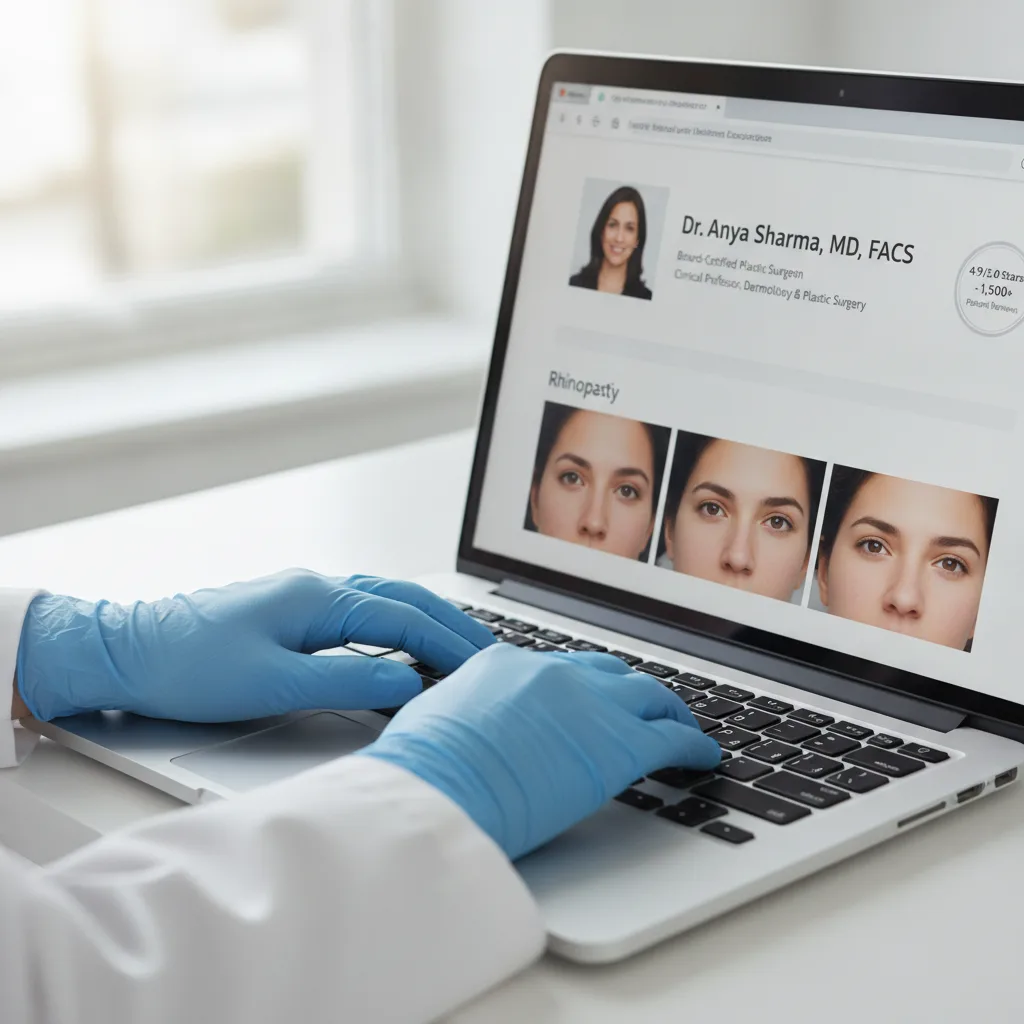
Google classifies plastic surgery as Your Money or Your Life (YMYL) content, which means your practice website must surface board certifications, hospital privileges, and facility accreditation credentials in plain HTML before it can rank on page one. A procedure page buried under generic copy will not clear Google's trust gates regardless of how many backlinks point at it. Surgeon-attributed authorship with a visible bio, ABPS or ABCS certification callout, and an AggregateRating schema block are the three structural requirements that separate a ranking page from one stuck on page three. Strong web design and a new website architecture built on these YMYL signals are the foundation every other digital marketing strategy depends on.
Plastic surgery website design also has a direct revenue math problem: mobile-optimized sites convert 41% better for plastic surgery clinics, and over 70% of all plastic surgery searches happen on mobile devices as of 2026. A site that loads slowly on a phone or forces pinch-to-zoom on a before-and-after gallery is losing the majority of its traffic before a single form is filled. Build procedure pages at 1,500–4,000 words with surgeon-attributed content, keep contact forms under 5 fields (38% of prospective patients abandon forms with more than 5 fields), and display financing availability — doing so increases conversions by 26% on its own.
Local search is the entry point for high-intent potential patients. Queries like 'plastic surgeon near me' and 'best facelift surgeon [city]' trigger Google's local pack, and practices without a fully optimized Google Business Profile get bypassed before the organic listing is ever seen. Add procedure-specific service categories, post before-and-after photos directly to the GBP, and keep hours accurate. Consistent branding across the GBP, practice website, RealSelf profile, and social media platforms retains 29% more leads through the funnel — inconsistency signals neglect, and a high-consideration patient notices. Local SEO is what converts a strong digital presence into first-page google ranking for your most valuable procedure terms.
Google Search Console
Free
Confirms which YMYL procedure pages are indexed, flags Core Web Vitals failures on mobile, and surfaces the exact search queries sending traffic to each page.
Surfer SEO
$89/month
Scores procedure page content against top-ranking competitors and identifies the specific keyword density and heading structure needed to clear Google's YMYL threshold for plastic surgery SEO.
Schema App
$29/month
Generates and validates Person, Physician, and AggregateRating schema without requiring a developer — the three schema types Google uses to verify surgeon authority on YMYL pages.
GEO Layer Required in 2026
AI-generated search results appear on 100% of cosmetic treatment and procedure queries according to BrightEdge as of 2026. Generative Engine Optimization (GEO) is now a required layer of any plastic surgery SEO strategy — write procedure pages so every key claim is self-contained in a single sentence an AI can cite verbatim, and structure FAQs in plain question-and-answer blocks that AI overviews pull directly.
Publish Procedure-Level Content Marketing That Captures Patients at Every Research Stage
Content marketing funnels account for 52% of plastic surgery leads, and educational content increases consultation bookings by 33% — making a hub-and-spoke content architecture the highest-leverage organic investment a practice can make. One authoritative pillar page per major procedure (rhinoplasty, breast augmentation, facelift, liposuction, blepharoplasty) supported by cluster pages targeting every comparison and concern query the patient types during weeks 2 through 10 of their research arc is the model that wins. A practice with only a homepage and five stub pages wins zero of those research touchpoints. Plastic surgery marketing strategies built on thin content stall out at page three regardless of technical SEO quality.
Search engine optimization delivers an 18.9% lead-to-consultation conversion rate for plastic surgery compared to 10.7% for Google Ads and 6.2% for Meta — making it the highest-converting digital channel in the mix. That gap exists because the patient who finds a surgeon through organic search has already self-qualified; they arrive at the contact form with less skepticism than a patient who clicked a paid ad cold. The organic flywheel takes 6–9 months to produce meaningful traffic and 12–18 months to become a primary lead generation channel, so a plastic surgery practice that hasn't started is already 12 months behind competitors who did.
Plastic surgery practice marketing at the content level also requires answering the questions patients are too embarrassed to ask during a consult: recovery timelines, revision rates, what 'board-certified' actually means versus 'board-eligible,' and financing breakdowns. Practices that publish this information openly attract a more educated patient demographic, shorten the consultation itself, and build patient trust before the surgeon ever shakes a hand. Each piece of educational content should carry the surgeon's name as the authored expert, a published date within the last 12 months, and a clear call to action pointing to the relevant procedure page.
Ahrefs
$99/month
Maps the full keyword universe around each procedure — including long-tail research queries like 'rhinoplasty recovery week by week' — so the content calendar targets patients at every stage of the 60–180 day research cycle.
Clearscope
$170/month
Grades plastic surgery procedure content against top-ranking pages in real time, ensuring each page hits the semantic coverage Google needs to award YMYL topical authority.
Shortcut
Repurpose the surgeon's consultation FAQ into blog posts immediately — these are the exact questions patients type into search engines at the middle stage of their 60–180 day research window. A 600-word FAQ post written in the surgeon's voice takes two hours to produce and often ranks for 15–30 long-tail queries within 90 days.
Dominate Reputation Management Across RealSelf, Google, and Social Media Platforms
Over 70% of prospective plastic surgery patients read online reviews before booking, and 84% trust those patient reviews as much as personal recommendations — making reputation management a direct revenue function. The platform priority order for a plastic surgery practice is: RealSelf first, Google second, Facebook third. A RealSelf analysis of 11,078 plastic surgery reviews found the platform's average rating sits at 4.77 — higher than any general review platform — and RealSelf users write longer, more detailed reviews that carry outsized weight with high-consideration patients researching surgical procedures. A sparse RealSelf profile in 2026 is a disqualifier, not an inconvenience. Cosmetic surgeons who treat RealSelf as optional are ceding the most credible research platform in aesthetic medicine to competitors who don't.
Only 57% of satisfied plastic surgery patients will leave a review without a direct request; when asked, 83% go on to leave one. A practice seeing 40 consultations per month and converting 15 to procedures has 15 patients per month who will review if asked and won't if they aren't. An automated post-appointment SMS sent 72 hours after the follow-up visit — linking directly to the Google Business Profile review page — is the single highest-ROI automation a plastic surgery practice can deploy. Birdeye and Podium both handle this workflow and integrate with most practice management systems. Patient testimonials posted with permission to Instagram and the practice website add a social proof layer that reinforces the review signal across multiple channels and boosts patient engagement with your digital presence.
Negative reviews require a HIPAA-compliant response strategy. Never confirm a person was a patient in a public reply — acknowledge the concern, invite direct contact, and demonstrate professionalism. The response is not for the reviewer; it's for the 50 other potential patients reading the thread. Practices that respond to all reviews, positive and negative, within 48 hours signal attentiveness that high-value patients factor into their shortlist decisions. Word of mouth has always been the most trusted channel in plastic surgery; online reviews are the digital version of that same referral mechanism, and managing them with the same care is non-negotiable for practice growth.
Birdeye
$299/month
Automates post-appointment review requests via SMS and email, aggregates reviews from RealSelf, Google, and Facebook into a single dashboard, and flags negative reviews for immediate response.
Podium
$289/month
Combines review automation with a webchat inbox so the same platform that generates Google reviews also captures inbound consult inquiries — reducing the number of tools the front desk manages.
Platform Watch
RealSelf's review ecosystem skews heavily toward surgical procedures like rhinoplasty, breast augmentation, and facelifts — the exact procedures with the highest average patient LTV. Practices offering reconstructive surgery and aesthetic procedures should maintain separate response workflows for RealSelf versus Google, since RealSelf reviewers expect more clinical detail in the surgeon's replies.
Build a Social Media Marketing and Video Content Engine That Earns the Shortlist
By the time a prospective patient reaches a surgeon's landing page, they have already audited the practice's social media — meaning the social presence was evaluated before the website was ever visited. Clinics producing video content book consultations at a rate 34% higher than non-video practices, and 61% of prospective patients watch educational surgery videos before booking. The video content strategy that converts uses three platform-specific formats: Instagram Reels and grid posts for before-and-after portfolio and surgeon personality; YouTube long-form for procedure education and the surgeon-familiarity effect that reduces anxiety around high-stakes decisions; and TikTok for organic reach and awareness only, since TikTok bans cosmetic surgery ads outright in the US as of 2026. Video ads on YouTube, when paired with compelling ad copy, extend patient acquisition reach to audiences who haven't yet started a Google search.
Eighty percent of patients review the surgeon's social media before booking a consult. That means the Instagram grid is a credential document, not an entertainment channel. Each post should demonstrate surgical skill (before-and-after with patient consent), answer a common patient question in the caption, or show the surgeon's personality in a way that makes a nervous patient feel comfortable. Social media engagement from comments and saves on educational videos signals to Instagram and YouTube algorithms that the content answers real patient questions, expanding organic reach without ad spend. A grid that alternates between generic clinic photos and promotional text fails this test entirely — and plastic surgery patients in a competitive market will notice immediately.
Video testimonials from real patients increase patient trust by 52%. A 2–3 minute video of a patient describing their breast augmentation experience — shot in the clinic, edited minimally, posted to YouTube with a procedure-specific title — ranks in search engines, surfaces in AI overviews, and serves as a social proof asset across every other social media channel simultaneously. Batch-record four to six patient testimonials per quarter and schedule them across social media channels on a rolling basis. Influencers with audiences that match the target audience demographic for cosmetic procedures can extend the reach of organic video content when the partnership is disclosed correctly and the content meets HIPAA media release requirements.
CapCut for Business
$19.99/month
Allows a non-editor staff member to trim and caption patient education and testimonial videos in under 30 minutes per clip, removing the production bottleneck that keeps most practices from publishing consistently.
Later
$25/month
Schedules Instagram, TikTok, Facebook, and YouTube posts from one calendar, tracks social media engagement metrics by post type, and identifies which before-and-after formats generate the most profile visits.
HIPAA Reminder
Every patient who appears in a before-and-after photo, video testimonial, or social media post must sign a HIPAA-compliant media release form. Store signed releases in the patient's chart, not in a shared folder. One undocumented use of a patient's image creates liability that can cost more than a year of ad spend to resolve.
Run Compliant Google Ads for Your Plastic Surgery Practice at the Right Budget Floor
Running plastic surgery PPC on Google requires LegitScript Healthcare Certification before a single ad can serve — the application fee is $975, and renewal costs $2,150 per year per domain. This is not optional and cannot be worked around. Google suspended accounts that attempted to run plastic surgery ads without LegitScript certification under the September 2025 policy update, which also restricted ad creative for mature cosmetic procedures. Apply for LegitScript before building any ad campaigns; the certification review takes 2–4 weeks and the practice cannot run Google Ads during that window. Meta removed lower-funnel optimization events for healthcare advertisers in January 2025, which effectively ended Meta as a direct consultation booking channel — Google Search is now the primary paid acquisition engine for plastic surgery services.
Budget floors for plastic surgery Google Ads vary by market. Moderate markets require $2,500 per month minimum to compete; major metros like Dallas and Miami need $8,000 or more per month to reach Tier 1 procedure keywords. The average cost-per-click across plastic surgery keywords runs $7.50, but surgical keywords push $8–$25, and 'best facelift surgeon [city]' queries in competitive metros reach $100 or more per click. Cost per consultation lead runs $80–$300, with high-performing ad campaigns reaching $50–$100 CPL. At a $12,000–$18,000 patient lifetime value, even a $300 CPL returns a strong multiple — but only if the conversion infrastructure at the landing page and front desk actually captures the inquiry. The average paid ad ROI for aesthetic clinics in 2026 is $3.62 per $1 spent; top performers hit 7x by combining compliant campaign structure with aggressive remarketing.
Campaign structure should be segmented by procedure, not by campaign type: one campaign for rhinoplasty, one for breast augmentation, one for facelifts, with separate ad groups for each intent signal within that procedure. Remarketing campaigns on Google Display re-engage the 40–60% of landing page visitors who didn't convert on the first visit, at a fraction of the search CPC. Call tracking through CallRail at the campaign and keyword level is non-negotiable — without it, the practice cannot calculate actual CPL or identify which procedure campaigns produce the highest-LTV patients. Transparent reporting by campaign, keyword, and conversion type is what separates a well-managed plastic surgeon marketing account from one burning budget with no feedback loop. Compelling ad copy that speaks to patient concerns around safety, credentials, and outcomes consistently outperforms promotional pricing copy in plastic surgery PPC.
LegitScript Healthcare Certification
$975 application + $2,150/year
Required by Google before any plastic surgery practice can serve paid search ads — without it, the account gets suspended and all ad spend stops immediately.
CallRail
$45/month
Tracks phone calls back to the specific Google Ads keyword and campaign that generated them, making CPL calculation accurate and exposing which procedure campaigns generate surgical patients versus non-converting inquiries.
Google Ads
Spend-based; min $2,500/month in moderate markets
The primary paid media channel for plastic surgery after Meta's January 2025 healthcare advertising restrictions — the only platform where compliant surgical procedure ads can target high-intent search queries at scale.
Budget Check
A $1,500 per month Google Ads budget in a competitive plastic surgery market will not generate enough impression share to produce consistent leads. At $7.50–$25 average CPC for surgical keywords, $1,500 buys 60–200 clicks — not enough data volume to optimize campaigns or test ad copy variations. Commit to the market's budget floor or redirect that spend to content marketing, which compounds over time rather than stopping the moment the budget does.
Install Lead Management and Sub-5-Minute Response Infrastructure
The average plastic surgery practice loses 40–50% of consultation requests due to slow response times or poor follow-up — this is the most expensive operational failure in plastic surgery practice marketing, and it is entirely fixable. Best-performing practices respond to new inquiries within 5 minutes during business hours. A lead that waits 24 hours for a callback has already contacted two other surgeons on their shortlist. The front desk does not need to answer every call in 5 minutes; an automated SMS confirmation sent the moment a form is submitted — acknowledging the inquiry, setting a timeline for the callback, and providing a direct line — resets the patient's clock and prevents them from moving on. Direct marketing to a captured lead within 5 minutes is operationally straightforward with the right system in place.
Consult show-up rates tell the full story of whether lead management is working. Practices using automated SMS and email reminder sequences achieve a 70–85% show rate versus the 50–60% industry average. Automated reminders cut no-shows from 25–30% down to 8–12%. A no-show for a plastic surgery consultation is a $5,000–$35,000 lost opportunity — the math makes the cost of a CRM that automates reminders look trivial by comparison. GoHighLevel handles the full lead management workflow: inquiry capture, automated SMS and email sequences, appointment reminders, and a pipeline view that shows every lead's status from first contact through consultation and booking. Virtual consultations added a layer that high-performing plastic surgery clinics now treat as a standard pre-screening step, filtering for procedure fit before the full in-person slot is reserved.
The practice website and landing pages should offer virtual consultations as an explicit booking option alongside in-person scheduling, with a frictionless link to a calendar tool like Calendly that does not require a phone call to confirm. Patient engagement at this stage — the gap between inquiry and scheduled consult — is where the 40–50% lead loss occurs. Routing all new inquiry forms to a shared email inbox that multiple staff members monitor is the most common lead management failure in plastic surgery clinics: no single person owns the response, so leads sit for hours. Assign one person or one automated workflow to own every new inquiry within 5 minutes. Ambiguity in ownership is what produces the 40–50% lead loss rate that most practices accept as normal when it is entirely preventable.
GoHighLevel
$97/month (agency plan: $297/month)
The agency standard for plastic surgery lead management — handles automated SMS and email sequences, appointment reminders, pipeline tracking, and two-way text conversations from a single dashboard that integrates with most practice management systems.
Calendly
$10/month per user
Removes the phone-tag friction from virtual consultation scheduling — patients self-book into available slots directly from the practice website or follow-up email, with automatic calendar confirmations sent to both parties.
Failure Mode to Avoid
Routing all new inquiry forms to a shared email inbox that three staff members monitor is the most common lead management failure in plastic surgery clinics. No single person owns the response, so leads sit for hours. Assign one person or one automated workflow to own every new inquiry within 5 minutes — ambiguity in ownership is what produces the 40–50% lead loss rate.
Activate Email and SMS Nurture Sequences to Maximize Patient Retention and Referral LTV
A well-structured email nurture sequence converts 15–25% of post-inquiry leads into booked procedures over a 12-month period when tied to procedure-specific content. Most plastic surgery practices collect an email address at inquiry and send nothing until the patient ghosts. The 60–180 day research cycle means a lead who went quiet after an initial inquiry is not lost — they are still researching, and the practice that stays in their inbox with relevant, non-pushy content owns the relationship when they are ready to book. Segment nurture sequences by procedure of interest: a rhinoplasty email track and a breast augmentation track deliver different content, different recovery timelines, and different financing options, which converts better than a generic monthly newsletter sent to everyone. Patient retention — keeping existing patients returning for additional cosmetic procedures, injectables, or reconstructive surgery — follows the same segmentation logic: tailor the message to the patient's history, not their zip code.
Referral programs account for roughly 22% of new patients at high-performing practices, and referrals convert at the highest rate of any patient acquisition channel because the trust shortcut is already built in. A satisfied patient who had rhinoplasty recommends their surgeon to a friend; that friend arrives with near-zero skepticism and converts to a consultation at a fraction of the effort and cost of a cold paid ad lead. A simple referral program — a handwritten note to the patient post-procedure, a referral card with a direct scheduling link, and a thank-you acknowledgment when a referral books — costs under $20 per patient to execute and compounds over years as a source of long-term growth. Word of mouth amplified by a structured referral mechanism is direct marketing at its most efficient. New patients acquired through referral also tend to match the patient demographics of the referring patient, which helps practices effectively market to their highest-value audience segments without paid media spend.
Displaying financing availability on every procedure page and in every nurture email increases conversions by 26%. Plastic surgery is an all-cash purchase for most patients — a $5,000–$35,000 out-of-pocket decision — and financing visibility removes a friction point that kills inquiries before they become consultations. Cherry, CareCredit, and Alphaeon Credit integrate directly with most plastic surgery practice websites and can be featured in email sequences as a decision-support tool, not a last-resort pitch. A 12-month nurture window is the default, not 3 months: the plastic surgery patient decision arc regularly spans 6–12 months from first inquiry to booked procedure, and a practice that stops following up after 90 days of silence loses the lead to a competitor whose automation is still running.
ActiveCampaign
$29/month entry; $149/month plus plan with CRM
Builds multi-path, procedure-specific nurture sequences with conditional logic — a patient who clicks the rhinoplasty link gets a rhinoplasty track; one who clicks breast augmentation gets a different sequence entirely — without requiring a developer to configure.
GoHighLevel
$97/month
Handles SMS and email nurture in a single platform alongside the lead management pipeline from Step 6, eliminating the integration overhead of running a separate ESP and CRM.
CareCredit
Free to integrate (merchant fee on transactions)
The most recognized patient financing brand in cosmetic surgery — displaying CareCredit acceptance on the practice website and in nurture emails signals accessibility to patients who assumed their procedure was financially out of reach.
12-Month Rule
Set a 12-month nurture window as the default, not 3 months. The plastic surgery patient decision arc regularly spans 6–12 months from first inquiry to booked procedure. A practice that stops following up after 90 days of silence loses the lead to a competitor whose automation is still running. The 15–25% conversion benchmark for email nurture assumes the full 12-month sequence, not a truncated version.

The One Mistake That Cancels Every Other Investment
Running plastic surgery Google Ads without LegitScript certification suspends the account immediately — all spend stops, all campaigns go dark, and the reinstatement process takes weeks. The same logic applies to skipping mobile optimization on landing pages: at 70%+ mobile search share, a non-mobile-optimized plastic surgery website is effectively invisible to the majority of its target audience. Fix the foundation before spending on traffic. A $297 per month GoHighLevel account paired with a LegitScript-certified Google Ads setup and a RealSelf profile with 25 or more reviews is worth more than $5,000 per month in ad spend pointed at a practice with no review presence, a slow website, and no follow-up automation. A plastic surgery marketing agency that audits these fundamentals before recommending ad spend is the partner worth hiring — and the one worth evaluating marketing experts against.
Plastic surgeon marketing is not a category where generic digital marketing strategies transfer. The 60–180 day patient research cycle, YMYL content rules, all-cash purchase psychology, and a competitive industry with cross-border medical tourism pressure demand a different playbook than any other home-services vertical. The four gates — YMYL SEO and local search visibility, reputation infrastructure across RealSelf and Google, compliant paid acquisition at the correct budget floor, and email and SMS nurture tied to referral and patient retention LTV — are sequential. Skipping gate two to invest in gate five produces an expensive funnel full of holes. The practices filling their consultation calendars in 2026 are the ones that treated trust as a measurable infrastructure project. A plastic surgery marketing agency that can audit each gate against hard benchmarks — 18.9% SEO conversion rate, 83% review completion when asked, sub-5-minute response time, 70–85% show rate with automation — is the partner worth hiring. Everything else is noise.
Frequently Asked Questions
Ready to get started? Contact Geek Powered Studios today.