
Effective weight loss clinic marketing in 2026 requires five keyword clusters, not one brand-name keyword list. GBP signals carry 32% of local ranking weight, making your Google Business Profile the single highest-return asset. Clinics that pair GBP dominance with review velocity (50-plus reviews at 4.5-plus stars), five targeted content clusters, E-E-A-T-optimized long-form pages, and AI-citation-ready FAQ schema reach $60–$180 CPL from organic and local search by month 9–12. Chasing "Ozempic near me" with paid ads triggers FDA and FTC scrutiny and rarely beats the telehealth entrants who own that term. The local Map Pack, GLP-1 comparison content, and structured FAQ content are where local clinics win.
-
32%Share of local ranking weight carried by GBP signals alone
-
50+ reviews at 4.5 starsThreshold that produces 37% more GBP bookings
-
$60–$180 CPLCost per lead via localized SEO and Google Ads in 2026
-
9–12 monthsWhen organic search becomes your dominant patient lead source
-
5 clustersKeyword cluster tiers local clinics can own beyond brand-name GLP-1 terms
-
20.9% vs. 15%Tirzepatide vs. semaglutide body weight reduction in SURMOUNT-1 — a stat that ranks
Weight loss clinic marketing in 2026 is a category war. The US medical weight loss market hit $10-plus billion annually as of 2026, GLP-1 prescriptions represent nearly 8% of all prescriptions filled in the US, and national telehealth companies, retail pharmacies, and direct-to-consumer compounders are all targeting the same patients your local clinic wants to reach. The standard advice — chase 'Ozempic near me' and run Google Ads — collides with three problems at once: those brand-name keywords are dominated by players with 8-figure marketing budgets, the FDA and FTC have spent 2024–2026 issuing enforcement actions against exactly that ad copy, and 89% of local clinics still fail to rank in the local Map Pack because they optimized for the wrong signals. This five-step playbook gives medical weight loss clinic owners and agency buyers a concrete system for building a strong online presence that generates $60–$180 CPL from organic and local search — without triggering regulatory scrutiny and without needing to out-spend a national telehealth competitor.
Before you start
- Google Business Profile claimed, verified, and fully populated for every clinic location — category set, services listed, and business description written
- Google Search Console and Google Analytics 4 configured with goal tracking; a HIPAA-compliant analytics setup with a signed BAA in place before any form-submission tracking fires
- A keyword research tool: Semrush ($139/mo), Ahrefs ($129/mo), or at minimum the Search Console Performance report for baseline ranking data
- A review-request workflow — text or email — capable of firing within 90 minutes of a patient appointment, connected to your EHR under a signed BAA
- A baseline content audit: every page on your site, its target keyword, and its current average ranking position in Search Console
- A healthcare attorney or compliance-specialist agency on call to review any page that names a GLP-1 medication before it publishes
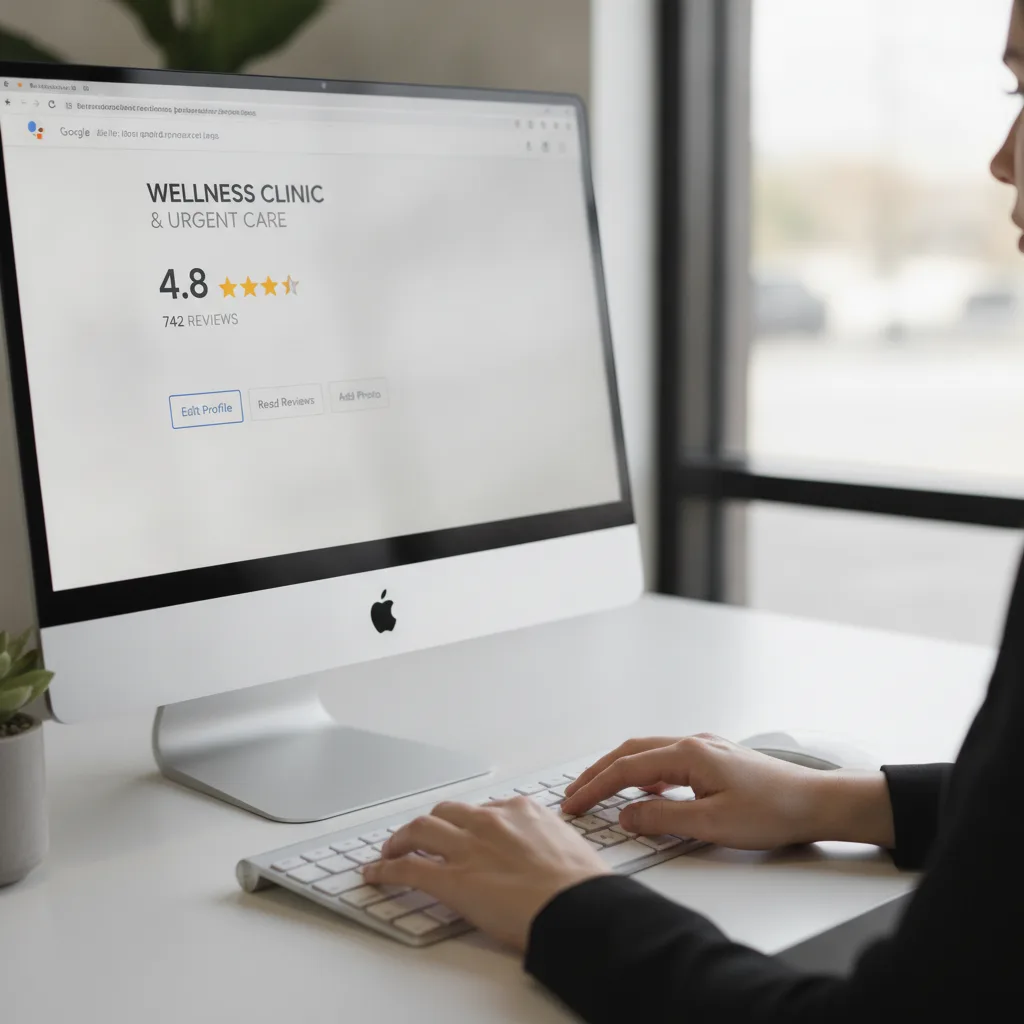
Dominate the Local Map Pack with Google Business Profile Signals
GBP signals carry 32% of total local ranking weight in 2026, making your Google Business Profile the single highest-return asset in your entire medical weight loss marketing stack — ahead of your website, your backlinks, and your citations. The full local ranking factor breakdown as of 2026: GBP signals (32%), on-page signals (19%), review signals (16%), link signals (15%), behavioral signals (8%), citation signals (7%). Fix GBP first. Everything else compounds on top of it.
Start with the five GBP fields that move rankings fastest: primary category (select 'Weight Loss Center,' not 'Medical Clinic'), services (list semaglutide consultations, tirzepatide programs, and metabolic health evaluations as discrete service entries with 150-word descriptions each), business description (750 characters, lead with the city name and the specific GLP-1 medications you prescribe), attributes (enable 'Online appointments' and 'Telehealth'), and weekly Google Posts. Clinics that post weekly on GBP show higher behavioral engagement signals, which feed back into local pack rankings within 60–90 days. This is one of the most direct and measurable marketing efforts available to a weight loss clinic with zero ad spend.
For multi-location clinics, each physical address needs its own GBP property with location-specific NAP (name, address, phone), a unique business description that names the neighborhood or suburb, and its own review pool. Do not consolidate locations into one profile. Google's local algorithm scores proximity, relevance, and prominence per location — a merged profile dilutes all three signals simultaneously and actively suppresses search results performance across every location.
BrightLocal
$39/mo
Audits GBP completeness, tracks local pack rankings by city and keyword, and monitors citation consistency across 80-plus directories simultaneously
GBP Insights (native)
Free
Shows which search queries triggered your GBP listing — the fastest signal of whether your category and service optimizations are working
HIPAA Warning
When responding to patient reviews on GBP, never confirm that a reviewer is a patient, reference any treatment detail, or thank them by name for visiting your clinic. A generic 'Thank you for sharing your experience — we're glad you're feeling well' is compliant. 'We're so glad your semaglutide treatment is working' is a HIPAA violation, even if the patient mentioned it first. Assign one staff member to handle all review responses using pre-approved HIPAA-compliant templates.
Build a Review Velocity System That Beats a 4.9-Star Competitor
A medical weight loss clinic with 200 reviews at a 4.7-star average outranks a clinic with 40 reviews at a 4.9-star average on most local Map Pack queries, even when the smaller clinic has stronger domain authority and cleaner on-page SEO. Review velocity — how fast new reviews arrive — outweighs average rating as a local ranking signal. The practical threshold: 4.5-plus stars and 50-plus reviews produce 37% more GBP bookings compared to profiles below that mark. Reputation management is not a soft metric; it is the second-most-important local pack ranking signal you control.
The fastest review-acquisition system for weight loss clinics is a two-touch automated sequence triggered at checkout. Touch one: a text message sent within 90 minutes of the appointment with a direct link to the GBP review form (no login required). Touch two: an email sent 48 hours later if no review was left, framed around the patient's weight loss journey rather than the clinic. Podium ($399/mo) and Birdeye ($299/mo) both integrate with most EHR systems to automate this sequence without storing PHI in a non-BAA-covered tool. Both platforms provide personalized communication at scale while keeping your clinic's online presence HIPAA-compliant. At $60–$180 CPL for new GLP-1 patients, the math to justify a review platform is straightforward.
Do not batch-request reviews from existing clients all at once. Google's algorithm flags sudden review spikes as suspicious and can filter them out of the count. Target 8–15 new reviews per month per location — consistent velocity matters more than volume bursts. Satisfied clients who feel their weight loss goals are being supported are your best brand ambassadors; the automation just ensures you ask at the right moment. Assign one staff member to check GBP weekly and respond to every review within 72 hours using HIPAA-compliant language.
Podium
$399/mo
Sends HIPAA-aware review-request texts from a local number, integrates with major EHR platforms, and consolidates responses across GBP, Healthgrades, and Yelp in one inbox
Birdeye
$299/mo
Healthcare-specific review automation with a signed BAA, multi-location dashboard, and automated HIPAA-compliant response templates
Pro Tip
A fresh 4.6-star rating with 12 reviews from the past 30 days often beats a stale 4.9-star rating with 200 reviews from 3 years ago in local pack rankings. Google's recency weighting on reviews increased after the March 2026 Core Update. Consistency beats a one-time push every time. Client testimonials from recent patients also carry more conversion weight on your website than older success stories — update both your GBP and your on-site social proof on the same quarterly schedule.

Build the Five Keyword Clusters That Win Medical Weight Loss Clinic SEO
Effective medical weight loss marketing in 2026 requires five distinct keyword clusters, not a single brand-name keyword list. 'Ozempic near me' and 'Wegovy doctor [city]' are floor-level keywords — high competition, dominated by national telehealth entrants and retail pharmacies, and legally hazardous in ad copy due to FDA brand-name restrictions. The five clusters that local clinics can actually own are: (1) GLP-1 comparison content, (2) body composition and metabolic health, (3) program structure and cost transparency, (4) provider credential content, and (5) AI-citation-ready FAQ content. Each cluster serves a different segment of your target audience at a different point in their weight loss journey.
Cluster 1, GLP-1 comparison content, targets potential patients who have already heard of Ozempic and are now researching their next step. Pages for 'tirzepatide vs semaglutide for weight loss,' 'Mounjaro vs Ozempic results,' and 'oral semaglutide vs injection' capture semaglutide switchers — the highest-intent patient segment in the GLP-1 space. Tirzepatide (Zepbound) produced a 20.9% mean body weight reduction vs. semaglutide's 15% in the SURMOUNT-1 trial; a page that cites that specific number builds clinical credibility and ranks for the comparison query simultaneously. Cluster 2, body composition and metabolic health, opens the top-of-funnel beyond GLP-1 brand names: 'how to lower A1C without insulin,' 'visceral fat reduction plan,' and 'weight management solutions' all carry purchase intent but zero competition from national compounders. Professional medical weight loss content in this cluster educates patients and positions clinics as the authoritative local resource for holistic approach to obesity medicine.
Cluster 3 targets the cost and program-structure questions that 77% of prospective patients research before booking: 'semaglutide program cost per month,' 'how much does a medical weight loss program cost,' and 'does insurance cover tirzepatide.' Oral Wegovy launched in January 2026 at $149/month cash-pay — a page explaining oral vs. injectable GLP-1 costs captures an entirely new search wave with zero ranking competition in most local markets. Cluster 4 covers provider credentials: 'board-certified obesity medicine doctor [city],' 'ABOM-certified weight loss physician near me,' and 'NP-run weight loss clinic vs MD clinic.' These pages foster trust and attract quality leads already committed to professional medical weight loss treatment. Cluster 5 is structured FAQ content formatted specifically for AI Overviews, Bing Copilot, and Perplexity — each FAQ page answers one question completely in the first paragraph, uses FAQ schema markup, and gets updated quarterly to stay current with a fast-moving medication pipeline.
Compliance Line
Do not use Ozempic, Wegovy, Mounjaro, or Zepbound as H1s or meta titles in a way that implies your clinic sells those branded products. Informational comparison content ('Tirzepatide vs. Semaglutide: What the Clinical Data Shows') is legally safe. A service page titled 'Buy Ozempic Online at [Clinic Name]' is not. The FDA's and FTC's 2024–2026 enforcement actions specifically targeted this distinction. Every new page that names a GLP-1 medication needs compliance review before it publishes.
Execute a Local SEO and Content Marketing Plan That Compounds to Month 12
Local SEO for medical weight loss clinics shows first ranking movement in 60–90 days for GBP and citation signals; content-driven organic authority takes 4–6 months to gain traction and 9–18 months to produce category-defining results. Most weight loss clinics see organic search become their dominant lead source by month 9–12 with consistent content investment. Build your content calendar around that timeline, not around the first 30 days. Search engine optimization for medical practices is a durable, compounding asset — not an immediate-visibility channel like pay per click.
Months 1–2: Fix technical SEO and citation consistency. Run a NAP audit across Healthgrades, Vitals, Yelp, WebMD, and the top 70 healthcare directories using BrightLocal or Whitespark ($17–$33/mo). Every address, phone number, and clinic name must match exactly — 'Suite 200' vs. '#200' is enough to suppress a local pack listing. Add LocalBusiness schema and MedicalClinic schema markup to every location page. Confirm your site loads in under 2.5 seconds on mobile devices (Google's Core Web Vitals threshold). A user-friendly, fast-loading site on mobile devices is now table stakes for search results placement in the health category. Months 3–5: Publish one long-form cluster page per week, alternating between the five clusters defined in Step 3. Each page should be 1,200–2,000 words, lead with a direct answer sentence, include FAQ schema on at least three questions, and internally link to your primary service pages. Months 6–12: Build topical authority with patient education content — 'what to expect in your first 90 days on semaglutide,' 'how to manage GLP-1 side effects,' and 'when to switch from semaglutide to tirzepatide' — that establishes your clinic as the local reference resource and serves to educate patients across every stage of their weight loss journey.
Content marketing for medical practices requires E-E-A-T signals that commodity content farms cannot replicate: name the prescribing physician in the author byline, add their board certifications, link to their NPI profile, and quote them directly in clinical content. Google's Helpful Content system gives significant weight to first-hand clinical experience signals in the health category. A 1,500-word semaglutide overview written under a named ABOM-certified physician's byline will outrank a 3,000-word generic guide with no named author within 4–6 months in most mid-size Texas markets. Email marketing is a natural complement to this content plan — a monthly patient education newsletter that surfaces your new cluster content keeps existing patients engaged, drives return visits to your site, and generates new leads through word-of-mouth referrals from satisfied clients who share valuable content with family and friends.
Semrush
$139/mo
Keyword gap analysis against local telehealth competitors, position tracking for all five content clusters, and on-page SEO scoring for each published page
Whitespark Local Citation Finder
$33/mo
Identifies citation sources your competitors have that you don't, and tracks NAP consistency across healthcare-specific directories
Yoast SEO Premium or RankMath Pro
$99/yr
Implements FAQ schema, LocalBusiness schema, and MedicalClinic schema without requiring a developer for each page update
Structure Content for AI Overviews and Generative Engine Optimization (GEO)
As of 2026, weight loss clinic content must be written for both human patients and AI systems — Google AI Overviews, Bing Copilot, and Perplexity all filter and summarize content before a prospective patient ever reaches your website. Clinics that structure content in Q&A format with FAQ schema are cited more frequently by these systems, and AI-driven leads from platforms like Perplexity convert at higher rates because the patient arrives with their question already answered and their decision nearly made. This is generative engine optimization (GEO), and it is now inseparable from effective search engine optimization for medical weight loss clinics.
The GEO framework for a medical weight loss clinic FAQ page has four rules. First, the opening paragraph of every page answers the page's primary question in two sentences or fewer — this is the sentence AI systems pull for citations. Second, every H2 is a question in natural language ('How much does semaglutide cost per month?'), not a keyword phrase ('Semaglutide Cost'). Third, FAQ schema markup wraps at least five question-answer pairs per page. Fourth, each answer cites a specific number, clinical trial name, or named medication — AI systems weight specificity when selecting citation sources. A page that states 'tirzepatide produced a 20.9% mean body weight reduction in the SURMOUNT-1 trial at the 15mg dose' gets cited; a page that states 'tirzepatide may help patients lose significant weight' does not. Content creation built on this four-rule framework is what positions clinics as the cited authority rather than the skipped result across a broader audience searching AI-first.
Update your FAQ content quarterly. GLP-1 medications are the fastest-moving category in primary care — oral Wegovy launched in January 2026 at $149/month, the FDA removed tirzepatide from the shortage list in late 2024, and the pipeline holds 190 obesity drugs in development per IQVIA data as of 2026. AI systems and Google's Freshness signal both reward pages that show recent update timestamps with substantive edits, not just a date change. Schedule a 90-minute quarterly content review: update statistics, add new medication options, revise any compliance language that references compounding pharmacy availability, and confirm that your weight loss solutions content still reflects the current standard of care. This commitment to staying current is what sustains measurable results and sustainable growth in search rankings over a 12-month horizon.
Schema App
$29/mo
Generates and validates FAQPage, MedicalClinic, and Physician schema markup without custom code, and monitors for Google Search Console schema errors
Perplexity (monitor)
Free
Test your clinic's name and key GLP-1 questions in Perplexity monthly to see if your content is being cited — the fastest proxy for GEO performance
Key Metric
A weight loss clinic website at 2% conversion paying $150 per Google Ads click pays $7,500 per inquiry. The same clinic at 5% conversion pays $3,000 for the same inquiry. Fixing on-page conversion — clear calls to action, a booking form above the fold on mobile devices, and load time under 2.5 seconds — cuts your effective CPL in half before you change a single keyword bid. Immediate visibility from Google Ads and pay per click campaigns only pays off when the page those clicks land on is built to book appointments.

The Regulatory Wall Most Clinics Hit at Month 3
The FTC's Health Products Compliance Guidance applies to every quantitative weight loss claim on your website, in your ads, and in your before-and-after photography. 'Lose 20 pounds in a month,' 'no diet or exercise required,' and implied typical results from patient success stories all require documented substantiation or they become enforcement targets. The FDA removed tirzepatide from the shortage list in late 2024 and moved similarly on semaglutide — marketing language that named branded GLP-1 products in ad headlines was acceptable in 2023 and now simultaneously triggers FDA, FTC, and state pharmacy board scrutiny. Build a compliance review into your content calendar before you publish, not after you receive a warning letter. Every new page that names a GLP-1 medication should be reviewed by a healthcare attorney or a marketing team that specializes in medical weight loss marketing — not a generalist agency that learned the space last year.
The US medical weight loss market hit $10-plus billion annually as of 2026, and GLP-1 prescriptions now represent nearly 8% of all prescriptions filled in the US. That is not a niche. It is a category war, and local clinics are competing against national telehealth companies, retail pharmacy prescribers, and direct-to-consumer compounders who have 8-figure marketing budgets. The only durable advantage a local clinic has is geographic trust, clinical credibility, and patient relationships that a national player cannot replicate. Medical weight loss clinic marketing built on GBP dominance, review velocity, five keyword clusters, and AI-citation-ready content converts that geographic trust into $60–$180 CPL and $3,000–$8,000 LTV patients. The clinics that commit to this system through month 12 own their local market — and they do it without chasing a brand-name keyword that the FDA, FTC, and Google Ads policy team are all watching at the same time. If you want a specialist team that understands the 2026 regulatory environment and can execute all five steps without putting your clinic's reputation at risk, that is exactly what Geek Powered Studios was built to deliver.
Frequently Asked Questions
Ready to get started? Contact Geek Powered Studios today.